Rising from the equatorial plains of central Kenya like a volcanic cathedral adorned with glaciers that have no geological business existing at this latitude, Mount Kenya stands as Africa's second-highest peak at 5,199 meters and one of the continent's most compelling mountaineering destinations. The Kikuyu people, who have farmed the mountain's fertile lower slopes for centuries, know it as Kirinyaga—the Place of Brightness—and regard it as the throne of Ngai, the supreme deity, whose presence manifests in the snow and mist that crown the summit. When European explorers first reported a snow-capped mountain on the equator in the mid-nineteenth century, the scientific establishment dismissed the claim as fantasy until irrefutable evidence forced a revision of what was considered possible.
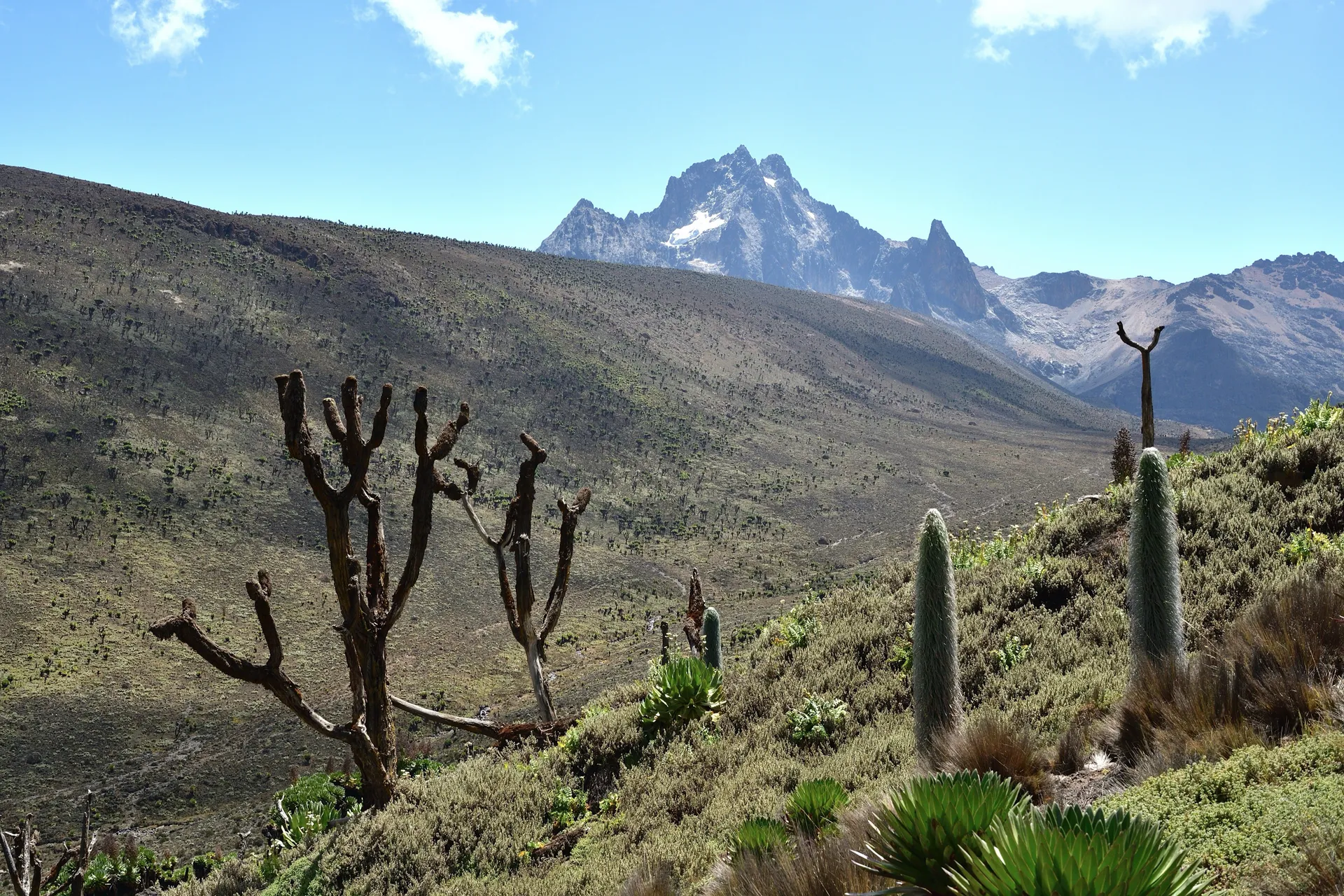
The character of Mount Kenya is defined by its extraordinary vertical zonation of ecosystems. Ascending from the base to the summit, climbers pass through dense montane forest alive with elephants, buffalo, and colobus monkeys; through a bamboo zone so thick it blocks the sky; into an afro-alpine moorland of giant groundsels and lobelias—bizarre, otherworldly plants that have evolved enormous rosettes and thick, woolly stems to survive the extreme altitude and equatorial ultraviolet radiation. Above 4,500 meters, the landscape transitions to bare rock and ice, where the Lewis Glacier and a handful of smaller ice bodies cling to the volcanic peaks—though they are retreating at a rate that makes their complete disappearance within decades virtually certain.
The mountaineering experience on Mount Kenya offers options for every level of ambition. Point Lenana, the third-highest peak at 4,985 meters, is achievable by fit trekkers without technical climbing skills via the Sirimon or Chogoria routes over three to five days. The summit itself—Batian Peak at 5,199 meters—requires serious rock and ice climbing skills and is typically attempted only by experienced mountaineers with guides. The Chogoria route, approaching from the east through forests and across the Gorges Valley, is widely considered one of the most beautiful mountain treks in Africa, with views across the moorland to the jagged peaks above that justify the effort of every step.
Mount Kenya National Park, a UNESCO World Heritage Site, protects the mountain and its surrounding ecosystems, supporting wildlife populations that include leopards at surprisingly high elevations, giant forest hogs, and the endemic Mount Kenya mouse shrew. The forests at the mountain's base are productive agricultural zones where Kenya's finest coffee and tea are cultivated on the rich volcanic soils, and the town of Nanyuki on the northwestern slope serves as the principal staging point for expeditions. The Sweetwaters Conservancy and Ol Pejeta Conservancy nearby offer safari experiences that combine big game viewing—including the last two northern white rhinoceroses on earth—with views of the mountain's snow-draped peaks.
Mount Kenya is reached from Nairobi (approximately three to four hours by road) via Nanyuki or Chogoria. The main trekking seasons are January through February and July through October, when drier conditions make the trails more manageable and cloud cover is less persistent. The mountain can be climbed year-round, but the wet seasons of March through May and November through December bring heavy rainfall at lower elevations and snow at higher altitudes. Altitude acclimatization is essential: responsible trekking operators schedule itineraries that allow adequate ascent rates, and Diamox medication should be discussed with a physician before departure.

