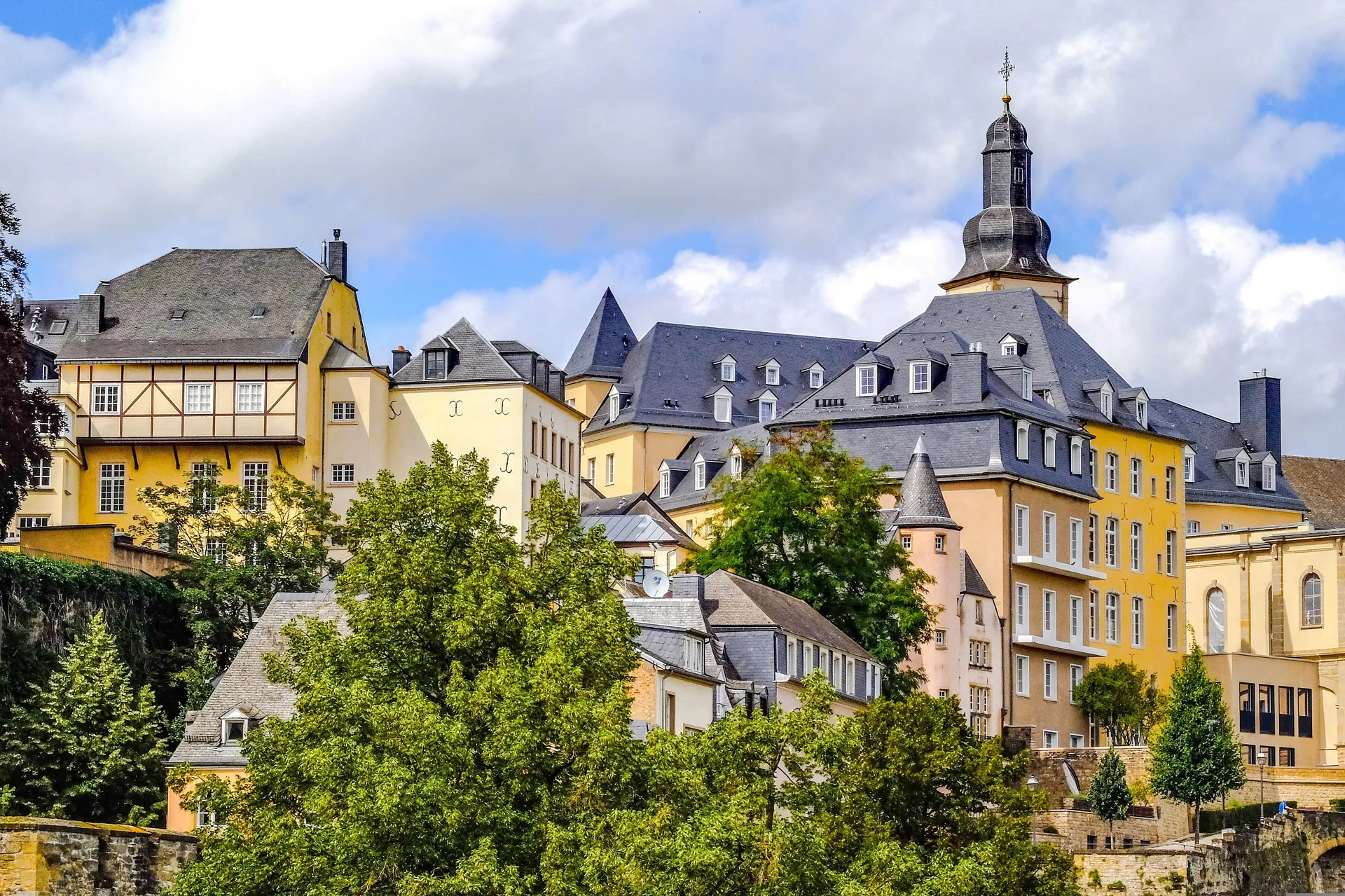
Luxembourg is Europe's most improbable capital — a city of barely 130,000 people that serves as a seat of the European Union, a global banking centre, and a UNESCO World Heritage Site, all compressed into a dramatic landscape of deep river gorges and fortified plateaus that medieval military engineers considered the "Gibraltar of the North." The Grand Duchy itself is the world's only remaining sovereign grand duchy, a constitutional curiosity smaller than Rhode Island yet wealthier per capita than any other nation on earth. None of this prepares you for the sheer physical beauty of the place: a skyline of church spires and glass towers perched above the Alzette and Petrusse valleys, connected by soaring stone viaducts and surrounded by forests so dense they seem to have wandered in from a fairy tale.
The old town, the Ville Haute, sits on a narrow promontory between the two river gorges, its fortifications having been built, reinforced, and fought over by Burgundians, Spanish, French, Austrians, and Prussians across five centuries. The Bock Casemates — seventeen kilometres of underground tunnels carved into the rock by the Spanish in the 1640s and extended by subsequent occupiers — are the city's most extraordinary attraction, a subterranean labyrinth that once sheltered 35,000 soldiers and their horses. Above ground, the Grand Ducal Palace, an elegant Renaissance building with Moorish-influenced turrets, serves as the official residence of Grand Duke Henri. The Place Guillaume II and the Place d'Armes form the social heart of the city, their cafe terraces filling on warm evenings with a polyglot crowd that switches effortlessly between Luxembourgish, French, German, and English.
Luxembourg's cuisine reflects its position at the crossroads of Romance and Germanic Europe. Judd mat Gaardebounen — smoked pork collar with broad beans in a cream sauce — is the national dish, hearty and deeply satisfying. Bouneschlupp, a green bean soup enriched with potatoes, bacon, and cream, appears on restaurant menus from October through March. The city's Michelin-starred restaurants — an extraordinary density for its size — blend French technique with German robustness and the increasingly inventive use of local products: Moselle valley Rieslings and Auxerrois whites, Ardennes game, and the Luxembourg-made Bofferding beer that has been brewed since 1842.
The Grund, the lower town in the Alzette valley, has been transformed from a working-class quarter into one of the city's most charming neighbourhoods, its narrow streets lined with bars, restaurants, and small galleries housed in centuries-old buildings. The Mudam — the Museum of Modern Art Grand-Duc Jean, designed by I.M. Pei — perches on the old fortress plateau and offers both outstanding contemporary art and panoramic views across the valleys. The nearby Kirchberg Plateau, the EU quarter, presents a contrasting cityscape of sleek institutional architecture: the European Court of Justice, the European Investment Bank, and the Philharmonie Luxembourg, whose 823 slim white columns have made it one of Europe's most acclaimed concert halls.
Luxembourg is a port of call for AmaWaterways on its Moselle and Rhine river itineraries. The city's compact centre means that the casemates, the old town, and the Grund are all within comfortable walking distance, connected by lifts and stairways that negotiate the dramatic changes in elevation. The best time to visit is May through October, when the valley gardens are in bloom and the cafe terraces are at their most inviting. Luxembourg is one of those places that visitors discover with genuine astonishment — a tiny country that manages to be simultaneously powerful, beautiful, and thoroughly liveable.

