Penang — or more precisely, George Town — is Southeast Asia's greatest street-food city, a UNESCO World Heritage treasure chest of colonial architecture, and a living laboratory of multicultural coexistence. Founded in 1786 by Captain Francis Light of the British East India Company, George Town attracted traders from China, India, Arabia, and the Malay Archipelago, each community building its own temples, mosques, and clan houses while contributing its culinary traditions to what would become one of the most remarkable food cultures in the world.
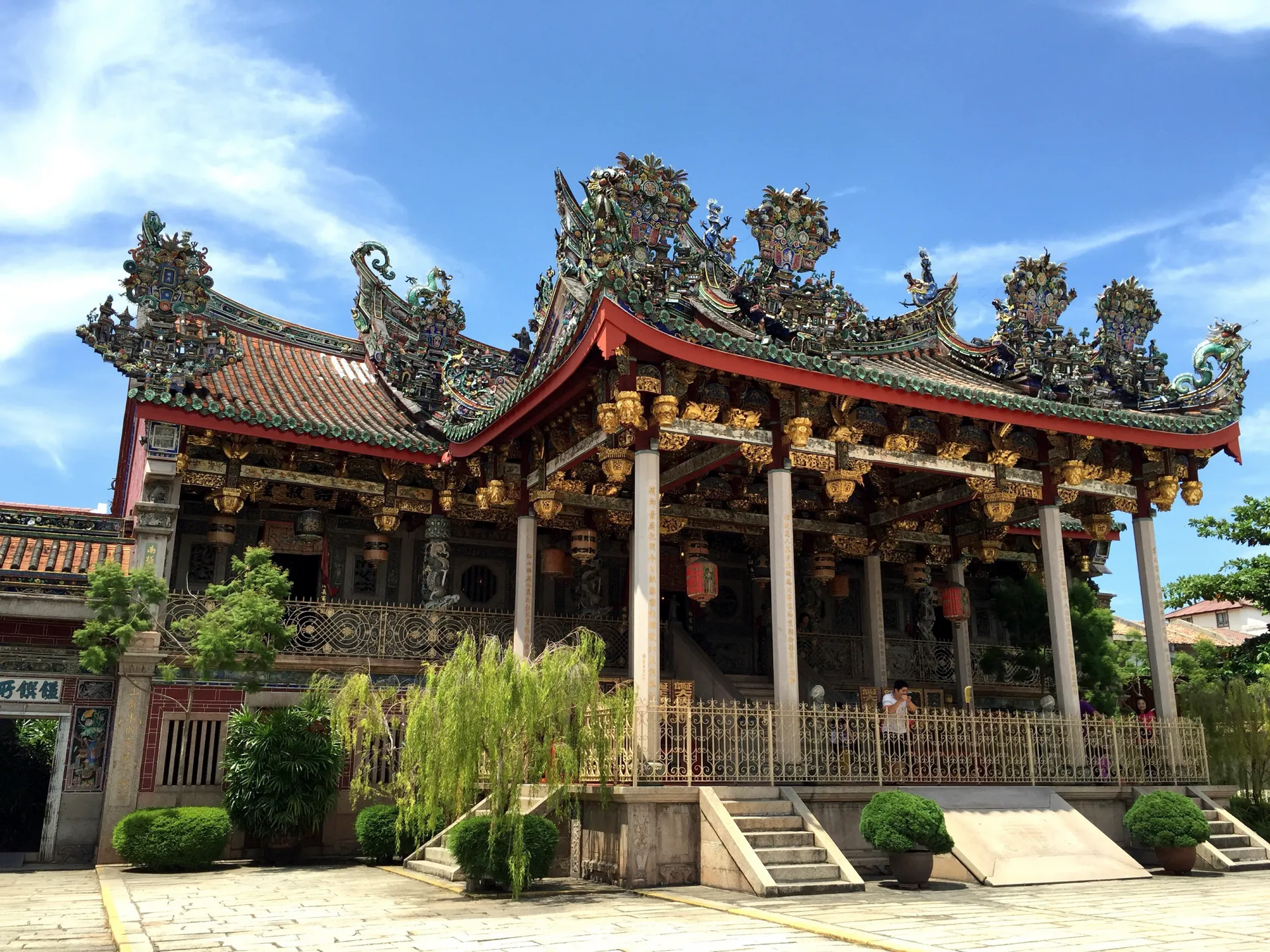
George Town's historic centre is a living museum of shophouse architecture. The Khoo Kongsi, the grandest Chinese clan house in Southeast Asia, is an explosion of carved dragons, gilded beams, and porcelain figurines. The Kapitan Keling Mosque, the Sri Mahamariamman Temple, and the Goddess of Mercy Temple all stand within a few blocks of each other along the Street of Harmony. Street-art murals by Lithuanian artist Ernest Zacharevic have added a contemporary layer.
Penang's food is its religion. Char kway teow — flat rice noodles stir-fried in a carbon-steel wok with prawns, cockles, and chives, kissed by smoky wok hei — defines Penang. But the menu extends infinitely: assam laksa, nasi kandar, cendol, and rojak. The hawker centres — New Lane, Gurney Drive, Cecil Street — are culinary cathedrals where extraordinary food costs a few dollars.
Beyond George Town, Penang offers jungle trekking in the national park, the funicular to Penang Hill, and the beaches of Batu Ferringhi. The Kek Lok Si Temple, one of Southeast Asia's largest Buddhist temples, blends Chinese, Thai, and Burmese styles.
Penang is a major cruise port welcoming Celebrity Cruises, Costa Cruises, MSC Cruises, Oceania Cruises, Royal Caribbean, and TUI Cruises Mein Schiff. The cruise terminal at Swettenham Pier is at the edge of the heritage zone. The best time to visit is November through March.

