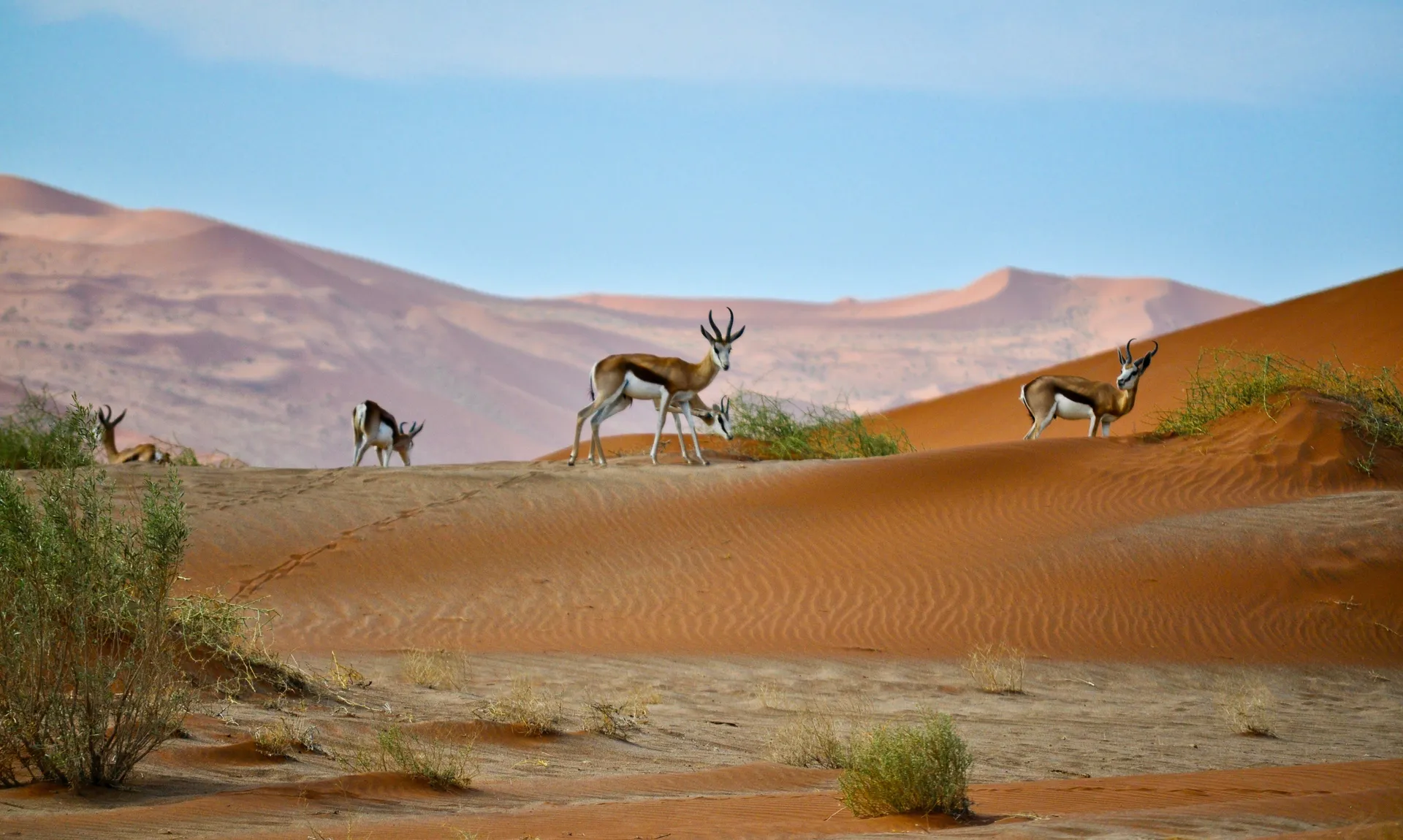
Luderitz clings to the Namibian coast like a Bavarian village that took a wrong turn and ended up in the desert. This extraordinary town of Art Nouveau buildings, Lutheran churches, and half-timbered houses sits on a rocky peninsula jutting into the cold, fog-shrouded Atlantic, surrounded by some of the most inhospitable terrain on earth: the Namib Desert to the east, the forbidden Sperrgebiet diamond area to the south, and the treacherous Skeleton Coast to the north. Founded in 1883 by the German merchant Adolf Luderitz, the town was the birthplace of German South West Africa and retains a distinctly Teutonic character that feels increasingly surreal the longer you stay.
The architecture of Luderitz is a fever dream of Jugendstil excess transplanted to the edge of the Namib. Goerke Haus, a hilltop villa built in 1909 for a diamond company manager, is the most extravagant example: a confection of stained glass, ornamental woodwork, and Art Nouveau flourishes that would look perfectly at home in Vienna or Munich but is rendered almost hallucinatory by its setting among desert rocks and wheeling flamingos. The Felsenkirche, a compact Lutheran church perched on a granite outcrop above the town, is visible for miles and contains stained-glass windows donated by Kaiser Wilhelm II. The town centre, small enough to walk in twenty minutes, preserves a remarkable collection of colonial German commercial and residential buildings.
The cuisine of Luderitz reflects both its German heritage and its Atlantic setting. Crayfish — specifically the West Coast rock lobster, harvested from the icy Benguela Current — is the local speciality, served grilled, in bisque, or simply with butter and lemon at the harbour restaurants. German traditions persist in the form of Kuchen (cake), Brotchen (bread rolls), and Bier that is brewed to Reinheitsgebot purity standards even here at the edge of the desert. The Luderitz waterfront, where fishing boats unload catches of snoek, yellowtail, and kabeljou, offers some of the freshest and most affordable seafood in Southern Africa.
The excursion from Luderitz that no visitor should miss is the ghost town of Kolmanskop, ten kilometres inland in the Sperrgebiet. Once a thriving diamond-mining settlement complete with a hospital, a ballroom, and the first X-ray machine in the Southern Hemisphere, Kolmanskop was abandoned in the 1950s when the diamond deposits were exhausted. Today, the Namib Desert is reclaiming it: sand dunes flow through doorways and pile against interior walls in sinuous waves, creating one of the most eerily beautiful photographic subjects in Africa. Guided tours operate daily, and the golden light of early morning or late afternoon transforms the ruins into a scene of haunting, melancholy splendour.
Luderitz is a port of call for Azamara, Celebrity Cruises, and Hapag-Lloyd Cruises on their Southern African and Atlantic itineraries. The harbour is small but functional, with the town centre within easy walking distance. The best time to visit is September through April, when temperatures are warmest (though "warm" in Luderitz rarely exceeds 25 degrees, thanks to the cold Benguela Current). The desert light, the colonial architecture, the crayfish, and the ghost town — Luderitz is a destination that defies every expectation and rewards every visit.

