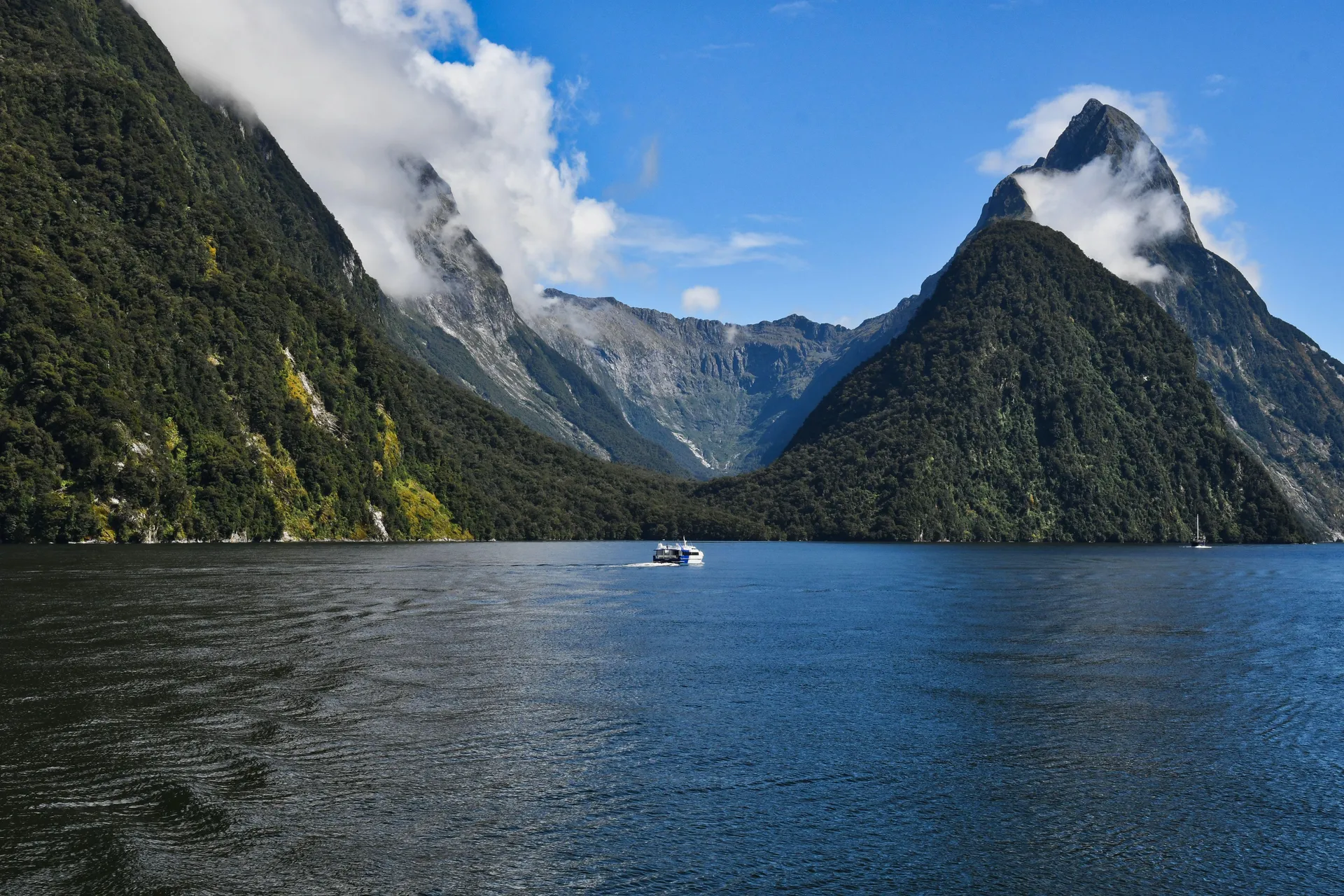
Rudyard Kipling called Milford Sound the "eighth wonder of the world," and while hyperbole was his stock in trade, the description is not far wrong. This fifteen-kilometer fjord — technically a fiord, carved by glaciers rather than rivers — cuts into the heart of Fiordland National Park on New Zealand's southwestern coast, its sheer granite walls rising 1,200 meters directly from the dark, mirror-still water. Mitre Peak, the iconic pyramidal summit that dominates the fjord's entrance, is one of the most photographed natural landmarks in the Southern Hemisphere, its reflection in the still water creating a symmetry so perfect it appears artificial.
The scale of Milford Sound overwhelms the senses. The cliffs on either side are so steep and high that the fjord floor receives direct sunlight for only a few hours each day, creating a perpetual twilight that lends the water its characteristic dark, almost black, appearance. Permanent waterfalls cascade from impossible heights — Stirling Falls plunges 155 meters directly into the fjord, while Lady Bowen Falls drops 162 meters from a hanging valley. After heavy rain, which Milford receives in extraordinary quantities (over 6,700 millimeters annually, making it one of the wettest inhabited places on Earth), hundreds of temporary waterfalls appear on every surface, transforming the fjord walls into sheets of white water.
The marine ecosystem of Milford Sound is unique. A permanent layer of dark, tannin-stained freshwater sits atop the saltwater below, creating conditions that allow deep-water species — black coral, sea pens, and brachiopods — to thrive at unusually shallow depths. The Milford Sound Underwater Observatory, located at Harrison Cove, provides a window into this remarkable environment, where visitors can descend ten meters below the surface to observe the marine life through large viewing windows. Bottlenose dolphins, fur seals, and Fiordland crested penguins — one of the world's rarest penguin species — are regularly spotted in the fjord.
Reaching Milford Sound is itself an adventure. The Milford Road (State Highway 94), a 120-kilometer drive from Te Anau through some of New Zealand's most dramatic alpine scenery, passes through beech forests, alongside mirror lakes, and through the Homer Tunnel — a 1.2-kilometer passage carved through solid granite that was one of New Zealand's most ambitious engineering projects. For those approaching by sea, the entrance to Milford Sound from the Tasman Sea is guarded by towering rock walls that part like a geological curtain to reveal the fjord's interior — an arrival that ranks among the most dramatic in world cruising.
Celebrity Cruises, Norwegian Cruise Line, and Oceania Cruises include Milford Sound on their New Zealand itineraries, typically as a scenic cruising experience through the fjord. Ships enter the sound from the Tasman Sea, navigate its length beneath the waterfalls and cliffs, and exit the same way — a journey of approximately two hours that condenses some of the planet's most dramatic scenery into a single, unforgettable experience. The best time to visit is November through March, the Southern Hemisphere summer, when the longest days and mildest temperatures coincide with the most stable weather — though Milford's legendary rain is a possibility in any season, and many argue the waterfalls make a rainy day the most spectacular of all.

