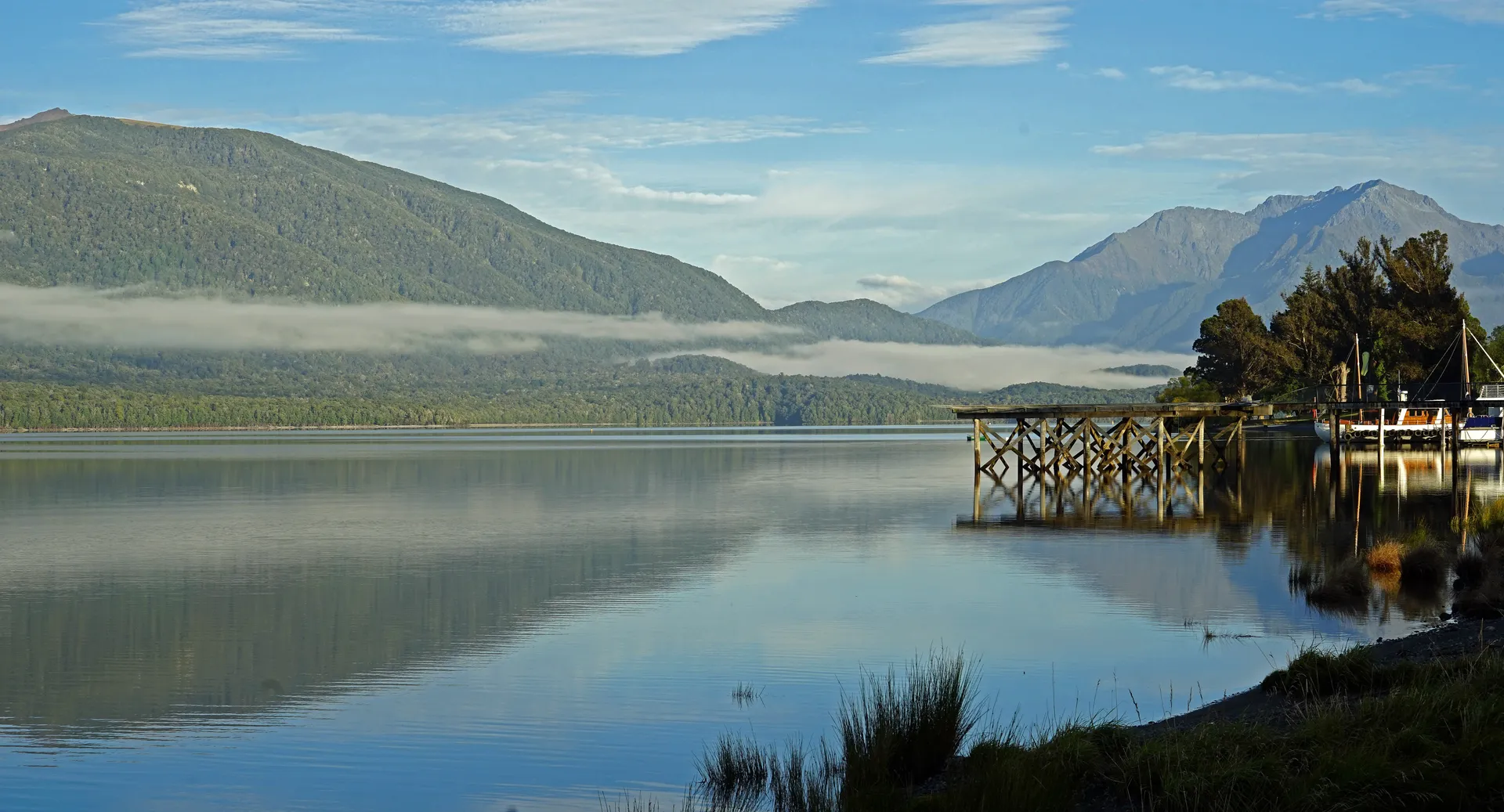
On the eastern shore of Lake Te Anau, New Zealand's second-largest lake, the small town of Te Anau serves as the gateway to Fiordland — a vast wilderness of mountains, rainforest, and fiords that is widely regarded as one of the most spectacular and least-altered landscapes remaining on Earth. The Maori knew this region as Te Anau-au, meaning the cave of swirling water, a reference to the subterranean caverns beneath the lake's western shore. Today, Te Anau remains the last outpost of civilization before the mountains and forest close in, a place where the boundary between the human world and the wild is drawn with unusual clarity.
Te Anau's character is that of a frontier town elevated by its extraordinary setting. The main street, facing the lake across a strip of park and beach, offers the comfortable amenities expected of a tourist centre — cafes, gear shops, restaurants — but the view from every window tells a different story. The lake stretches away to the west, its far shore lost in the blue-grey silhouette of the Murchison Mountains, where the takahe — a large, flightless bird thought extinct until its rediscovery in 1948 — still survives in the tussock valleys. On clear days, the peaks of the Fiordland mountains rise beyond, their slopes dark with ancient beech forest and their summits dusted with snow that feeds the waterfalls cascading into the valleys below.
The food scene in Te Anau reflects its position between the agricultural heartland of Southland and the wild resources of Fiordland. Venison from the surrounding high country, Bluff oysters from the cold waters of Foveaux Strait, and the crayfish that inhabit the deep lakes feature on restaurant menus alongside New Zealand lamb and local salmon. The town's cafes serve excellent flat whites — New Zealand's contribution to global coffee culture — and the local craft beer scene has grown to include several producers working with ingredients foraged from the surrounding bush. The Saturday morning market brings together honey from remote valleys, merino wool products, and preserves made from Fiordland's wild berries.
From Te Anau, Fiordland's great natural attractions fan outward. Milford Sound, 120 kilometres north via one of the world's most scenic roads, presents sheer granite walls rising 1,200 metres from dark water, its summit Mitre Peak one of New Zealand's most iconic images. Doubtful Sound, accessible via Lake Manapouri and a pass over the mountains, offers a wilder, quieter alternative — three times the length of Milford and reached by far fewer visitors. The Kepler Track, one of New Zealand's Great Walks, begins just minutes from town and climbs through beech forest to an alpine ridge with views across the entire lake system. The Te Anau Glowworm Caves, reached by boat across the lake, provide an underground encounter with thousands of luminous glowworms reflected in still black water.
Te Anau is accessible by road from Queenstown, approximately two hours' drive through rolling pastoral country, or by air via Queenstown airport. The town serves as the staging point for most Fiordland excursions. The best months to visit are November through March, when the longest days and mildest temperatures make hiking and outdoor activities most enjoyable. However, Fiordland receives over seven metres of rainfall annually, and visitors should be prepared for wet weather at any time — a reality that, rather than diminishing the experience, enhances it, as rain transforms the fiords and forests into cascading wonderlands where temporary waterfalls appear on every cliff face.

