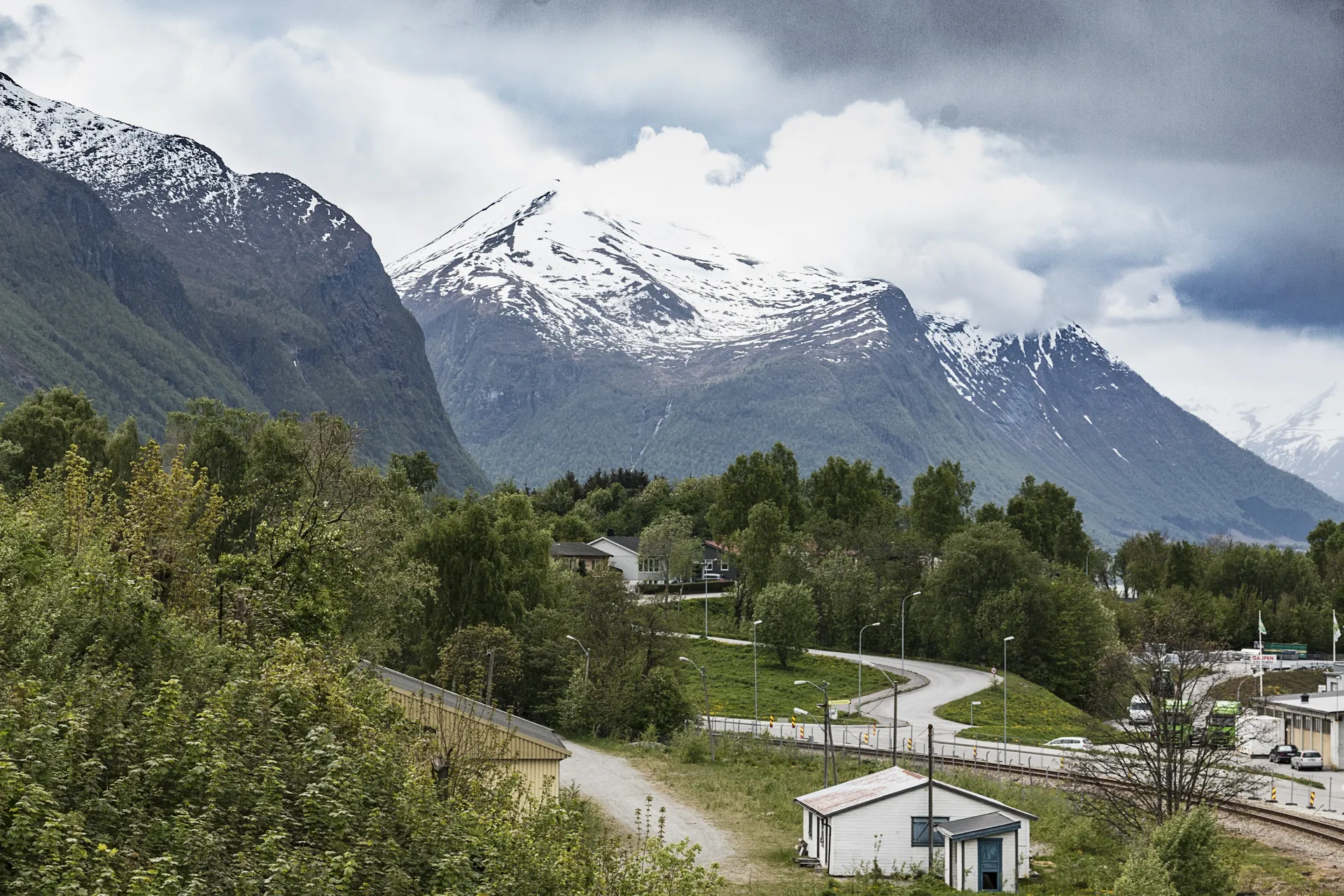
Where the Rauma river completes its dramatic descent from the mountain plateaus to meet the silver-grey waters of Romsdalsfjorden, Åndalsnes has welcomed travellers since the 1800s, when British aristocrats and salmon anglers first discovered this remote corner of western Norway. The Rauma railway, completed in 1924, transformed the village into a gateway for mountaineers drawn to the vertical walls of Romsdalen — a valley that the Royal Norwegian Mountaineering Club had been exploring since its founding in 1908. By the early twentieth century, Åndalsnes had earned its quiet reputation as the alpine capital of Norway, a title it carries with understated confidence to this day.
Arriving by sea, the approach alone is worth the voyage. The ship glides through Romsdalsfjorden beneath cathedral-scale granite walls draped in mist and threaded with waterfalls that appear and vanish with the weather. The town itself is unhurried and intimate — a scattering of timber houses, a riverside promenade, and the soaring Norsk Tindesenter, a mountaineering centre designed by Reiulf Ramstad Architects that mirrors the angular peaks surrounding it. There is no pretence here, no manufactured charm. Åndalsnes earns its beauty honestly, framed by the iconic Trollveggen — Europe's tallest vertical rock face at 1,100 metres — and the serpentine hairpins of Trollstigen, a mountain road so theatrically engineered it feels carved by giants.
The culinary landscape reflects the fjord-to-table ethos that defines Norway's western coast. Freshly smoked laks from the Rauma — once so prized that British lords leased entire stretches of the river — remains a local delicacy, served simply on flatbrød with a whisper of dill and mustard sauce. Seek out klippfisk grateng, the golden-crusted salt cod gratin that speaks to centuries of maritime trade, or warm raspeballer — tender potato dumplings served with salted lamb and root vegetables, a dish that tastes of mountain farms and wood-smoke. For those with a sweet inclination, multekrem — cloudberries folded into whipped cream — captures the fleeting Nordic summer in a single spoonful. The village brewery, Romsdal Brygghus, pours craft ales inspired by glacial water and wild botanicals, best enjoyed on a terrace overlooking the fjord as the evening light refuses to fade.
The surrounding region rewards exploration with a generosity that borders on excess. A sailing north reveals Ålesund, the Art Nouveau jewel rebuilt in Jugendstil splendour after the great fire of 1904, its pastel turrets reflected in harbour waters. To the south, the quieter fjord villages of Lofthus and Balestrand offer orchard-lined shores and galleries celebrating the legacy of landscape painters who found their muse in these waters. Eidsdal, tucked into the Norddal valley, serves as a crossing point to the Geirangerfjord — another UNESCO World Heritage Site whose emerald depths and cascading bridal-veil falls have become synonymous with Norwegian grandeur. Together, these destinations form an interconnected constellation of fjord culture that no single visit can exhaust.
Åndalsnes has become an increasingly prominent port of call for cruise lines navigating Norway's western seaboard. Silversea and Holland America Line bring their refined itineraries through these waters, while P&O Cruises and Fred Olsen Cruise Lines offer accessible routes for British travellers eager to witness Trollstigen from the deck. AIDA introduces German-speaking guests to the alpine drama, and Ambassador Cruise Line crafts boutique sailings that linger longer in port. HX Expeditions — formerly Hurtigruten Expeditions — brings an expedition sensibility to the fjords, complementing the iconic Hurtigruten coastal voyage that has connected Norwegian port towns since 1893. Ships typically tender or dock at the compact harbour within walking distance of the town centre, granting passengers immediate access to mountain excursions, river walks, and the Trollstigen road — an experience best savoured between late May and September, when the mountain pass is open and the midnight sun stretches each day into something that feels, quite deliberately, endless.

