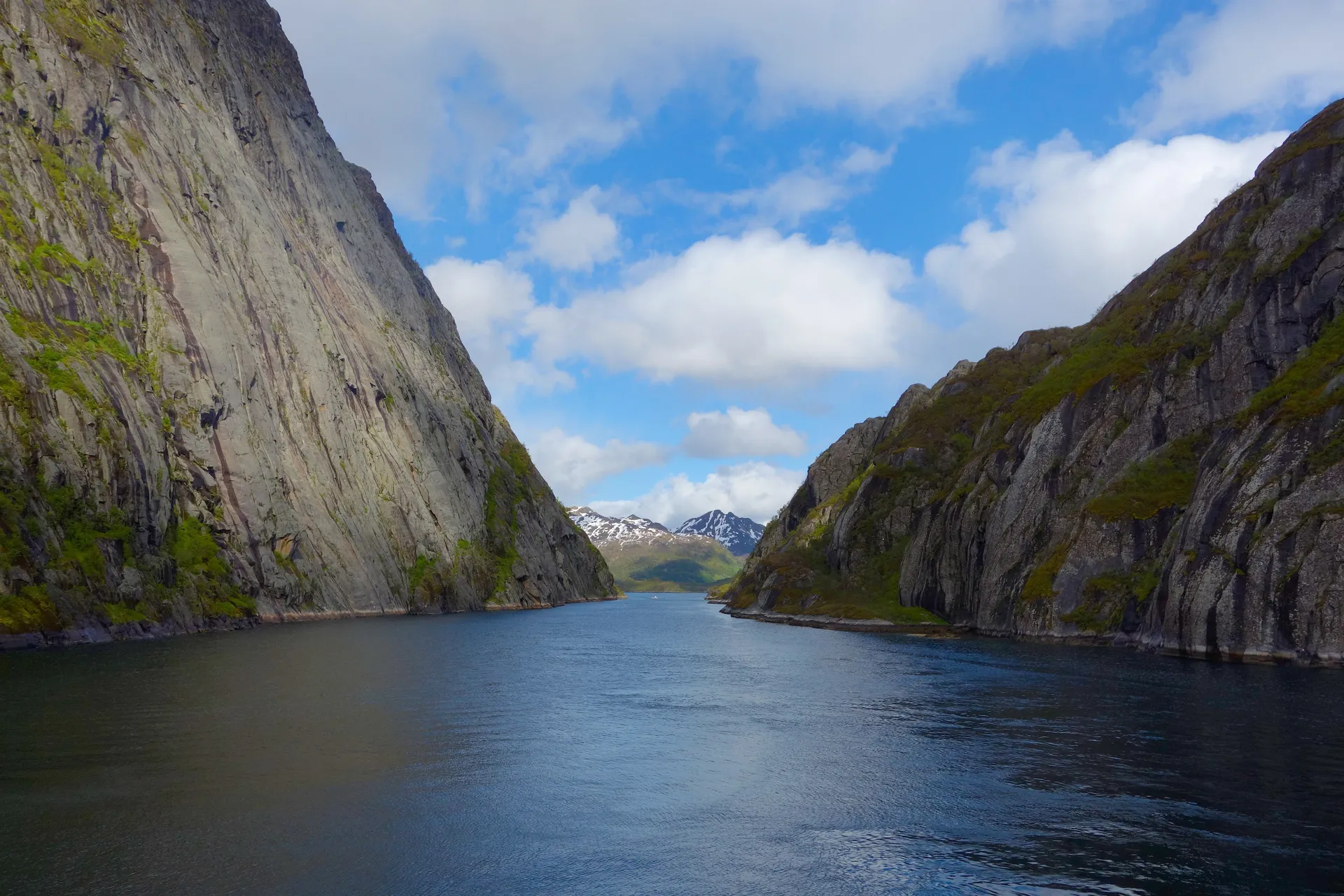
The entrance to Trollfjord is so narrow — barely 100 metres wide between vertical rock walls that rise 1,100 metres on either side — that the first time a cruise ship threads the gap, passengers instinctively hold their breath. This two-kilometre cleft in the granite mountains of the Raftsundet strait, separating the Vesteralen and Lofoten archipelagos in northern Norway, is one of the most dramatic natural features on the Norwegian coast. The fjord takes its name from the trolls of Norse mythology, those immense stone creatures said to turn to rock at sunrise, and it requires no imagination to see their shapes in the weathered cliff faces that lean over the water like giants frozen mid-stride.
Trollfjord's fame was cemented by a confrontation more theatrical than any troll saga. In 1890, local fishermen in small rowing boats blockaded the fjord entrance against steam-powered trawlers from the south who were attempting to monopolise the lucrative cod fishing grounds within. The "Battle of Trollfjord" — captured in a monumental painting by Gunnar Berg that now hangs in the Svolvaer gallery — led to legislation protecting the rights of small-scale fishermen and became a founding story of Norwegian environmental consciousness. The fjord's waters still teem with cod during the winter Lofoten fishery, and sea eagles patrol the cliff tops year-round, their two-metre wingspans silhouetted against the Arctic sky.
The experience of entering Trollfjord by ship is a masterclass in natural theatre. As the vessel clears the entrance gap, the fjord opens into a slightly wider basin backed by a cascading waterfall that feeds from a glacial lake invisible from below. The rock walls, streaked with mineral deposits in shades of rust, sage, and charcoal, amplify every sound — the throb of the ship's engines, the cry of kittiwakes, the crack of a calving ice fragment from the seasonal snowpack. In winter, the northern lights dance above the fjord rim, reflected in the black water below. In summer, the midnight sun illuminates the peaks in tones of amber and rose that persist through the small hours.
The surrounding Lofoten and Vesteralen islands are among the most spectacular landscapes in Scandinavia. Svolvaer, the gateway to Lofoten, offers the famous Svolvaergeita goat-horn peak for climbers and a waterfront of restored rorbuer — traditional fishermen's cabins now converted into characterful accommodation. The fishing villages of Reine and Nusfjord, with their red-painted cabins reflected in still harbour waters against a backdrop of jagged peaks, are among the most photographed scenes in Norway. The Vesteralen side is renowned for whale watching — sperm whales, orca, and humpbacks feed in the nutrient-rich waters of the continental shelf edge just offshore.
Trollfjord is navigated by HX Expeditions on Norwegian coastal expedition itineraries, and the famous Hurtigruten coastal express has been threading the fjord entrance since 1891. The summer months of June through August offer midnight sun and the best weather for deck viewing, while the winter months from November through January bring northern lights and the atmospheric drama of navigating the fjord in polar twilight.

