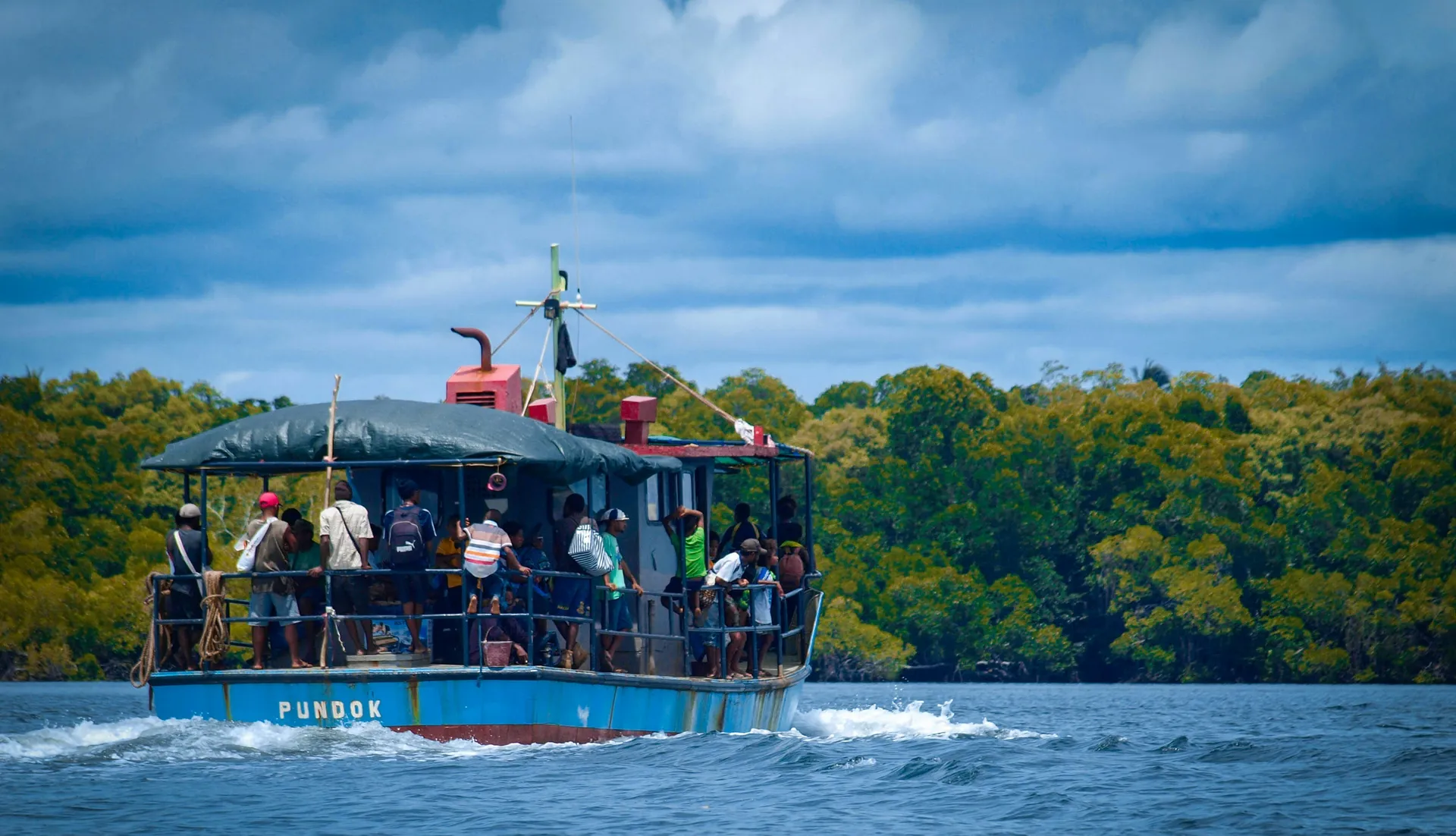
Madang sits on the northern coast of Papua New Guinea, a town of approximately 30,000 people that was once known as the "prettiest town in the Pacific" — and the claim, though less frequently made today, retains considerable validity. The town occupies a peninsula jutting into Astrolabe Bay, its waterfront lined with coconut palms, flame trees, and the frangipanis whose fragrance scents the warm, humid air. The harbor is enclosed by a barrier reef and scattered with small islands — some accessible by kayak, others by outrigger canoe — creating a lagoon of remarkable beauty. The town's infrastructure, developed during the German colonial period (1884–1914) and expanded under Australian administration, gives Madang a more ordered, more garden-like character than many Papua New Guinean towns, though the tropical energy of Melanesian life — the betel-nut vendors, the bilum (net bag) weavers, the market women with their towers of produce — is unmistakably present.
The underwater world of Madang is the town's greatest natural treasure. The reefs, dropping to dramatic walls and pinnacles just offshore, support coral diversity that rivals anywhere in the Coral Triangle — the global epicenter of marine biodiversity. Divers and snorkelers encounter hard and soft corals in riotous profusion, sea fans the size of small cars, and fish populations — anemonefish, anthias, surgeonfish, barracuda, reef sharks — whose density reflects the relative absence of destructive fishing practices. World War II wrecks — including several Japanese vessels sunk during the fierce fighting for Madang in 1943–1944 — provide artificial reef habitat of particular interest. The visibility, typically fifteen to thirty meters, and the water temperature (27–30°C year-round) make Madang one of the Pacific's premier diving destinations.
The cuisine of Madang reflects the intersection of Melanesian tradition and the tropical abundance of Papua New Guinea's north coast. The mumu — meat, root vegetables, and greens wrapped in banana leaves and cooked over hot stones in an earth pit — is the communal feast that anchors social and ceremonial life. Fresh fish and shellfish from the reef provide the daily protein, prepared simply — grilled over coconut husks or in coconut cream. Sago, processed from the pith of the sago palm in a labor-intensive procedure that yields a starchy staple, remains important in the diet of surrounding villages. The town's market is a sensory experience of remarkable intensity — heaps of betel nut, sweet potato, taro, bananas, pawpaw, and the leafy greens that provide essential vitamins in a diet otherwise focused on starch and protein.
The cultural attractions of Madang extend into the surrounding villages, where traditional sing-sing (dance festivals), spirit houses, and canoe-building traditions maintain the creative vitality of Melanesian culture. The Madang Museum, though small, preserves a collection of local artifacts — masks, pottery, carved figures, bilums — that illustrates the cultural diversity of the north coast's many language groups. The offshore islands — Kranket, Siar, Krangket — provide day-trip destinations for snorkeling, beach visits, and encounters with island communities who maintain fishing and gardening lifestyles largely unchanged by modernity. The Ramu River, accessible by boat from Madang, penetrates into the interior highlands, offering glimpses of a Papua New Guinea that few visitors reach.
Madang is served by Madang Airport with domestic flights from Port Moresby (one hour) and other Papua New Guinean cities. Expedition cruise ships call at Madang on Papua New Guinea itineraries. Accommodation ranges from the historic Madang Resort Hotel (established during the Australian administrative period) to smaller guesthouses. The climate is tropical year-round, with a drier season from May to October that offers the most comfortable conditions and best diving visibility. The wet season (November–April) brings heavier rainfall but does not preclude visiting. Visitors should be aware that Papua New Guinea requires more logistical planning than most destinations — internal transport can be unreliable, and infrastructure outside the main towns is limited.

