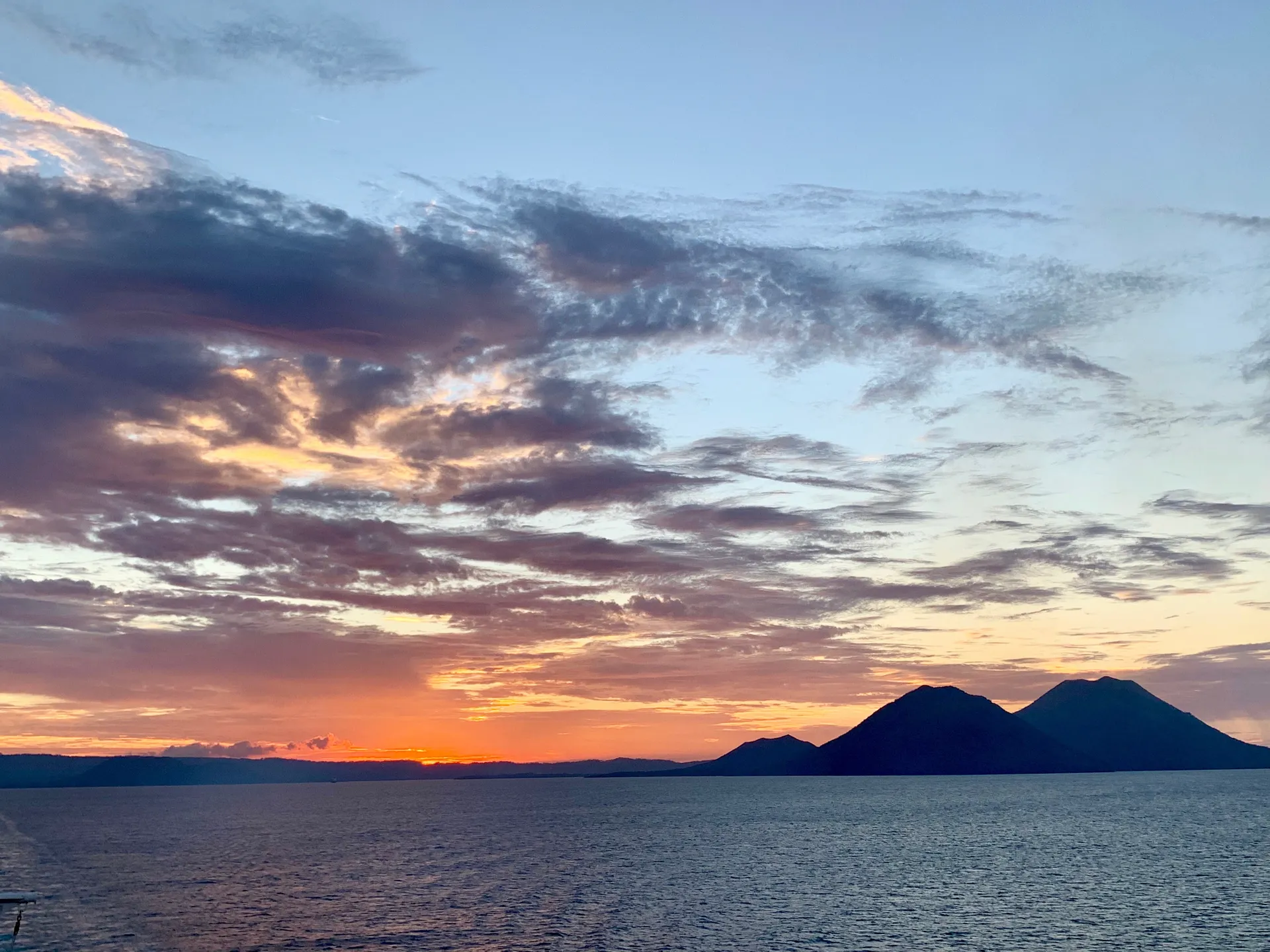
Rising from the warm waters of the Bismarck Sea in a crescent of volcanic peaks and tropical forest, Rabaul was once the most beautiful town in the South Pacific — a cosmopolitan colonial settlement set within the caldera of an active volcano that the Germans, Japanese, and Australians all coveted for its magnificent natural harbor. The eruption of Tavurvur and Vulcan in September 1994 buried much of the town under meters of volcanic ash, destroying the administrative center and forcing the relocation of the provincial capital to nearby Kokopo. Today, Rabaul exists in a state of extraordinary post-apocalyptic beauty — half-buried buildings emerge from volcanic debris, the still-steaming Tavurvur cone rises directly above the harbor, and the resilient Tolai people continue their cultural practices amid a landscape that serves as a vivid reminder of nature's supremacy.
The volcanic landscape of Simpson Harbour — the caldera that constitutes Rabaul's anchorage — presents one of the most dramatic port approaches in world cruising. Tavurvur, though diminished since its 1994 eruption, continues to emit sulfurous steam and the occasional ash plume, its conical form perfectly reflected in the harbor's calm waters on still mornings. The Mother, the massive volcanic peak that forms the caldera's northern wall, stands as a reminder that the entire harbor is essentially the interior of a volcano — a geological fact that adds a certain frisson to any port call. Hot springs along the shore allow visitors to cook eggs in naturally heated pools while watching cruise ships anchor in the caldera's deep water.
The Japanese wartime tunnels carved into the mountains surrounding Rabaul constitute one of the most extensive underground military complexes in the Pacific. During World War II, Rabaul served as Japan's principal fortress in the South Pacific, with over one hundred thousand troops garrisoned in a network of tunnels, bunkers, and underground hospitals that honeycombed the volcanic hills. The Admiral Yamamoto bunker, from which the architect of Pearl Harbor directed naval operations, can be visited along with tunnels containing wartime artifacts, rusting Zero fighters, and the poignant remains of submarine pens carved directly into the harbor's cliff face. The Bita Paka War Cemetery, where over a thousand Commonwealth soldiers lie buried beneath immaculate lawns, provides the most solemn counterpoint to the tunnels' military archaeology.
The Tolai people, whose traditional lands surround Rabaul, maintain one of Papua New Guinea's most vibrant cultural traditions. The Duk-Duk and Tubuan secret societies, whose masked ceremonial figures emerge from the sea during important rituals, represent a living cultural practice that predates European contact by centuries. The local markets overflow with tropical produce, betel nut, and the shell money (tambu) that continues to function as a traditional currency alongside the national kina. The coral reefs surrounding the caldera, enriched by volcanic minerals, support diving and snorkeling of remarkable quality, with the wreckage of Japanese wartime vessels adding an archaeological dimension to the underwater experience.
Costa Cruises and Seabourn include Rabaul in their Pacific and Melanesian itineraries, with vessels anchoring in Simpson Harbour's deep waters. The tropical climate is warm year-round, with the dry season from May through October offering the most comfortable conditions. The nearby Conflict Island Group and Manam Island provide additional Melanesian experiences, but Rabaul's unique combination of active volcanism, wartime history, and living indigenous culture — all compressed into a single caldera — creates a port experience unlike any other in world cruising. The town's partially buried state, far from being depressing, lends it an atmosphere of haunting beauty that speaks to the impermanence of all human enterprise.

