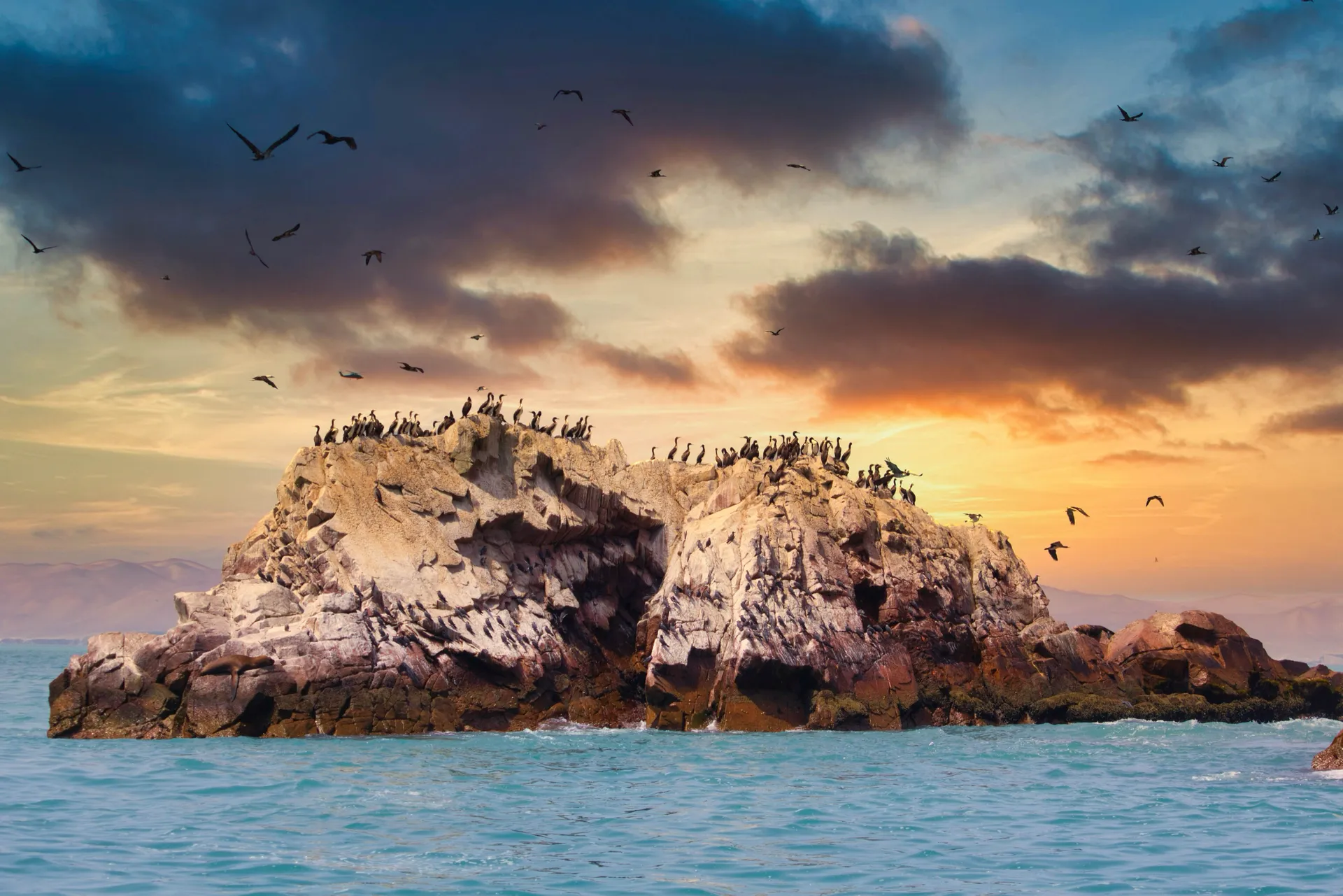
The Ballestas Islands emerge from the cold, nutrient-rich waters of the Humboldt Current like a fever dream of wildlife abundance — three small islands and a scattering of rocky islets off the southern coast of Peru, approximately 260 kilometers south of Lima, that support one of the densest concentrations of marine life in the Pacific. Often called the "Poor Man's Galápagos," the Ballestas deserve a more dignified comparison: they are, in their own right, one of the great wildlife spectacles of South America, a place where the collision of cold Antarctic waters with the tropical sun creates a marine ecosystem of almost absurd productivity. The guano that coats every surface — sometimes meters thick — was once so valuable that Peru fought a war to protect it, and its harvest continues today under government regulation.
The boat ride to the Ballestas begins from the port of Paracas, crossing the bay past the enigmatic Candelabra — a 180-meter geoglyph etched into the sandy hillside, its trident form visible only from the sea, its origin and purpose debated by archaeologists for over a century. Some attribute it to the Paracas culture (800–100 BCE), others to later civilizations, and a few to the independence-era general José de San Martín, who is said to have seen it as a sign from heaven. Whatever its origin, the Candelabra is a fitting prelude to the wonders ahead — a reminder that this coast has inspired awe and mystery for millennia.
The islands themselves are a pandemonium of life. Humboldt penguins waddle along rock shelves, their comical gait belying the elegance of their submarine hunting. South American sea lions — bulls weighing up to 350 kilograms — bellow from rocky platforms, surrounded by harems of smaller females and playful pups. Peruvian boobies, guanay cormorants, and pelicans nest in colonies so dense that the rock beneath them has vanished entirely under layers of white guano. The smell is robust, the noise is extraordinary, and the sheer density of animal life — estimated at hundreds of thousands of individual birds — creates a sensory experience that overwhelms even seasoned wildlife travelers. Dolphins frequently accompany the boats, and between June and October, humpback whales may be spotted in the deeper waters offshore.
The adjacent Paracas National Reserve, encompassing 335,000 hectares of desert peninsula and marine habitat, extends the wildlife experience onto land. The reserve's desert landscape — wind-sculpted cliffs, red sand beaches, and coastal formations in shades of ochre and crimson — is starkly beautiful, particularly at the Playa Roja (Red Beach), where iron-rich sand creates a surreal crimson shoreline. Chilean flamingos feed in the shallow lagoons, and the endangered Andean condor occasionally soars overhead, descending from the mountains to feed on sea lion carcasses. The town of Paracas itself, once a quiet fishing village, has developed a comfortable tourist infrastructure of seafood restaurants and waterfront hotels — the ideal base for exploring both the islands and the reserve.
The Ballestas Islands are visited exclusively by boat tour from Paracas harbor (approximately two hours round trip), with departures every morning. Landing on the islands is prohibited to protect the wildlife and guano harvest. Paracas is reached from Lima by road (three to four hours) or as a stop on cruise itineraries along the Peruvian coast. The driest and warmest months are December through March, but the wildlife is present year-round — with whale season adding a bonus from June to October. Bring a windbreaker for the open-boat crossing and a hat for the intense coastal sun.

