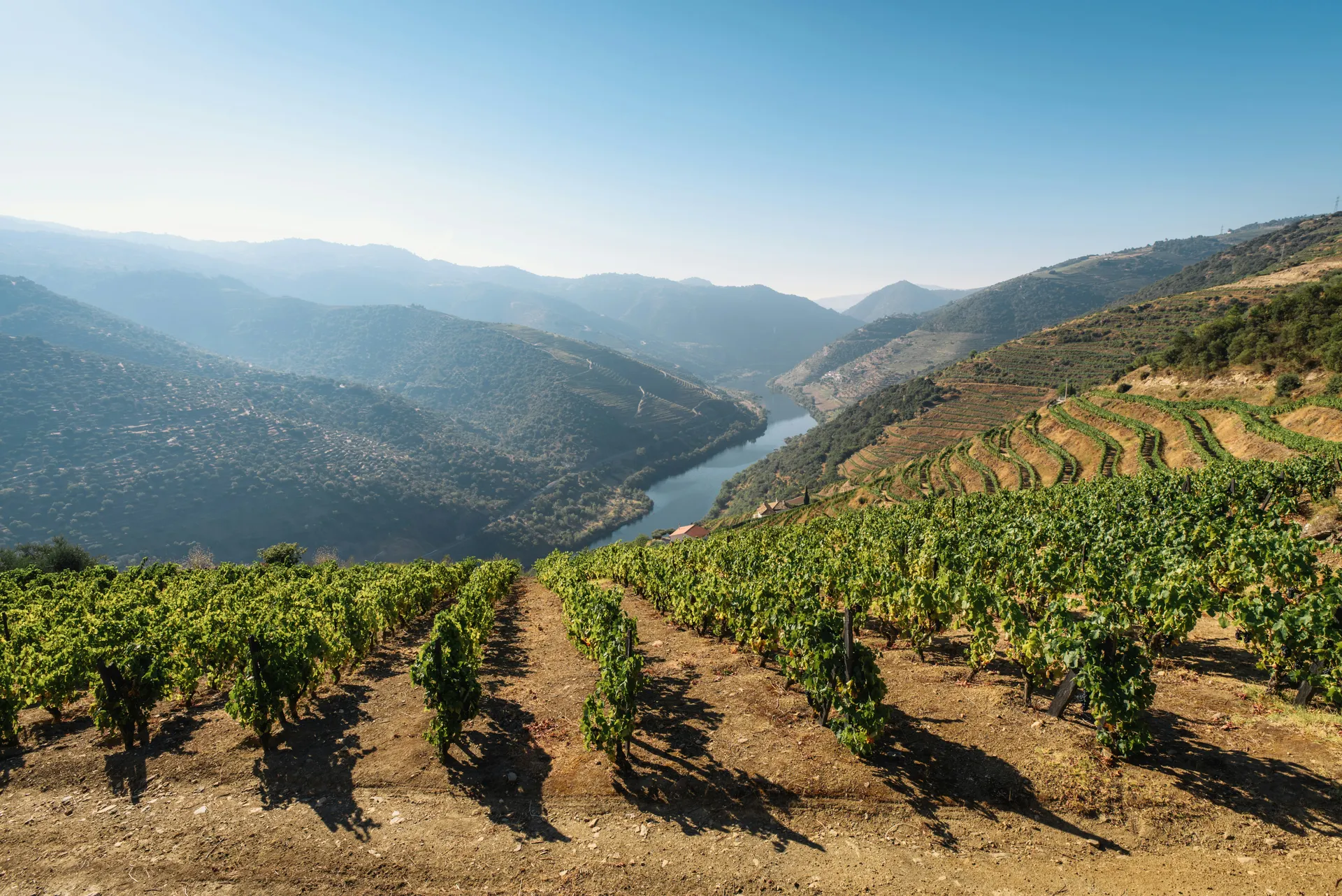
Barca d'Alva occupies the uppermost navigable point on the Douro River, a remote frontier village pressed against the Spanish border where the river narrows between granite cliffs and almond-covered hillsides. This tiny settlement — barely more than a handful of whitewashed houses, a church, and an abandoned railway station — marks the eastern terminus of Portuguese Douro cruises and the point where the landscape transitions from the cultivated terraces of the port wine region into the wild, sparsely populated borderlands of Trás-os-Montes. The disused railway station, once the terminus of the Linha do Douro, retains a melancholy charm with its faded azulejo tiles and silent platform, a monument to a slower era of travel.
The landscape around Barca d'Alva is one of austere grandeur. The Douro here has carved a deep canyon through ancient schist and granite, creating the International Douro Natural Park (Parque Natural do Douro Internacional), a protected area shared between Portugal and Spain where golden eagles, griffon vultures, and Egyptian vultures ride the thermals above sheer cliff faces. The climate is continental rather than maritime — bitterly cold in winter and scorching in summer — and the vegetation reflects this extremity: cork oaks, cistus, and wild lavender cling to the rocky slopes, while almond trees paint the valley pink and white each February. The silence here is profound, broken only by birdsong and the gentle current of the river.
The cuisine of this remote border region reflects its Trás-os-Montes heritage — robust, meat-heavy fare designed for harsh winters. Alheira and farinheira sausages, smoked over oak and chestnut wood, are essential charcuterie. Cabrito assado no forno (oven-roasted kid goat) and javali (wild boar) stew represent the region's connection to pastoral and hunting traditions. Migas, a bread-based dish fried with garlic and olive oil, accompanies nearly every meal. Local olive oil, produced from trees growing on the terraced slopes, is among Portugal's finest — thick, green, and peppery. The region's wines are increasingly recognised: beyond port, the Douro produces outstanding unfortified reds from indigenous Touriga Nacional, Tinta Roriz, and Touriga Franca grapes.
From Barca d'Alva, excursions cross into Spain to the fortified town of Ciudad Rodrigo, a beautifully preserved medieval walled city with a twelfth-century cathedral and a plaza mayor ringed by arcaded buildings. The prehistoric rock art of the Côa Valley — thousands of Paleolithic engravings of horses, aurochs, and ibex — lies within the UNESCO-listed Côa Valley Archaeological Park, accessible from the nearby village of Vila Nova de Foz Côa. Further downstream, the wine estates of the upper Douro — Quinta do Vesúvio, Quinta do Crasto — offer tastings in settings of extraordinary natural beauty.
Barca d'Alva serves as the turnaround point for Douro river cruises operated by A-ROSA, AmaWaterways, Avalon Waterways, CroisiEurope, Scenic River Cruises, Tauck, Uniworld River Cruises, and Viking. Nearby ports include Pinhão, Régua, and Porto. The Douro season runs from March through November, with the almond blossom in February, the grape harvest in September, and the autumn colours in October each offering unique reasons to make this remote corner of Europe a destination in its own right.

