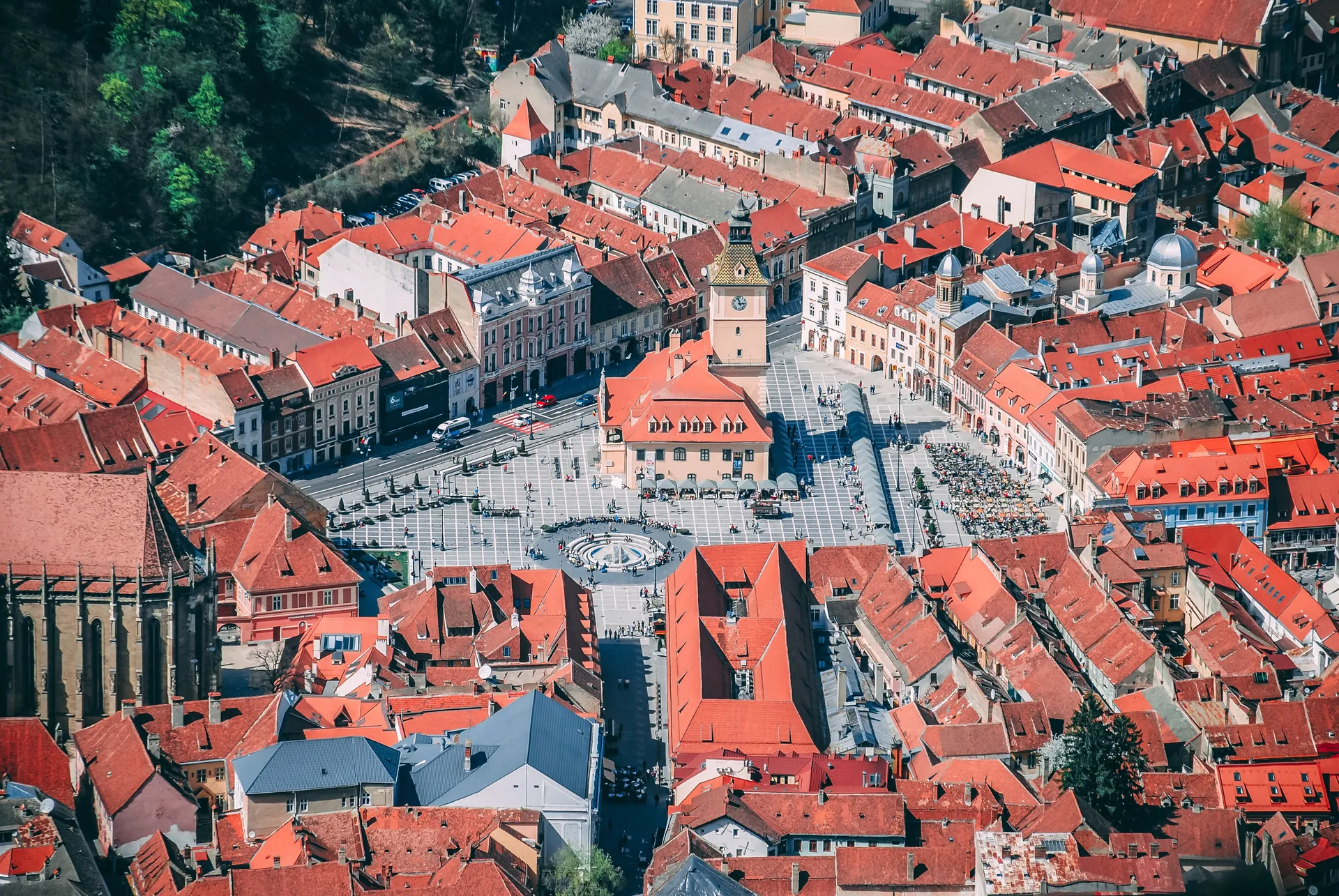
Brasov sits in a valley at the foot of the Carpathian Mountains in the heart of Transylvania, its medieval Saxon architecture so perfectly preserved that it feels less like a city and more like a stage set for a Gothic fairy tale — which, given the proximity of Bran Castle and the legend of Dracula, is not entirely coincidental. Founded in the thirteenth century by Teutonic Knights and subsequently developed by Saxon German colonists, Brasov grew wealthy as a trading centre on the routes connecting the Ottoman Empire with Central Europe. Its fortified churches, guild towers, and thick defensive walls speak to centuries of prosperity and peril in equal measure, and the old town retains an atmosphere of medieval grandeur that few cities in Eastern Europe can match.
The Council Square, Brasov's magnificent central plaza, is surrounded by merchant houses, guild buildings, and the wedding-cake facade of the old City Hall. The Black Church, the largest Gothic church in southeastern Europe, dominates the square with a presence that borders on the imperious. Named for the soot that blackened its walls during the great fire of 1689, the church contains one of Europe's largest collections of Anatolian carpets — over a hundred Ottoman prayer rugs gifted by Saxon merchants as trophies of their trading success. The Tampa mountain, rising 960 metres directly behind the old town, offers a cable-car ride to a viewpoint that surveys the entire city, the surrounding mountains, and the red-roofed expanse of the medieval centre below.
Transylvanian cuisine is a fusion of Romanian, Hungarian, Saxon German, and Ottoman influences. Sarmale — cabbage rolls stuffed with minced pork, rice, and dill, served with sour cream and mamaliga (polenta) — is the definitive Romanian dish and tastes best in the traditional restaurants that line Brasov's old streets. Mici, small grilled sausages of minced meat seasoned with garlic, cumin, and thyme, are Romania's favourite street food and the inevitable accompaniment to any glass of beer. Papanasi, a fried doughnut-like dessert topped with sour cream and jam, is sinfully delicious. The local wines, from the Dealu Mare region south of the Carpathians, are increasingly impressive — robust Feteasca Neagra reds and aromatic Feteasca Alba whites that deserve wider international recognition.
The attractions surrounding Brasov draw from both natural beauty and dark legend. Bran Castle, perched on a rocky outcrop thirty kilometres southwest, is marketed as "Dracula's Castle" — a connection that owes more to tourism marketing than historical accuracy, though the fourteenth-century fortress is genuinely atmospheric and well worth visiting. The Peles Castle in Sinaia, a Neo-Renaissance masterpiece that served as the summer residence of Romania's first king, is one of the most beautiful palaces in Europe. The Piatra Craiului National Park, rising behind Brasov in a dramatic limestone ridge, offers hiking through alpine meadows, beech forests, and the domain of brown bears, wolves, and lynx — Europe's last great population of large carnivores.
Brasov is accessible as an excursion from Danube cruise ports on itineraries offered by Avalon Waterways, Emerald Cruises, and Scenic River Cruises, typically via overland transfer from the Romanian river towns. The journey through the Carpathian foothills is scenic and historically rich. The best time to visit is May through October, with autumn (September through October) delivering spectacular foliage in the surrounding mountains and a golden light that sets the medieval architecture ablaze.

