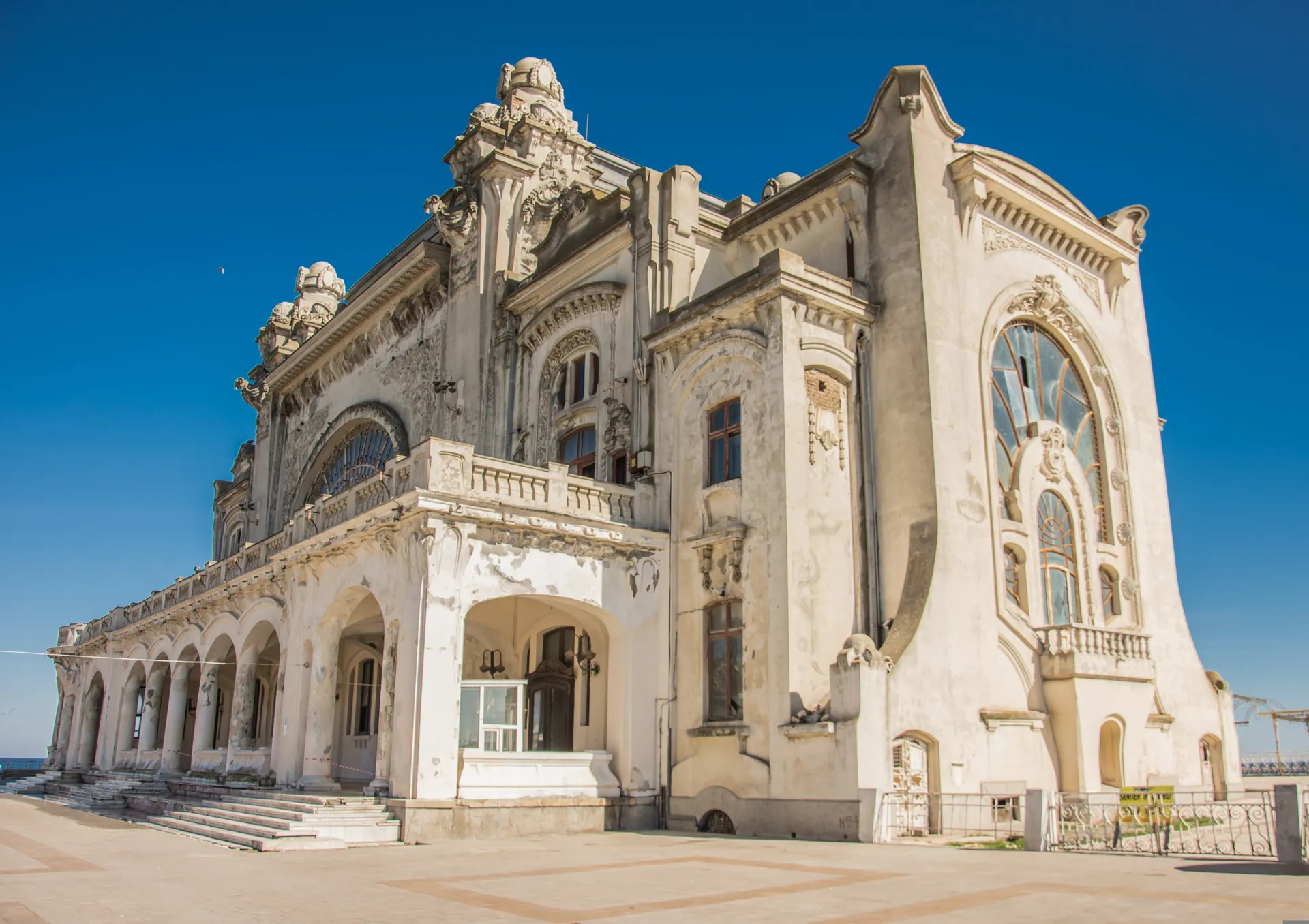
On the western shore of the Black Sea, where the Danube's influence still freshens the coastal waters and the ghosts of Greek colonists mingle with Roman legionaries and Ottoman merchants, Constanța stands as Romania's portal to the Mediterranean world. Founded as Tomis by Greek settlers from Miletus in the sixth century BC, this is the city where the Roman poet Ovid spent his final years in exile, composing his melancholy Tristia while gazing across the same waters that visitors contemplate today from the Casino's Art Nouveau terrace. With over two and a half millennia of continuous habitation, Constanța layers civilizations like geological strata, each era leaving its mark on a city that refuses to be defined by any single chapter.
The Casino of Constanța, perched on the seafront promenade like a faded grande dame refusing to surrender her dignity, is the city's most iconic building and one of the great Art Nouveau structures of southeastern Europe. Designed by Daniel Renard and completed in 1910, its ornate facades and sweeping terraces once hosted the Romanian royal family and European aristocracy; today, though closed for restoration, it remains the emotional heart of the city, its silhouette inseparable from Constanța's identity. The Archaeological Museum nearby houses one of Romania's richest collections, including the stunning Glycon serpent sculpture — a second-century marble masterpiece discovered in 1962 that has become the city's symbol.
The old town rewards exploration with its layers of history compressed into a walkable area. The Roman Mosaic Building, discovered during construction work in 1959, preserves an enormous floor mosaic from the fourth century AD, its geometric and floral patterns still vivid after seventeen centuries. The Great Mahmudiye Mosque, built in 1910 by King Carol I for the city's Turkish community, rises from a neighborhood where Orthodox churches, mosques, and synagogues stand in remarkably close proximity — a spatial expression of the multicultural heritage that defines Black Sea port cities. The Genoese Lighthouse, though dating only from 1860, marks the site where medieval Italian traders maintained their commercial presence.
Beyond the city, the Romanian Black Sea coast offers compelling excursions. The Danube Delta, a UNESCO World Heritage Site accessible from Constanța, is Europe's largest and best-preserved delta — a labyrinth of channels, floating reed islands, and lakes that supports over three hundred species of birds, including Europe's largest pelican colonies. The ancient fortress of Histria, founded by the same Milesian Greeks who established Tomis, stands on a promontory overlooking a coastal lagoon, its ruins spanning six centuries of continuous occupation. The resort of Mamaia, stretching along a narrow strip between the Black Sea and Lake Siutghiol, provides beach relaxation when the weather cooperates.
Scenic River Cruises and Viking include Constanța in their extended Danube and Black Sea itineraries, typically as the terminus or turning point of voyages that traverse the river's entire navigable length. The port facilities accommodate ocean-going vessels, and the city's compact center is easily explored on foot. The optimal visiting season runs from May through September, with summer bringing warm swimming temperatures and the liveliest beach culture, while spring and autumn offer milder weather ideal for exploring the archaeological sites and the Danube Delta. Nearby Sibiu and Sighișoara in Transylvania add medieval charm for those extending their Romanian exploration.

