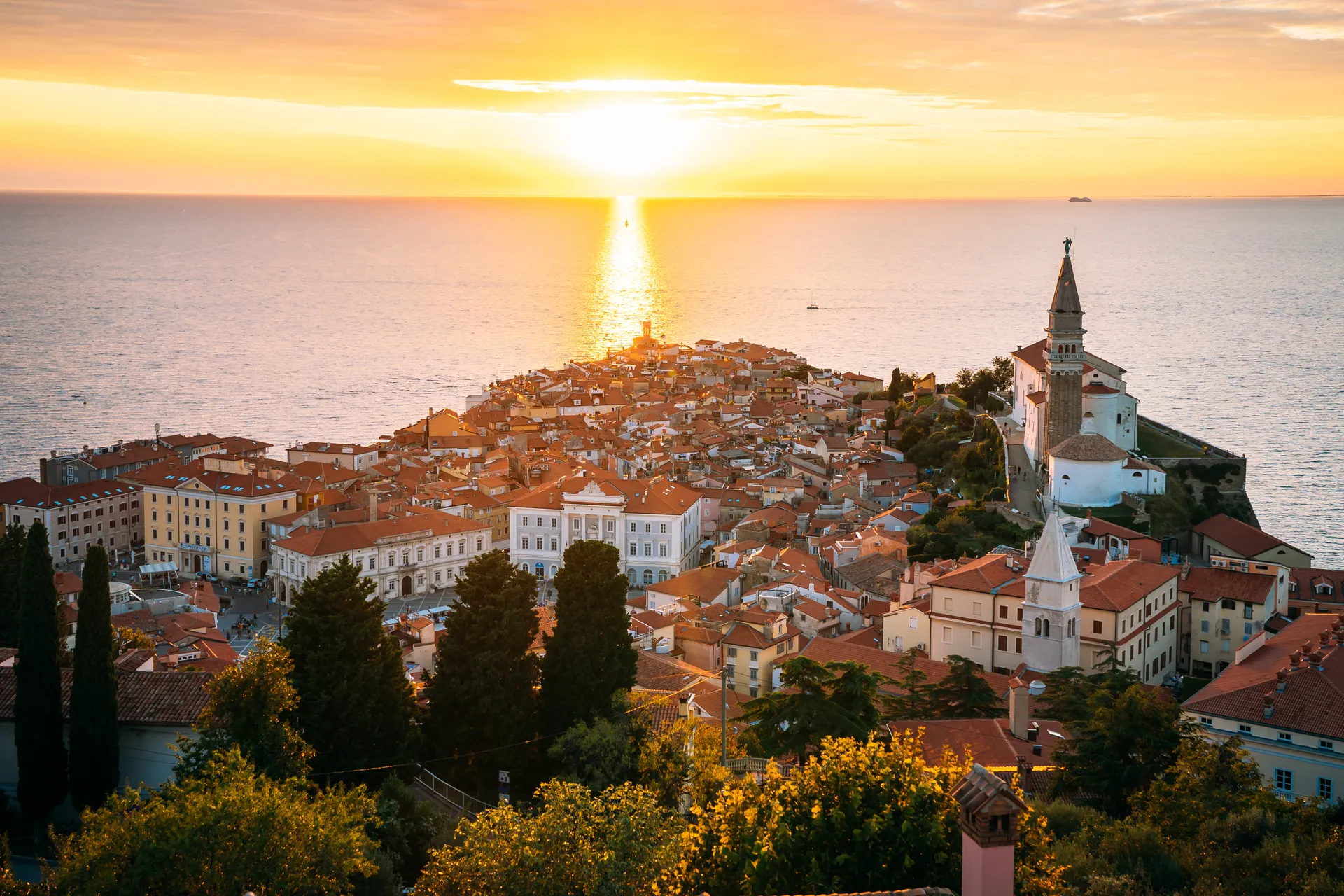
Piran is a Venetian jewel set on the Slovenian coast, a walled town perched on a narrow peninsula that juts into the Adriatic with the graceful confidence of a place that has been beautiful for seven centuries. From the thirteenth to the eighteenth century, Piran was a possession of the Republic of Venice, and the influence is unmistakable: the Tartini Square, one of the most elegant piazzas on the Adriatic, is flanked by Venetian Gothic palaces, a loggia, and a town hall that could have been transplanted from the Veneto. The square is named for Giuseppe Tartini, the virtuoso violinist and composer born here in 1692, whose bronze statue gazes toward the harbor with the focused intensity of a man about to play the Devil's Trill Sonata.
The town is small enough to explore in an afternoon, but rich enough to reward a longer stay. The medieval walls climb the hill behind the town to the Church of St. George, whose bell tower—modeled on the Campanile of St. Mark's in Venice—provides a 360-degree panorama of the Istrian coast, the Julian Alps, and, on clear days, the Italian shore across the Gulf of Trieste. The narrow streets below are a labyrinth of stone houses, their facades painted in faded terracotta and ochre, with laundry strung between buildings and cats dozing on sun-warmed windowsills. Unlike many Adriatic tourist destinations, Piran remains a functioning town—its residents are fishermen, salt workers, and families who have lived within these walls for generations.
The cuisine of Piran draws on both its maritime setting and its position at the crossroads of Italian, Slavic, and Central European culinary traditions. Fresh Adriatic seafood dominates: branzino (sea bass) grilled whole over charcoal, risotto nero blackened with cuttlefish ink, and frittura mista of tiny fish and calamari are staples of the waterfront restaurants that line the harbor. The Sečovlje salt pans, just south of town, have been producing salt by traditional methods since the fourteenth century, and the fleur de sel harvested here—hand-raked from shallow evaporation pools—is among the finest in Europe. Local olive oil, pressed from groves that cover the Istrian hillsides, and wines from nearby Goriška Brda (Slovenia's "little Tuscany") complete a culinary picture that is Mediterranean in spirit but uniquely Slovenian in character.
Beyond the town walls, the short Slovenian coast packs remarkable diversity into its forty-seven kilometers. The Sečovlje Salina Nature Park preserves the salt pans as a working landscape and a haven for migratory birds, including avocets, stilts, and egrets. The underground passages of the Postojna Cave, one of the largest cave systems in Europe, lie an hour's drive inland—a train ride through stalactite-decorated chambers reveals a subterranean world that has fascinated visitors since the seventeenth century. Predjama Castle, built into the mouth of a cave halfway up a 123-meter cliff, is one of the most dramatically situated castles in the world. Ljubljana, Slovenia's charming capital, is just ninety minutes northeast.
Piran is accessible as a port of call for small expedition and boutique cruise vessels navigating the northern Adriatic, and it pairs naturally with visits to Venice, Rovinj, and the Dalmatian coast. The best time to visit is May through October, when the Mediterranean climate delivers warm, sunny days and the harbor-side cafés are at their most inviting. July and August bring the warmest water temperatures and the liveliest atmosphere. The shoulder months of May, June, September, and October offer a more tranquil experience, with golden light and the pleasure of having the town's narrow streets largely to yourself.

