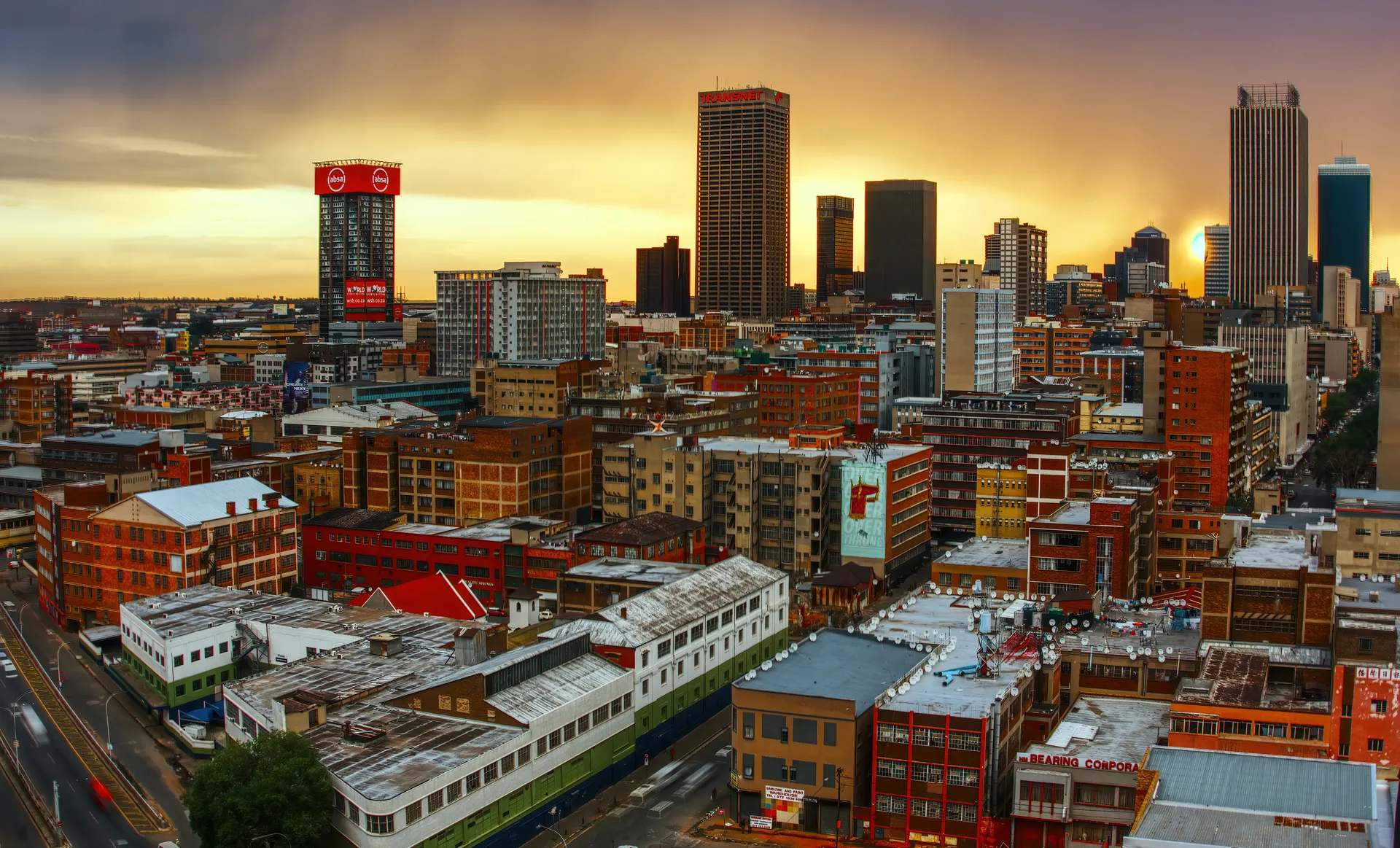
Born from the feverish promise of gold, Johannesburg emerged in 1886 when an Australian prospector named George Harrison stumbled upon a reef of gold-bearing ore on the Witwatersrand ridge, igniting one of the greatest mineral rushes the world has ever witnessed. Within a decade, what had been empty highveld grassland transformed into the wealthiest square mile in Africa, drawing fortune-seekers from every continent and laying the foundations for a metropolis that would shape the destiny of an entire nation. Today, the city that locals call Jozi carries the weight of that extraordinary genesis in every street corner and skyline, a place where ambition and reinvention are written into the very bedrock.
There is a particular quality to Johannesburg's light — sharp, crystalline, almost theatrical at 1,753 metres above sea level — that lends the city an energy unlike any other on the continent. The sprawling township of Soweto, once home to both Nelson Mandela and Archbishop Desmond Tutu, pulses with a creative vitality that has long outgrown its origins of resistance, its streets now lined with galleries, jazz venues, and design studios that attract a new generation of cultural pilgrims. In the leafy northern suburbs of Rosebank and Parkhurst, jacaranda-canopied avenues shelter independent boutiques and courtyard restaurants where the conversation is as cosmopolitan as anything you might overhear in London or São Paulo. The Apartheid Museum and Constitution Hill stand as unflinching testaments to the country's passage through darkness toward democracy, their architecture alone worth the journey — raw concrete and rusted steel arranged with a gravity that commands silence.
To dine in Johannesburg is to encounter a cuisine shaped by migration, innovation, and the fierce pride of a city that refuses to be defined by a single narrative. Begin with a plate of mogodu — slow-simmered tripe seasoned with curry leaves and served with crumbled pap — at one of Soweto's legendary street-food stalls, where the queue is your guarantee of authenticity. In Maboneng, the regenerated inner-city precinct, chefs at establishments like Che Argentine Grill and Urbanologi craft dishes that marry South African ingredients with global technique: think bobotie reimagined as delicate parcels, or biltong shaved tableside over burrata with a drizzle of avocado oil from Limpopo groves. Wash it all down with an Amarula cream cocktail or a glass of Methode Cap Classique from the nearby Gauteng wine estates, and you begin to understand why Jozi's food scene now rivals Cape Town's in ambition, if not yet in international recognition.
Beyond the city limits, the highveld unfolds into landscapes of startling contrast. Pretoria, scarcely forty minutes north, offers the neoclassical grandeur of the Union Buildings and, in October, the ethereal spectacle of seventy thousand jacaranda trees erupting into violet bloom. The upscale enclave of Sandton — often called Africa's richest square mile — presents a different kind of theatre: flagship luxury boutiques, world-class hotels, and the Nelson Mandela Square, where a six-metre bronze of Madiba presides over al fresco lunches with quiet authority. For those drawn to the coast, the Eastern Cape beckons: Gqeberha, formerly Port Elizabeth, serves as the gateway to Addo Elephant National Park and the sapphire waters of Algoa Bay, while the remote fishing village of Arniston, with its limestone caves and whitewashed cottages, feels like a secret whispered between only the most discerning travellers.
As a point of embarkation for river voyaging, Johannesburg occupies a singular position. AmaWaterways, the acclaimed river cruise line known for its intimate vessels and destination-immersive itineraries, includes Johannesburg as a vital anchor in its Southern African programming, often pairing the city with multi-day extensions along the Chobe River and into Botswana's wildlife corridors. Arriving by river — or departing toward the waterways that lace this corner of the continent — allows travellers to experience Johannesburg not as a layover but as a prologue, a city whose complexity and magnetism deserve the unhurried attention that luxury river cruising, by its very nature, encourages. Pre- and post-cruise stays in the city's finest properties, from the Saxon Hotel in Sandhurst to the Four Seasons in the Westcliff, ensure that the transition between urban sophistication and wilderness wonder is seamless.