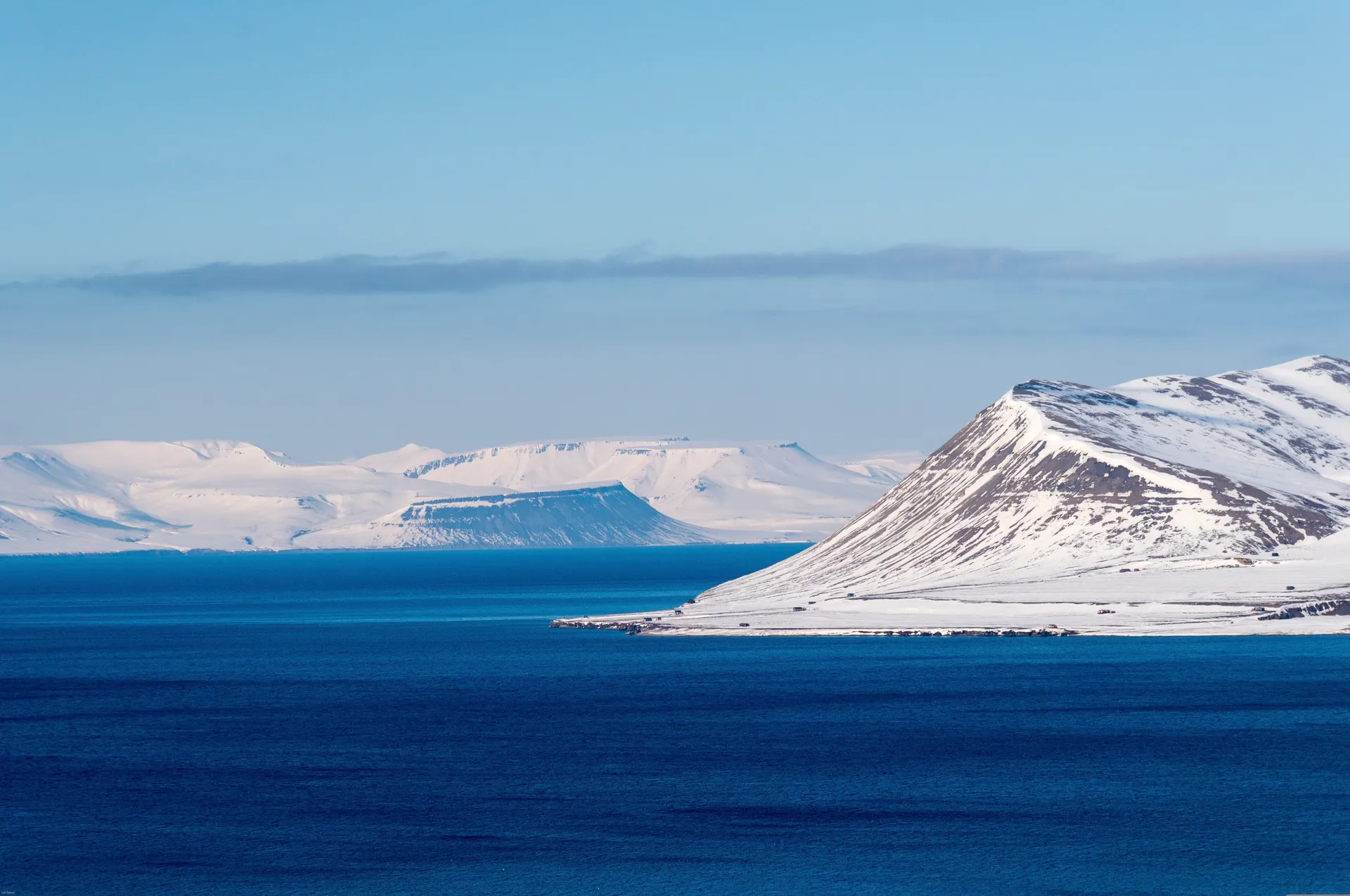
Jan Mayen is one of the most remote inhabited islands on Earth—a 55-kilometer sliver of volcanic rock rising from the Norwegian Sea roughly halfway between Norway and Greenland, crowned by the Beerenberg volcano, the northernmost active volcano in the world at 2,277 meters. The island has no permanent civilian population; its only residents are the roughly 18 members of the Norwegian Armed Forces and Norwegian Meteorological Institute who operate the weather station and LORAN-C navigation facility on the island's southern end. There are no hotels, no restaurants, no tourist infrastructure of any kind—and yet Jan Mayen draws expedition cruise ships specifically because of this extraordinary isolation, offering visitors the rare experience of setting foot on a place where human presence is measured in single digits.
Beerenberg dominates the island's geography and imagination. The volcano last erupted in 1985, sending lava flows toward the station buildings and forcing a temporary evacuation. Its cone, perpetually encased in glacial ice, rises from sea level to its summit in a single, unbroken sweep that creates one of the most dramatic volcanic profiles in the North Atlantic. The island's landscape is divided between the mountainous northern section (Nord-Jan), dominated by Beerenberg and its glaciers, and the lower, flatter southern section (Sør-Jan), where the station, airstrip, and most of the island's limited flat ground are located. Between them, a narrow isthmus of lava and volcanic sand connects the two halves in a landscape of raw, primordial beauty.
Wildlife on Jan Mayen is concentrated on the coast and in the surrounding waters. The island supports significant seabird colonies, including fulmars, little auks, Brünnich's guillemots, and Arctic skuas that nest on the volcanic cliffs and scree slopes. Polar bears occasionally arrive on drift ice from Greenland, though sightings are unpredictable. The surrounding waters are rich with marine life—fin whales, humpbacks, and minke whales feed in the nutrient-rich convergence zone where warm Atlantic and cold Arctic water masses meet. The seals that haul out on the island's rocky shores include bearded, ringed, and the occasional hooded seal. The combination of volcanic geology and Arctic marine biology creates an environment of stark, compelling contrasts—black lava beaches meeting pack ice, steaming fumaroles surrounded by snowfields, and sea stacks colonized by thousands of nesting birds rising from cold, green swells.
The human history of Jan Mayen, though brief, is characteristically dramatic. Dutch whalers established seasonal stations here in the seventeenth century, and the island was named for the Dutch captain Jan Jacobszoon May van Schellinkhout, who claimed formal discovery in 1614. Norwegian sovereignty was established in 1929, and the meteorological station has operated continuously since 1921—providing weather data critical for North Atlantic forecasting. The station buildings, a functional collection of prefabricated structures clustered on the island's southern tip, represent one of the most isolated permanently staffed outposts in the Northern Hemisphere. For expedition passengers, a visit to the station offers a fascinating glimpse into the logistics of maintaining human habitation in one of the world's most extreme environments.
Aurora Expeditions, Crystal Cruises, HX Expeditions, and Viking include Jan Mayen on their Arctic and North Atlantic expedition itineraries, typically as a Zodiac cruising and landing destination between Iceland or Svalbard. Landings are subject to weather and sea conditions, which are notoriously challenging—strong winds, heavy swells, and fog can prevent access even in the brief summer season. When landings are possible (typically July–August), passengers explore the volcanic beaches, observe seabird colonies, and—if conditions allow—hike inland toward the lower slopes of Beerenberg. The island has no sheltered anchorage, so ships must hold position offshore in the open sea, and all operations are conducted by Zodiac. Jan Mayen is not a destination for those who require comfort or certainty; it is a destination for those who understand that the most extraordinary places on Earth are precisely the ones that are hardest to reach.

