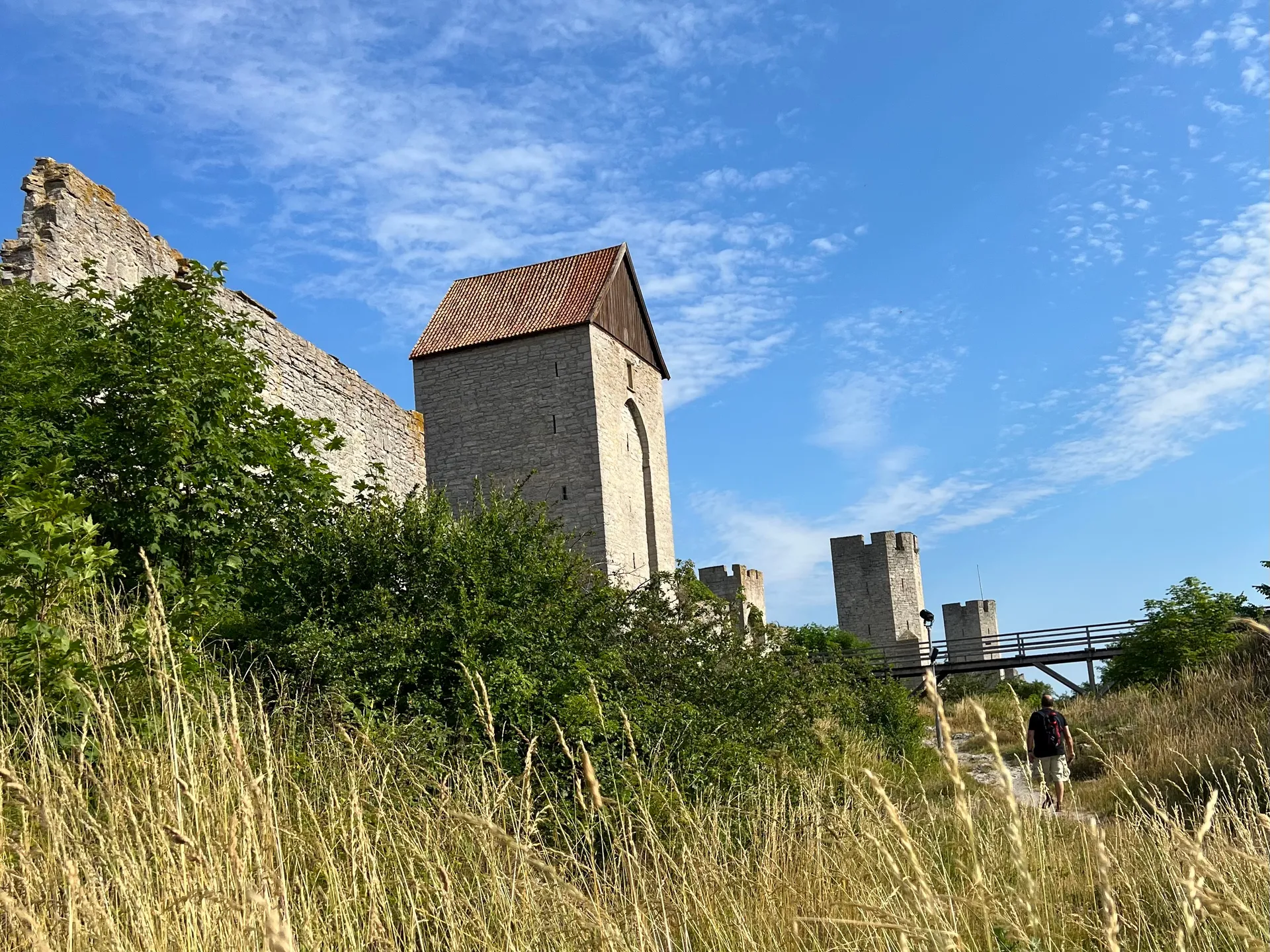
Inscribed on the UNESCO World Heritage list since 1995, Visby stands as the best-preserved medieval city in all of Scandinavia — a place where thirteenth-century merchant wealth built limestone churches so numerous that their ruins still punctuate the skyline like stone sentinels. Founded as a Viking trading post around the tenth century, the city rose to extraordinary prominence as a leading hub of the Hanseatic League, its harbour once crowded with vessels carrying furs, beeswax, and amber between the Baltic and the markets of Northern Europe. That medieval golden age left behind a 3.4-kilometre ring wall, remarkably intact, its forty-four towers still watching over the rooftops of Gotland's capital with quiet, enduring authority.
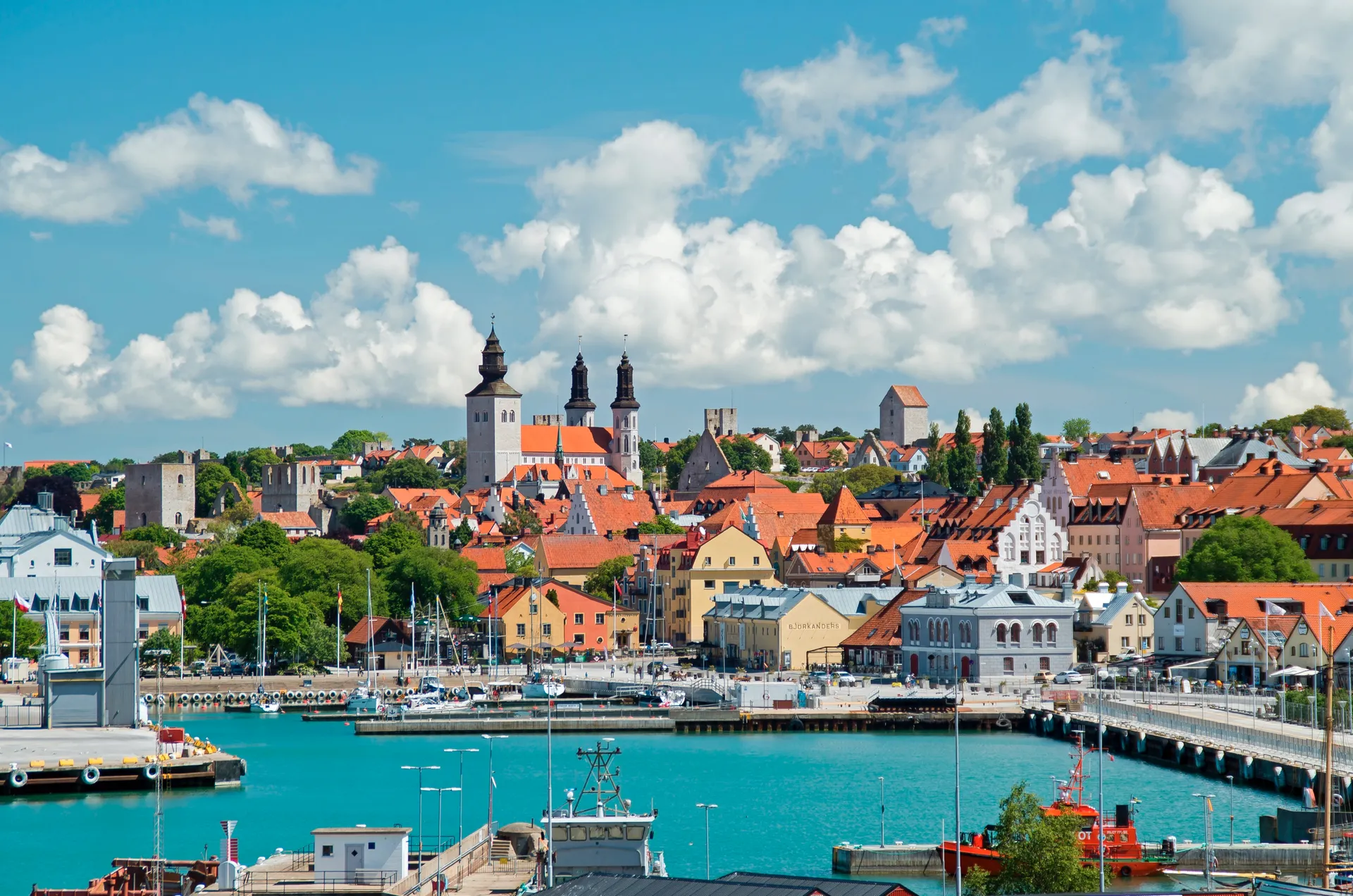
To arrive in Visby by sea is to understand why the Norse called Gotland "the good land." The harbour opens onto a tableau that feels almost theatrical: the crenellated wall rising above terracotta roofs, climbing roses spilling over garden gates, and the skeletal arches of St Karin's and St Nikolai's ruined churches framing the sky in pale grey limestone. Wander the narrow cobbled lanes of Strandgatan and Adelsgatan, where medieval warehouses have been reimagined as boutiques and galleries, and you will find the rare pleasure of a town that rewards aimlessness. Every sloping alley seems to deliver you to another café terrace, another sun-warmed courtyard, another view of the sea glittering beyond the walls — a city that insists, with quiet grace, that you slow your pace to match its own.
The table in Visby is a celebration of Gotland's terroir, an island blessed with mild microclimates, wild-foraged herbs, and lamb that grazes on salt-kissed meadows. Seek out *saffranspannkaka*, the island's signature saffron pancake — a golden, custardy confection traditionally served with dewberries and whipped cream, its recipe stretching back centuries. At the harbour-side restaurants, locally smoked fish and *kroppkakor*, hearty potato dumplings stuffed with salt pork and onion, speak to a culinary tradition rooted in Baltic abundance. Gotland's burgeoning craft scene deserves attention as well: the island now produces its own gin infused with wild juniper, and several small-batch breweries have earned devoted followings among Stockholm weekenders. Pair a tasting with a slice of *klimp* — a dense, comforting bread dumpling — and you have an afternoon perfectly spent.
For those whose itinerary allows exploration beyond the city walls, Gotland's position in the Baltic opens a wider narrative of Swedish discovery. The storybook town of Mariefred, clustered around the Renaissance magnificence of Gripsholm Castle on the shores of Lake Mälaren, offers one of Sweden's most photogenic day excursions. Malmö, Sweden's cosmopolitan southern gateway, pairs Scandinavian design sensibility with a multicultural culinary scene anchored by the Malmöhus Castle quarter. Further north, the inland city of Karlstad sits where the Klarälven River meets Lake Vänern, its sun-drenched summers earning it the affectionate title of Sweden's sunshine capital. And for those drawn to the wild beauty of the upper coast, Sundsvall — rebuilt in stone after a devastating 1888 fire — presents a striking ensemble of late-nineteenth-century architecture set against a backdrop of forested hills and the Gulf of Bothnia.
Visby's deep-water harbour and compact, walkable layout have made it a cherished port of call for the world's most distinguished cruise lines. Guests sailing with Seabourn and Oceania Cruises will find intimate ship sizes ideally matched to the town's unhurried character, while Viking's culturally immersive itineraries draw a natural connection to Gotland's Norse heritage. Princess Cruises and Cunard bring their signature transatlantic elegance to Baltic circuits that anchor here during the luminous Scandinavian summer, and Norwegian Cruise Line offers the freedom to explore at one's own rhythm. MSC Cruises and AIDA extend Visby's reach to Mediterranean and European travellers for whom this medieval jewel might otherwise remain undiscovered, each vessel adding its own accent to the colourful procession that enlivens the harbour from May through September. However you arrive, the experience is the same: stepping off the gangway and through a portal into a beautifully preserved past, where the light is long, the roses are in bloom, and the ancient walls hold centuries of stories in their sun-warmed stone.