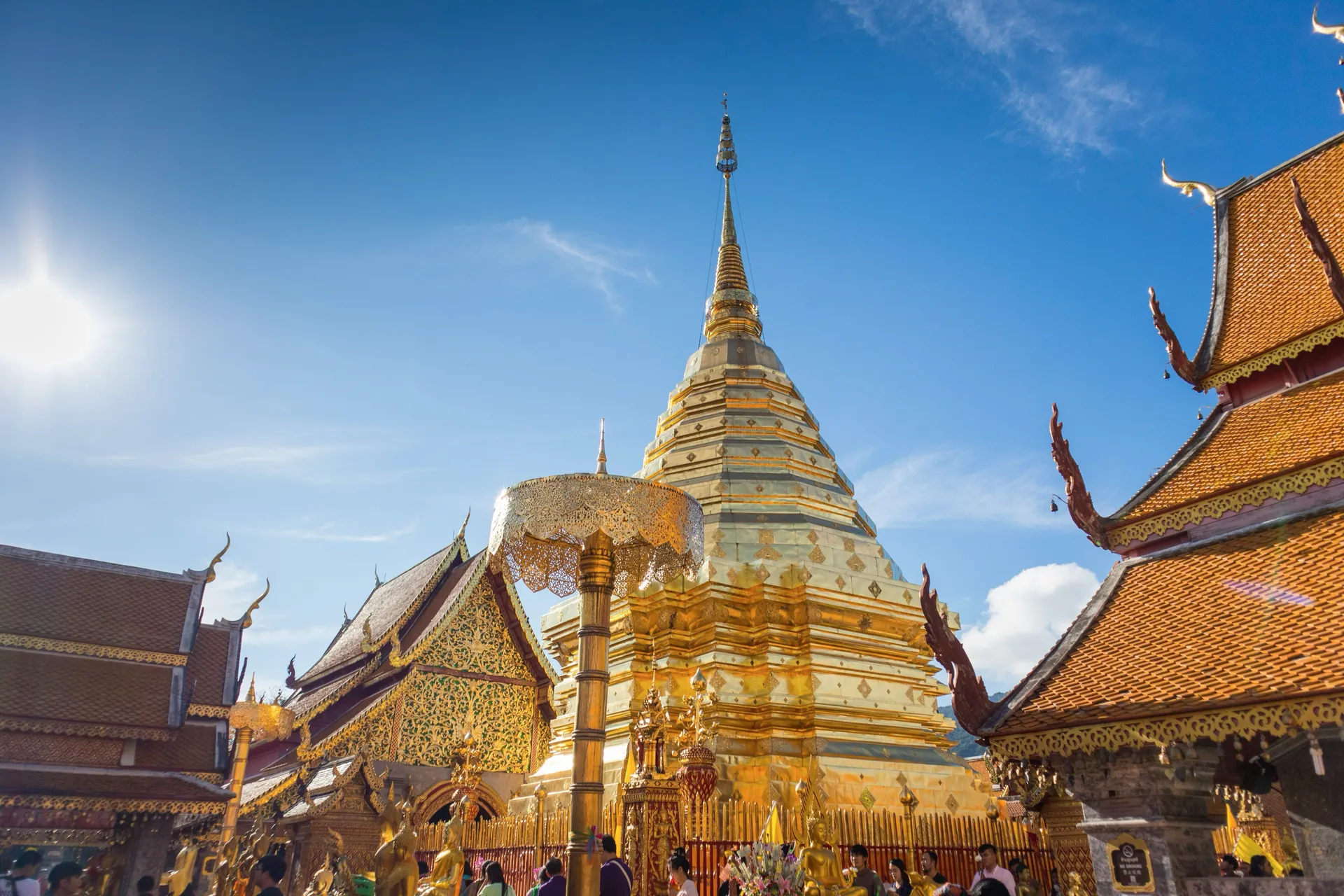
Chiang Mai was founded in 1296 as the capital of the Lanna Kingdom, and seven centuries later the old city still bears the imprint of that founding vision—a perfect square of crumbling brick walls and moats, oriented to the cardinal directions, enclosing over three hundred temples whose golden spires punctuate the skyline like a musical score. For centuries, Chiang Mai existed in splendid isolation from Bangkok, separated by mountains and jungle that kept its culture, language, and cuisine distinct from the Siamese south. Today, it is Thailand's second city and its cultural capital, a place where tradition and modernity coexist with a grace that Bangkok's frenetic energy rarely permits.
The old city within the moat is an intoxicating maze of narrow lanes, temple compounds, and shophouses converted into cafés, galleries, and boutique hotels. Wat Phra Singh houses one of Thailand's most revered Buddha images; Wat Chedi Luang's massive fifteenth-century stupa, partially destroyed by an earthquake in 1545, remains one of the most impressive religious structures in Southeast Asia. Beyond the moat, the Nimmanhaemin district has emerged as Chiang Mai's creative quarter—a grid of trendy streets lined with design shops, specialty coffee roasters, and contemporary art galleries that reflect the city's status as a magnet for digital nomads and creative entrepreneurs from around the world.
Chiang Mai's food culture is among the richest in Southeast Asia, and the city has become a global destination for culinary travelers. The cuisine of northern Thailand is distinct: khao soi, a coconut-curry noodle soup topped with crispy egg noodles, is the city's signature dish and alone justifies the journey. Sai ua, a herbaceous northern sausage redolent with lemongrass and galangal, pairs beautifully with sticky rice—the staple grain of the north, eaten with the hands. The night markets—particularly the Saturday Walking Street on Wualai Road—offer an overwhelming parade of regional delicacies, from laab (spiced minced meat salad) to khanom jeen (rice noodles with curry). Cooking classes, offered by dozens of excellent schools, are the most popular tourist activity in the city.
The mountains surrounding Chiang Mai provide a dramatic counterpoint to the lowland culture. Doi Suthep, the forested peak that rises directly above the city, is crowned by Wat Phra That Doi Suthep—a gleaming golden temple reached by a staircase of 309 steps flanked by naga serpent balustrades, offering panoramic views of the entire Chiang Mai valley. The hill tribe villages of the Doi Inthanon massif (Thailand's highest peak at 2,565 meters) reveal cultures—Hmong, Karen, Lisu—that maintain traditions predating the Thai state. Elephant sanctuaries in the surrounding hills, particularly those that prioritize ethical treatment and rehabilitation, offer deeply moving encounters with these intelligent creatures.
Chiang Mai is accessible by air from Bangkok and serves as a base for exploring northern Thailand, including the Golden Triangle, Chiang Rai's White Temple, and the ancient city of Lampang. The ideal time to visit is the cool season, November through February, when temperatures are pleasant and the skies are clear. The hot season (March–May) brings burning haze from agricultural fires that can significantly reduce air quality. The rainy season (June–October) brings lush greenery and fewer tourists but occasional flooding in low-lying areas.

