Where the Aegean coast of Turkey meets the legacy of classical antiquity, the port of Kuşadası serves as the gateway to Ephesus — one of the ancient world's greatest cities and arguably the most magnificently preserved Greco-Roman urban site on earth. The ruins that spread across the valley below the town of Selçuk represent not merely a collection of monuments but an entire civilization captured in marble and stone: a city that was home to over a quarter million people, that housed one of the Seven Wonders of the Ancient World, and that witnessed the early growth of Christianity as Saint Paul preached in its great theatre and Saint John composed his gospel in its hills.
The Celsus Library, Ephesus's most photographed monument, greets visitors at the end of the Curetes Street with a two-story facade of such architectural refinement that it seems impossible it was constructed nearly two thousand years ago. The library once held twelve thousand scrolls in a clever double-walled structure designed to protect them from moisture, and its restoration — one of the great achievements of modern archaeology — allows visitors to experience something close to what a Roman citizen would have seen. Beyond the library, the Great Theatre rises into the hillside with seats for twenty-five thousand spectators, its acoustics so perfect that a whisper from the stage reaches the uppermost rows. It was here that Ephesus's silversmiths rioted against Paul's preaching, which threatened their lucrative trade in miniature Artemis statues.
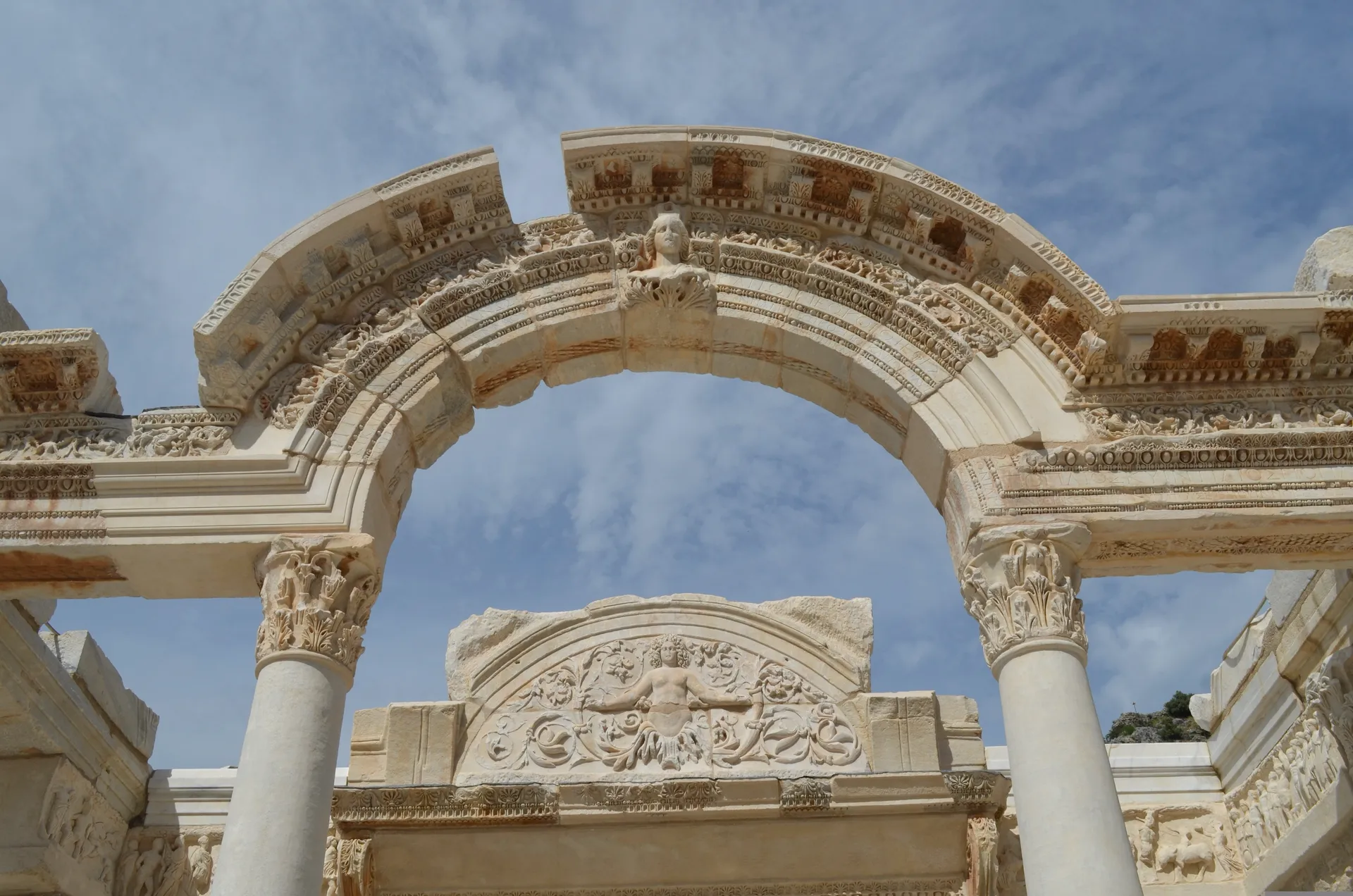
The Terraced Houses — the so-called "houses of the rich" — offer the most intimate connection to daily life in ancient Ephesus. These private residences, excavated and covered with protective structures, preserve floor mosaics, wall frescoes, and even graffiti that bring the ancient inhabitants startlingly to life. Central heating systems, running water, and sophisticated decorative programs reveal a standard of living that would not be matched in Western Europe for over a millennium. The Temple of Hadrian, the Gate of Augustus, and the Fountain of Trajan provide further testimony to a city that the Roman historian Strabo ranked among the finest in the eastern Mediterranean.
Kuşadası itself offers pleasures beyond the archaeological. The town's waterfront promenade, dominated by the sixteenth-century Güvercinada fortress connected to the mainland by a causeway, provides atmospheric dining and shopping in a setting that blends Ottoman heritage with modern Turkish resort culture. The nearby Dilek Peninsula National Park preserves rare Anatolian wildlife — wild horses, jackals, and the elusive Anatolian cheetah — in a landscape of forested mountains dropping to crystal-clear swimming coves. The village of Şirince, a former Greek settlement nestled in the hills above Selçuk, produces fruit wines and preserves a charming architectural heritage of stone houses and an Orthodox church that survives as a monument to the region's multicultural past.
Azamara and Royal Caribbean include Kuşadası in their Eastern Mediterranean and Greek Islands itineraries, with the port's modern cruise terminal accommodating the largest vessels. The season runs from April through November, with spring and autumn offering the most comfortable temperatures for exploring Ephesus — summer heat can be intense, and the site offers limited shade. Early morning arrivals have a significant advantage, as the site is most magical in the slanting light of early day, before the midday crowds arrive. The proximity of Istanbul and the Aegean coast's many other treasures — including Datça and the Turquoise Coast — makes Kuşadası a pivotal port in understanding Turkey's extraordinary layering of civilizations.

