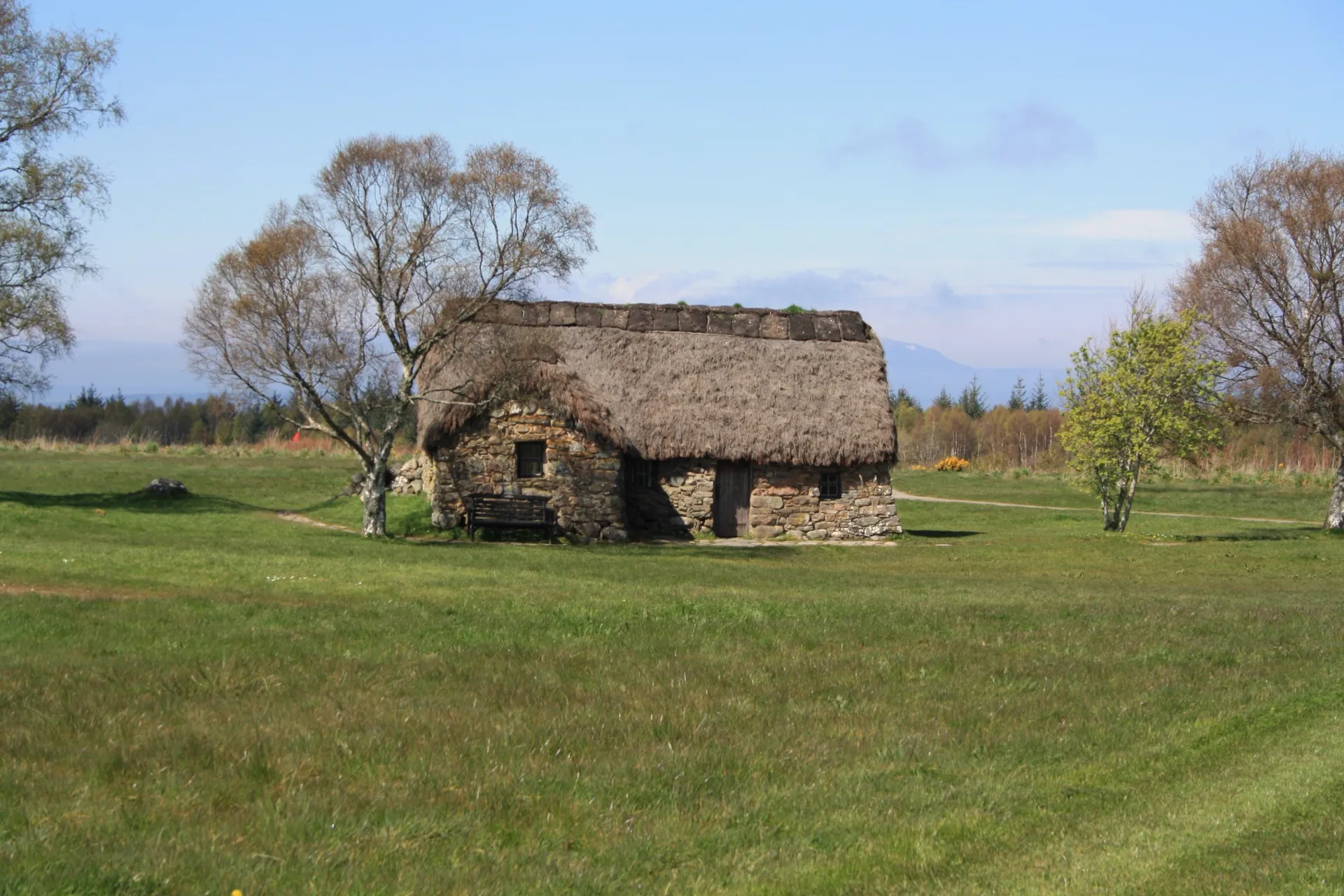
Five miles east of Inverness, on a bleak moorland plateau that catches every wind sweeping across the Scottish Highlands, Culloden Moor holds the memory of the last pitched battle fought on British soil — and arguably the most consequential. On April 16, 1746, the Jacobite forces of Bonnie Prince Charlie were destroyed in barely an hour by the Duke of Cumberland's government army, ending not merely a dynastic rebellion but an entire way of life. The Highland culture of clans, tartans, and Gaelic language would be systematically suppressed in the decades that followed, making Culloden not just a battlefield but a turning point in Scottish and British identity.
The battlefield today is maintained by the National Trust for Scotland with a restraint that befits its gravity. The moor itself has been carefully restored to something approaching its 1746 appearance — a flat, waterlogged expanse of heather and rough grass that immediately conveys why the terrain so disadvantaged the charging Highlanders. Clan grave markers — rough stone cairns bearing the names of the MacDonald, Fraser, Cameron, and other clans — punctuate the landscape with a directness that no monument could improve upon. The memorial cairn, erected in 1881, stands at the centre of the field with stark simplicity.
The visitor centre, opened in 2007, is one of the finest battlefield interpretive facilities anywhere in Europe. An immersive film places visitors in the midst of the battle using surround sound and projections that convey the terrifying chaos of the Highland charge and the devastating effect of government artillery. Interactive displays explore the wider context — the Jacobite cause, the Stuart claim to the throne, the political machinations that led two armies to this remote moor on a sleeting April morning. The exhibition treats both sides with historical fairness, neither romanticizing the Jacobite cause nor celebrating the government victory.
Culloden sits within easy reach of Inverness, the capital of the Scottish Highlands and a gateway to the wider region. The nearby Clava Cairns — a group of Bronze Age burial chambers predating Culloden by four thousand years — add prehistoric depth to a landscape already layered with history. Fort George, a vast Hanoverian fortress built after the rebellion to pacify the Highlands, lies on the coast nearby and remains one of the finest examples of 18th-century military architecture in Europe.
Culloden is accessible by bus from Inverness (fifteen minutes) or by car. Cruise ships calling at Invergordon, on the Cromarty Firth, regularly include Culloden in their shore excursion offerings. The site is open year-round, though the atmospheric impact is arguably greatest in spring and autumn, when low cloud and mist across the moor evoke the weather conditions of the battle itself. The visitor centre is fully accessible and offers audio guides in multiple languages.

