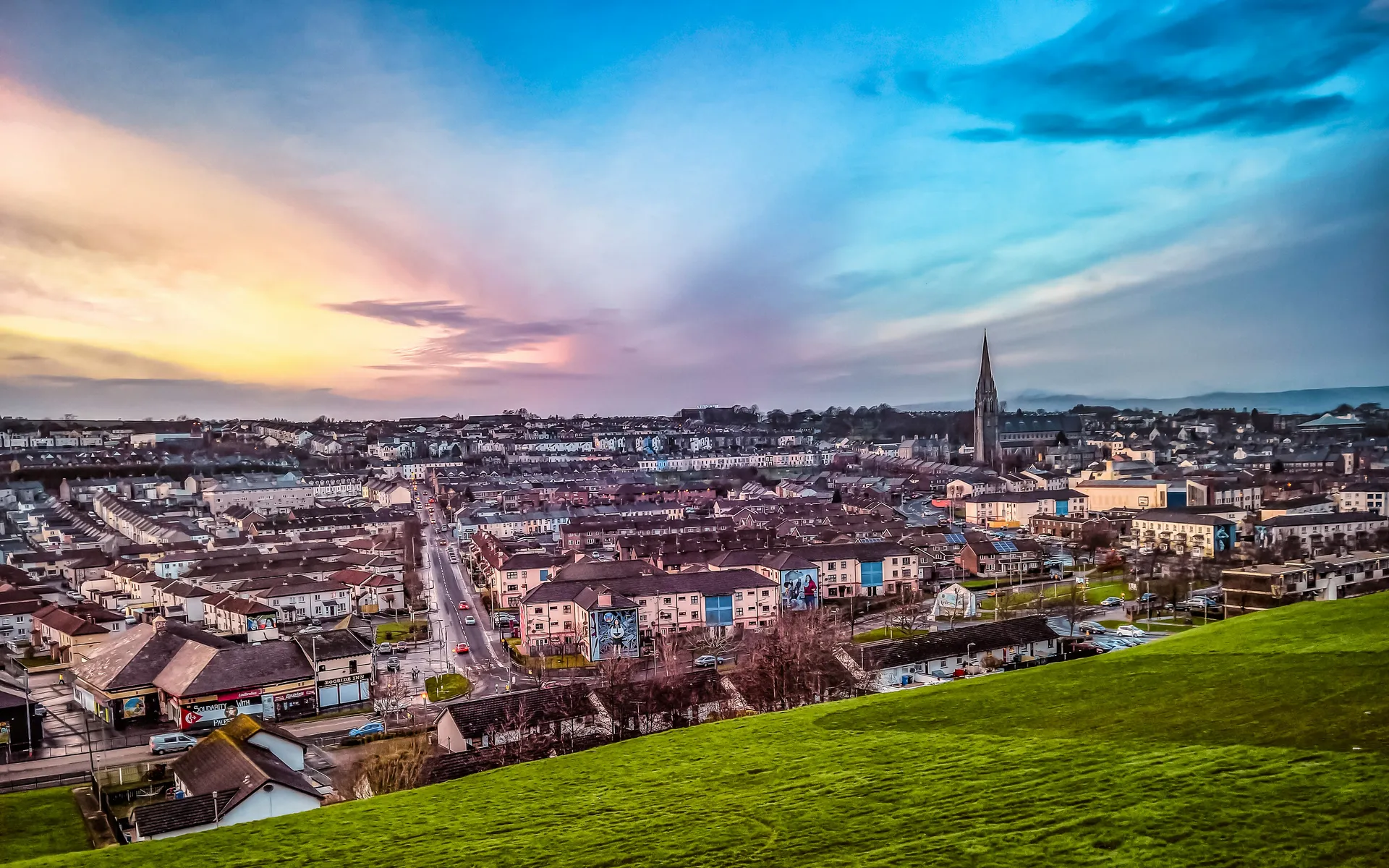
Derry — or Londonderry, as it is formally known, though locals will tell you the name you use says more about your politics than your geography — sits on the banks of the River Foyle in the northwest corner of Northern Ireland, a city whose turbulent history has forged a character of remarkable resilience, warmth, and creative energy. Founded as a monastic settlement by Saint Columba in the sixth century, besieged by Jacobite forces in 1689, and scarred by the Troubles of the late twentieth century, Derry has emerged into the twenty-first century as one of the most compelling cities on the island of Ireland — a place where centuries of conflict have given way to a vibrant cultural renaissance.
The defining feature of Derry is its city walls, the finest and most complete set of fortifications in Ireland and among the best-preserved in all of Europe. Built between 1613 and 1619, these sturdy limestone ramparts form a continuous circuit of roughly 1.5 kilometres around the old city, punctuated by bastions, gates, and cannon emplacements that have witnessed some of the most dramatic episodes in Irish history. Walking the walls offers constantly shifting perspectives: on one side, the spires and Georgian terraces of the inner city; on the other, the Bogside neighbourhood, where the murals of Free Derry tell the story of the civil rights movement and the Troubles in vivid, unflinching colour. The Museum of Free Derry and the Tower Museum, both within the walls, provide essential context.
Derry's food scene has blossomed in recent years, fuelled by the rich agricultural hinterland of Donegal and the Foyle's own bounty. The river is one of the finest salmon fisheries in Europe, and local restaurants make the most of it — pan-seared Foyle salmon with samphire and brown butter is a signature dish. Craft breweries and artisan coffee roasters have sprouted in the old warehouse district near the waterfront, while the Walled City Market, held weekly in the Guildhall Square, showcases farmhouse cheeses, Donegal oysters, and baked goods from local producers. For a hearty, traditional experience, seek out a bowl of Irish stew or a plate of champ — creamy mashed potatoes folded with scallions and butter — at one of the pubs in the Craft Village, a charming cluster of artisan shops within the walls.
The surrounding landscape of the northwest is among the most dramatic in Ireland. The Wild Atlantic Way begins its epic coastal journey just over the border in Donegal, where the sea cliffs of Slieve League — twice the height of the Cliffs of Moher and far less crowded — plunge 600 metres into the Atlantic. The Giant's Causeway, Northern Ireland's only UNESCO World Heritage Site, lies an hour's drive east along the stunning Causeway Coastal Route, with its 40,000 interlocking basalt columns that look as though they were laid by a geometer with a taste for the hexagonal. Closer to Derry, the beaches of Portstewart Strand and Benone offer miles of golden sand backed by dunes and rolling farmland.
Derry is a port of call for Tauck on their British Isles and Ireland itineraries, offering an intimate and deeply engaging introduction to Northern Ireland's complex history and vibrant present. The city's compact centre means the walls, museums, and dining options are all within comfortable walking distance. The best time to visit is May through September, when the long northern days — Derry lies at roughly the same latitude as Labrador — offer up to seventeen hours of daylight and the surrounding countryside is at its greenest. Derry is a city that has learned to wear its scars with dignity and its future with optimism, and it leaves an impression that lingers long after the ship has sailed.

