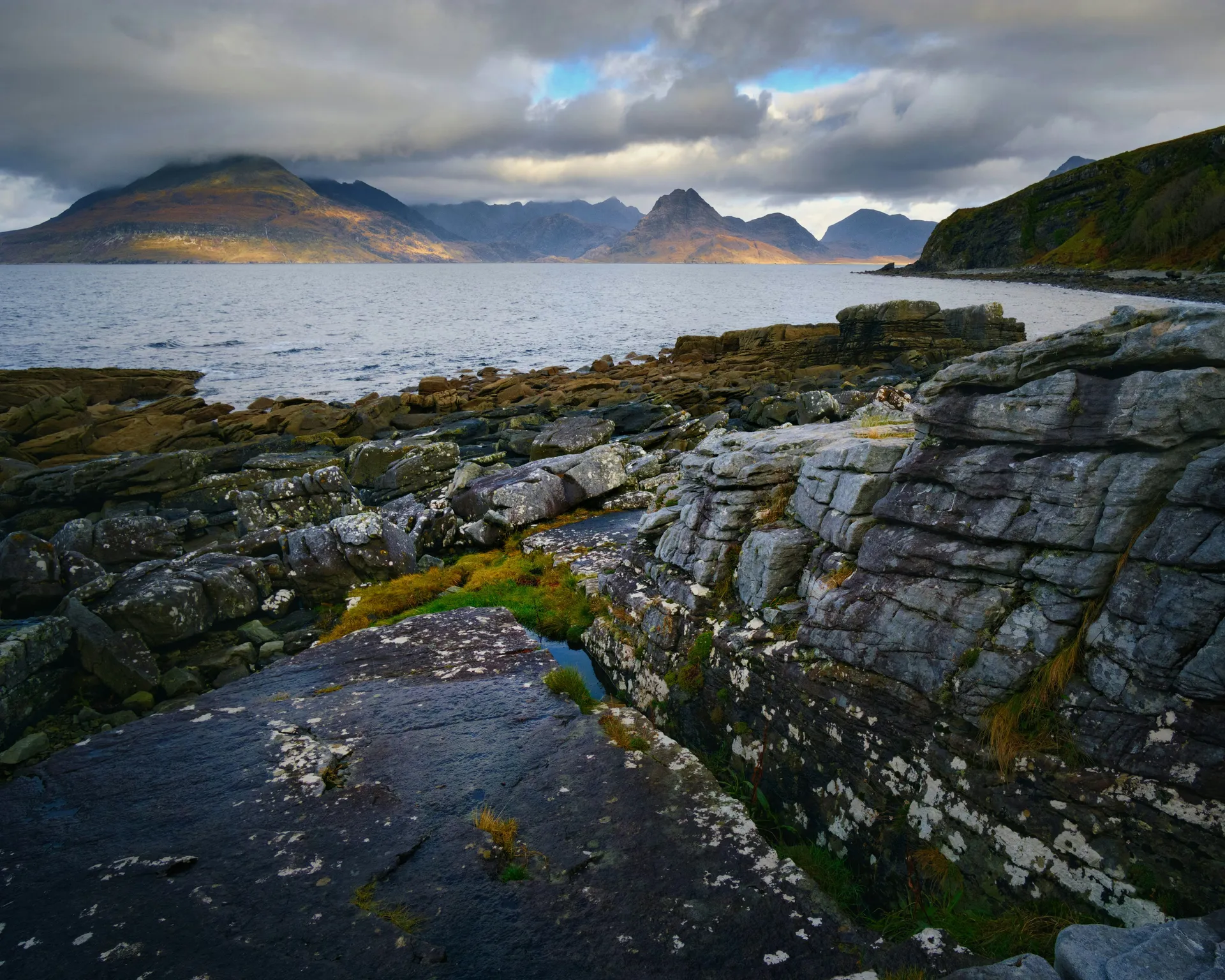
Loch Scavaig is a sea loch on the southern coast of the Isle of Skye that opens directly onto one of the most dramatic mountain amphitheaters in the British Isles — the Black Cuillin ridge, whose jagged gabbro peaks erupt from the loch's edge in a wall of dark rock so imposing it seems to belong to a different geological era. This is not the gentle, heathered Scotland of tourist postcards; this is Scotland at its most elemental, a landscape of such raw grandeur that mountaineers rank the Cuillin among the finest peaks in Europe.
The approach to Loch Scavaig by sea reveals the mountains in a sequence of mounting drama. The outer loch, flanked by moorland and scattered crofts, gives way to an inner basin where the Cuillin ridge closes in on three sides, its serrated skyline — a succession of pinnacles, ridges, and gullies — rising to nearly 1,000 meters directly from the waterline. At the head of the loch, a short walk over rough ground leads to Loch Coruisk, a freshwater loch trapped within the mountain amphitheater that is considered one of the most beautiful and wild places in Scotland.
Loch Coruisk has been celebrated by writers and artists since the Romantic era. Sir Walter Scott visited in 1814 and declared it one of the most sublime scenes he had ever witnessed. Turner painted it. The Victorian mountaineer-scientist James Forbes described it as "a scene of utter solitude." Today, the experience is unchanged: Coruisk lies in its mountain bowl, its dark waters reflecting the Cuillin peaks, surrounded by a silence so profound that the splash of a trout rising sends ripples through the air as well as the water.
Wildlife encounters around Loch Scavaig are frequent. Golden eagles patrol the ridgelines, their immense wingspans visible against the sky as they ride the thermals that form along the cliff faces. White-tailed sea eagles — reintroduced to Scotland in the 1970s after being hunted to extinction — are increasingly common around Skye's sea lochs. Seals haul out on the rocks at the loch's entrance, and otters, though shy, can sometimes be spotted fishing in the shallows at dawn and dusk. The waters of the loch support porpoises and, occasionally, basking sharks.
Expedition cruise ships anchor in Loch Scavaig and tender passengers ashore by Zodiac, landing on the rocky beach at the head of the loch from where the walk to Coruisk begins. The terrain is rough and requires sturdy footwear — this is not a paved path but a scramble over rocks and boggy ground. The best visiting season is May through September, when the longest daylight hours and mildest weather make the walk most feasible, though rain and cloud are common even in summer — and when the mist lifts suddenly to reveal the full Cuillin ridge, the moment is all the more powerful for having been uncertain. Loch Scavaig is a destination that demands physical effort and rewards it with one of the most profound landscape experiences in the British Isles.

