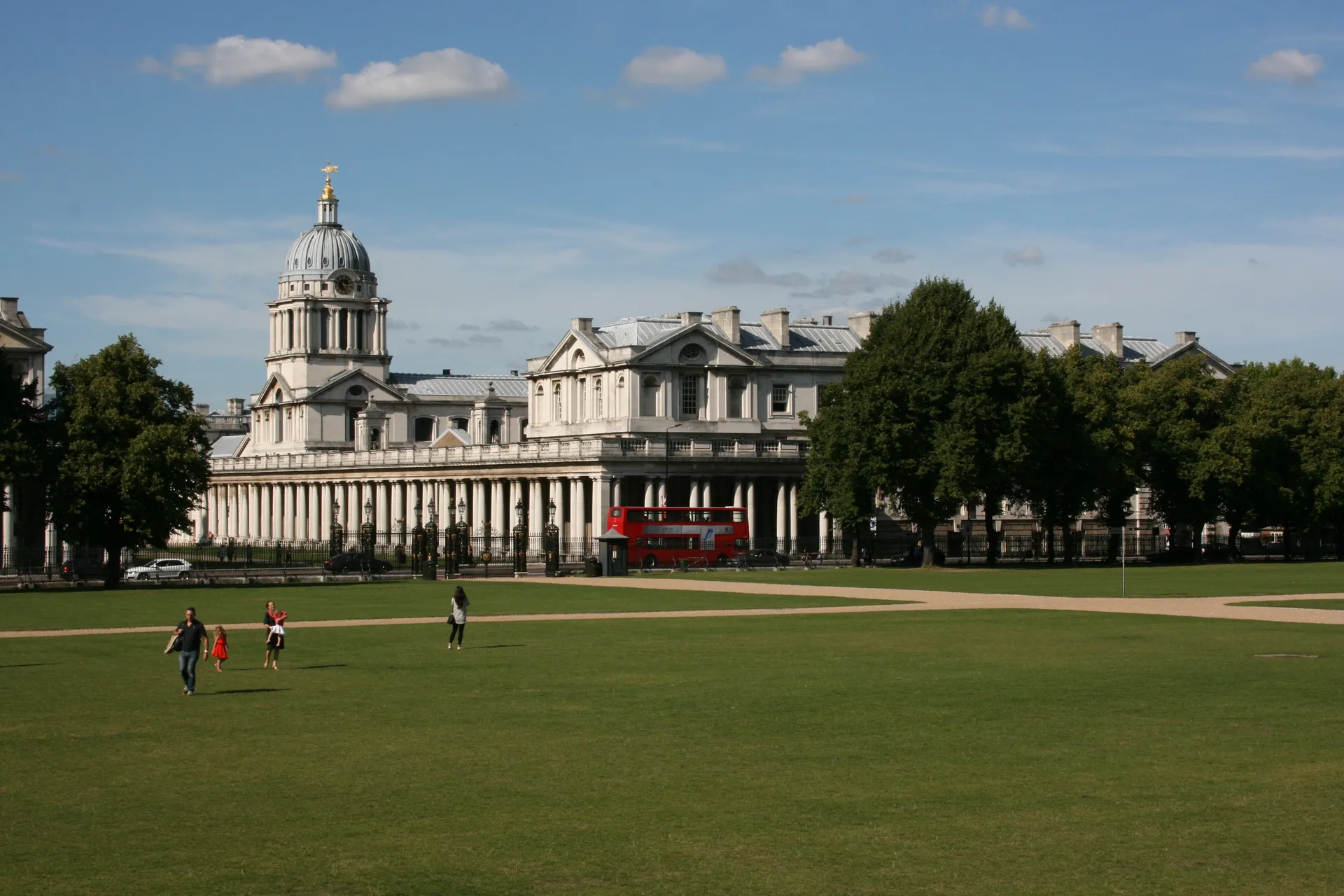
Greenwich's position in the history of global navigation is without equal: it was here, at the Royal Observatory perched on a hilltop above the Thames, that the Prime Meridian of the World — Longitude 0° — was established by international agreement in 1884, giving every navigator on every ocean a fixed reference point for determining east from west. The observatory had been founded two centuries earlier, in 1675, when King Charles II commissioned Christopher Wren to design a building capable of improving astronomical observations so that British sailors could determine their longitude at sea — the great unsolved problem of the age. Visitors today can stand astride the brass meridian line inlaid in the courtyard with one foot in each hemisphere.
The borough of Greenwich, now a UNESCO World Heritage Site, clusters its principal monuments within easy walking distance of the Thames pier. The Painted Hall of the Old Royal Naval College — a baroque interior so lavishly decorated by James Thornhill between 1708 and 1727 that it is often called "the Sistine Chapel of the UK" — rewards unhurried inspection. The Cutty Sark, the last surviving Victorian tea clipper, sits in permanent dry dock nearby, its beautifully restored hull offering a visceral sense of the speed and danger of 19th-century ocean trade. The National Maritime Museum, the largest of its kind in the world, traces Britain's relationship with the sea from Tudor exploration to the age of steam.
Greenwich's covered market, operating since 1737, fills weekends with independent food stalls, vintage clothing, antiques, and craft studios of impressive quality. The market's food hall delivers a miniature tour of London's diverse culinary scene — wood-fired Neapolitan pizza alongside Keralan curry, Ethiopian injera beside Japanese katsu, craft beer from local Borough Brewery. Nearby Blackheath village offers a calmer, more residential alternative with its own pleasant high street and Georgian architecture, while the riverside pubs of the Trafalgar Tavern — where Dickens once dined on the whitebait the Thames then provided in abundance — offer a tangible connection to Greenwich's literary past.
The Thames Clipper river service connects Greenwich directly to central London in 25-35 minutes, making the city's greatest attractions — the Tower of London, Tate Modern, the British Museum, Westminster — accessible within the day. The O2 Arena, once the Millennium Dome, sits across the river in North Greenwich and houses a rooftop climbing experience with panoramic views across the capital. Further afield, Windsor Castle is 45 kilometres west, the white chalk cliffs of the Kent coast and the historic towns of Fowey in Cornwall are accessible on longer excursions, and Bangor serves as the gateway to Belfast and the Northern Irish countryside.
London Greenwich serves as a specialist cruise terminal for lines preferring intimate Thames moorings over the larger Tilbury facilities downstream. AIDA, Aurora Expeditions, Emerald Cruises, Hapag-Lloyd Cruises, Oceania Cruises, Ponant, Scenic Ocean Cruises, Scenic River Cruises, Seabourn, Silversea, Tauck, and Windstar Cruises have all utilised Greenwich on Northern European and British Isles itineraries. The British summer — June through August — offers the longest days and warmest weather, though London in spring and autumn rewards with a golden-hour quality that photographers prize above all.

