Portree, Isle of Skye: Scotland's Most Dramatic Island
Portree is the capital of the Isle of Skye — Scotland's most celebrated island, a place of such dramatic, rain-swept beauty that it has inspired artists, poets, and pilgrims since Boswell and Johnson landed here in 1773. The town's name derives from the Gaelic Port Rìgh (King's Port), commemorating a visit by King James V in 1540, and its harbour — a perfect horseshoe of brightly painted houses reflected in sheltered water — has become one of the most photographed scenes in Scotland. But Portree is primarily a gateway: the real Skye lies beyond, in the Cuillin mountains, the Trotternish peninsula, and the coastal cliffs that make this island one of the most visually extraordinary places in the British Isles.
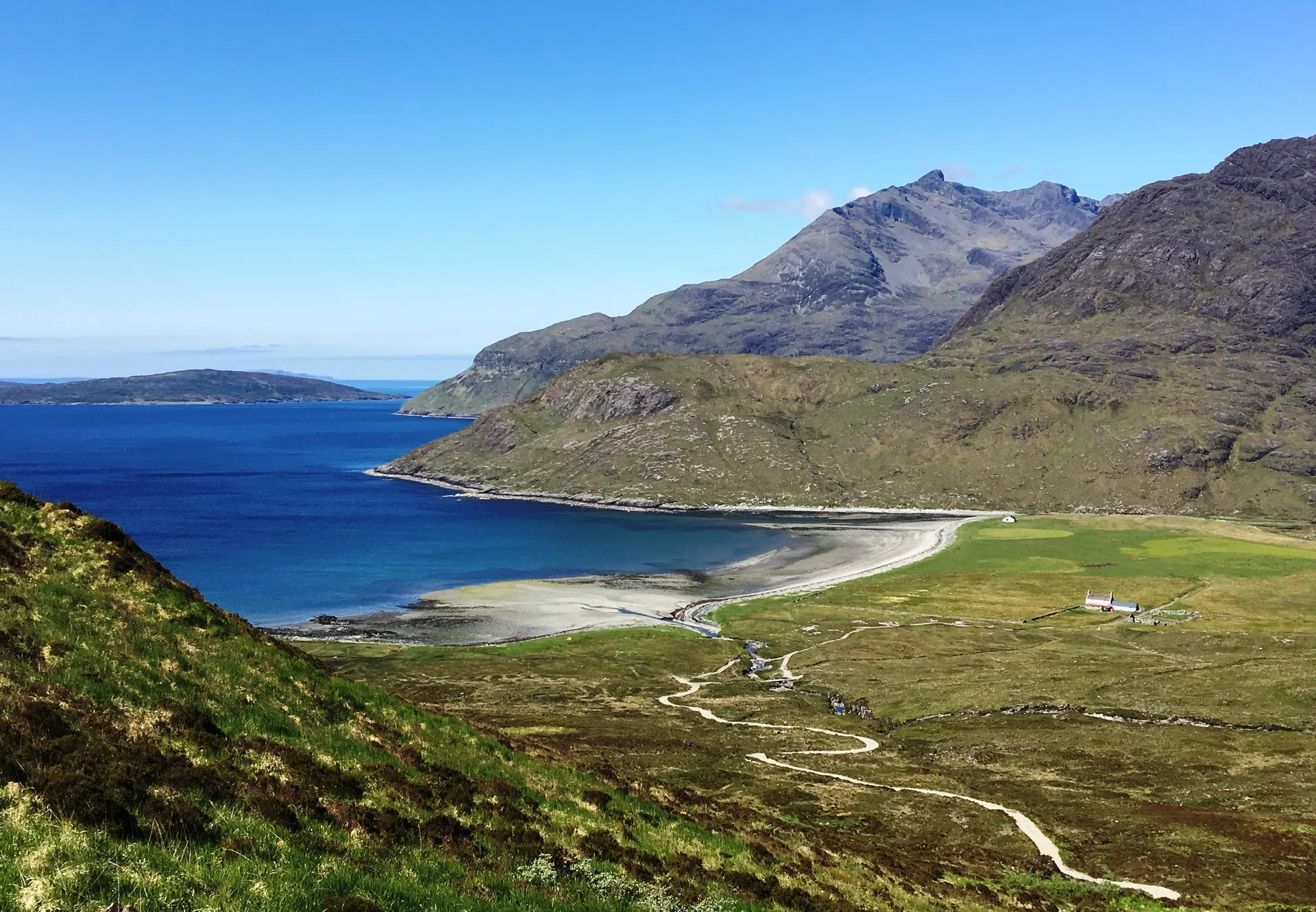
The character of Skye is shaped by its geology and its weather in roughly equal measure. The Cuillin ridge — a twelve-kilometre horseshoe of gabbro peaks reaching 992 metres at Sgùrr Alasdair — is the most challenging mountain range in Britain, its jagged pinnacles, knife-edge ridges, and vertical rock faces providing climbing of Alpine difficulty within sight of the sea. The Trotternish peninsula in the north presents a different geological drama: the Old Man of Storr, a fifty-metre pinnacle of ancient lava standing against the sky, and the Quiraing, a landscape of pinnacles, cliffs, and hidden plateaus created by massive landslips, offer hiking through scenery that looks more like Iceland or Middle-earth than the Scottish Highlands. And then there is the weather: Skye receives over fifteen hundred millimetres of rain annually, and the constant interplay of sun, cloud, and mist creates a quality of light that transforms the landscape minute by minute.
The food culture of Skye has undergone a quiet revolution. The Three Chimneys, in a converted croft house on the remote northwest coast, has been serving refined Scottish cuisine since 1985 and remains one of the most celebrated restaurants in Scotland — its tasting menus built around Skye lobster, langoustines, Highland venison, and foraged seaweed. In Portree itself, the Dulse & Brose restaurant on the harbour serves locally caught seafood with contemporary flair, while the Café Arriba offers imaginative daytime cooking in a colourful, bohemian setting. The Talisker Distillery, on the shores of Loch Harport, produces one of Scotland's most distinctive single malts — peaty, maritime, with a peppery finish that seems to distil the island's character into liquid form.
Beyond the dramatic landscapes, Skye offers cultural depth through its Gaelic heritage. The island is one of the last strongholds of the Gaelic language in Scotland, and the Sabhal Mòr Ostaig college on the Sleat peninsula is the only Gaelic-medium college in the world. Dunvegan Castle, seat of the chiefs of Clan MacLeod for over eight hundred years, claims to be the longest continuously inhabited castle in Scotland and houses the Fairy Flag — a mysterious silk banner believed to have the power to save the clan in times of peril. The Skye Museum of Island Life near Kilmuir preserves a township of traditional thatched blackhouses and tells the story of the Highland Clearances, when landlords evicted crofting communities to make way for sheep farming.
Hapag-Lloyd Cruises, Holland America Line, Norwegian Cruise Line, Oceania Cruises, Scenic Ocean Cruises, and Tauck all call at Portree, typically anchoring in the bay and tendering passengers to the harbour. The island's single-track roads can be busy during peak season, but the landscapes they access are worth every passing place. For travellers who have cruised the Norwegian fjords and seek a comparable landscape with the added layers of Scottish history, Gaelic culture, and world-class whisky, Skye delivers an experience that is uniquely, unforgettably Scottish. May through September offers the most daylight and the best chance of clear weather, though Skye's beauty is arguably at its most intense when the clouds are low and the light is grey.

