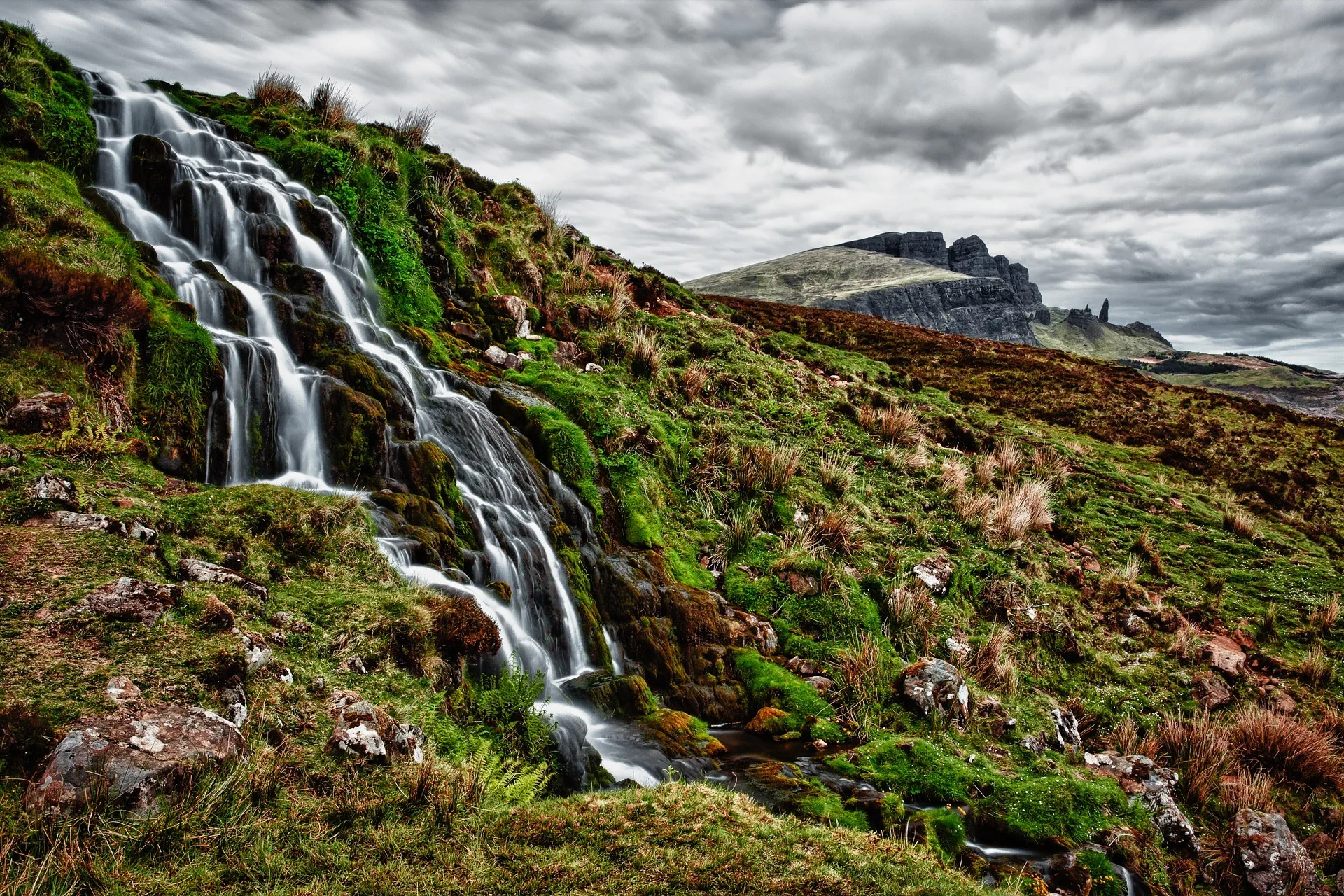
The Shiant Isles are a small, uninhabited archipelago in the Minch strait between the Isle of Lewis and the Scottish mainland — three main islands of dark basalt columns and grassy cliff tops that host one of the largest seabird colonies in Europe and have been described by their most famous owner, the writer Adam Nicolson, as "the place where I have been happiest in my life." Nicolson's family has owned the Shiants since 1925, when his grandfather Compton Mackenzie (author of Whisky Galore) purchased them for a few hundred pounds, and Nicolson's book Sea Room remains the definitive account of life on these storm-lashed, bird-haunted rocks.
The Shiants' defining characteristic is their seabird population. Over 200,000 breeding pairs nest on the islands during the summer months — puffins burrow into the grassy slopes of Garbh Eilean, razorbills and guillemots pack the basalt cliff ledges in rows so dense they resemble spectators in a stadium, and fulmars patrol the updrafts along the cliff faces with the effortless flight that only a bird with a four-million-year evolutionary head start can achieve. The sheer density of bird life on the Shiants is overwhelming — the noise, the smell, and the constant aerial traffic create an atmosphere of biological intensity that makes mainland birdwatching seem genteel by comparison.
The geology of the Shiants is as dramatic as their birdlife. The islands are formed from a Tertiary volcanic sill — molten rock that intruded between older sedimentary layers and cooled into the columnar basalt formations that give the cliff faces their extraordinary architecture. The columns, hexagonal in cross-section and up to 50 metres tall, resemble a natural cathedral organ — their regular geometry creating patterns that seem designed rather than geological. Eilean an Tighe, the smallest of the three main islands, displays the most spectacular colonnade, its western face a wall of dark columns plunging vertically into the sea.
The Minch, the strait in which the Shiants sit, is a body of water of considerable wildness. The tidal races and currents that sweep through the channel create challenging sea conditions even in summer, and the weather can change with the suddenness for which the Hebrides are famous. Minke whales, harbour porpoises, and white-beaked dolphins patrol the waters around the islands, while white-tailed eagles — reintroduced to Scotland after their Victorian-era extinction — are occasionally spotted soaring above the cliff lines. The nearest inhabited communities — Scalpay to the northwest and Shieldaig to the southeast — are fishing villages whose residents have known the Shiants as landmarks and hazards for generations.
The Shiant Isles are visited by Cunard and Ponant on Scottish Isles and Hebridean itineraries, with passengers arriving by Zodiac for shore landings on Garbh Eilean when conditions permit. The visiting season runs from May through August, with June and July being optimal for the seabird breeding season and the longest daylight hours. Landings are weather-dependent — the exposed position of the Shiants means that calm days are the exception rather than the rule, adding a genuine element of expedition uncertainty to every planned visit.

