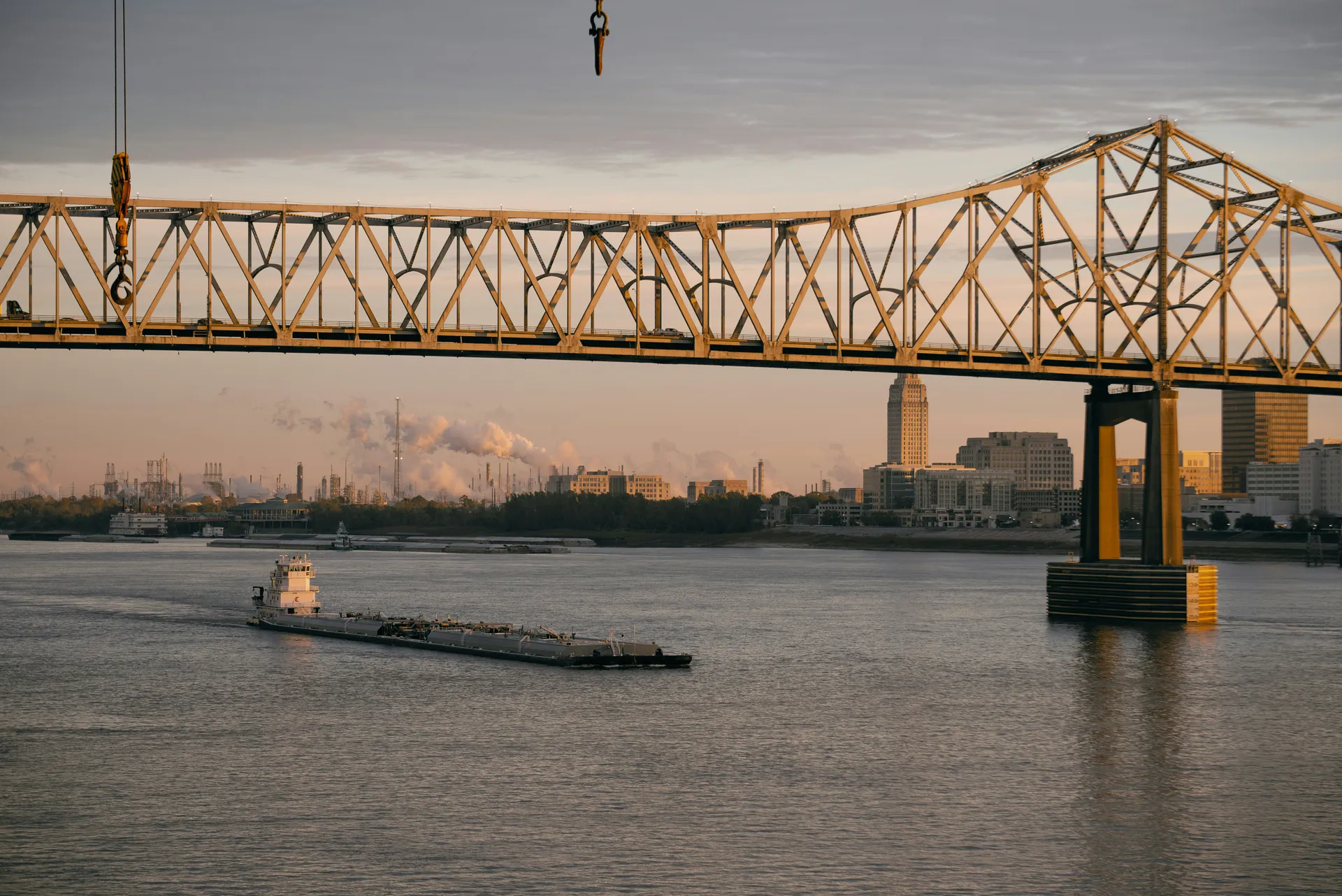
On the bluffs above the Mississippi River, where the great waterway bends in a sweeping curve that gave the city its French name — le bâton rouge, the red stick that once marked the boundary between two tribal territories — Louisiana's capital city offers a journey into the deepest currents of American Southern culture. Baton Rouge lacks the theatrical self-awareness of New Orleans, sixty miles downstream, and that is precisely its appeal: this is the working South, where the state's political dramas unfold in a skyscraper Capitol built by the legendary Huey Long, where petrochemical industry and antebellum plantation heritage coexist in uneasy proximity, and where the culinary traditions of Cajun and Creole cooking remain rooted in home kitchens rather than tourist menus.
The Louisiana State Capitol, a thirty-four-story Art Deco tower that Huey Long erected in just fourteen months during the Depression, dominates the Baton Rouge skyline with a boldness that mirrors its controversial builder. Long was assassinated in its corridors in 1935, and the bullet holes in the marble walls remain visible — preserved, some say, as a warning about the costs of political ambition. The observation deck on the twenty-seventh floor offers panoramic views that trace the Mississippi's serpentine path through a landscape of refineries, river bridges, and the lush bottomland forests that once covered this entire floodplain.
The plantation country surrounding Baton Rouge presents American history at its most complex and consequential. Nottoway, the South's largest remaining antebellum mansion, rises from the sugarcane fields like a white Greek temple, its sixty-four rooms telling a story of extraordinary wealth built on human bondage. The Whitney Plantation, by contrast, has pioneered a fundamentally different approach to plantation interpretation, centering the experiences of enslaved people through their own testimonies, memorial sculptures, and preserved slave quarters. Together, these sites offer a more complete understanding of the American South than either could alone.
Baton Rouge's food culture represents Louisiana cooking at its most authentic. Boudin — a Cajun rice-and-pork sausage — is available at gas stations and specialty shops throughout the region, each purveyor guarding their recipe with family honor. The city's restaurants serve crawfish étouffée, blackened catfish, and gumbo that reflects the full spectrum of Louisiana's culinary influences — French, African, Spanish, and Native American traditions merged over three centuries into something entirely original. The Third Street downtown district has emerged as the city's dining and entertainment hub, while the area around LSU's campus provides the energetic college-town atmosphere that makes Baton Rouge feel perpetually young.
Viking features Baton Rouge in its Mississippi River cruise itineraries, with vessels docking along the downtown riverfront within walking distance of the Capitol and the Old State Capitol, a Gothic Revival castle that Mark Twain memorably described as a monument to Sir Walter Scott's pernicious influence on Southern taste. The cruising season operates year-round, though spring and autumn offer the most comfortable temperatures and the most dynamic river conditions. Baton Rouge serves as both a port of call and an embarkation point, its position halfway between New Orleans and the plantation country of St. Francisville making it an ideal base for understanding the Mississippi's central role in American history.

