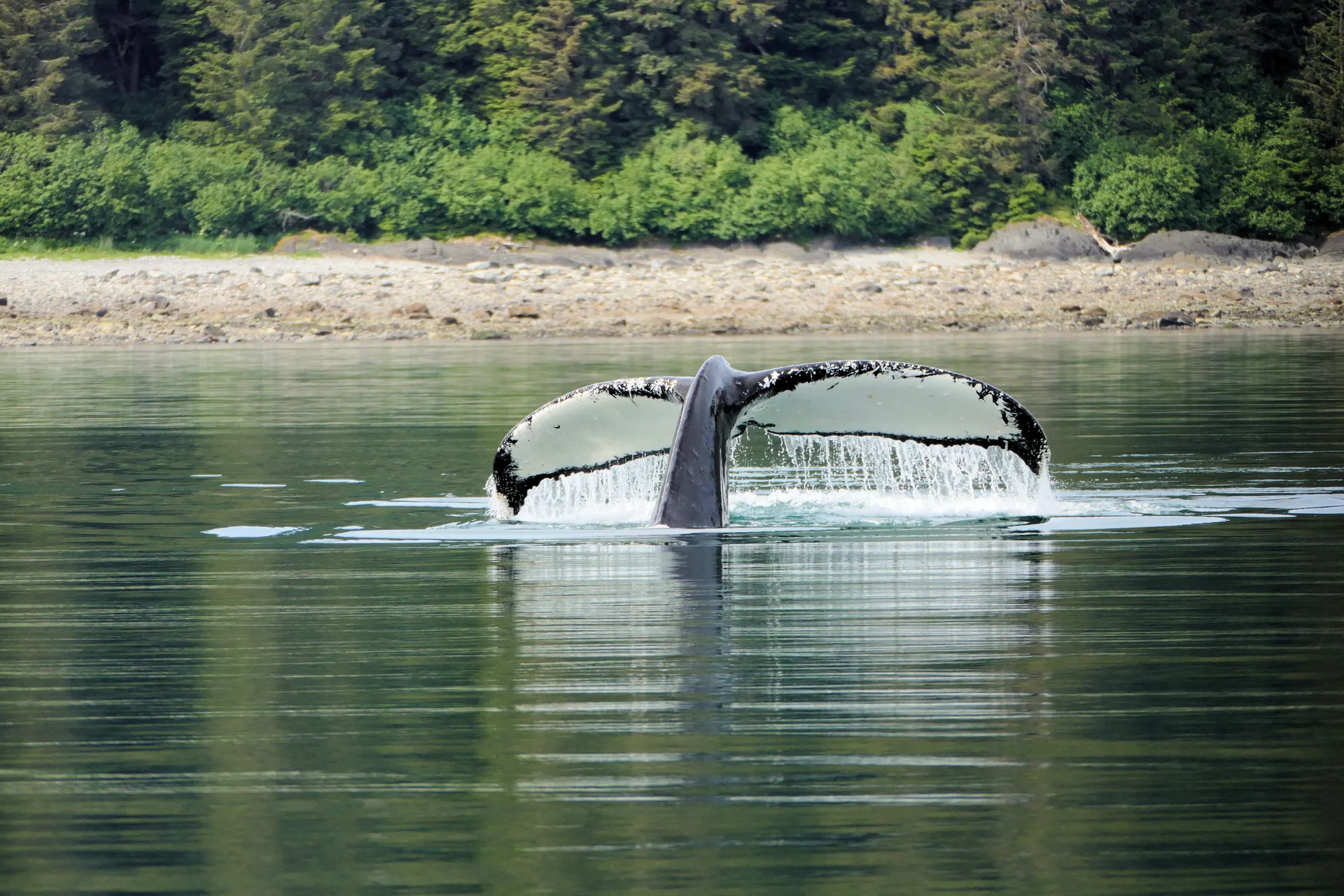
Frederick Sound is the great whale highway of Southeast Alaska — a broad, deep waterway between Admiralty Island and the mainland where the upwelling of nutrient-rich water from the Pacific creates one of the most productive marine feeding grounds on the planet. Each summer, humpback whales gather here in concentrations that can number in the hundreds, their bubble-net feeding behaviour — a cooperative hunting technique in which whales create curtains of bubbles to corral krill and herring before lunging upward through the trapped school with mouths agape — providing one of the most spectacular wildlife displays in the natural world. From the deck of an expedition vessel anchored in the sound, the sight of multiple whale groups feeding simultaneously, their exhalations hanging in the cold morning air like smoke signals, is unforgettable.
The sound takes its name from Prince Frederick of the British Royal Family, bestowed during the 1794 survey by Captain George Vancouver, though the waterway had been navigated by the Tlingit people for thousands of years before European contact. The Tlingit knew these waters intimately — they fished for halibut and salmon in the sound's currents, harvested herring eggs from the kelp forests along its shores, and traveled by canoe between their settlements on Admiralty Island (which they called Kootznoowoo, meaning "Fortress of the Bears") and the mainland villages. The cultural significance of the whale to the Tlingit — as a symbol of strength, family, and the interconnection of all living things — adds a layer of meaning to every encounter with these animals in their ancestral waters.
Admiralty Island, forming the western boundary of Frederick Sound, is one of the great wildlife sanctuaries of the Pacific Northwest. The island harbours an estimated 1,600 brown bears — the densest population of brown bears in North America, with approximately one bear per square mile — earning it the reputation as the "ABC" island (Admiralty, Baranof, Chichagof) that collectively host more brown bears than the rest of North America combined. The Pack Creek Bear Observatory, on the island's eastern shore facing Frederick Sound, provides supervised viewing of bears fishing for salmon at close range — an experience that reveals the individual personalities of these animals and the sophisticated social dynamics of their salmon-stream hierarchies.
The marine ecosystem of Frederick Sound extends well beyond whales. Orca pods — both the fish-eating resident pods and the marine-mammal-hunting transient pods — patrol the sound throughout the summer. Steller sea lions haul out on rocky islets, their bellowing audible from a considerable distance. Bald eagles are so numerous that they cease to be remarkable within an hour of entering the sound — they perch on every available snag, their white heads dotting the shoreline like ornamental finials. Sea otters, their populations recovering after near-extermination by the fur trade, float on their backs in the kelp beds, cracking shellfish on stones balanced on their chests with the dexterity of practiced craftsmen.
Frederick Sound is navigated by Lindblad Expeditions on Southeast Alaska expedition itineraries, typically between May and September. July and August offer the peak whale concentrations, the warmest temperatures (though "warm" in Southeast Alaska means mid-teens Celsius), and the salmon runs that draw bears to the streams. Zodiac excursions, kayaking among icebergs calved from the nearby LeConte Glacier, and onshore hikes through temperate rainforest are standard components of the Frederick Sound experience.

