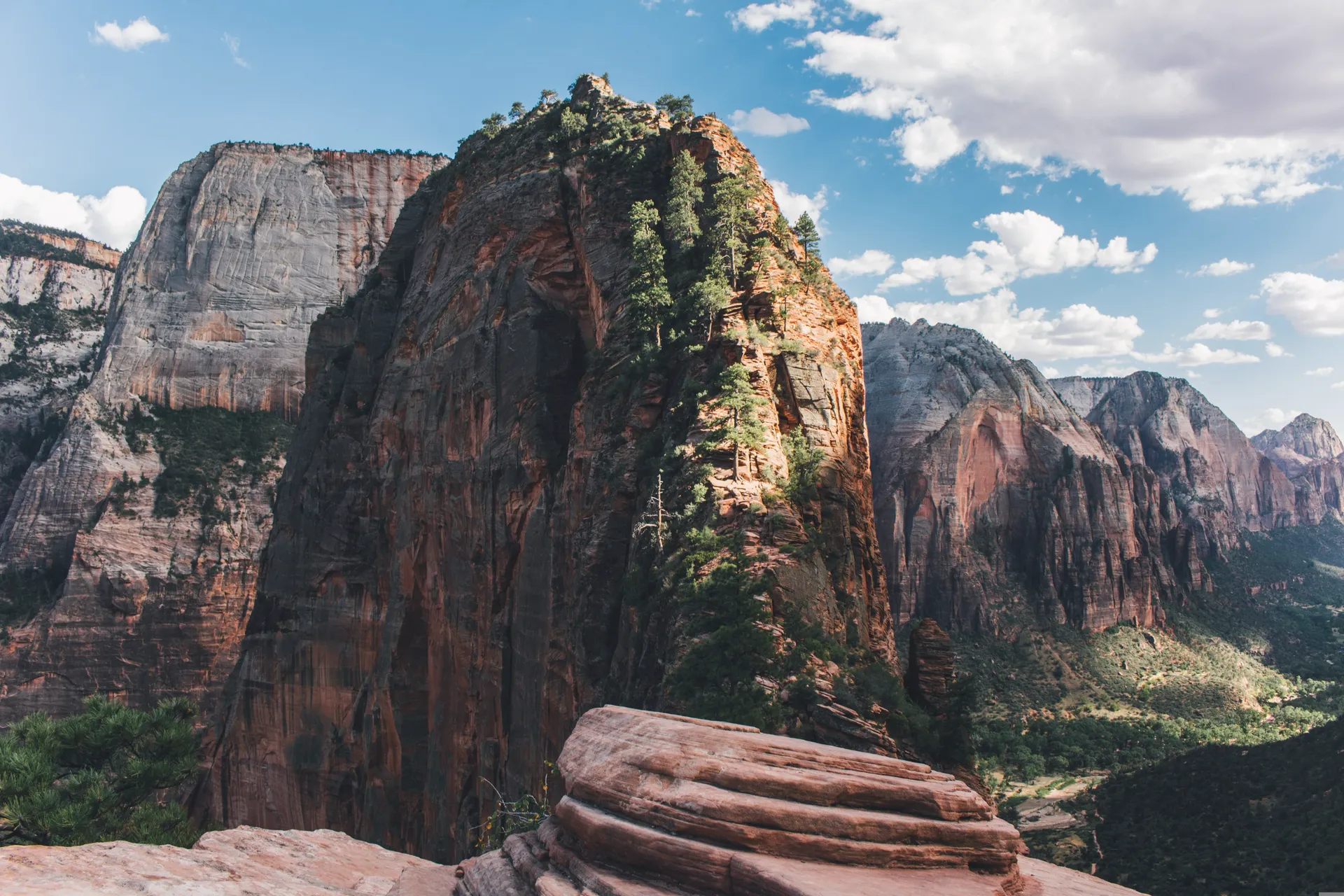
Zion is a landscape of vertical drama. The park's defining feature is Zion Canyon, a fifteen-mile gorge carved by the North Fork of the Virgin River through the Navajo Sandstone of the Colorado Plateau—a process that has taken millions of years and produced walls that rise over 2,000 feet in places, creating a sense of enclosure and grandeur that is unique among American national parks. The canyon's name itself speaks to the reverence the landscape inspires: Mormon pioneers named it Zion, the promised land, when they settled the surrounding valleys in the 1860s. The Paiute people, who preceded them by centuries, knew it as Mukuntuweap—"straight canyon."
The experience of entering Zion Canyon is one of progressive revelation. The Zion Canyon Scenic Drive follows the Virgin River through the narrowing canyon, the sandstone walls growing taller and closer with each mile. The rock, stained by iron oxide and desert varnish into a palette of cream, salmon, rust, and chocolate, catches the light differently at every hour—sunrise and sunset transform the walls into glowing screens of color. The Great White Throne, a monolith of white Navajo Sandstone rising 2,350 feet from the canyon floor, is one of the great rock formations of the American West. The Court of the Patriarchs—Abraham, Isaac, and Jacob—presents three massive sandstone peaks named by a Methodist minister who saw biblical figures in their forms.
Zion's trails range from gentle riverside walks to some of the most challenging and famous hikes in the world. Angels Landing, a five-mile round trip that culminates in a narrow ridge with 1,500-foot drops on both sides, secured by chains bolted into the rock, is often called the most thrilling hike in America—the final half-mile is not for those with a fear of heights, but the view from the summit, overlooking the entire length of Zion Canyon, rewards the nerve required to reach it. The Narrows, a hike up the Virgin River through a slot canyon where the walls narrow to twenty feet apart and rise a thousand feet above, is a wade-through-water experience unlike any other—depending on the season and water level, hikers may be waist-deep in the river, navigating between boulders with the narrow strip of sky far above.
The park's ecosystems span an extraordinary range, from the Mojave Desert at its lowest elevations to the conifer forests of the Kolob Plateau at its highest (nearly 9,000 feet). This vertical gradient supports a diversity of wildlife that includes mule deer, bighorn sheep, California condors (reintroduced and now nesting in the park), mountain lions, and Mexican spotted owls. The hanging gardens—lush colonies of ferns, mosses, and wildflowers that grow where water seeps from the sandstone walls—are among the park's most enchanting features, creating patches of green paradise on the otherwise dry cliff faces.
Zion is located in southwestern Utah, three hours from Las Vegas and five hours from Salt Lake City, and is the most visited of Utah's "Mighty Five" national parks. The canyon is served by a mandatory shuttle system from March through November, which has dramatically improved the visitor experience by eliminating vehicle congestion. The best time to visit is March through May and September through November, when temperatures are moderate and the crowds are manageable. Summer brings intense heat in the canyon (often exceeding 100°F) and peak visitation. Winter offers solitude and occasional snow on the canyon rims—a dramatic contrast of white against red rock. Permits are required for Angels Landing and The Narrows.

