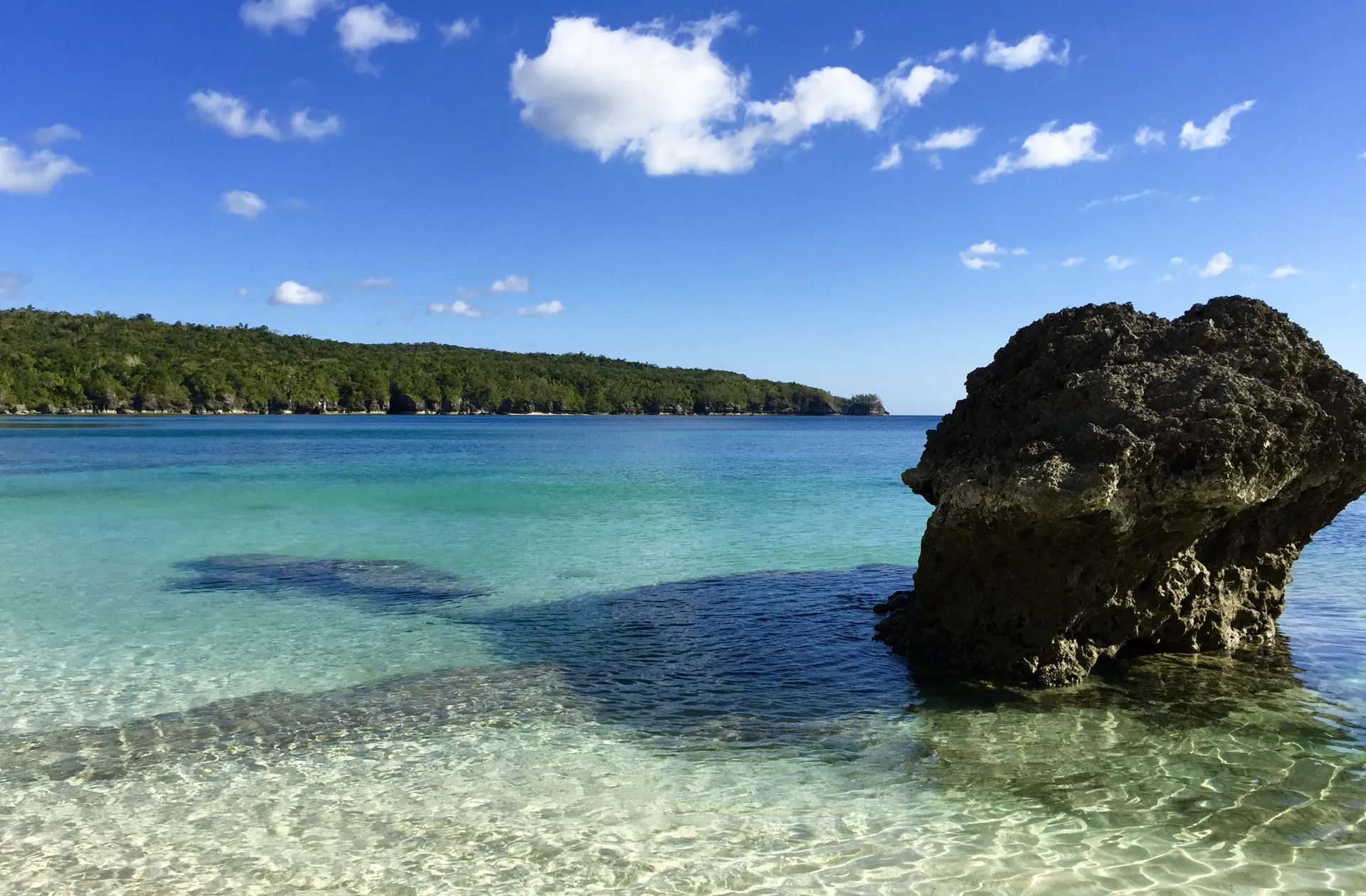
On the northeastern coast of Espiritu Santo, the largest island in the Vanuatu archipelago, Champagne Bay curves in a crescent of powdery white sand backed by coconut palms and lapped by water so clear that swimmers appear to float in mid-air. The bay earns its effervescent name from a natural phenomenon that occurs along parts of the shore: volcanic gas seeps through the sandy seabed, releasing tiny bubbles that fizz up through the shallow water like champagne in a flute — a geological curiosity that transforms a beautiful beach into something genuinely unique. This combination of scenic perfection and natural whimsy has placed Champagne Bay on lists of the world's finest beaches for decades.
The character of Champagne Bay reflects Vanuatu's status as one of the South Pacific's least-commercialized destinations. There are no resort towers, no beach clubs, no jet ski rentals — only the sand, the sea, the palms, and the small community of ni-Vanuatu villagers who manage access to the beach and offer refreshments from simple thatched shelters. This absence of development is not neglect but deliberate choice: land in Vanuatu is held communally according to kastom (custom), and the villagers who control the bay have chosen to maintain it in a state that balances visitor access with environmental and cultural preservation.
The food experience at Champagne Bay is a celebration of tropical simplicity. Village women prepare grilled fish, lobster when available, and the coconut crab that is one of the Pacific's great delicacies — an enormous hermit crab whose flesh tastes of the coconut it feeds on. These are served with lap-lap, Vanuatu's national dish: grated root vegetables — taro, yam, or manioc — mixed with coconut cream, wrapped in banana leaves, and cooked in an underground earth oven called a lovo. Fresh tropical fruits, young coconuts cracked open for their water, and kava — the mildly narcotic root drink central to Melanesian social life — complete the island menu.
Espiritu Santo offers experiences beyond the beach that reveal Vanuatu's extraordinary natural and historical dimensions. The Blue Holes — Matevulu, Riri, and Nanda — are freshwater swimming pools of almost supernatural blue, fed by underground rivers filtered through volcanic limestone. Million Dollar Point, on the island's southeastern coast, preserves an extraordinary underwater junkyard of American military equipment — trucks, bulldozers, and supplies — dumped into the sea at the end of World War II when the French and British colonial authorities refused to purchase the surplus. The SS President Coolidge, a luxury liner converted to a troop transport and sunk by mines off Luganville in 1942, is considered one of the world's most accessible and spectacular wreck dives.
Champagne Bay is accessible by road from Luganville, Espiritu Santo's main town, approximately ninety minutes' drive on unsealed roads. Cruise ships anchor offshore and tender passengers to the beach. The best months to visit are May through October, during the dry season, when temperatures are pleasant and the risk of cyclones minimal. The wet season from November through April brings higher humidity and occasional tropical storms but also fewer visitors and the most vivid tropical vegetation. A modest entry fee paid to the local community supports maintenance of the beach and the village.

