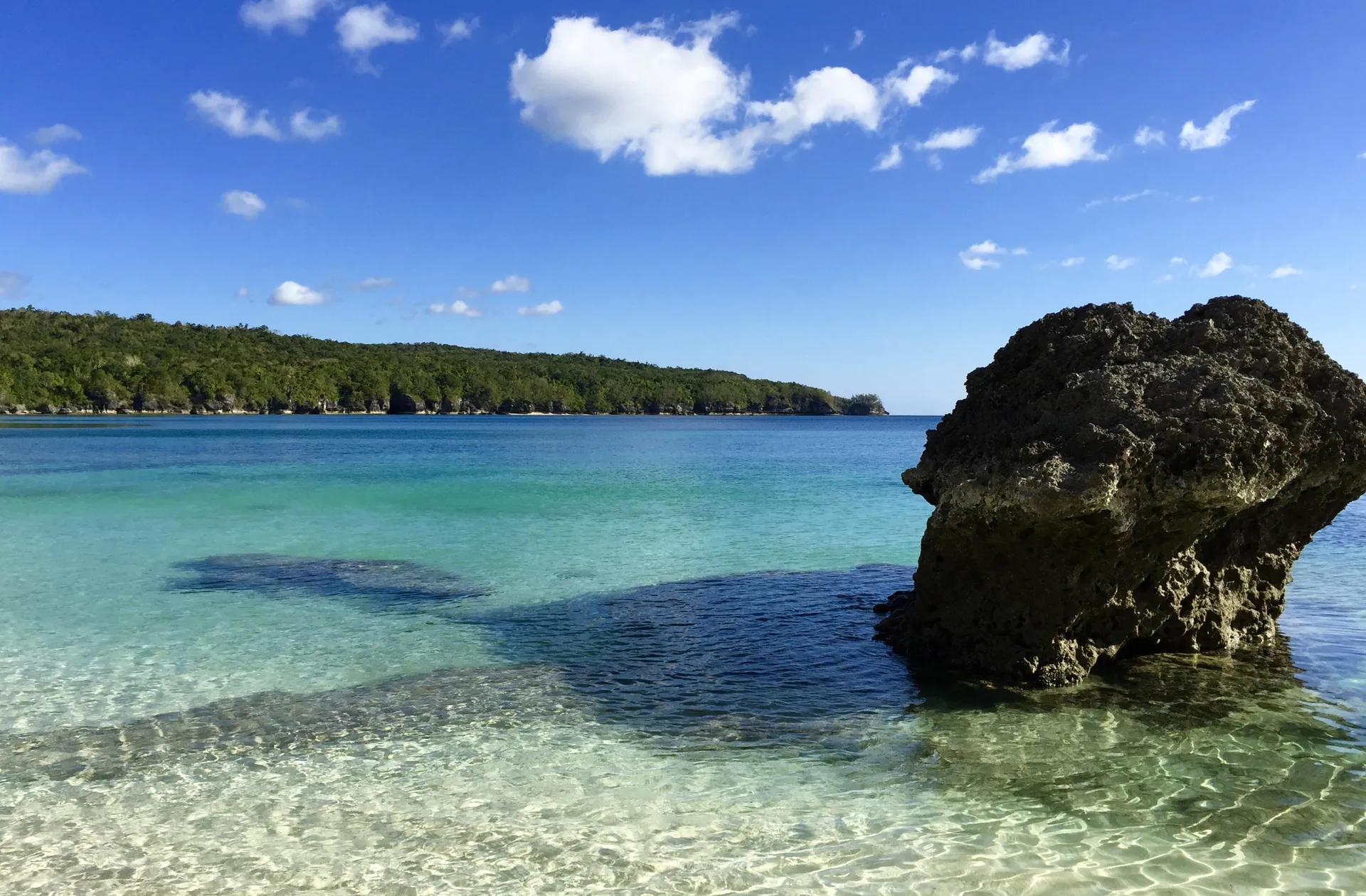
The largest island in the Vanuatu archipelago rises from the Pacific in a dramatic profile of jungle-clad mountains, hidden blue holes, and beaches of such luminous beauty that they seem to generate their own light. Espiritu Santo — named by the Portuguese explorer Pedro Fernandez de Quiros, who believed he had found the great southern continent in 1606 — was the site of one of the largest American military bases in the South Pacific during World War II, a history that left behind underwater treasures and roadways now reclaimed by tropical growth. Today, Santo, as locals call it, remains one of the South Pacific's least-developed major islands, its natural wonders accessible to those willing to venture beyond the standard cruise routes.
The character of Santo is defined by water in all its forms. The island's interior is mountainous and densely forested, with peaks exceeding 1,800 metres that catch the Pacific moisture and feed dozens of rivers that cascade to the coast through channels of polished limestone. These rivers create the Blue Holes — freshwater swimming pools of almost supernatural blue, where underground springs emerge through volcanic limestone, their mineral content producing colours that seem illuminated from below. The Nanda, Matevulu, and Riri Blue Holes each offer a different character, from broad, sun-drenched lagoons to intimate jungle pools overhung by banyan trees.
Santo's WWII heritage adds a fascinating dimension to its natural beauty. Million Dollar Point, on the island's southeastern coast, preserves the extraordinary underwater remains of American military equipment — trucks, jeeps, bulldozers, Coca-Cola bottles, and thousands of other items — dumped into the sea when the French and British colonial authorities refused to purchase the surplus at war's end. The SS President Coolidge, a luxury liner converted to troop transport and sunk by friendly mines off Luganville in 1942, is considered one of the world's most accessible large wreck dives, lying in fifteen to seventy metres of water with its chandeliers, swimming pool, and military cargo still visible.
Ni-Vanuatu cuisine on Santo reflects the island's tropical abundance. Lap-lap, the national dish of grated root vegetables mixed with coconut cream and baked in banana-leaf parcels in an underground earth oven, is served at every communal gathering. Fresh fish, crab, and lobster appear at the waterfront restaurants of Luganville, the island's modest main town. Coconut crab — the world's largest terrestrial arthropod — is a prized delicacy whose sweet, coconut-flavoured flesh justifies its status as one of the Pacific's great culinary experiences. Kava, the ceremonial root drink that is central to Melanesian social life, is consumed at nakamals (kava bars) throughout the island as dusk falls.
Espiritu Santo is accessible by air from Port Vila, Vanuatu's capital, and by cruise ship anchoring off Luganville. The best months to visit are May through October, during the dry season, when temperatures are pleasant, humidity manageable, and the risk of cyclones minimal. The wreck dives require certified diving, though Million Dollar Point is accessible to snorkellers at its shallow end. The Blue Holes are reachable by road from Luganville, with local guides available for those unfamiliar with the sometimes challenging roads. A modest entry fee at each site supports local landowners and conservation.

