Chan May is not a destination in itself so much as a gateway — but what a gateway it is. This deep-water port on the coast of central Vietnam, sheltered by a curving peninsula where the Truong Son Mountains tumble into the South China Sea, serves as the maritime portal to two of Southeast Asia's most captivating cities: Hue, the former imperial capital, and Da Nang, the resurgent coastal metropolis. For centuries, this stretch of coastline has been a crucible of Vietnamese civilisation, where Cham kingdoms, Nguyen emperors, French colonists, and American soldiers each left indelible marks on a landscape of staggering beauty and profound historical weight.
Hue, thirteen kilometres inland along the storied Perfume River, is the jewel in Chan May's crown. The Imperial Citadel — a vast, walled complex modelled on Beijing's Forbidden City — was the seat of the Nguyen dynasty from 1802 until 1945, and its partially restored palaces, temples, and ceremonial halls remain one of Vietnam's most powerful UNESCO World Heritage Sites. Lotus blossoms float in the moat, incense drifts from ancestral altars, and the Noon Gate still inspires a hush of reverence. Beyond the Citadel, the royal tombs of emperors Tu Duc, Minh Mang, and Khai Dinh are scattered through the pine-forested hills along the Perfume River, each one a masterwork of landscape architecture and dynastic ambition.
The cuisine of Hue is considered the most refined in all of Vietnam, a legacy of the royal kitchens that once served the emperor's table. Bun bo Hue, a fiery lemongrass-and-chilli beef noodle soup, is the city's signature dish and one of the great bowls of soup in all of Asia. Banh khoai, a crispy rice-flour crepe stuffed with shrimp and pork, and nem lui, grilled lemongrass pork skewers wrapped in rice paper with herbs and pickled vegetables, are equally essential. For a royal banquet experience, several restaurants in the Citadel quarter serve multi-course meals recreating the dishes once prepared for Emperor Tu Duc, presented on lotus-leaf platters with the theatrical flourish that Vietnamese haute cuisine demands.
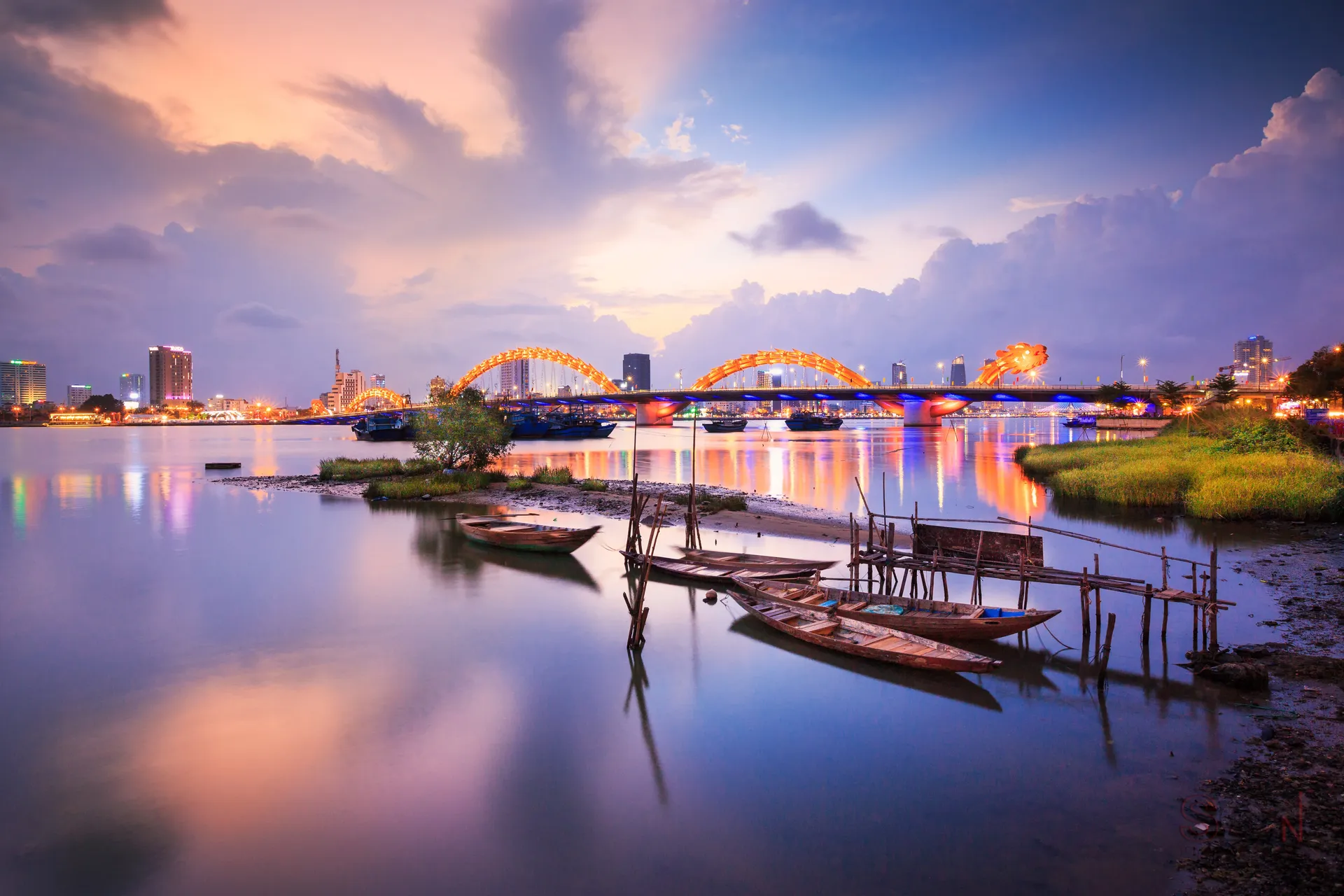
Da Nang, an hour south of Chan May along the spectacular Hai Van Pass — one of the most dramatic coastal roads on earth — offers a different energy entirely. The Marble Mountains, five limestone-and-marble outcrops riddled with Buddhist shrines and dripping caves, rise dramatically from the coastal plain. My Khe Beach, consistently rated among Asia's finest, stretches for kilometres of pristine white sand, while the city's Dragon Bridge — a 666-metre span that breathes fire and water on weekend evenings — has become an emblem of modern Vietnam's ambition. The nearby ancient town of Hoi An, a UNESCO World Heritage Site, enchants with its lantern-lit streets, centuries-old merchant houses, and the tailor shops that can produce a bespoke suit in twenty-four hours.
Chan May is a well-served cruise port, welcoming APT Cruising, Azamara, Cunard, Emerald Cruises, Oceania Cruises, Princess Cruises, Scenic River Cruises, and Silversea. The port facility is modern and efficient, with organised excursions departing directly for Hue, Da Nang, and Hoi An. The best months to visit are February through August, before the autumn monsoon season brings heavy rains to central Vietnam. For travellers drawn to the intersection of ancient culture, extraordinary cuisine, and landscapes that shift from misty mountains to turquoise sea in the span of a single morning, Chan May is an essential port of call.

