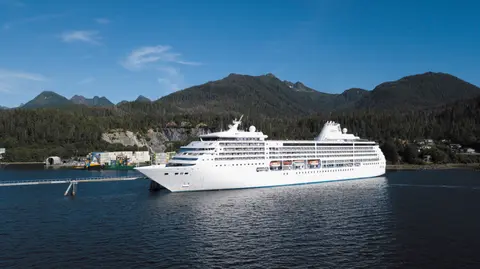
Regent Seven Seas CruisesMAR260629D
Grand Arctic Adventure New York to Barcelona
Date
2026-06-29
Duration
81 nights
Departure Port
New York
United States
Arrival Port
Barcelona
Spain
Rating
Ultra Luxury
Theme
—
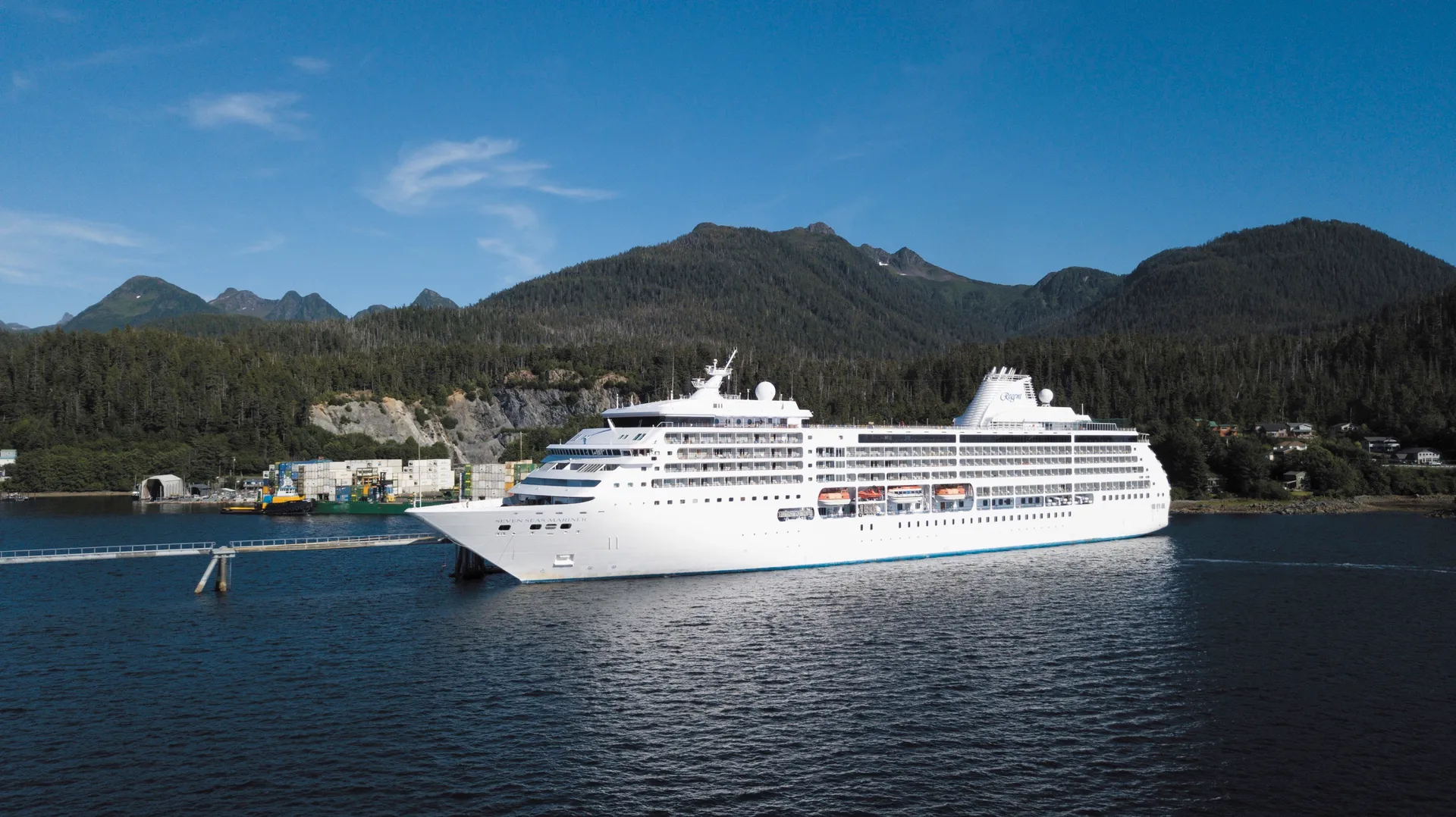

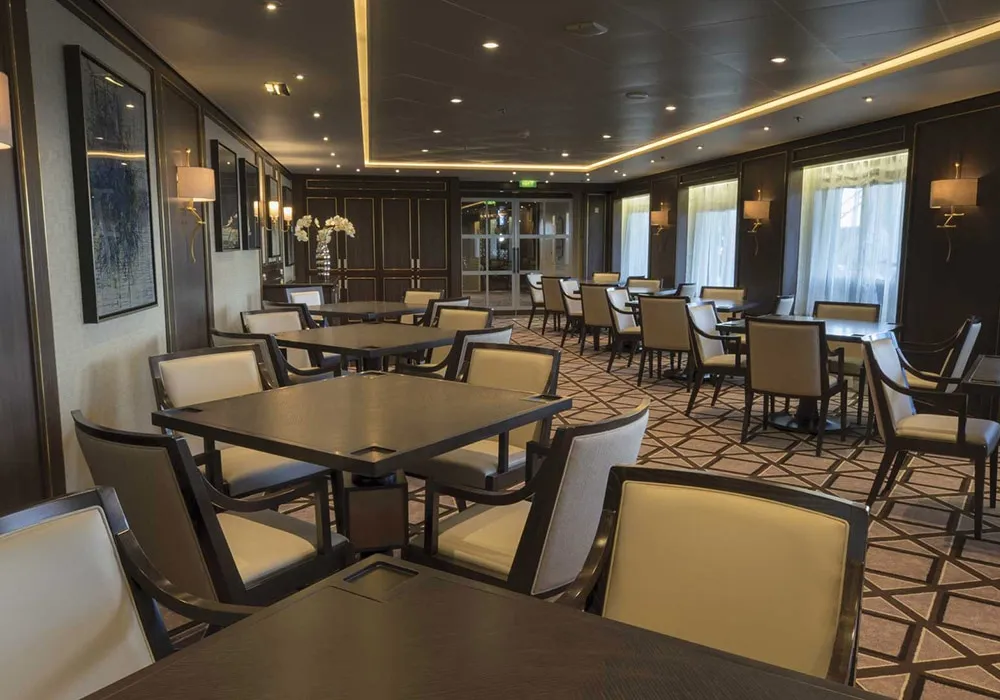
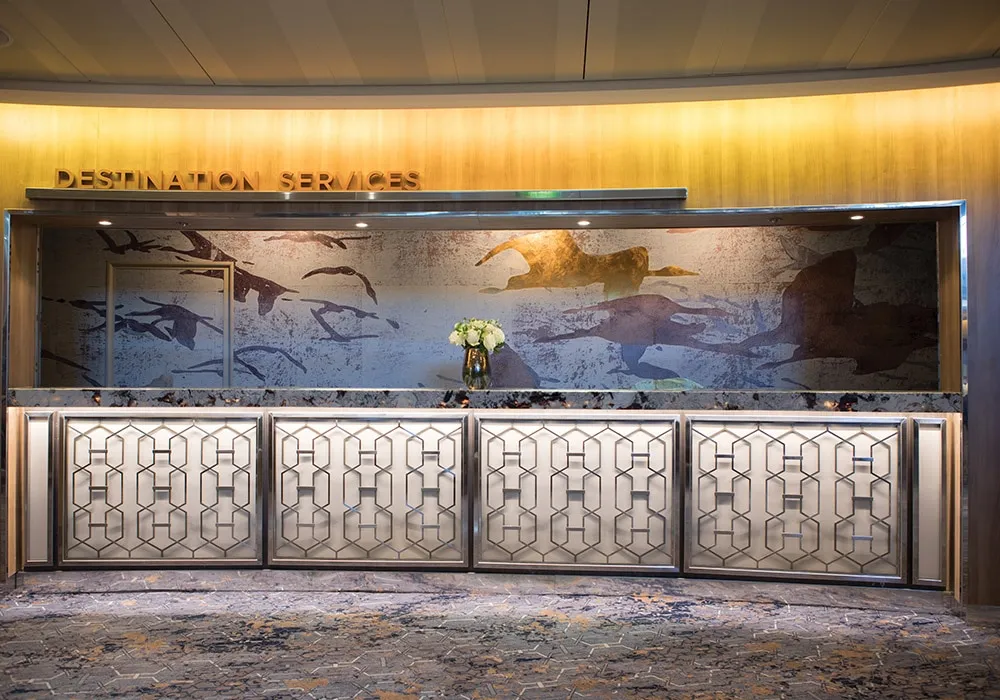

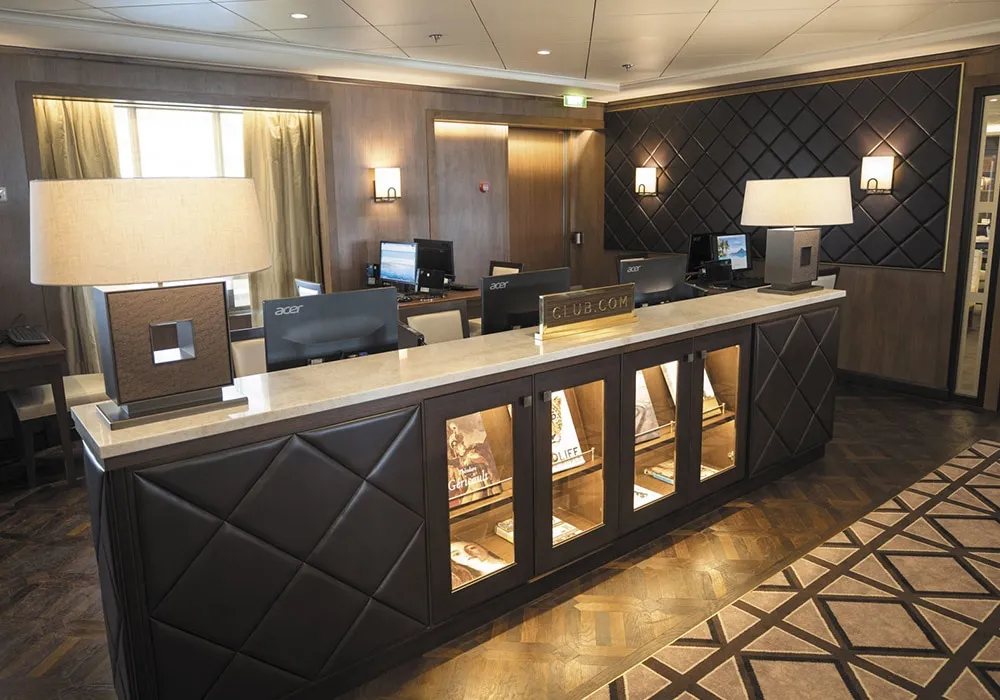


Regent Seven Seas Cruises
Seven Seas Mariner
Launched
2001
Refitted
2018
Tonnage
48,075 GT
Passengers
700
Cabins
350
Crew
459
Length
216 m
Width
28 m
Speed
20 knots
Adults Only
No
Itinerary
Day 1
Day 1
New York
Depart 16:00
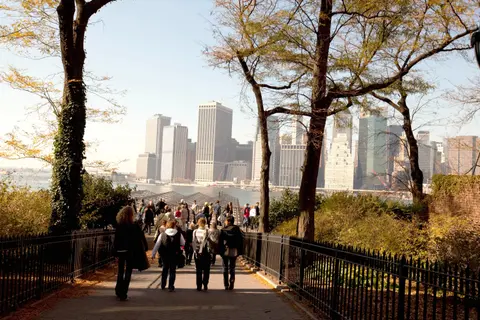
The Port of New York is a bustling maritime gateway rich in history and cultural diversity, making it a must-visit destination. Don't miss the chance to savor authentic New York pizza and explore the vibrant Chelsea Market. The best time to visit is during the spring or fall, when the weather is pleasant, and the city is alive with activity.
Day 2
Day 2
At Sea
Day 3
Day 3
Halifax
Arrive 08:00Depart 16:00
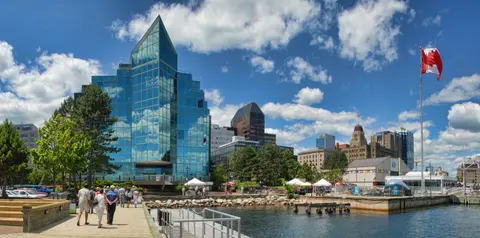
Halifax, the historic capital of Nova Scotia, is a refined Atlantic port where centuries of maritime heritage meet a flourishing culinary scene anchored by Digby scallops, donairs, and one of North America's oldest farmers' markets. Visitors should not miss the star-shaped Citadel Hill and the harbourfront boardwalk's constellation of galleries and tasting rooms. The ideal season stretches from late June through October, when autumn's blazing foliage transforms the entire province into a masterwork of colour and the cruise terminal welcomes the world's finest vessels.
Day 4
Day 4
Sydney
Arrive 10:00Depart 18:00
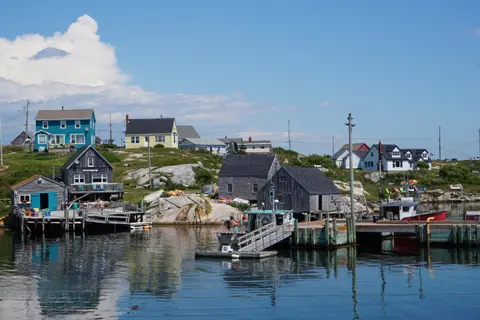
Sydney, on Cape Breton Island in Nova Scotia, is a charming harbour city where Scottish-Acadian heritage meets raw Atlantic beauty, serving as the gateway to the legendary Cabot Trail — one of the world's most spectacular coastal drives. Visitors should savour the island's renowned seafood chowder and traditional oatcakes while exploring the colourful waterfront boardwalk. The peak season stretches from late June through October, when autumn's fiery foliage transforms the highlands into a tapestry of crimson and gold.
Day 5
Day 5
At Sea
Day 6
Day 6
At Sea
Day 7
Day 7
At Sea
Day 8
Day 8
Paamiut (Frederikshab)
Arrive 07:00Depart 19:00
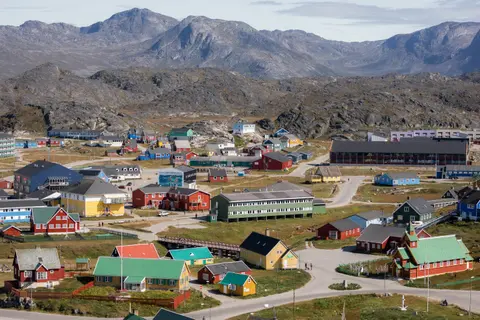
Paamiut is a small Greenlandic town on the Davis Strait coast, set against a dramatic backdrop of ice-capped mountains and drifting icebergs in one of Earth's most sparsely inhabited regions. Must-dos include kayaking among icebergs, whale watching from the harbor, and tasting fresh Arctic char and halibut. Visit June to September for midnight sun and the warmest conditions.
Day 9
Day 9
Nuuk Godthaab
Arrive 10:00
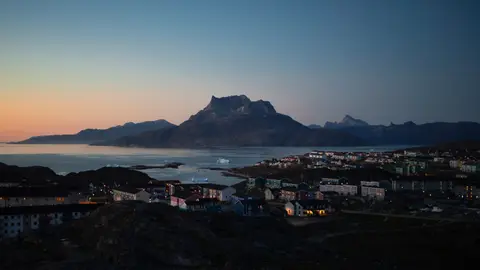
Nuuk, Greenland's diminutive capital, is a city of vivid contrasts — colourful colonial houses against Arctic granite, Inuit heritage alongside contemporary Nordic culture, and world-class museums steps from untamed fjords. Visitors should not miss the Greenland National Museum's Qilakitsoq mummies and a Zodiac excursion into the surrounding iceberg-studded fjord system. The prime cruising season runs from June through September, when extended daylight illuminates the landscape in an ethereal sub-Arctic glow and waters remain navigable for expedition vessels.
Day 11
Day 11
Nuuk Godthaab
Depart 19:00
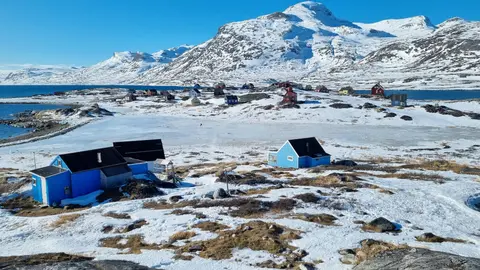
Nuuk, Greenland's diminutive capital, is a city of vivid contrasts — colourful colonial houses against Arctic granite, Inuit heritage alongside contemporary Nordic culture, and world-class museums steps from untamed fjords. Visitors should not miss the Greenland National Museum's Qilakitsoq mummies and a Zodiac excursion into the surrounding iceberg-studded fjord system. The prime cruising season runs from June through September, when extended daylight illuminates the landscape in an ethereal sub-Arctic glow and waters remain navigable for expedition vessels.
Day 12
Day 12
At Sea
Day 13
Day 13
Prince Christian Sound Cruising
Arrive 08:00Depart 15:00
Day 14
Day 14
At Sea
Day 15
Day 15
Isafjordur
Arrive 10:00Depart 18:00
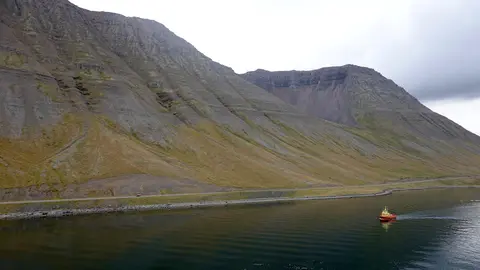
Ísafjörður is the cultural and historical capital of Iceland's remote Westfjords, a dramatic fjord-side settlement where centuries of fishing heritage meet stark Arctic grandeur. Visitors should not miss the communal seafood feast at Tjöruhúsið restaurant and a journey to the surreal red sands of Rauðasandur beach near Patreksfjörður. The optimal visiting window is June through August, when nearly perpetual daylight illuminates the encircling mountains and the town's vibrant cultural calendar reaches its peak.
Day 16
Day 16
Akureyri
Arrive 08:00Depart 17:00
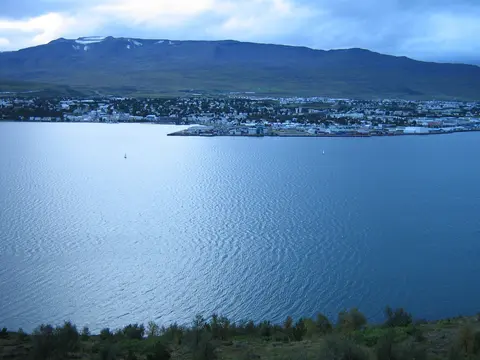
Akureyri, the cultural capital of northern Iceland, sits at the head of the majestic Eyjafjörður and serves as a gateway to some of the island's most dramatic landscapes, including the thundering Goðafoss waterfall, the volcanic wonderland of Lake Mývatn, and Europe's most powerful cascade at Dettifoss. Visitors should not miss the excursion to Mývatn's geothermal pools and the tasting of traditional *hangikjöt* smoked lamb at a harbourside restaurant. The ideal season to visit is June through August, when the midnight sun bathes the fjord in endless golden light and the botanical gardens reach their luminous peak.
Day 17
Day 17
Grundarfjørdur
Arrive 11:00Depart 20:00
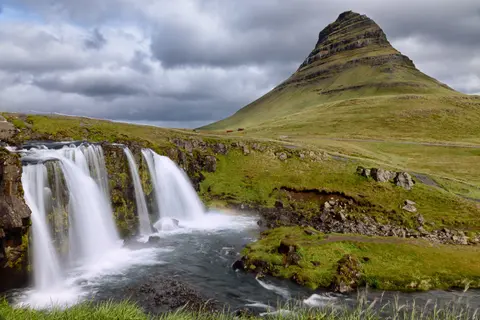
Grundarfjörður is a fishing town at the base of Kirkjufell, Iceland's most photographed mountain, and the gateway to the Snæfellsnes Peninsula—dubbed "Iceland in miniature" for its concentrated geological diversity. Must-dos include photographing Kirkjufell with its companion waterfall and exploring Snæfellsjökull, the glacier volcano from Jules Verne's novel. June and July offer midnight sun and the most reliable weather for peninsula exploration.
Day 18
Day 18
Reykjavik
Arrive 07:00
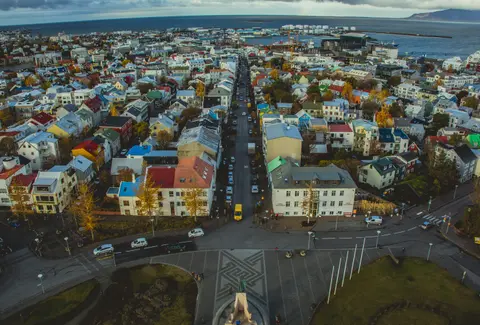
Reykjavik, the world's northernmost capital, distils the entire improbable beauty of Iceland into one compact, creatively charged city. The soaring basalt columns of Hallgrímskirkja dominate a skyline of primary-coloured rooftops, while the Harpa Concert Hall shimmers beside the harbour like a captured aurora. Day trips from the city unlock the Golden Circle's geysers and Geysir hot spring, the black sand beaches of Vík, and the ethereal glacier lagoon at Jökulsárlón. Geothermal pools — from the legendary Blue Lagoon to intimate neighbourhood hot pots — offer warmth year-round. June and July bring the bewitching midnight sun.
Day 20
Day 20
Heimaey
Arrive 08:00Depart 17:00
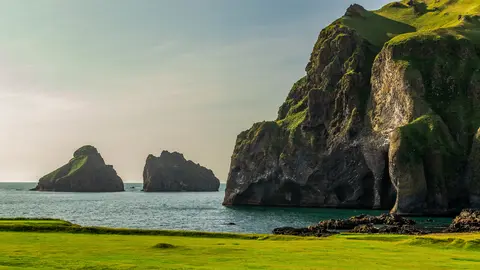
Heimaey is Iceland's volcanic island where the dramatic 1973 eruption story, the world's largest puffin colony of one million breeding pairs, and the children's annual puffling rescue create one of the North Atlantic's most extraordinary port experiences. Visit May through August via Lindblad or Windstar for Eldfell volcano hikes, the Eldheimar Museum's excavated homes, and the harbor approach through a channel literally reshaped by eruption.
Day 21
Day 21
Seydisfjordur
Arrive 08:30Depart 17:00
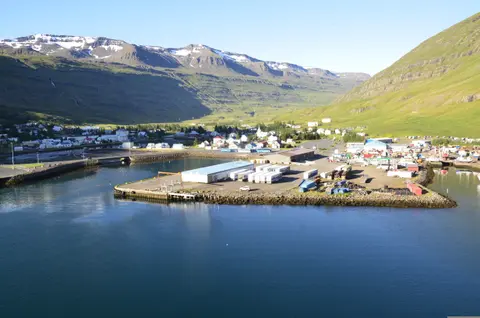
Seyðisfjörður is a remote artist colony and historic port tucked into a dramatic fjord on Iceland's eastern coast, renowned for its nineteenth-century painted timber houses, the iconic Blue Church, and a thriving creative scene anchored by the annual LungA festival. Visitors should not miss the fjord approach by sea and a day trip to Dettifoss, Europe's most powerful waterfall. The prime visiting season is June through August, when the midnight sun bathes the fjord in golden light and cruise lines including Viking, Celebrity, and Holland America call at this intimate harbour.
Day 22
Day 22
At Sea
Day 23
Day 23
At Sea
Day 24
Day 24
Kirkwall
Arrive 09:00Depart 19:00
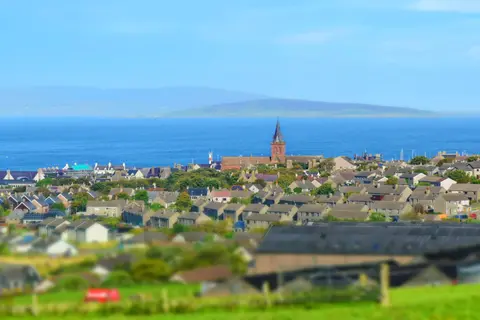
Kirkwall, the Norse-founded capital of Scotland's Orkney Islands, is a sandstone harbour town framed by UNESCO-listed Neolithic monuments, a twelfth-century cathedral, and some of Britain's finest coastal landscapes. Visitors should not miss the five-thousand-year-old village of Skara Brae and a tasting of North Ronaldsay seaweed-fed lamb paired with Highland Park whisky. The prime cruising season runs from May through August, when Orkney enjoys up to nineteen hours of daylight and the wild coastal light is at its most luminous.
Day 25
Day 25
Stornoway
Arrive 08:00Depart 16:00
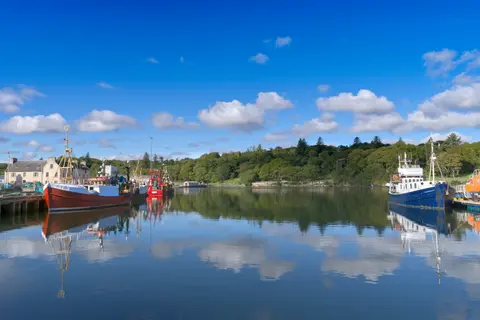
Stornoway, the sheltered harbour capital of Scotland's Isle of Lewis in the Outer Hebrides, offers an extraordinary blend of Norse heritage, Victorian architecture, and raw Atlantic beauty. Visitors should not miss the twelfth-century Lewis Chessmen at Museum nan Eilean inside the restored Lews Castle, nor the chance to taste the island's PGI-protected Stornoway black pudding at its source. The sailing season from May through September delivers the longest daylight hours and mildest conditions, with late June offering near-endless twilight that bathes the ancient Callanish Standing Stones in an ethereal glow.
Day 26
Day 26
Killybegs
Arrive 08:30Depart 16:00
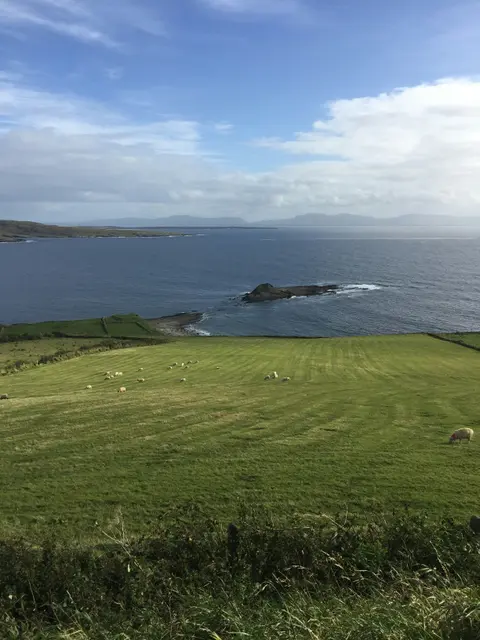
Killybegs is Ireland's premier fishing port on the wild Atlantic coast of County Donegal, gateway to the magnificent Slieve League sea cliffs and pristine Gaeltacht landscapes. Visit from May through September for dramatic coastal walks, traditional Irish music, and some of the finest seafood on the island.
Day 27
Day 27
Douglas
Arrive 10:30Depart 19:00
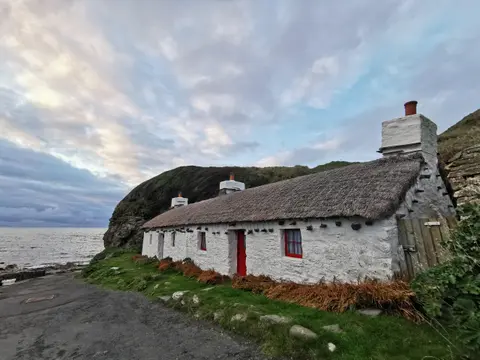
Douglas is the capital of the Isle of Man, home to the world's oldest parliament (Tynwald), the legendary Tourist Trophy motorcycle races, and a Victorian promenade served by horse-drawn trams since 1876. Visit May through September via Azamara or Windstar for TT race excitement and the cultural distinctiveness of a self-governing island.
Day 28
Day 28
Dun Laoghaire
Arrive 08:00Depart 19:00
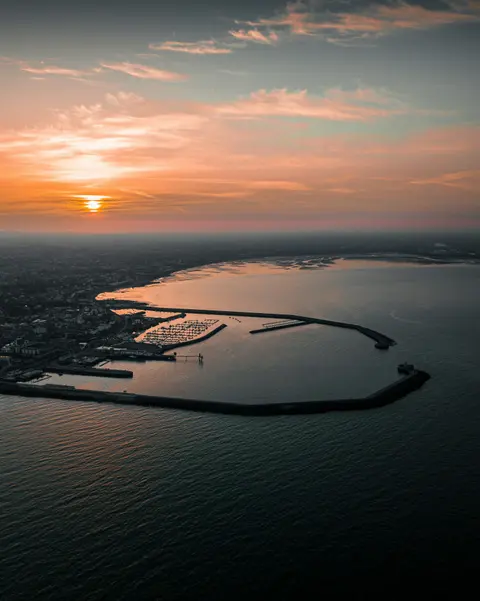
Dún Laoghaire is an elegant Victorian harbour town on Dublin Bay, renowned for its sweeping nineteenth-century granite piers, literary heritage tied to James Joyce, and vibrant artisan food culture featuring Dublin Bay prawns, boxty, and farmhouse cheeses. Visitors should walk the historic East Pier for panoramic bay views and explore the Sunday market at People's Park. The ideal season is late May through September, when long Irish summer evenings bathe the waterfront in golden light and outdoor dining comes alive along the seafront.
Day 29
Day 29
Liverpool
Arrive 08:00Depart 21:00
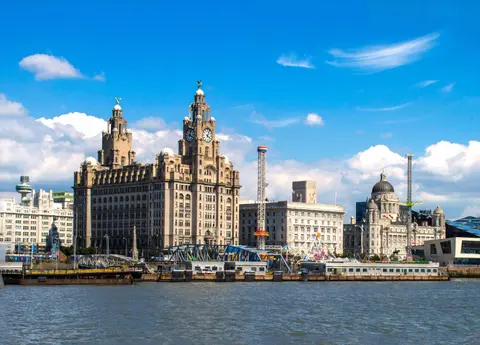
Liverpool, an historic port city, is renowned for its unique blend of vibrant culture and rich maritime heritage. Must-do experiences include sampling authentic Scouse and exploring the Three Graces along the waterfront. The best season to visit is during the mild summer months, when festivals and events enliven the city’s atmosphere.
Day 30
Day 30
Holyhead
Arrive 08:00Depart 19:00
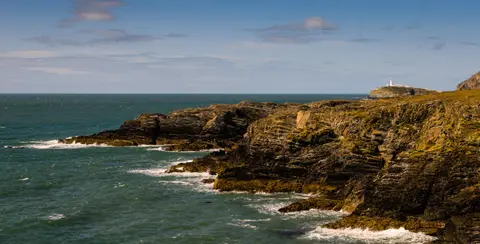
Holyhead is Wales's maritime gateway on Holy Island, offering dramatic cliff walks to South Stack Lighthouse with its puffin colonies, plus access to Anglesey's Neolithic burial chambers and Edward I's Beaumaris Castle. Must-do experiences include tasting Halen Môn sea salt and lobster at coastal restaurants, exploring Bryn Celli Ddu's ancient passage tomb, and walking the Victorian breakwater. May through September is best, with summer bringing puffins and the longest days.
Day 31
Day 31
Waterford
Arrive 08:00Depart 18:00

Waterford is Ireland's oldest city, founded by Vikings in 914 AD, featuring a magnificently restored medieval quarter, the world-famous House of Waterford Crystal, and three museums housing the finest medieval collection in the country. Must-dos include Reginald's Tower, crystal-making demonstrations, and tasting the city's unique blaa bread rolls. May through September offers the warmest weather, with September often bringing surprise Indian summer days.
Day 32
Day 32
At Sea
Day 33
Day 33
Southampton
Arrive 06:00Depart 19:00
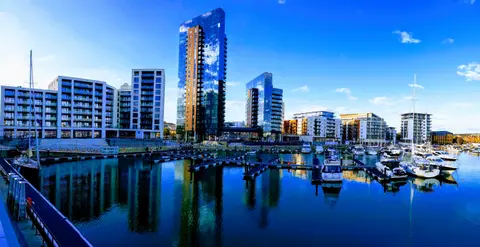
Southampton, England's storied ocean liner capital on the southern coast, carries an indelible maritime identity — this is the port from which the Titanic departed and from which the Queen Mary 2 still sails in grandeur today. The medieval Bargate and City Walls speak to a history stretching back to Roman times, while the SeaCity Museum tells the story of the great liners with moving intimacy. Day excursions reach Winchester's magnificent cathedral, the stately rooms of Beaulieu, and the primeval wilderness of the New Forest — where ancient ponies still roam freely. Spring and summer offer the most pleasant conditions for exploring the region.
Day 34
Day 34
Honfleur
Arrive 07:00Depart 17:00
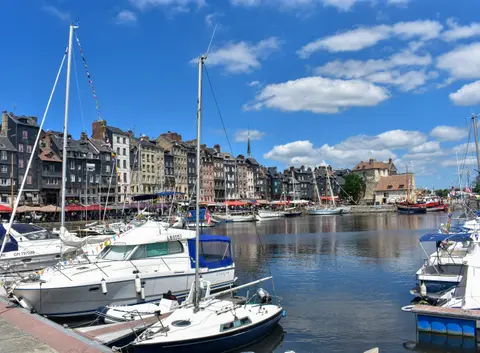
Honfleur, a historic port in Normandy, is known for its stunning waterfront and vibrant artistic heritage, having been a launching point for significant voyages like Samuel de Champlain's to Quebec. Don’t miss the chance to savor local specialties such as moules marinières and tarte normande while exploring the charming cobbled streets. The best time to visit is during the spring and summer months when the town bursts into bloom and outdoor dining thrives.
Day 35
Day 35
Antwerp
Arrive 13:00
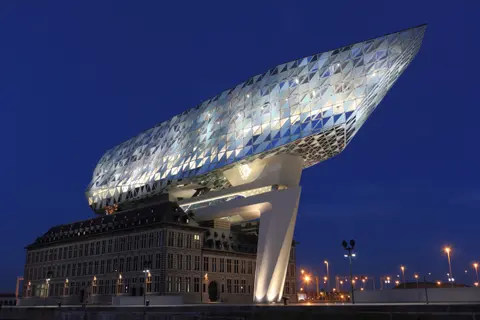
Antwerp has been one of Europe's great mercantile capitals since the fifteenth century, when it commanded the world's first commodity exchange and Peter Paul Rubens made it the artistic capital of the Baroque world — a legacy preserved in the magnificent Rubenshuis studio and the soaring Cathedral of Our Lady, whose nave houses four of the master's greatest altarpieces. Today the city leads global fashion from the acclaimed Antwerp Six design school and remains the diamond capital of the world, with 84% of the world's rough diamonds trading through its storied district. Visit in spring or autumn; Brussels and Bruges are each under an hour away by train.
Day 37
Day 37
Amsterdam
Arrive 11:00Depart 20:00
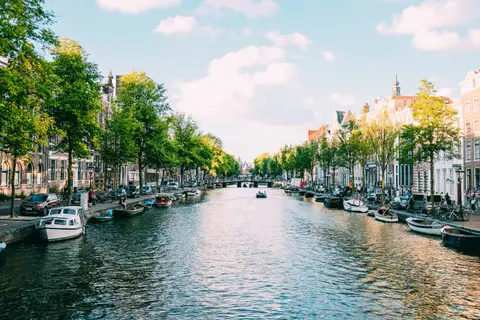
Amsterdam's UNESCO-listed canal ring — a concentric web of seventeenth-century merchant houses and arching stone bridges — remains one of the Western world's most perfectly preserved Golden Age cityscapes, best explored by bicycle or canal boat at a pace that lets the city's genius reveal itself slowly. The Rijksmuseum's collection of Rembrandt and Vermeer masterpieces is essential, while the Anne Frank House offers one of Europe's most profoundly moving historical encounters. Spring brings the iconic tulip season; summer fills the terraces of the Jordaan district. Schiphol Airport makes Amsterdam a seamless gateway to the entire European continent.
Day 38
Day 38
At Sea
Day 39
Day 39
Lysekil
Arrive 08:00Depart 18:00
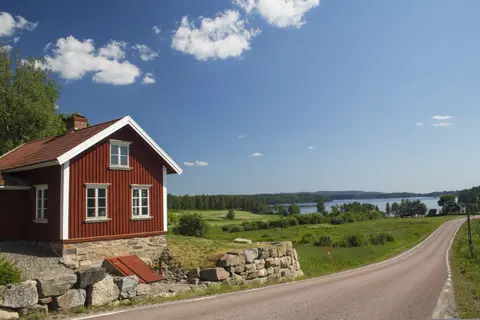
Lysekil in Sweden offers dramatic Nordic landscapes where fjords, glaciers, and pristine wilderness create scenes of remarkable natural grandeur. The essential experience is immersion in the outdoor environment—hiking, wildlife watching, and savoring the region's exceptional seafood in settings of extraordinary beauty. Best visited June through September, when long northern days and mild temperatures make exploration a pleasure. Cruise lines including Crystal Cruises feature this port on their most compelling itineraries. Whether you have a few hours or a full day, the port rewards exploration at every pace and in every direction.
Day 40
Day 40
Aarhus
Arrive 08:00Depart 18:00
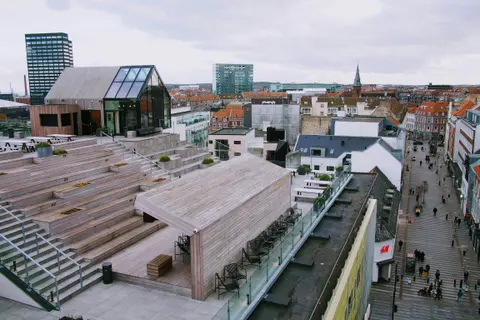
Aarhus, Denmark's spirited second city, blends Viking heritage with cutting-edge Nordic design along the shores of Aarhus Bay. No visit is complete without ascending the rainbow panorama at ARoS Art Museum and savoring *stegt flæsk* or freshly prepared *smørrebrød* in the Latin Quarter. The ideal season to arrive is late May through September, when long Scandinavian daylight hours illuminate the waterfront promenades and outdoor dining flourishes along the canals.
Day 41
Day 41
Warnemunde
Arrive 06:00Depart 23:00
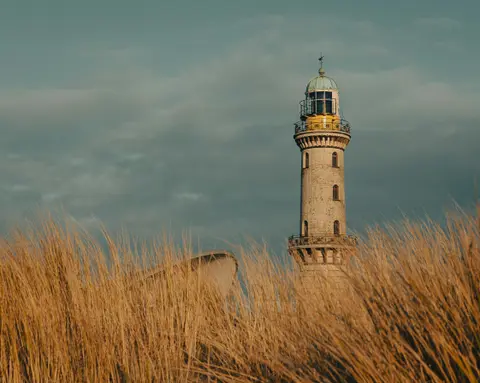
Warnemünde is a beguiling Baltic seaside town at the mouth of the Warnow — at once a historic fishing port documented since 1195, an East German nostalgic resort beloved for its endless sandy beach and candy-striped lighthouse, and the maritime gateway to the proud Hanseatic city of Rostock just minutes away. The broad promenade, traditional Strandkörbe wicker beach chairs, and lively harbor-front fish restaurants give the town an unhurried, timeless character quite distinct from Germany's busier North Sea resorts. Summer is the prime season, when the Baltic's mild waters warm for swimming and the Rostock sailing regatta brings vibrant nautical pageantry to the harbor.
Day 42
Day 42
At Sea
Day 43
Day 43
Liepaja
Arrive 08:00Depart 18:00
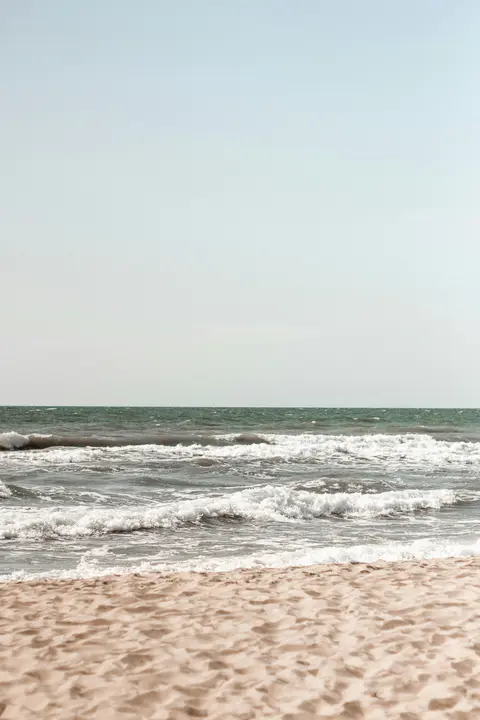
Liepāja is Latvia's windswept Baltic port city, home to the extraordinary Karosta former Russian Imperial naval base, a vibrant live music scene, and some of Latvia's finest white-sand beaches with interactive piano sculptures along the promenade. Must-dos include exploring the Karosta prison and Byzantine-style cathedral, attending a concert at the amber-glass Great Amber hall, and walking the Blue Flag beach. June through August offers the warmest weather and longest Baltic daylight.
Day 44
Day 44
Visby
Arrive 08:00Depart 16:00
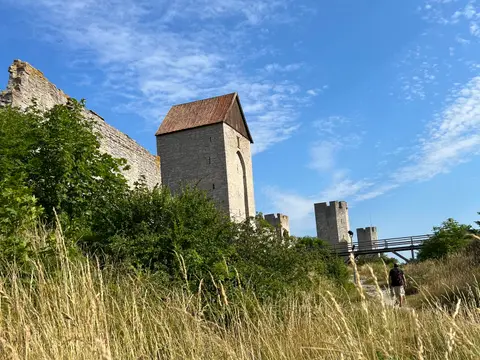
Visby, on Sweden's island of Gotland, is a UNESCO-listed medieval treasure and the best-preserved walled city in Scandinavia, where thirteenth-century Hanseatic merchant heritage meets cobbled lanes draped in roses. Visitors should walk the complete 3.4-kilometre ring wall for panoramic views and taste the island's signature saffron pancake, saffranspannkaka, with dewberries and cream. The ideal season is June through August, when the Baltic light lingers well past midnight and the harbour welcomes the finest cruise lines on their summer itineraries.
Day 45
Day 45
Helsinki
Arrive 11:00Depart 20:00
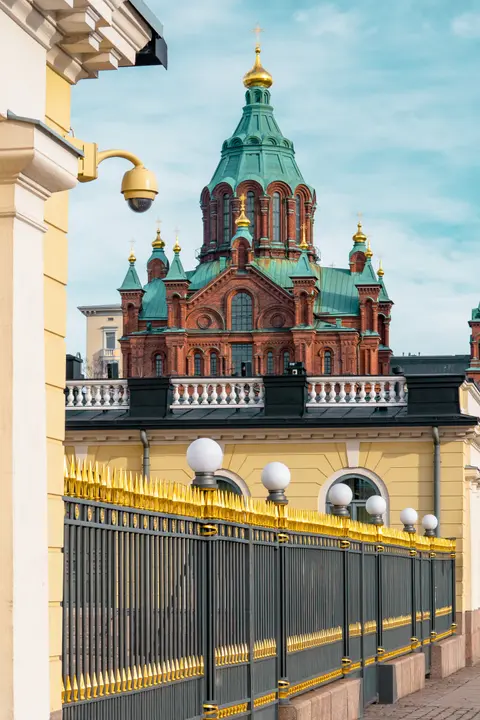
Helsinki’s port is a gateway to a captivating blend of history, modern architecture, and vibrant culture, making it a must-visit destination in the Baltic Sea. Highlights include savoring traditional Finnish dishes at the lively Market Square and exploring nearby attractions like the UNESCO-listed town of Rauma. The best season to visit is during the summer months when the city comes alive with festivals and outdoor activities.
Day 46
Day 46
Tallinn
Arrive 07:00Depart 16:00
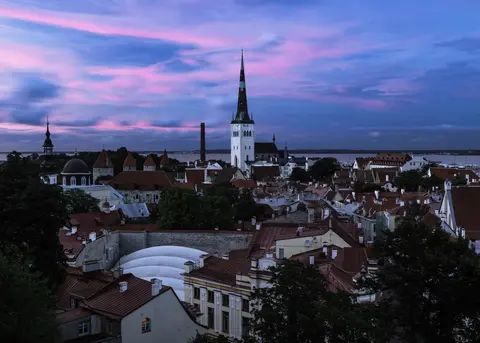
Tallinn’s port offers a captivating blend of history and modernity, with its medieval Old Town recognized as a UNESCO World Heritage site. Must-do experiences include exploring the iconic Raekoja plats and indulging in local culinary delights like kama and smoked herring. The best season to visit is during the summer when the city comes alive with festivals and outdoor activities.
Day 47
Day 47
Stockholm
Arrive 08:00
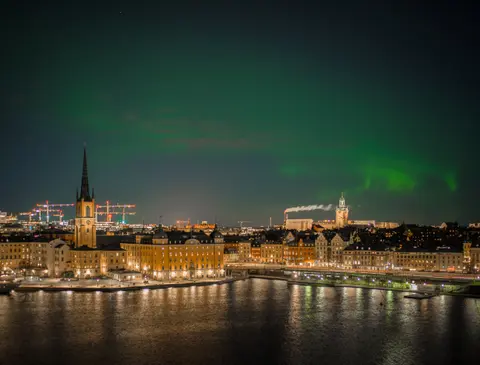
Stockholm's port is a stunning gateway to one of Europe’s most beautiful cities, uniquely positioned on fourteen islands. Must-do experiences include savoring traditional Swedish dishes like **köttbullar** and exploring nearby attractions such as Visby and Malmö. The best season to visit is during the summer months when the city is vibrant with life and outdoor activities.
Day 49
Day 49
At Sea
Day 50
Day 50
Copenhagen
Arrive 07:00
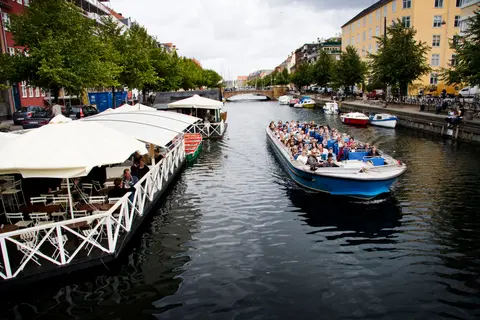
Rising from the harbour that Viking chieftain Absalon fortified in 1167, Copenhagen has evolved into one of Europe's most sophisticated capitals — a city where medieval spires and cutting-edge architecture coexist with effortless style. Savour smørrebrød at a century-old lunch counter, cycle across the harbour bridge to the revitalised Meatpacking District, and venture north to Kronborg Castle — Shakespeare's Elsinore. As one of Northern Europe's premier cruise homeports, it serves as the ideal gateway to Baltic and Scandinavian itineraries, best experienced from May to September.
Day 52
Day 52
Lysekil
Arrive 09:00Depart 21:00
Lysekil in Sweden offers dramatic Nordic landscapes where fjords, glaciers, and pristine wilderness create scenes of remarkable natural grandeur. The essential experience is immersion in the outdoor environment—hiking, wildlife watching, and savoring the region's exceptional seafood in settings of extraordinary beauty. Best visited June through September, when long northern days and mild temperatures make exploration a pleasure. Cruise lines including Crystal Cruises feature this port on their most compelling itineraries. Whether you have a few hours or a full day, the port rewards exploration at every pace and in every direction.
Day 53
Day 53
Oslo
Arrive 08:00Depart 18:00
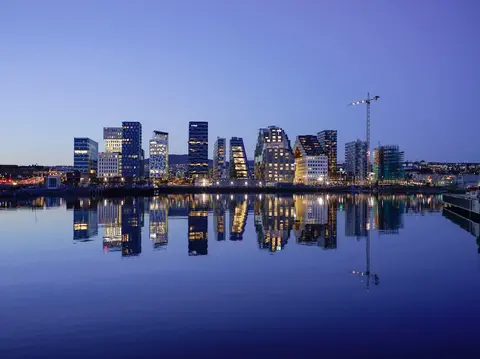
The port of Oslo is a scenic gateway to Norway's rich history and vibrant culture, marked by stunning architecture and lush landscapes. Must-do experiences include savoring traditional dishes like **rakfisk** and exploring the nearby fjords and charming villages. The best time to visit is during the summer months, when the city comes alive with festivals and outdoor activities.
Day 54
Day 54
Skagen
Arrive 08:00Depart 18:00
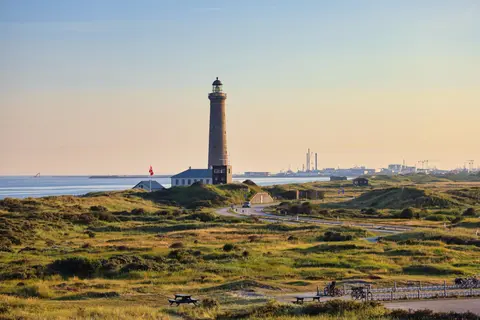
Skagen, Denmark's northernmost town, is a refined coastal destination where two seas meet at the tip of the Jutland peninsula, celebrated for its extraordinary painters' light, working fishing harbour, and pristine white-sand beaches at Grenen. Visitors should not miss tasting impeccably fresh *toast Skagen* at a harbourside restaurant and walking to the very point where the Kattegat and Skagerrak visibly collide — a rare natural spectacle. The ideal season to visit is June through August, when endless Scandinavian summer light bathes the landscape in the same golden luminosity that inspired the famous Skagen artists of the nineteenth century.
Day 55
Day 55
Mandal
Arrive 08:00Depart 17:00
Mandal is Norway's southernmost town, celebrated for Sjosanden — widely considered Norway's finest beach — along with beautifully preserved white wooden architecture and the birthplace museum of sculptor Gustav Vigeland. Must-dos include swimming at the golden sand beach, strolling the cobblestone streets of the historic Brygga quarter, and sampling langoustines at the annual Shellfish Festival. Visit June through August for the warmest weather and the longest Scandinavian summer days.
Day 56
Day 56
Rosendal
Arrive 08:00Depart 18:00
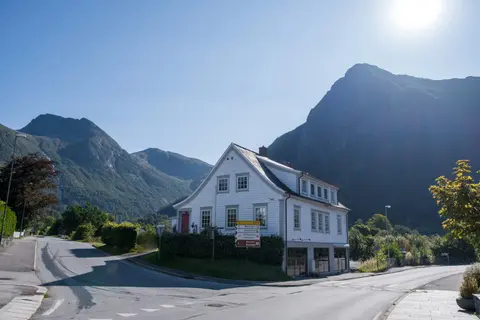
Rosendal is a historic barony on Norway's Hardangerfjord, home to Scandinavia's only barony manor house set in rose gardens with views to the Folgefonna glacier. Must-dos include touring the 1665 manor house, hiking to the turquoise Bondhusvatnet glacial lake, and visiting during the spectacular May fruit blossom season. Visit May for orchard blossoms or June through August for warm weather and glacier hiking.
Day 57
Day 57
Olden
Arrive 11:00Depart 20:00
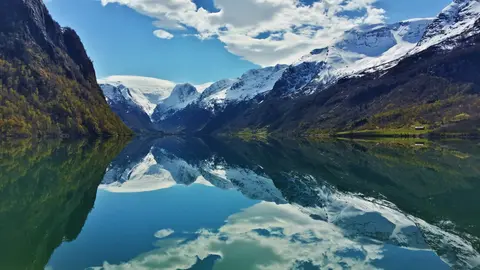
Olden is a serene fjord village at the head of Nordfjord in western Norway, where glacial rivers meet emerald waters beneath towering peaks. The essential experience is the journey to Briksdal Glacier, an arm of Europe's largest ice cap, followed by tasting traditional *raspeball* dumplings and cloudberry cream at a local farmstead. The prime visiting season stretches from June through August, when near-endless daylight illuminates the valley and summer temperatures make glacier hikes and fjord kayaking particularly rewarding.
Day 58
Day 58
Kristiansund
Arrive 08:00Depart 21:00
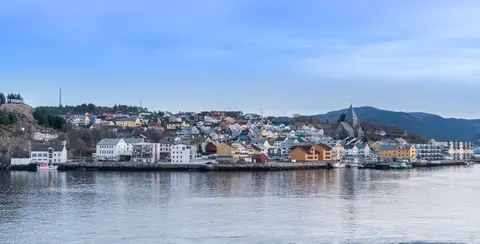
Kristiansund sprawls across four rocky islands at the mouth of a fjord on Norway's northwestern coast, a maritime town whose fortunes were built on klippfisk — the salt-cured dried cod that supplied Catholic Europe for centuries and still forms the basis of the local specialty bacalao. The picturesque old quarter of Innlandet preserves timber warehouses and colorful boathouses from the golden age of the klippfisk trade, while the modern Atlantic Road nearby — a storm-battered causeway that leaps between skerries across the open sea — is one of the world's most dramatic drives. Kristiansund is best visited May through September, though the winter king crab season and northern lights offer compelling reasons to brave the cold.
Day 59
Day 59
Trondheim
Arrive 07:00Depart 16:00
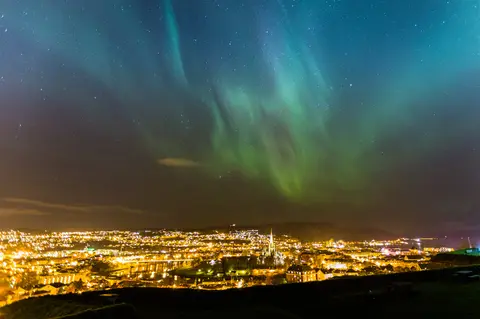
Trondheim, Norway's ancient first capital, has drawn pilgrims for a thousand years to the Nidaros Cathedral — Scandinavia's greatest medieval building, raised over the tomb of Saint Olav and still serving as Norway's royal coronation church, its Gothic west facade a sublime gallery of stone scripture. The city unfolds along the banks of the Nidelva River in a harmonious mix of centuries-old wooden wharfhouses, elegant baroque streetscapes, and a confident contemporary university culture. Summer is the ideal season for Trondheim, when long golden evenings allow leisurely exploration of Bakklandet's cafés and the Ringve Music Museum's extraordinary instrument collections.
Day 60
Day 60
At Sea
Day 61
Day 61
Hammerfest
Arrive 07:00Depart 22:00
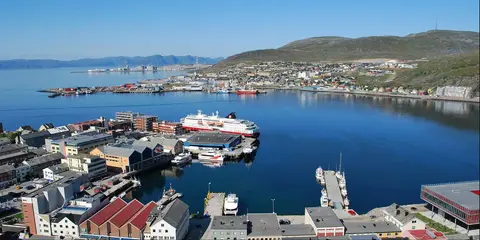
Hammerfest, Norway's northernmost town, is a vibrant blend of history and modernity, renowned for its stunning landscapes and rich local culture. Must-do experiences include savoring traditional dishes like **rakfisk** and exploring nearby attractions such as **Ålesund** and **Balestrand**. The best time to visit is during the summer months, when the midnight sun illuminates the rugged beauty of the region.
Day 62
Day 62
Honningsvag
Arrive 07:00Depart 15:00
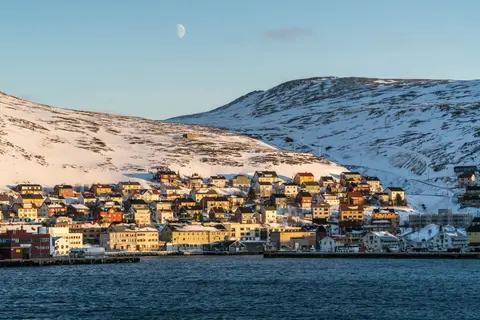
Perched at the very tip of Norway on the island of Magerøya, Honningsvåg is the storied gateway to the North Cape — the dramatic cliff that marks Europe's northernmost point, where the Arctic Ocean stretches uninterrupted to the Pole. The town's modest fishing-village character only deepens the sense of extraordinary remoteness, making arrival here feel like a genuine expedition. Visit the North Cape plateau for a midnight sun spectacle or the mesmerizing curtains of the northern lights; both experiences are among the most transcendent in nature. Summer (June–August) brings perpetual daylight; winter (November–February) offers prime aurora viewing.
Day 63
Day 63
Tromso
Arrive 08:00Depart 20:00
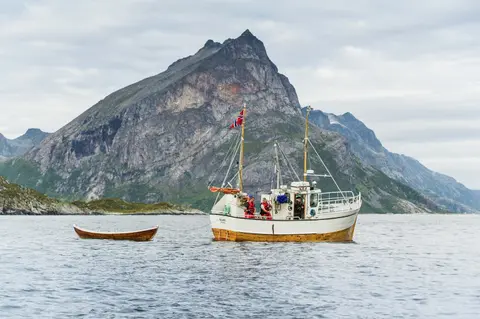
Tromsø, perched 300 kilometers north of the Arctic Circle on its own island in a fjord-carved landscape of breathtaking severity, is the world's finest base for witnessing the northern lights — a phenomenon that illuminates the polar night here from late September through March with an intensity unmatched across Scandinavia. The city's striking Arctic Cathedral, vibrant university culture, and excellent Polar Museum trace Norway's heroic age of polar exploration, while dog sledding, snowshoeing, and whale-watching expeditions provide exhilarating encounters with the high Arctic wilderness. Summer's unbroken midnight sun offers an equally otherworldly experience beneath skies that never darken.
Day 64
Day 64
At Sea
Day 65
Day 65
Alesund
Arrive 11:00Depart 23:00
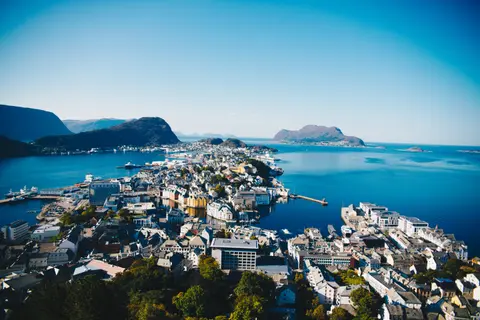
Ålesund, rebuilt in just three years after a catastrophic 1904 fire, rose from its ashes as one of Europe's most remarkable concentrations of Art Nouveau architecture — turrets, dragon motifs, and floral stonework lining a Norwegian fishing town waterfront like an open-air Jugendstil museum. Climb the 418 steps of Aksla hill for a panorama that sweeps across the Art Nouveau rooftops to the surrounding fjords, then descend to sample the town's celebrated fresh Atlantic seafood at the harbor quay. Summer brings the midnight sun; autumn offers moody light and the region's famous apple orchards. The Geirangerfjord, a UNESCO treasure, is an hour's sail away.
Day 66
Day 66
Maloy
Arrive 08:00Depart 20:00

Måløy, a charming coastal village in Norway, is renowned for its rich maritime history and stunning natural beauty. Must-do experiences include sampling local seafood specialties like "klippfisk" and visiting the historic Måløy Raid Center. The best season to visit is during the summer months, when the weather is mild and the coastal scenery is at its most captivating.
Day 67
Day 67
Lerwick
Arrive 10:00Depart 19:00
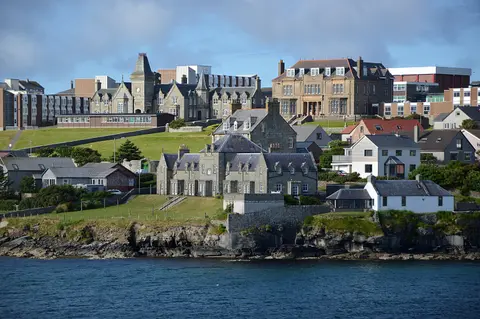
Lerwick, capital of Scotland's Shetland Islands, is a captivating Norse-Scottish harbour town renowned for its seventeenth-century granite waterfront, Viking heritage, and pristine maritime larder of wind-dried reestit mutton and hand-dived scallops. Visitors should explore the lodberries along Commercial Street and the award-winning Shetland Museum at Hay's Dock. The optimal season is late May through August, when near-perpetual daylight — the famous "simmer dim" — bathes the islands in an ethereal golden glow and seabird colonies along the cliffs reach their spectacular peak.
Day 68
Day 68
Invergordon
Arrive 09:00Depart 18:00

Invergordon is a charming port town in the Scottish Highlands, known for its rich history and scenic beauty. Must-do experiences include exploring the historic Battlefield of Culloden and savoring traditional dishes like haggis and cranachan. The best season to visit is during the summer months when local festivals and events bring the vibrant culture to life.
Day 69
Day 69
At Sea
Day 70
Day 70
Zeebrugge
Arrive 07:00Depart 17:00
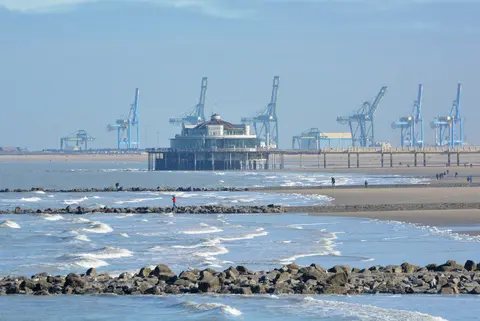
Zeebrugge — Belgium's principal cruise port, whose very name means 'Sea-Bruges' — serves as the maritime portal to one of Europe's most perfectly preserved medieval cities, with the UNESCO-listed canal network of Bruges just fifteen minutes away, its lace shops, chocolate artisans, and moated Beguinage offering an almost impossibly picturesque step back into the Flemish Golden Age. The port itself carries its own dramatic history: the site of the audacious 1918 Zeebrugge Raid, when the Royal Navy launched a daring assault to block the harbor during World War I. Year-round access to Bruges, Ghent, and Brussels — each within easy reach — makes Zeebrugge a supremely versatile port of call.
Day 71
Day 71
Amsterdam
Arrive 06:00Depart 22:00
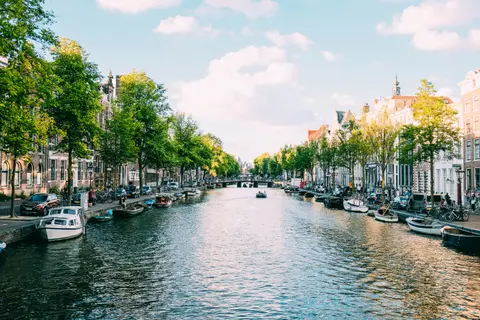
Amsterdam's UNESCO-listed canal ring — a concentric web of seventeenth-century merchant houses and arching stone bridges — remains one of the Western world's most perfectly preserved Golden Age cityscapes, best explored by bicycle or canal boat at a pace that lets the city's genius reveal itself slowly. The Rijksmuseum's collection of Rembrandt and Vermeer masterpieces is essential, while the Anne Frank House offers one of Europe's most profoundly moving historical encounters. Spring brings the iconic tulip season; summer fills the terraces of the Jordaan district. Schiphol Airport makes Amsterdam a seamless gateway to the entire European continent.
Day 72
Day 72
At Sea
Day 73
Day 73
At Sea
Day 74
Day 74
Bordeaux
Arrive 07:00
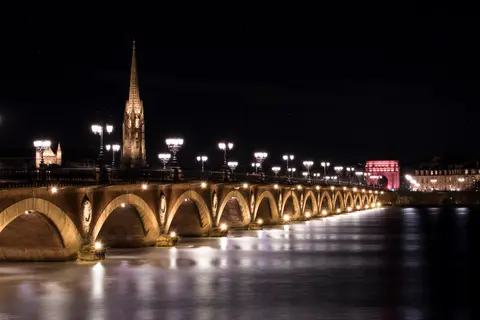
Bordeaux, France's premier port city, is renowned for its historical significance, stunning architecture, and world-class wine. Must-do experiences include savoring local delicacies at Marché des Quais and exploring the breathtaking art installations at Place de la Bourse. The best season to visit is during the late spring and early autumn, when the weather is pleasant and the vineyards are in full bloom.
Day 76
Day 76
At Sea
Day 77
Day 77
Porto
Arrive 08:00Depart 17:00

Porto, set dramatically on the granite bluffs above the Douro River, is among Europe's most romantically dishevelled cities — a place where baroque church towers rise above terracotta rooftops and century-old azulejo tilework lines every alley. Cross the iron Dom Luís I Bridge for sweeping views and descend into Vila Nova de Gaia's atmospheric wine lodges for a tasting of aged tawny port direct from the barrel. Seafood is magnificent: salt cod prepared a hundred ways, barnacles glistening with lemon, and custard tarts still warm from the oven. Spring and early autumn offer the finest conditions.
Day 78
Day 78
Lisbon
Arrive 07:00Depart 16:00
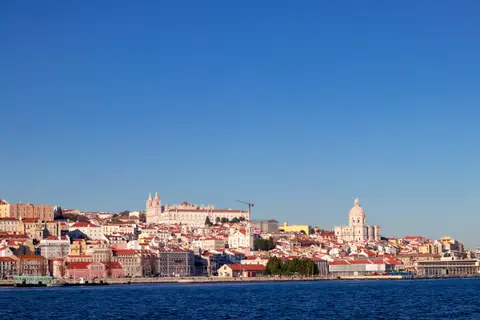
Lisbon, Portugal's enchanting capital, stands out for its rich history, stunning architecture, and vibrant culture. Must-try experiences include savoring local dishes like bacalhau à brás and pastéis de nata at Mercado da Ribeira. The best time to visit is during the spring or fall, when the weather is mild and the city is alive with festivals and events.
Day 79
Day 79
Cadiz
Arrive 11:30Depart 20:00
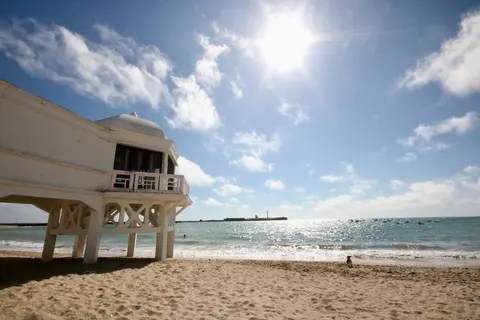
Cádiz, founded by Phoenician traders around 1100 BC and a strong contender for the oldest continuously inhabited city in Western Europe, juts into the Atlantic on a narrow peninsula where honey-colored ramparts frame improbable views of open ocean and the sun sets directly into the sea. The old quarter is an intoxicating labyrinth of baroque churches, hidden plazas, and carnival spirit — Cádiz's annual February carnival is the wildest and most satirically sharp in Spain — while the tapas culture here, centered on fresh Atlantic seafood cooked with Andalusian simplicity, represents Spanish cuisine at its most elemental and joyful. Visit February for carnival or spring for gentle Atlantic breezes. Seville is ninety minutes inland by bus or rail.
Day 80
Day 80
Malaga
Arrive 07:00Depart 19:00
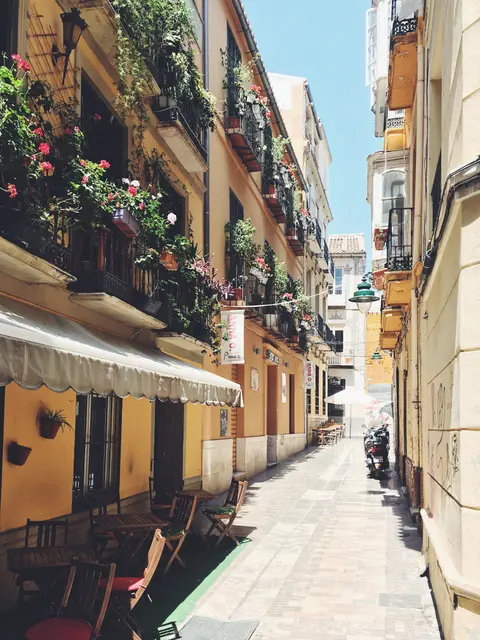
Málaga distils three thousand years of Mediterranean civilisation into one of Andalusia's most compelling port cities, where the Moorish Alcazaba fortress surveys a modern waterfront of elegant promenades and sun-drenched café terraces. Do not leave without visiting the Museo Picasso — the artist was born here in 1881 — and ascending to the ruined Castillo de Gibralfaro for panoramic views stretching to the Rif Mountains of Morocco on clear days. Malagueta anchovies fried in olive oil and the sweet Pedro Ximénez-laced dessert wine are the city's defining pleasures. The shoulder seasons of April, May, and October offer perfect Mediterranean warmth.
Day 81
Day 81
At Sea
Day 82
Day 82
Barcelona
Arrive 07:00
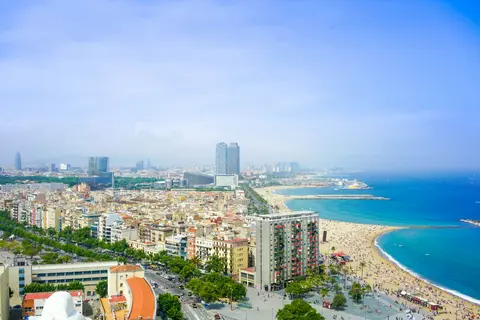
Barcelona is the city where Roman history, Gothic grandeur, and Gaudí's delirious Modernisme collide in a Mediterranean coastal capital of astonishing energy and beauty. The Sagrada Família — still under construction after 140 years — continues its audacious ascent toward completion, while the Gothic Quarter's Roman-era foundations and the Passeig de Gràcia's extraordinary concentration of Modernisme masterpieces reward days of exploration. For a complete sensory experience, lose an afternoon in the covered labyrinth of La Boqueria market before descending to the waterfront for Catalan seafood at its finest. May through June and September through October offer the most pleasant weather; the city connects directly to Paris by overnight train.
Day 1
New York
Depart 16:00
The Port of New York is a bustling maritime gateway rich in history and cultural diversity, making it a must-visit destination. Don't miss the chance to savor authentic New York pizza and explore the vibrant Chelsea Market. The best time to visit is during the spring or fall, when the weather is pleasant, and the city is alive with activity.
Day 2
At Sea
Day 3
Halifax
Arrive 08:00Depart 16:00
Halifax, the historic capital of Nova Scotia, is a refined Atlantic port where centuries of maritime heritage meet a flourishing culinary scene anchored by Digby scallops, donairs, and one of North America's oldest farmers' markets. Visitors should not miss the star-shaped Citadel Hill and the harbourfront boardwalk's constellation of galleries and tasting rooms. The ideal season stretches from late June through October, when autumn's blazing foliage transforms the entire province into a masterwork of colour and the cruise terminal welcomes the world's finest vessels.
Day 4
Sydney
Arrive 10:00Depart 18:00
Sydney, on Cape Breton Island in Nova Scotia, is a charming harbour city where Scottish-Acadian heritage meets raw Atlantic beauty, serving as the gateway to the legendary Cabot Trail — one of the world's most spectacular coastal drives. Visitors should savour the island's renowned seafood chowder and traditional oatcakes while exploring the colourful waterfront boardwalk. The peak season stretches from late June through October, when autumn's fiery foliage transforms the highlands into a tapestry of crimson and gold.
Day 5
At Sea
Day 6
At Sea
Day 7
At Sea
Day 8
Paamiut (Frederikshab)
Arrive 07:00Depart 19:00
Paamiut is a small Greenlandic town on the Davis Strait coast, set against a dramatic backdrop of ice-capped mountains and drifting icebergs in one of Earth's most sparsely inhabited regions. Must-dos include kayaking among icebergs, whale watching from the harbor, and tasting fresh Arctic char and halibut. Visit June to September for midnight sun and the warmest conditions.
Day 9
Nuuk Godthaab
Arrive 10:00
Nuuk, Greenland's diminutive capital, is a city of vivid contrasts — colourful colonial houses against Arctic granite, Inuit heritage alongside contemporary Nordic culture, and world-class museums steps from untamed fjords. Visitors should not miss the Greenland National Museum's Qilakitsoq mummies and a Zodiac excursion into the surrounding iceberg-studded fjord system. The prime cruising season runs from June through September, when extended daylight illuminates the landscape in an ethereal sub-Arctic glow and waters remain navigable for expedition vessels.
Day 11
Nuuk Godthaab
Depart 19:00
Nuuk, Greenland's diminutive capital, is a city of vivid contrasts — colourful colonial houses against Arctic granite, Inuit heritage alongside contemporary Nordic culture, and world-class museums steps from untamed fjords. Visitors should not miss the Greenland National Museum's Qilakitsoq mummies and a Zodiac excursion into the surrounding iceberg-studded fjord system. The prime cruising season runs from June through September, when extended daylight illuminates the landscape in an ethereal sub-Arctic glow and waters remain navigable for expedition vessels.
Day 12
At Sea
Day 13
Prince Christian Sound Cruising
Arrive 08:00Depart 15:00
Day 14
At Sea
Day 15
Isafjordur
Arrive 10:00Depart 18:00
Ísafjörður is the cultural and historical capital of Iceland's remote Westfjords, a dramatic fjord-side settlement where centuries of fishing heritage meet stark Arctic grandeur. Visitors should not miss the communal seafood feast at Tjöruhúsið restaurant and a journey to the surreal red sands of Rauðasandur beach near Patreksfjörður. The optimal visiting window is June through August, when nearly perpetual daylight illuminates the encircling mountains and the town's vibrant cultural calendar reaches its peak.
Day 16
Akureyri
Arrive 08:00Depart 17:00
Akureyri, the cultural capital of northern Iceland, sits at the head of the majestic Eyjafjörður and serves as a gateway to some of the island's most dramatic landscapes, including the thundering Goðafoss waterfall, the volcanic wonderland of Lake Mývatn, and Europe's most powerful cascade at Dettifoss. Visitors should not miss the excursion to Mývatn's geothermal pools and the tasting of traditional *hangikjöt* smoked lamb at a harbourside restaurant. The ideal season to visit is June through August, when the midnight sun bathes the fjord in endless golden light and the botanical gardens reach their luminous peak.
Day 17
Grundarfjørdur
Arrive 11:00Depart 20:00
Grundarfjörður is a fishing town at the base of Kirkjufell, Iceland's most photographed mountain, and the gateway to the Snæfellsnes Peninsula—dubbed "Iceland in miniature" for its concentrated geological diversity. Must-dos include photographing Kirkjufell with its companion waterfall and exploring Snæfellsjökull, the glacier volcano from Jules Verne's novel. June and July offer midnight sun and the most reliable weather for peninsula exploration.
Day 18
Reykjavik
Arrive 07:00
Reykjavik, the world's northernmost capital, distils the entire improbable beauty of Iceland into one compact, creatively charged city. The soaring basalt columns of Hallgrímskirkja dominate a skyline of primary-coloured rooftops, while the Harpa Concert Hall shimmers beside the harbour like a captured aurora. Day trips from the city unlock the Golden Circle's geysers and Geysir hot spring, the black sand beaches of Vík, and the ethereal glacier lagoon at Jökulsárlón. Geothermal pools — from the legendary Blue Lagoon to intimate neighbourhood hot pots — offer warmth year-round. June and July bring the bewitching midnight sun.
Day 20
Heimaey
Arrive 08:00Depart 17:00
Heimaey is Iceland's volcanic island where the dramatic 1973 eruption story, the world's largest puffin colony of one million breeding pairs, and the children's annual puffling rescue create one of the North Atlantic's most extraordinary port experiences. Visit May through August via Lindblad or Windstar for Eldfell volcano hikes, the Eldheimar Museum's excavated homes, and the harbor approach through a channel literally reshaped by eruption.
Day 21
Seydisfjordur
Arrive 08:30Depart 17:00
Seyðisfjörður is a remote artist colony and historic port tucked into a dramatic fjord on Iceland's eastern coast, renowned for its nineteenth-century painted timber houses, the iconic Blue Church, and a thriving creative scene anchored by the annual LungA festival. Visitors should not miss the fjord approach by sea and a day trip to Dettifoss, Europe's most powerful waterfall. The prime visiting season is June through August, when the midnight sun bathes the fjord in golden light and cruise lines including Viking, Celebrity, and Holland America call at this intimate harbour.
Day 22
At Sea
Day 23
At Sea
Day 24
Kirkwall
Arrive 09:00Depart 19:00
Kirkwall, the Norse-founded capital of Scotland's Orkney Islands, is a sandstone harbour town framed by UNESCO-listed Neolithic monuments, a twelfth-century cathedral, and some of Britain's finest coastal landscapes. Visitors should not miss the five-thousand-year-old village of Skara Brae and a tasting of North Ronaldsay seaweed-fed lamb paired with Highland Park whisky. The prime cruising season runs from May through August, when Orkney enjoys up to nineteen hours of daylight and the wild coastal light is at its most luminous.
Day 25
Stornoway
Arrive 08:00Depart 16:00
Stornoway, the sheltered harbour capital of Scotland's Isle of Lewis in the Outer Hebrides, offers an extraordinary blend of Norse heritage, Victorian architecture, and raw Atlantic beauty. Visitors should not miss the twelfth-century Lewis Chessmen at Museum nan Eilean inside the restored Lews Castle, nor the chance to taste the island's PGI-protected Stornoway black pudding at its source. The sailing season from May through September delivers the longest daylight hours and mildest conditions, with late June offering near-endless twilight that bathes the ancient Callanish Standing Stones in an ethereal glow.
Day 26
Killybegs
Arrive 08:30Depart 16:00
Killybegs is Ireland's premier fishing port on the wild Atlantic coast of County Donegal, gateway to the magnificent Slieve League sea cliffs and pristine Gaeltacht landscapes. Visit from May through September for dramatic coastal walks, traditional Irish music, and some of the finest seafood on the island.
Day 27
Douglas
Arrive 10:30Depart 19:00
Douglas is the capital of the Isle of Man, home to the world's oldest parliament (Tynwald), the legendary Tourist Trophy motorcycle races, and a Victorian promenade served by horse-drawn trams since 1876. Visit May through September via Azamara or Windstar for TT race excitement and the cultural distinctiveness of a self-governing island.
Day 28
Dun Laoghaire
Arrive 08:00Depart 19:00
Dún Laoghaire is an elegant Victorian harbour town on Dublin Bay, renowned for its sweeping nineteenth-century granite piers, literary heritage tied to James Joyce, and vibrant artisan food culture featuring Dublin Bay prawns, boxty, and farmhouse cheeses. Visitors should walk the historic East Pier for panoramic bay views and explore the Sunday market at People's Park. The ideal season is late May through September, when long Irish summer evenings bathe the waterfront in golden light and outdoor dining comes alive along the seafront.
Day 29
Liverpool
Arrive 08:00Depart 21:00
Liverpool, an historic port city, is renowned for its unique blend of vibrant culture and rich maritime heritage. Must-do experiences include sampling authentic Scouse and exploring the Three Graces along the waterfront. The best season to visit is during the mild summer months, when festivals and events enliven the city’s atmosphere.
Day 30
Holyhead
Arrive 08:00Depart 19:00
Holyhead is Wales's maritime gateway on Holy Island, offering dramatic cliff walks to South Stack Lighthouse with its puffin colonies, plus access to Anglesey's Neolithic burial chambers and Edward I's Beaumaris Castle. Must-do experiences include tasting Halen Môn sea salt and lobster at coastal restaurants, exploring Bryn Celli Ddu's ancient passage tomb, and walking the Victorian breakwater. May through September is best, with summer bringing puffins and the longest days.
Day 31
Waterford
Arrive 08:00Depart 18:00
Waterford is Ireland's oldest city, founded by Vikings in 914 AD, featuring a magnificently restored medieval quarter, the world-famous House of Waterford Crystal, and three museums housing the finest medieval collection in the country. Must-dos include Reginald's Tower, crystal-making demonstrations, and tasting the city's unique blaa bread rolls. May through September offers the warmest weather, with September often bringing surprise Indian summer days.
Day 32
At Sea
Day 33
Southampton
Arrive 06:00Depart 19:00
Southampton, England's storied ocean liner capital on the southern coast, carries an indelible maritime identity — this is the port from which the Titanic departed and from which the Queen Mary 2 still sails in grandeur today. The medieval Bargate and City Walls speak to a history stretching back to Roman times, while the SeaCity Museum tells the story of the great liners with moving intimacy. Day excursions reach Winchester's magnificent cathedral, the stately rooms of Beaulieu, and the primeval wilderness of the New Forest — where ancient ponies still roam freely. Spring and summer offer the most pleasant conditions for exploring the region.
Day 34
Honfleur
Arrive 07:00Depart 17:00
Honfleur, a historic port in Normandy, is known for its stunning waterfront and vibrant artistic heritage, having been a launching point for significant voyages like Samuel de Champlain's to Quebec. Don’t miss the chance to savor local specialties such as moules marinières and tarte normande while exploring the charming cobbled streets. The best time to visit is during the spring and summer months when the town bursts into bloom and outdoor dining thrives.
Day 35
Antwerp
Arrive 13:00
Antwerp has been one of Europe's great mercantile capitals since the fifteenth century, when it commanded the world's first commodity exchange and Peter Paul Rubens made it the artistic capital of the Baroque world — a legacy preserved in the magnificent Rubenshuis studio and the soaring Cathedral of Our Lady, whose nave houses four of the master's greatest altarpieces. Today the city leads global fashion from the acclaimed Antwerp Six design school and remains the diamond capital of the world, with 84% of the world's rough diamonds trading through its storied district. Visit in spring or autumn; Brussels and Bruges are each under an hour away by train.
Day 37
Amsterdam
Arrive 11:00Depart 20:00
Amsterdam's UNESCO-listed canal ring — a concentric web of seventeenth-century merchant houses and arching stone bridges — remains one of the Western world's most perfectly preserved Golden Age cityscapes, best explored by bicycle or canal boat at a pace that lets the city's genius reveal itself slowly. The Rijksmuseum's collection of Rembrandt and Vermeer masterpieces is essential, while the Anne Frank House offers one of Europe's most profoundly moving historical encounters. Spring brings the iconic tulip season; summer fills the terraces of the Jordaan district. Schiphol Airport makes Amsterdam a seamless gateway to the entire European continent.
Day 38
At Sea
Day 39
Lysekil
Arrive 08:00Depart 18:00
Lysekil in Sweden offers dramatic Nordic landscapes where fjords, glaciers, and pristine wilderness create scenes of remarkable natural grandeur. The essential experience is immersion in the outdoor environment—hiking, wildlife watching, and savoring the region's exceptional seafood in settings of extraordinary beauty. Best visited June through September, when long northern days and mild temperatures make exploration a pleasure. Cruise lines including Crystal Cruises feature this port on their most compelling itineraries. Whether you have a few hours or a full day, the port rewards exploration at every pace and in every direction.
Day 40
Aarhus
Arrive 08:00Depart 18:00
Aarhus, Denmark's spirited second city, blends Viking heritage with cutting-edge Nordic design along the shores of Aarhus Bay. No visit is complete without ascending the rainbow panorama at ARoS Art Museum and savoring *stegt flæsk* or freshly prepared *smørrebrød* in the Latin Quarter. The ideal season to arrive is late May through September, when long Scandinavian daylight hours illuminate the waterfront promenades and outdoor dining flourishes along the canals.
Day 41
Warnemunde
Arrive 06:00Depart 23:00
Warnemünde is a beguiling Baltic seaside town at the mouth of the Warnow — at once a historic fishing port documented since 1195, an East German nostalgic resort beloved for its endless sandy beach and candy-striped lighthouse, and the maritime gateway to the proud Hanseatic city of Rostock just minutes away. The broad promenade, traditional Strandkörbe wicker beach chairs, and lively harbor-front fish restaurants give the town an unhurried, timeless character quite distinct from Germany's busier North Sea resorts. Summer is the prime season, when the Baltic's mild waters warm for swimming and the Rostock sailing regatta brings vibrant nautical pageantry to the harbor.
Day 42
At Sea
Day 43
Liepaja
Arrive 08:00Depart 18:00
Liepāja is Latvia's windswept Baltic port city, home to the extraordinary Karosta former Russian Imperial naval base, a vibrant live music scene, and some of Latvia's finest white-sand beaches with interactive piano sculptures along the promenade. Must-dos include exploring the Karosta prison and Byzantine-style cathedral, attending a concert at the amber-glass Great Amber hall, and walking the Blue Flag beach. June through August offers the warmest weather and longest Baltic daylight.
Day 44
Visby
Arrive 08:00Depart 16:00
Visby, on Sweden's island of Gotland, is a UNESCO-listed medieval treasure and the best-preserved walled city in Scandinavia, where thirteenth-century Hanseatic merchant heritage meets cobbled lanes draped in roses. Visitors should walk the complete 3.4-kilometre ring wall for panoramic views and taste the island's signature saffron pancake, saffranspannkaka, with dewberries and cream. The ideal season is June through August, when the Baltic light lingers well past midnight and the harbour welcomes the finest cruise lines on their summer itineraries.
Day 45
Helsinki
Arrive 11:00Depart 20:00
Helsinki’s port is a gateway to a captivating blend of history, modern architecture, and vibrant culture, making it a must-visit destination in the Baltic Sea. Highlights include savoring traditional Finnish dishes at the lively Market Square and exploring nearby attractions like the UNESCO-listed town of Rauma. The best season to visit is during the summer months when the city comes alive with festivals and outdoor activities.
Day 46
Tallinn
Arrive 07:00Depart 16:00
Tallinn’s port offers a captivating blend of history and modernity, with its medieval Old Town recognized as a UNESCO World Heritage site. Must-do experiences include exploring the iconic Raekoja plats and indulging in local culinary delights like kama and smoked herring. The best season to visit is during the summer when the city comes alive with festivals and outdoor activities.
Day 47
Stockholm
Arrive 08:00
Stockholm's port is a stunning gateway to one of Europe’s most beautiful cities, uniquely positioned on fourteen islands. Must-do experiences include savoring traditional Swedish dishes like **köttbullar** and exploring nearby attractions such as Visby and Malmö. The best season to visit is during the summer months when the city is vibrant with life and outdoor activities.
Day 49
At Sea
Day 50
Copenhagen
Arrive 07:00
Rising from the harbour that Viking chieftain Absalon fortified in 1167, Copenhagen has evolved into one of Europe's most sophisticated capitals — a city where medieval spires and cutting-edge architecture coexist with effortless style. Savour smørrebrød at a century-old lunch counter, cycle across the harbour bridge to the revitalised Meatpacking District, and venture north to Kronborg Castle — Shakespeare's Elsinore. As one of Northern Europe's premier cruise homeports, it serves as the ideal gateway to Baltic and Scandinavian itineraries, best experienced from May to September.
Day 52
Lysekil
Arrive 09:00Depart 21:00
Lysekil in Sweden offers dramatic Nordic landscapes where fjords, glaciers, and pristine wilderness create scenes of remarkable natural grandeur. The essential experience is immersion in the outdoor environment—hiking, wildlife watching, and savoring the region's exceptional seafood in settings of extraordinary beauty. Best visited June through September, when long northern days and mild temperatures make exploration a pleasure. Cruise lines including Crystal Cruises feature this port on their most compelling itineraries. Whether you have a few hours or a full day, the port rewards exploration at every pace and in every direction.
Day 53
Oslo
Arrive 08:00Depart 18:00
The port of Oslo is a scenic gateway to Norway's rich history and vibrant culture, marked by stunning architecture and lush landscapes. Must-do experiences include savoring traditional dishes like **rakfisk** and exploring the nearby fjords and charming villages. The best time to visit is during the summer months, when the city comes alive with festivals and outdoor activities.
Day 54
Skagen
Arrive 08:00Depart 18:00
Skagen, Denmark's northernmost town, is a refined coastal destination where two seas meet at the tip of the Jutland peninsula, celebrated for its extraordinary painters' light, working fishing harbour, and pristine white-sand beaches at Grenen. Visitors should not miss tasting impeccably fresh *toast Skagen* at a harbourside restaurant and walking to the very point where the Kattegat and Skagerrak visibly collide — a rare natural spectacle. The ideal season to visit is June through August, when endless Scandinavian summer light bathes the landscape in the same golden luminosity that inspired the famous Skagen artists of the nineteenth century.
Day 55
Mandal
Arrive 08:00Depart 17:00
Mandal is Norway's southernmost town, celebrated for Sjosanden — widely considered Norway's finest beach — along with beautifully preserved white wooden architecture and the birthplace museum of sculptor Gustav Vigeland. Must-dos include swimming at the golden sand beach, strolling the cobblestone streets of the historic Brygga quarter, and sampling langoustines at the annual Shellfish Festival. Visit June through August for the warmest weather and the longest Scandinavian summer days.
Day 56
Rosendal
Arrive 08:00Depart 18:00
Rosendal is a historic barony on Norway's Hardangerfjord, home to Scandinavia's only barony manor house set in rose gardens with views to the Folgefonna glacier. Must-dos include touring the 1665 manor house, hiking to the turquoise Bondhusvatnet glacial lake, and visiting during the spectacular May fruit blossom season. Visit May for orchard blossoms or June through August for warm weather and glacier hiking.
Day 57
Olden
Arrive 11:00Depart 20:00
Olden is a serene fjord village at the head of Nordfjord in western Norway, where glacial rivers meet emerald waters beneath towering peaks. The essential experience is the journey to Briksdal Glacier, an arm of Europe's largest ice cap, followed by tasting traditional *raspeball* dumplings and cloudberry cream at a local farmstead. The prime visiting season stretches from June through August, when near-endless daylight illuminates the valley and summer temperatures make glacier hikes and fjord kayaking particularly rewarding.
Day 58
Kristiansund
Arrive 08:00Depart 21:00
Kristiansund sprawls across four rocky islands at the mouth of a fjord on Norway's northwestern coast, a maritime town whose fortunes were built on klippfisk — the salt-cured dried cod that supplied Catholic Europe for centuries and still forms the basis of the local specialty bacalao. The picturesque old quarter of Innlandet preserves timber warehouses and colorful boathouses from the golden age of the klippfisk trade, while the modern Atlantic Road nearby — a storm-battered causeway that leaps between skerries across the open sea — is one of the world's most dramatic drives. Kristiansund is best visited May through September, though the winter king crab season and northern lights offer compelling reasons to brave the cold.
Day 59
Trondheim
Arrive 07:00Depart 16:00
Trondheim, Norway's ancient first capital, has drawn pilgrims for a thousand years to the Nidaros Cathedral — Scandinavia's greatest medieval building, raised over the tomb of Saint Olav and still serving as Norway's royal coronation church, its Gothic west facade a sublime gallery of stone scripture. The city unfolds along the banks of the Nidelva River in a harmonious mix of centuries-old wooden wharfhouses, elegant baroque streetscapes, and a confident contemporary university culture. Summer is the ideal season for Trondheim, when long golden evenings allow leisurely exploration of Bakklandet's cafés and the Ringve Music Museum's extraordinary instrument collections.
Day 60
At Sea
Day 61
Hammerfest
Arrive 07:00Depart 22:00
Hammerfest, Norway's northernmost town, is a vibrant blend of history and modernity, renowned for its stunning landscapes and rich local culture. Must-do experiences include savoring traditional dishes like **rakfisk** and exploring nearby attractions such as **Ålesund** and **Balestrand**. The best time to visit is during the summer months, when the midnight sun illuminates the rugged beauty of the region.
Day 62
Honningsvag
Arrive 07:00Depart 15:00
Perched at the very tip of Norway on the island of Magerøya, Honningsvåg is the storied gateway to the North Cape — the dramatic cliff that marks Europe's northernmost point, where the Arctic Ocean stretches uninterrupted to the Pole. The town's modest fishing-village character only deepens the sense of extraordinary remoteness, making arrival here feel like a genuine expedition. Visit the North Cape plateau for a midnight sun spectacle or the mesmerizing curtains of the northern lights; both experiences are among the most transcendent in nature. Summer (June–August) brings perpetual daylight; winter (November–February) offers prime aurora viewing.
Day 63
Tromso
Arrive 08:00Depart 20:00
Tromsø, perched 300 kilometers north of the Arctic Circle on its own island in a fjord-carved landscape of breathtaking severity, is the world's finest base for witnessing the northern lights — a phenomenon that illuminates the polar night here from late September through March with an intensity unmatched across Scandinavia. The city's striking Arctic Cathedral, vibrant university culture, and excellent Polar Museum trace Norway's heroic age of polar exploration, while dog sledding, snowshoeing, and whale-watching expeditions provide exhilarating encounters with the high Arctic wilderness. Summer's unbroken midnight sun offers an equally otherworldly experience beneath skies that never darken.
Day 64
At Sea
Day 65
Alesund
Arrive 11:00Depart 23:00
Ålesund, rebuilt in just three years after a catastrophic 1904 fire, rose from its ashes as one of Europe's most remarkable concentrations of Art Nouveau architecture — turrets, dragon motifs, and floral stonework lining a Norwegian fishing town waterfront like an open-air Jugendstil museum. Climb the 418 steps of Aksla hill for a panorama that sweeps across the Art Nouveau rooftops to the surrounding fjords, then descend to sample the town's celebrated fresh Atlantic seafood at the harbor quay. Summer brings the midnight sun; autumn offers moody light and the region's famous apple orchards. The Geirangerfjord, a UNESCO treasure, is an hour's sail away.
Day 66
Maloy
Arrive 08:00Depart 20:00
Måløy, a charming coastal village in Norway, is renowned for its rich maritime history and stunning natural beauty. Must-do experiences include sampling local seafood specialties like "klippfisk" and visiting the historic Måløy Raid Center. The best season to visit is during the summer months, when the weather is mild and the coastal scenery is at its most captivating.
Day 67
Lerwick
Arrive 10:00Depart 19:00
Lerwick, capital of Scotland's Shetland Islands, is a captivating Norse-Scottish harbour town renowned for its seventeenth-century granite waterfront, Viking heritage, and pristine maritime larder of wind-dried reestit mutton and hand-dived scallops. Visitors should explore the lodberries along Commercial Street and the award-winning Shetland Museum at Hay's Dock. The optimal season is late May through August, when near-perpetual daylight — the famous "simmer dim" — bathes the islands in an ethereal golden glow and seabird colonies along the cliffs reach their spectacular peak.
Day 68
Invergordon
Arrive 09:00Depart 18:00
Invergordon is a charming port town in the Scottish Highlands, known for its rich history and scenic beauty. Must-do experiences include exploring the historic Battlefield of Culloden and savoring traditional dishes like haggis and cranachan. The best season to visit is during the summer months when local festivals and events bring the vibrant culture to life.
Day 69
At Sea
Day 70
Zeebrugge
Arrive 07:00Depart 17:00
Zeebrugge — Belgium's principal cruise port, whose very name means 'Sea-Bruges' — serves as the maritime portal to one of Europe's most perfectly preserved medieval cities, with the UNESCO-listed canal network of Bruges just fifteen minutes away, its lace shops, chocolate artisans, and moated Beguinage offering an almost impossibly picturesque step back into the Flemish Golden Age. The port itself carries its own dramatic history: the site of the audacious 1918 Zeebrugge Raid, when the Royal Navy launched a daring assault to block the harbor during World War I. Year-round access to Bruges, Ghent, and Brussels — each within easy reach — makes Zeebrugge a supremely versatile port of call.
Day 71
Amsterdam
Arrive 06:00Depart 22:00
Amsterdam's UNESCO-listed canal ring — a concentric web of seventeenth-century merchant houses and arching stone bridges — remains one of the Western world's most perfectly preserved Golden Age cityscapes, best explored by bicycle or canal boat at a pace that lets the city's genius reveal itself slowly. The Rijksmuseum's collection of Rembrandt and Vermeer masterpieces is essential, while the Anne Frank House offers one of Europe's most profoundly moving historical encounters. Spring brings the iconic tulip season; summer fills the terraces of the Jordaan district. Schiphol Airport makes Amsterdam a seamless gateway to the entire European continent.
Day 72
At Sea
Day 73
At Sea
Day 74
Bordeaux
Arrive 07:00
Bordeaux, France's premier port city, is renowned for its historical significance, stunning architecture, and world-class wine. Must-do experiences include savoring local delicacies at Marché des Quais and exploring the breathtaking art installations at Place de la Bourse. The best season to visit is during the late spring and early autumn, when the weather is pleasant and the vineyards are in full bloom.
Day 76
At Sea
Day 77
Porto
Arrive 08:00Depart 17:00
Porto, set dramatically on the granite bluffs above the Douro River, is among Europe's most romantically dishevelled cities — a place where baroque church towers rise above terracotta rooftops and century-old azulejo tilework lines every alley. Cross the iron Dom Luís I Bridge for sweeping views and descend into Vila Nova de Gaia's atmospheric wine lodges for a tasting of aged tawny port direct from the barrel. Seafood is magnificent: salt cod prepared a hundred ways, barnacles glistening with lemon, and custard tarts still warm from the oven. Spring and early autumn offer the finest conditions.
Day 78
Lisbon
Arrive 07:00Depart 16:00
Lisbon, Portugal's enchanting capital, stands out for its rich history, stunning architecture, and vibrant culture. Must-try experiences include savoring local dishes like bacalhau à brás and pastéis de nata at Mercado da Ribeira. The best time to visit is during the spring or fall, when the weather is mild and the city is alive with festivals and events.
Day 79
Cadiz
Arrive 11:30Depart 20:00
Cádiz, founded by Phoenician traders around 1100 BC and a strong contender for the oldest continuously inhabited city in Western Europe, juts into the Atlantic on a narrow peninsula where honey-colored ramparts frame improbable views of open ocean and the sun sets directly into the sea. The old quarter is an intoxicating labyrinth of baroque churches, hidden plazas, and carnival spirit — Cádiz's annual February carnival is the wildest and most satirically sharp in Spain — while the tapas culture here, centered on fresh Atlantic seafood cooked with Andalusian simplicity, represents Spanish cuisine at its most elemental and joyful. Visit February for carnival or spring for gentle Atlantic breezes. Seville is ninety minutes inland by bus or rail.
Day 80
Malaga
Arrive 07:00Depart 19:00
Málaga distils three thousand years of Mediterranean civilisation into one of Andalusia's most compelling port cities, where the Moorish Alcazaba fortress surveys a modern waterfront of elegant promenades and sun-drenched café terraces. Do not leave without visiting the Museo Picasso — the artist was born here in 1881 — and ascending to the ruined Castillo de Gibralfaro for panoramic views stretching to the Rif Mountains of Morocco on clear days. Malagueta anchovies fried in olive oil and the sweet Pedro Ximénez-laced dessert wine are the city's defining pleasures. The shoulder seasons of April, May, and October offer perfect Mediterranean warmth.
Day 81
At Sea
Day 82
Barcelona
Arrive 07:00
Barcelona is the city where Roman history, Gothic grandeur, and Gaudí's delirious Modernisme collide in a Mediterranean coastal capital of astonishing energy and beauty. The Sagrada Família — still under construction after 140 years — continues its audacious ascent toward completion, while the Gothic Quarter's Roman-era foundations and the Passeig de Gràcia's extraordinary concentration of Modernisme masterpieces reward days of exploration. For a complete sensory experience, lose an afternoon in the covered labyrinth of La Boqueria market before descending to the waterfront for Catalan seafood at its finest. May through June and September through October offer the most pleasant weather; the city connects directly to Paris by overnight train.
Cabin Categories
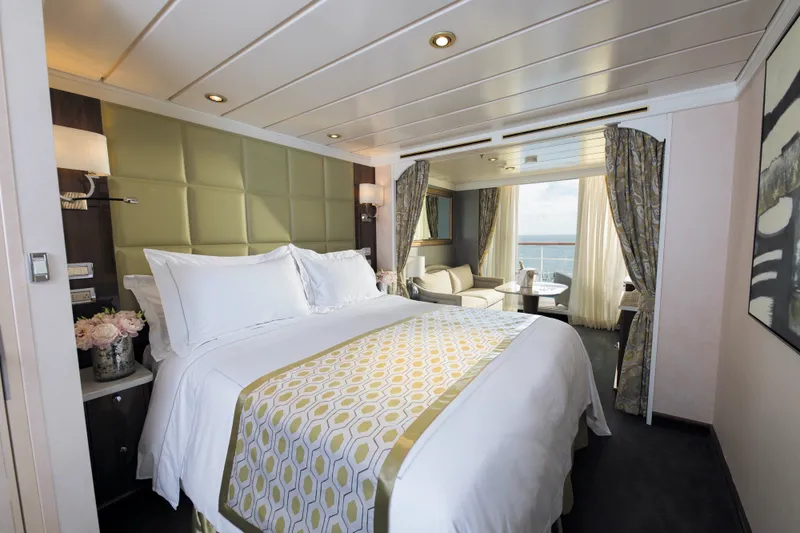
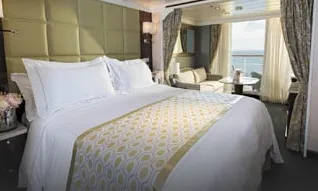
Concierge Suite
Suite
301 m²Max 3
DE
In this superbly designed suite, you enjoy the comfort of richly furnished accommodations as well as exclusive luxuries available only in suites at the Concierge level and higher. Your suite includes amenities such as an illy espresso maker and cashmere blankets, perfect for use in the morning when you wish to sip coffee and enjoy an in-suite breakfast on your private balcony. Take advantage of 24-hour room service when the mood strikes.
SUITE SIZE
23.5
M2
BALCONY SIZE
4.5
M2
LAYOUT
1 Marble Bathroom
Private Balcony
Sitting Area
Maximum of 3 Guests
Vanity AreaTVFree Wi-FiCoffee MachineBathKing or Twin Configuration+11
US$83,189 /person+ US$8,706 taxes & fees
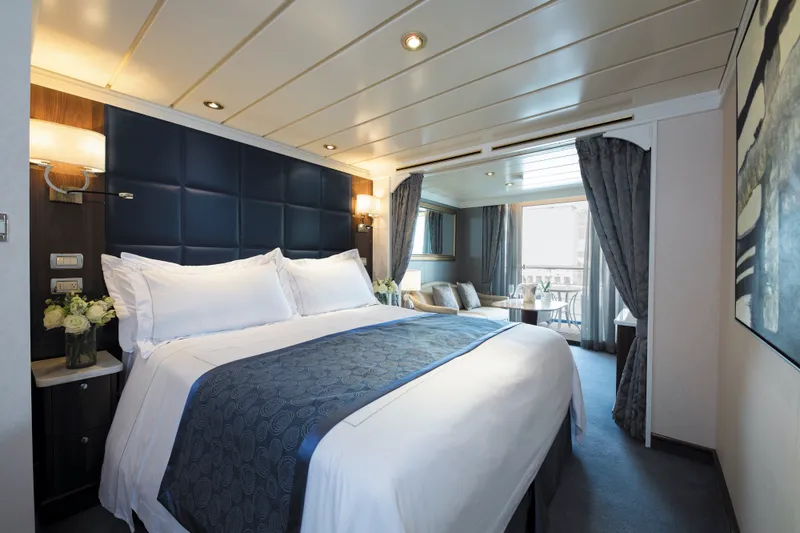
Deluxe Suite
Suite
301 m²Max 3
H
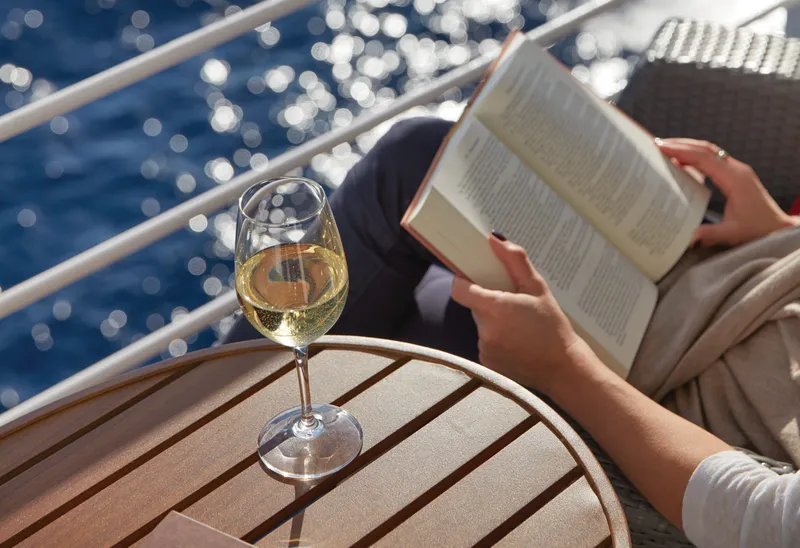
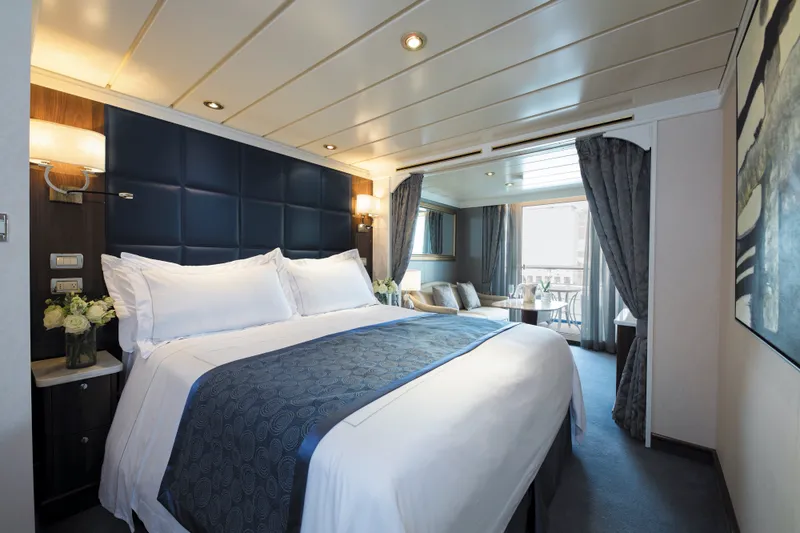
Every inch of this suite has been thoughtfully designed to maximize interior space and embrace the magnificent scenery outdoors. From the sitting area, admire the ocean views through the floor-to-ceiling windows, or better yet, take a seat outside on your private balcony to watch the world go by. Elegant finishes such as luxurious bedding and beautiful marble detailing in the bath further enhance your comfort.
SUITE SIZE
23.5
M2
BALCONY SIZE
4.5
M2
LAYOUT
1 Marble Bathroom
Private Balcony
Sitting Area
Maximum of 3 Guests
Vanity AreaFree Mini BarTVFree Wi-FiBathKing or Twin Configuration+10
View Details
Deluxe Veranda Suite
Suite
301 m²Max 3
FG
Every inch of this suite has been thoughtfully designed to maximize interior space and embrace the magnificent scenery outdoors. From the sitting area, admire the ocean views through the floor-to-ceiling windows, or better yet, take a seat outside on your private balcony to watch the world go by. Elegant finishes such as luxurious bedding and beautiful marble detailing in the bath further enhance your comfort.
SUITE SIZE
23.5
M2
BALCONY SIZE
4.5
M2
LAYOUT
1 Marble Bathroom
Private Balcony
Sitting Area
Maximum of 3 Guests
Vanity AreaFree Mini BarTVFree Wi-FiBathKing or Twin Configuration+10
US$78,689 /person+ US$8,706 taxes & fees

Grand Suite
Suite
987 m²Max 3
GS
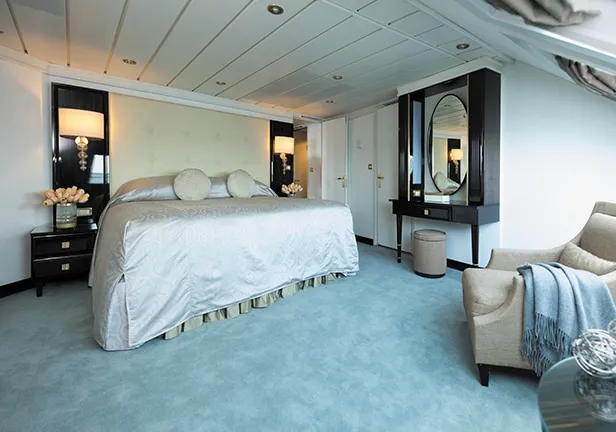
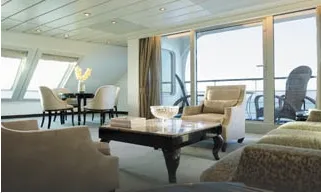
Step into the richness of a dining area perfectly ensconced within a spacious, art-filled living room. Just outside is a private balcony with a table and chairs just right for in-suite breakfast. The master bedroom is large and inviting, its soothing color palette conducive to a peaceful night’s rest on your King-Sized Elite Slumber Bed. Two full baths and luxurious bath products invite you to indulge in unbridled ‘me time’.
SUITE SIZE
84
M2
BALCONY SIZE
8
M2
LAYOUT
2 Marble Bathrooms
Private Balcony
Spacious Bedroom
Expansive Living Room
Maximum of 3 Guests
Lounge AreaVanity AreaBathSuite BenefitsButler ServiceTV+13
View Details

Horizon Suite
Suite
628 m²Max 3
HS
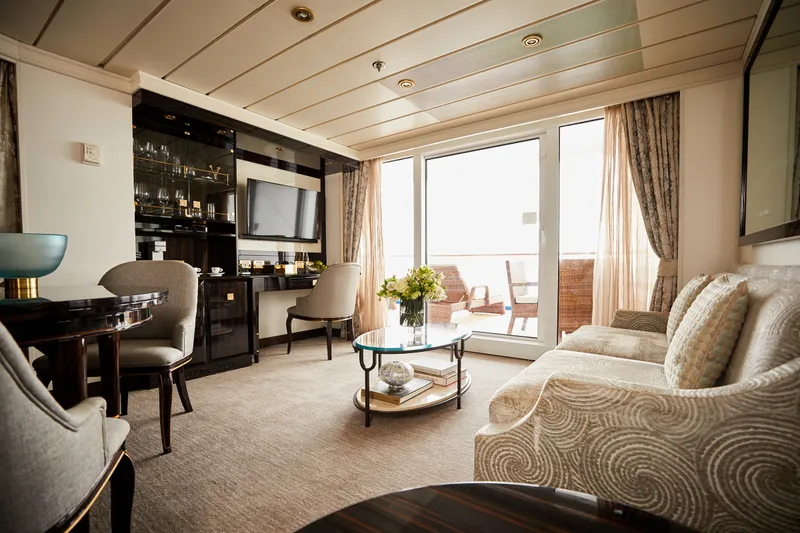
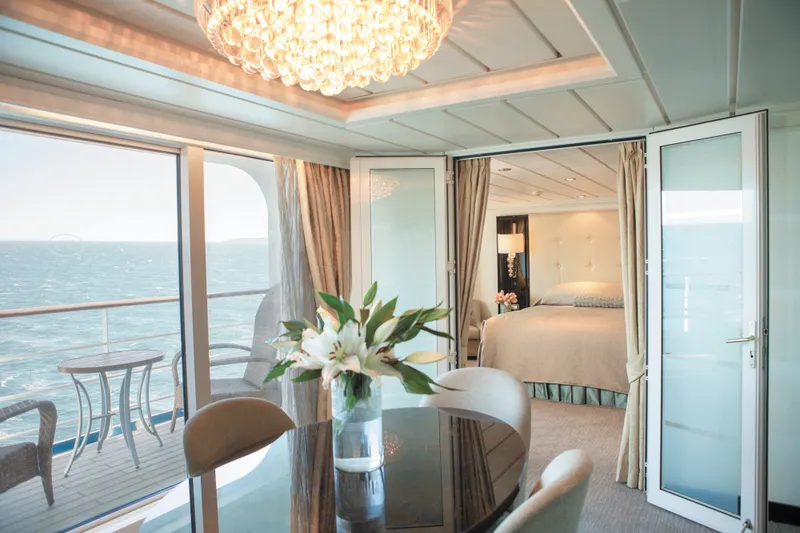
Located along the stern of Seven Seas Mariner, this suite offers a panoramic vista and expansive balcony that is large enough for two cushioned chaises, two chairs and a table. Inside, the bed alcove is separated from a beautifully appointed sitting area by curtains, allowing you to control how much sunlight greets you each morning. You’ll also have a personal butler attending to your needs and a bevy of luxurious amenities.
SUITE SIZE
33.5
M2
BALCONY SIZE
25
M2
LAYOUT
1 Marble Bathroom
Private Balcony
Sitting Area
Maximum of 3 Guests
Lounge AreaVanity AreaSuite BenefitsButler ServiceTVFree Wi-Fi+11
View Details
Mariner Suite
Suite
740 m²Max 4
MN
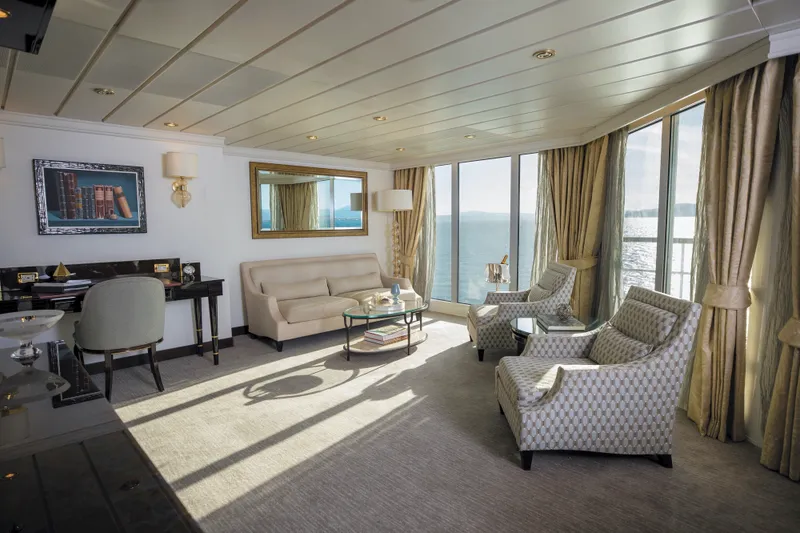
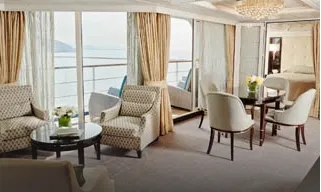
Spectacular panoramic views will seem to have been created just for you when you relax on your suite’s private balcony. Comfortably located mid-ship, this suite has a spacious separate bedroom with a European king-sized Elite Slumber bed and one-and-a-half baths. This suite features a spacious walk-in closet with drawers as well. To elevate your experience even more, a personal butler will be on call to help make your onboard wishes come true.
SUITE SIZE
60.5
M2
BALCONY SIZE
8.5
M2
LAYOUT
1 1/2 Marble Bathrooms
Private Balcony
Spacious Bedroom
Expansive Living Room
Maximum of 3 Guests
Lounge AreaVanity AreaSuite BenefitsButler ServiceTVFree Wi-Fi+13
View Details
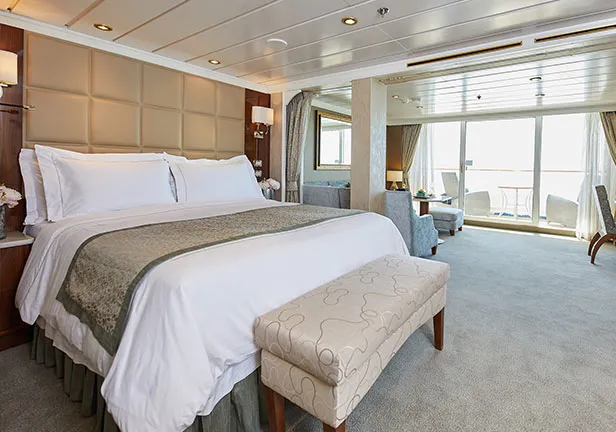
Penthouse Suite
Suite
449 m²Max 3
ABC
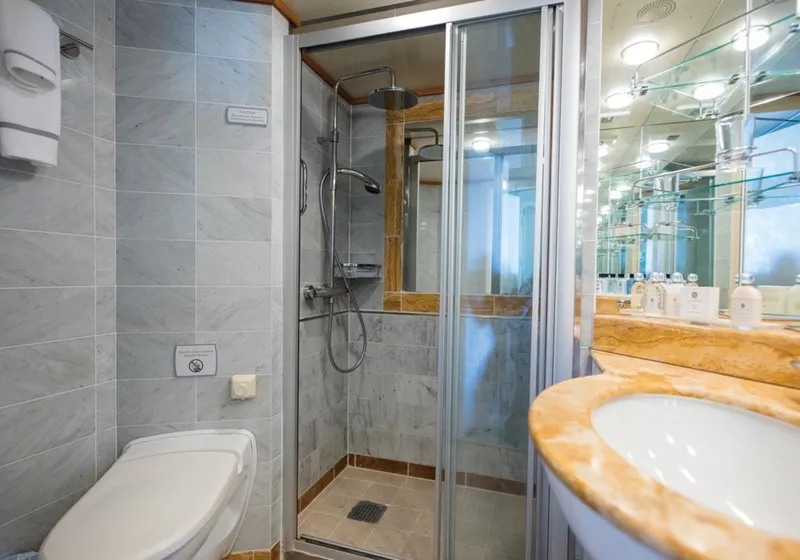
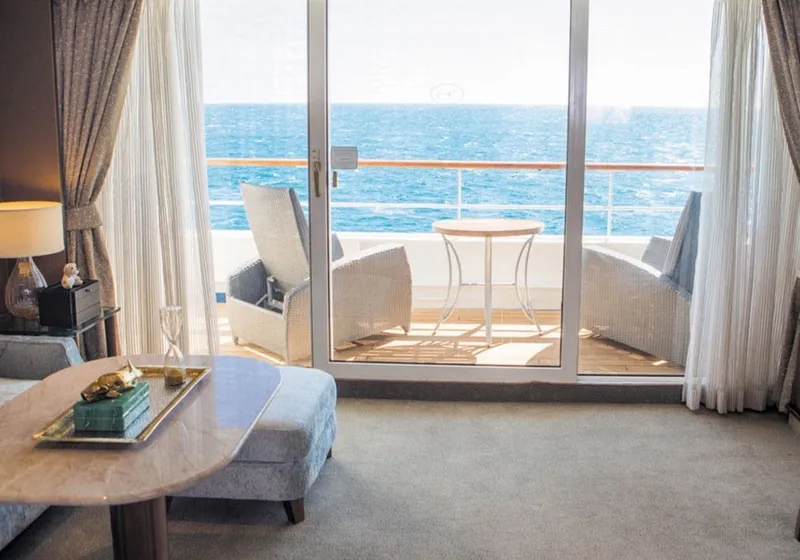
The luxurious suite has been carefully designed to maximize space and comfort. Relax on your private balcony and indulge in your lavish bath amenities as you recharge and ready yourself for new adventures in the next port of call. This suite also includes priority online reservations for shore excursions and dining, and you’re encouraged to call on the services of a personal butler for special requests.
SUITE SIZE
35
M2
BALCONY SIZE
7
M2
LAYOUT
1 Marble Bathroom
Private Balcony
Sitting Area
Maximum of 3 Guests
Vanity AreaTVFree Wi-FiCoffee MachineBathKing or Twin Configuration+11
View Details
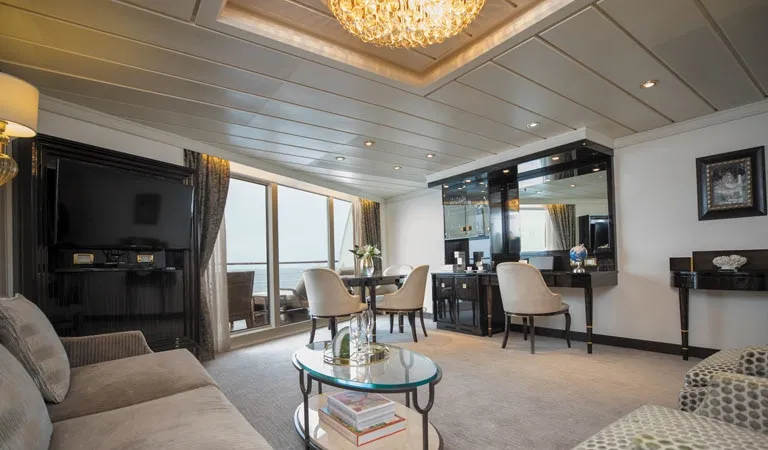
Seven Seas Suite (AFT)
Suite
SSA
This suite welcomes you with soothing colors, pleasing artwork and comfortable furnishings. Relax in the sitting area after an exciting day ashore and enjoy the selection of fresh canapés delivered by your personal butler. Then retreat to your private balcony to watch the ever-changing vistas and ponder your next destination. Up to one-and-a-half baths feature fine marble accents and a tub or walk-in shower.
SUITE SIZE
52
M2
BALCONY SIZE
27
M2
LAYOUT
1 1/2 Marble Bathrooms
Private Balcony
Spacious Bedroom
Living Area
Maximum of 3 Guests
View Details
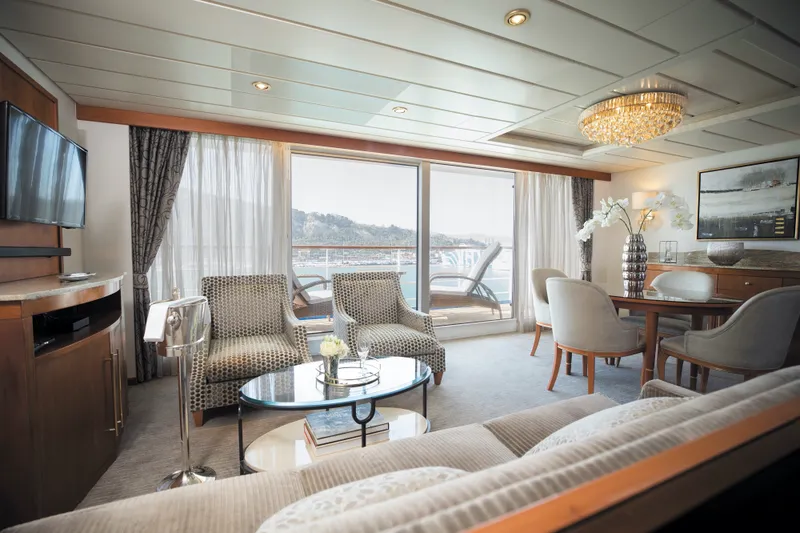
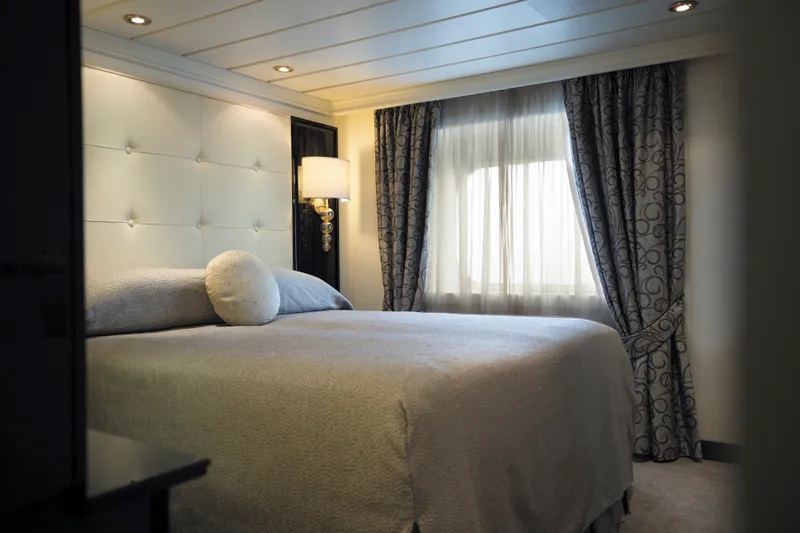
Seven Seas Suite (Forward)
Suite
601–847 m²Max 3
SS
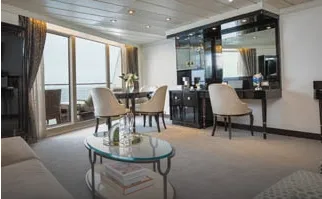
This suite welcomes you with soothing colors, pleasing artwork and comfortable furnishings. Relax in the sitting area after an exciting day ashore and enjoy the selection of fresh canapés delivered by your personal butler. Then retreat to your private balcony to watch the ever-changing vistas and ponder your next destination. Up to one-and-a-half baths feature fine marble accents and a tub or walk-in shower.
SUITE SIZE
47
M2
BALCONY SIZE
9
M2
LAYOUT
1 1/2 Marble Bathrooms
Private Balcony
Spacious Bedroom
Living Area
Maximum of 3 Guests
Lounge AreaVanity AreaSuite BenefitsButler ServiceTVFree Wi-Fi+12
View Details
Signature Suite
Suite
2002 m²Max 5
SG
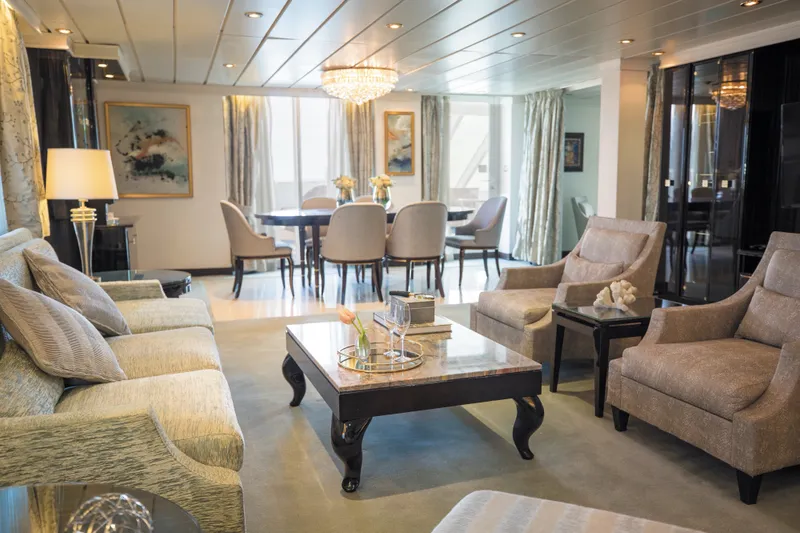
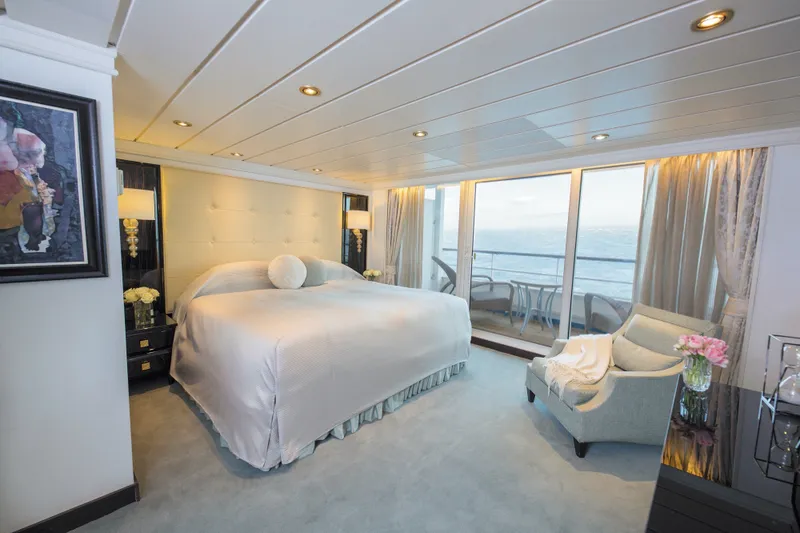
You'll find Park Avenue chic onboard Seven Seas Mariner in this spectacular suite. Elegant rosewood furniture, luxe fabrics and a crystal chandelier create sophisticated comfort, while a personal butler is available to fulfil whatever requests you may have. With two bedrooms, two-and-a-half baths, a large living room and two private balconies, this sublime suite is perfect for hosting new friends in luxury.
SUITE SIZE
112
M2
BALCONY SIZE
74
M2
LAYOUT
2 Private Balconies
2 1/2 Marble Bathrooms
2 Spacious Bedrooms
Expansive Living Room
Maximum of Five Guests
Lounge AreaVanity AreaBathSuite BenefitsButler ServiceTV+13
View Details
Interested in This Voyage?
Our cruise specialists can help you find the perfect cabin and the best available pricing.
(+886) 02-2721-7300Contact Advisor