Date
2027-01-31
Duration
7 nights
Departure Port
Budapest
Hungary
Arrival Port
Budapest
Hungary
Rating
Luxury
Theme
—


AmaWaterways
2018
—
3,600 GT
156
78
51
443 m
11.5 m
11 knots
No

Budapest, divided by the Danube into the hilly Buda of thermal baths and medieval castle lanes on one bank and the grand Pest of coffee-house culture and Art Nouveau splendor on the other, delivers the most theatrical first impression of any European capital — whether approached by river as the neo-Gothic Parliament materializes from the water or by night from the Citadella's sweep of illuminated panorama below. The city's celebrated thermal bath culture, rooted in Ottoman-era hammams and perfected in palatial Secession-era pools like the Széchenyi, is an experience entirely unlike anything else in Europe. Visit spring and autumn for comfortable temperatures; Vienna is two and a half hours west by train.

Bratislava, the only national capital bordering two sovereign states, sits sixty kilometres downstream from Vienna on the Danube — close enough for a day trip to the Austrian capital, yet possessed of its own entirely distinct character: a pastel-hued medieval old town of hidden courtyards, playful bronze statues, and hilltop castle views, where wine bars pour outstanding Slovak Riesling at prices that make the Viennese feel extravagant. The city's dramatic reinvention since 1989 has produced a dynamic, youthful culture that fills the old quarter's restaurants and concert halls with genuine warmth. Pair with Vienna or Budapest for the classic Danube river trilogy; all three cities are within two hours of each other.

Melk Abbey is among the most theatrical expressions of Baroque ambition in all of Europe — a gilded monastery perched on a granite outcrop above the Danube, its domed church and frescoed library presiding over the Wachau Valley with serene authority since Benedictine monks replaced the Babenberg fortress in 1089. Umberto Eco immortalised it as the inspiration for his labyrinthine monastery in "The Name of the Rose," and the library's 100,000 medieval manuscripts remain one of the continent's supreme collections. After the abbey, stroll down to the historic market town and sample the valley's celebrated Grüner Veltliner wines. The Wachau is at its most bewitching in April and October.

Austria's third city has accomplished one of Europe's most convincing urban transformations — reinventing itself from industrial centre to cultural powerhouse, a journey recognised in 2009 when it was named European Capital of Culture. The Ars Electronica Center, a museum of digital art and technology that glows with LED light across the Danube each evening, epitomises Linz's forward-looking identity. Yet the city's Roman roots, its baroque Hauptplatz (one of Austria's finest main squares), and its proximity to the Wachau Valley anchor it firmly in history. The Upper Austrian cuisine — particularly Linzer Torte, the world's oldest-documented cake recipe — is exceptional. Linz is most agreeable May through September.

The port of Vienna is a cultural gem along the Danube River, famous for its stunning architecture, rich history, and vibrant culinary scene. Must-do experiences include sampling authentic Wiener Schnitzel and visiting the picturesque village of Dürnstein. The best season to visit is spring or early fall, when the city's gardens bloom and outdoor activities abound.

Budapest, divided by the Danube into the hilly Buda of thermal baths and medieval castle lanes on one bank and the grand Pest of coffee-house culture and Art Nouveau splendor on the other, delivers the most theatrical first impression of any European capital — whether approached by river as the neo-Gothic Parliament materializes from the water or by night from the Citadella's sweep of illuminated panorama below. The city's celebrated thermal bath culture, rooted in Ottoman-era hammams and perfected in palatial Secession-era pools like the Széchenyi, is an experience entirely unlike anything else in Europe. Visit spring and autumn for comfortable temperatures; Vienna is two and a half hours west by train.
Day 1

Budapest, divided by the Danube into the hilly Buda of thermal baths and medieval castle lanes on one bank and the grand Pest of coffee-house culture and Art Nouveau splendor on the other, delivers the most theatrical first impression of any European capital — whether approached by river as the neo-Gothic Parliament materializes from the water or by night from the Citadella's sweep of illuminated panorama below. The city's celebrated thermal bath culture, rooted in Ottoman-era hammams and perfected in palatial Secession-era pools like the Széchenyi, is an experience entirely unlike anything else in Europe. Visit spring and autumn for comfortable temperatures; Vienna is two and a half hours west by train.
Day 2

Bratislava, the only national capital bordering two sovereign states, sits sixty kilometres downstream from Vienna on the Danube — close enough for a day trip to the Austrian capital, yet possessed of its own entirely distinct character: a pastel-hued medieval old town of hidden courtyards, playful bronze statues, and hilltop castle views, where wine bars pour outstanding Slovak Riesling at prices that make the Viennese feel extravagant. The city's dramatic reinvention since 1989 has produced a dynamic, youthful culture that fills the old quarter's restaurants and concert halls with genuine warmth. Pair with Vienna or Budapest for the classic Danube river trilogy; all three cities are within two hours of each other.
Day 3

Melk Abbey is among the most theatrical expressions of Baroque ambition in all of Europe — a gilded monastery perched on a granite outcrop above the Danube, its domed church and frescoed library presiding over the Wachau Valley with serene authority since Benedictine monks replaced the Babenberg fortress in 1089. Umberto Eco immortalised it as the inspiration for his labyrinthine monastery in "The Name of the Rose," and the library's 100,000 medieval manuscripts remain one of the continent's supreme collections. After the abbey, stroll down to the historic market town and sample the valley's celebrated Grüner Veltliner wines. The Wachau is at its most bewitching in April and October.
Day 4

Austria's third city has accomplished one of Europe's most convincing urban transformations — reinventing itself from industrial centre to cultural powerhouse, a journey recognised in 2009 when it was named European Capital of Culture. The Ars Electronica Center, a museum of digital art and technology that glows with LED light across the Danube each evening, epitomises Linz's forward-looking identity. Yet the city's Roman roots, its baroque Hauptplatz (one of Austria's finest main squares), and its proximity to the Wachau Valley anchor it firmly in history. The Upper Austrian cuisine — particularly Linzer Torte, the world's oldest-documented cake recipe — is exceptional. Linz is most agreeable May through September.
Day 5

The port of Vienna is a cultural gem along the Danube River, famous for its stunning architecture, rich history, and vibrant culinary scene. Must-do experiences include sampling authentic Wiener Schnitzel and visiting the picturesque village of Dürnstein. The best season to visit is spring or early fall, when the city's gardens bloom and outdoor activities abound.
Day 7

Budapest, divided by the Danube into the hilly Buda of thermal baths and medieval castle lanes on one bank and the grand Pest of coffee-house culture and Art Nouveau splendor on the other, delivers the most theatrical first impression of any European capital — whether approached by river as the neo-Gothic Parliament materializes from the water or by night from the Citadella's sweep of illuminated panorama below. The city's celebrated thermal bath culture, rooted in Ottoman-era hammams and perfected in palatial Secession-era pools like the Széchenyi, is an experience entirely unlike anything else in Europe. Visit spring and autumn for comfortable temperatures; Vienna is two and a half hours west by train.


In-room temperature control
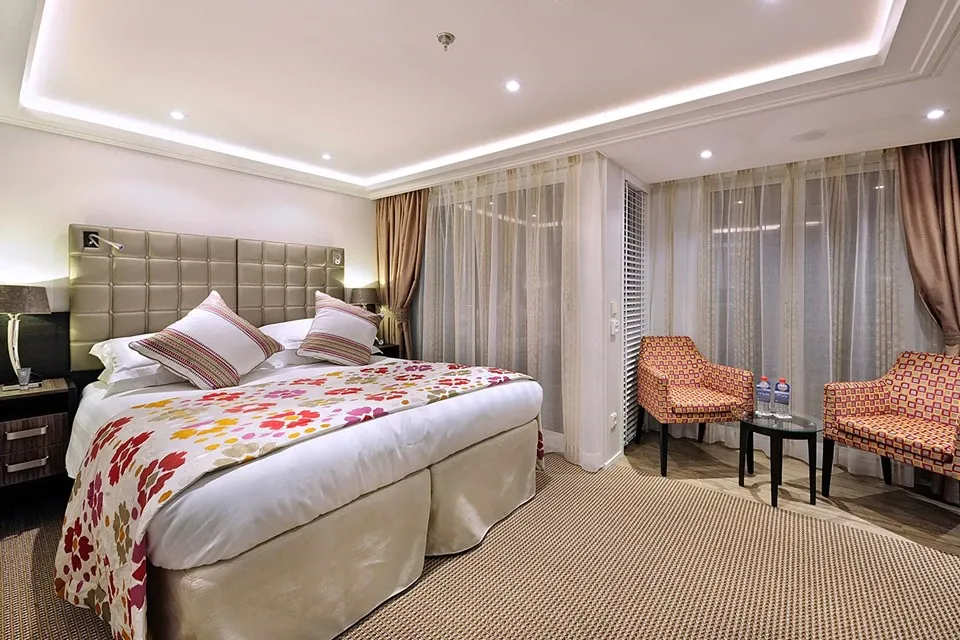
Deluxe hotel-style bedding with Egyptian linen, down pillows and duvet
Spacious bathrooms with multi-jet showerheads
Large wardrobe, full-length mirror, hair dryer, safe and direct-dial telephone
Flat-screen TV that also works as a computer
Entertainment on Demand system providing complimentary TV, movies and music library
Complimentary internet and Wi-Fi
Complimentary bottled water replenished daily
Desk and chair


In-room temperature control
Deluxe hotel-style bedding with Egyptian linen, down pillows and duvet
Spacious bathrooms with multi-jet showerheads
Large wardrobe, full-length mirror, hair dryer, safe and direct-dial telephone
Flat-screen TV that also works as a computer
Entertainment on Demand system providing complimentary TV, movies and music library
Complimentary internet and Wi-Fi
Complimentary bottled water replenished daily
Desk and chair


In-room temperature control
Deluxe hotel-style bedding with Egyptian linen, down pillows and duvet
Spacious bathrooms with multi-jet showerheads
Large wardrobe, full-length mirror, hair dryer, safe and direct-dial telephone
Flat-screen TV that also works as a computer
Entertainment on Demand system providing complimentary TV, movies and music library
Complimentary internet and Wi-Fi
Complimentary bottled water replenished daily
Desk and chair


In-room temperature control
Deluxe hotel-style bedding with Egyptian linen, down pillows and duvet
Spacious bathrooms with multi-jet showerheads
Large wardrobe, full-length mirror, hair dryer, safe and direct-dial telephone
Flat-screen TV that also works as a computer
Entertainment on Demand system providing complimentary TV, movies and music library
Complimentary internet and Wi-Fi
Complimentary bottled water replenished daily
Desk and chair
Our cruise specialists can help you find the perfect cabin and the best available pricing.
(+886) 02-2721-7300Contact Advisor