Date
2026-10-08
Duration
14 nights
Departure Port
Paris
France
Arrival Port
Arles
United Kingdom
Rating
—
Theme
—


AmaWaterways
Contemporary
2009
—
3,350 GT
144
73
45
360 m
12 m
—
No

Paris rewards every arrival as though it were the first — the sweep of the Seine, the Gothic tracery of Notre-Dame rising again from its 2019 ashes, the Eiffel Tower somehow managing to astonish at each encounter, the Louvre's glass pyramid reflecting clouds in the courtyard of a palace that served French kings for four centuries. Beyond the monuments, Paris is a city of neighbourhoods: the Belle Époque brasseries of Montparnasse, the covered passages of the 2nd arrondissement, the rooftop terraces of Le Marais. The Luxembourg Gardens in April, or a late-September evening on the Canal Saint-Martin, are among the most civilised experiences in the world.

Les Andelys occupies one of the Seine's most dramatic bends, dominated by the spectral ruins of Château Gaillard — Richard the Lionheart's 'Saucy Castle,' built with medieval speed in a single year and considered a masterpiece of twelfth-century military engineering. The view from the castle's white chalk promontory across the river's great loop is among the most beautiful in Normandy, a landscape that captivated Monet and Pissarro. Below, the twin villages of Grand and Petit Andely offer excellent Normandy cuisine, notably duck dishes prepared with local cider. Les Andelys is best visited April through October as part of a Seine river cruise; golden autumn light renders the chalk cliffs particularly luminous.

Founded in 1517 by Francis I and rebuilt after World War II devastation by Auguste Perret's visionary grid of reinforced concrete — now a UNESCO World Heritage Site — Le Havre is a city where urban architecture becomes a form of art. The monumental church of Saint-Joseph, lit from within by fifteen thousand pieces of coloured glass, is a masterpiece of post-war modernism. Day trips to Honfleur, the exquisite half-timbered port that launched Impressionism, and to the D-Day beaches of Normandy, make Le Havre one of the channel's most strategically placed cruise calls. The city is most agreeable May through September; the Honfleur excursion rewards in any season.

Caudebec-en-Caux nestles in a Seine meander between Rouen and the sea, famous for its Flamboyant Gothic Eglise Notre-Dame — a masterwork of late medieval stone lacework so exquisite that Henri IV called it 'the most beautiful chapel in my kingdom.' The town serves as an ideal quiet base for exploring the Seine Valley's quieter pleasures: the remarkable Abbaye de Jumiéges, its roofless nave open to the Norman sky, and the Manoir d'Ango, a Renaissance manor of extraordinary ambition, are both within easy reach. The tidal atmosphere of the Seine at this point rewards early morning walks along the embankment. Rouen, with its Gothic cathedral and Impressionist legacy, lies forty minutes east.

Rouen, the medieval capital of Normandy set in a wooded meander of the Seine, rewards slow exploration with one of France's richest concentrations of Gothic architecture. The vast cathedral — immortalised by Monet in his celebrated series of canvases — dominates a city where half-timbered lanes wind between Renaissance mansions and the square where Joan of Arc was burned in 1431. The covered market overflows with Normandy's great dairy bounty: camembert, livarot, and pont-l'évêque alongside cider and calvados. Paris lies just ninety minutes south by train. Spring and early autumn offer the most atmospheric conditions.

Vernon is a quietly beguiling Norman town on the Seine whose greatest treasure lies just four kilometers beyond its medieval bridge: the garden and water lily ponds at Giverny, where Claude Monet lived and painted for forty-three years, creating the luminous imagery that changed the course of modern art. The town itself retains considerable charm — a romanticly ruined twelfth-century bridge tower draped in ivy, half-timbered houses along the riverbank, and a fine museum housing several original Monet canvases. Monet's garden is open from April through October, reaching its peak splendor in May and June when his beloved water lilies are in full, painterly bloom.

Paris rewards every arrival as though it were the first — the sweep of the Seine, the Gothic tracery of Notre-Dame rising again from its 2019 ashes, the Eiffel Tower somehow managing to astonish at each encounter, the Louvre's glass pyramid reflecting clouds in the courtyard of a palace that served French kings for four centuries. Beyond the monuments, Paris is a city of neighbourhoods: the Belle Époque brasseries of Montparnasse, the covered passages of the 2nd arrondissement, the rooftop terraces of Le Marais. The Luxembourg Gardens in April, or a late-September evening on the Canal Saint-Martin, are among the most civilised experiences in the world.

Dijon, the capital of Burgundy, is a port city rich in history, known for its stunning architecture and vibrant culinary scene. Must-do experiences include sampling the world-famous moutarde de Dijon at local markets and indulging in regional dishes like coq au vin. The best time to visit is during the autumn gastronomic fair, when the city truly comes alive with local flavors and traditions.

Birthplace of photography and gateway to Burgundy's finest vineyards, Chalon-sur-Saône is a Saône River gem that rewards those who linger beyond its famous streets. The Musée Nicéphore Niépce, housed in a riverside mansion, chronicles the invention of the medium that changed human perception forever, while the surrounding Côte Chalonnaise wine villages — Mercurey, Givry, Rully — offer some of Burgundy's most approachable yet complex Pinot Noirs. Visit in late summer or early autumn for harvest season, when the vineyards blush gold and local restaurants celebrate the new vintage.

Tain-l'Hermitage is the beating heart of the northern Rhône wine country, a compact town whose steeply terraced granite hill has yielded some of France's most majestic Syrahs and finest Marsannes since the Roman era. The revered Hermitage hill — its legend entwined with a thirteenth-century crusader hermit — rises directly behind the main street, and the great wine estates of Jaboulet, Chapoutier, and Ferraton offer some of the Loire Valley's most memorable cellar tastings. Autumn harvest season brings the vineyards to their most photogenic golden glory; spring and summer offer ideal touring weather along the Rhône cycling routes between vines and river.

Mâcon, a historic city in Burgundy, is a captivating port known for its rich heritage, charming architecture, and vibrant culinary scene. Must-do experiences include savoring local specialties such as "poulet de Bresse" and exploring the bustling Mâcon market. The best season to visit is spring, when the surrounding vineyards are lush and the local festivals bring the city's culture to life.

Lyon sits at the confluence of the Rhône and the Saône — a geographic destiny that made it the capital of Roman Gaul, a Renaissance silk-trading powerhouse, and, by contemporary consensus, the undisputed gastronomic capital of France. The UNESCO-listed Vieux Lyon preserves Europe's finest concentration of Renaissance architecture, its labyrinthine traboules — secret passageways threading through courtyard after courtyard — offering endless discovery. Paul Bocuse's legacy lives on in the city's constellation of bouchons, where quenelles de brochet and tablier de sapeur are served with the straightforward confidence of a city that has never needed to prove its culinary supremacy. Lyon rewards a visit in any season, with the Festival of Lights in December being particularly magical.

Viviers is one of France's most beautifully preserved medieval secrets — a cathedral town of barely four thousand souls perched on a limestone spur above the Rhône, serving as an episcopal seat since the fifth century when its bishops chose this formidable rock over the declining Roman city below. The Romanesque bell tower, vaulted passageways, and Renaissance townhouses of the haute ville form an ensemble of extraordinary architectural coherence, virtually unaltered since the seventeenth century. River cruise guests arriving from Lyon or Avignon typically spend languid afternoons exploring these narrow, time-suspended streets, best visited in spring or early autumn when Rhône Valley light is at its most golden.

Avignon's Palais des Papes — a fortress-palace of staggering medieval ambition where seven successive popes held court for seventy years — still dominates this Provençal city's skyline, its limestone bulk enclosing frescoed chapels and vast ceremonial halls that once shaped the destiny of Christendom. In July, the city transforms for the celebrated Festival d'Avignon, Europe's premier theatre gathering, turning every courtyard and cloister into a stage. Year-round, the beautifully preserved historic centre offers world-class Rhône Valley wines, refined Provençal cuisine, and the beguiling spectacle of the Pont Saint-Bénézet stretching halfway across the river. Lyon and Marseille are each accessible in under ninety minutes by TGV.

Arles, the most important city in Roman Gaul after Lyon, wears its history with casual magnificence: a first-century amphitheatre still hosts bullfights beneath open skies, and the haunting Alyscamps necropolis — once among the most prestigious burial grounds in the Western world — lines a poplar-shaded avenue with ancient sarcophagi. Yet Arles is equally celebrated as the city that intoxicated Vincent van Gogh, who produced over three hundred works here in fifteen fevered months; the Fondation Vincent van Gogh now honors his legacy in beautifully renovated rooms. Spring and autumn are ideal, with the Camargue's flamingo-filled wetlands just minutes south. Lyon is two hours north by TGV.
Day 1

Paris rewards every arrival as though it were the first — the sweep of the Seine, the Gothic tracery of Notre-Dame rising again from its 2019 ashes, the Eiffel Tower somehow managing to astonish at each encounter, the Louvre's glass pyramid reflecting clouds in the courtyard of a palace that served French kings for four centuries. Beyond the monuments, Paris is a city of neighbourhoods: the Belle Époque brasseries of Montparnasse, the covered passages of the 2nd arrondissement, the rooftop terraces of Le Marais. The Luxembourg Gardens in April, or a late-September evening on the Canal Saint-Martin, are among the most civilised experiences in the world.
Day 2

Les Andelys occupies one of the Seine's most dramatic bends, dominated by the spectral ruins of Château Gaillard — Richard the Lionheart's 'Saucy Castle,' built with medieval speed in a single year and considered a masterpiece of twelfth-century military engineering. The view from the castle's white chalk promontory across the river's great loop is among the most beautiful in Normandy, a landscape that captivated Monet and Pissarro. Below, the twin villages of Grand and Petit Andely offer excellent Normandy cuisine, notably duck dishes prepared with local cider. Les Andelys is best visited April through October as part of a Seine river cruise; golden autumn light renders the chalk cliffs particularly luminous.
Day 3

Founded in 1517 by Francis I and rebuilt after World War II devastation by Auguste Perret's visionary grid of reinforced concrete — now a UNESCO World Heritage Site — Le Havre is a city where urban architecture becomes a form of art. The monumental church of Saint-Joseph, lit from within by fifteen thousand pieces of coloured glass, is a masterpiece of post-war modernism. Day trips to Honfleur, the exquisite half-timbered port that launched Impressionism, and to the D-Day beaches of Normandy, make Le Havre one of the channel's most strategically placed cruise calls. The city is most agreeable May through September; the Honfleur excursion rewards in any season.
Day 4

Caudebec-en-Caux nestles in a Seine meander between Rouen and the sea, famous for its Flamboyant Gothic Eglise Notre-Dame — a masterwork of late medieval stone lacework so exquisite that Henri IV called it 'the most beautiful chapel in my kingdom.' The town serves as an ideal quiet base for exploring the Seine Valley's quieter pleasures: the remarkable Abbaye de Jumiéges, its roofless nave open to the Norman sky, and the Manoir d'Ango, a Renaissance manor of extraordinary ambition, are both within easy reach. The tidal atmosphere of the Seine at this point rewards early morning walks along the embankment. Rouen, with its Gothic cathedral and Impressionist legacy, lies forty minutes east.
Day 5

Rouen, the medieval capital of Normandy set in a wooded meander of the Seine, rewards slow exploration with one of France's richest concentrations of Gothic architecture. The vast cathedral — immortalised by Monet in his celebrated series of canvases — dominates a city where half-timbered lanes wind between Renaissance mansions and the square where Joan of Arc was burned in 1431. The covered market overflows with Normandy's great dairy bounty: camembert, livarot, and pont-l'évêque alongside cider and calvados. Paris lies just ninety minutes south by train. Spring and early autumn offer the most atmospheric conditions.
Day 6

Vernon is a quietly beguiling Norman town on the Seine whose greatest treasure lies just four kilometers beyond its medieval bridge: the garden and water lily ponds at Giverny, where Claude Monet lived and painted for forty-three years, creating the luminous imagery that changed the course of modern art. The town itself retains considerable charm — a romanticly ruined twelfth-century bridge tower draped in ivy, half-timbered houses along the riverbank, and a fine museum housing several original Monet canvases. Monet's garden is open from April through October, reaching its peak splendor in May and June when his beloved water lilies are in full, painterly bloom.
Day 7

Paris rewards every arrival as though it were the first — the sweep of the Seine, the Gothic tracery of Notre-Dame rising again from its 2019 ashes, the Eiffel Tower somehow managing to astonish at each encounter, the Louvre's glass pyramid reflecting clouds in the courtyard of a palace that served French kings for four centuries. Beyond the monuments, Paris is a city of neighbourhoods: the Belle Époque brasseries of Montparnasse, the covered passages of the 2nd arrondissement, the rooftop terraces of Le Marais. The Luxembourg Gardens in April, or a late-September evening on the Canal Saint-Martin, are among the most civilised experiences in the world.
Day 8

Dijon, the capital of Burgundy, is a port city rich in history, known for its stunning architecture and vibrant culinary scene. Must-do experiences include sampling the world-famous moutarde de Dijon at local markets and indulging in regional dishes like coq au vin. The best time to visit is during the autumn gastronomic fair, when the city truly comes alive with local flavors and traditions.
Day 9

Birthplace of photography and gateway to Burgundy's finest vineyards, Chalon-sur-Saône is a Saône River gem that rewards those who linger beyond its famous streets. The Musée Nicéphore Niépce, housed in a riverside mansion, chronicles the invention of the medium that changed human perception forever, while the surrounding Côte Chalonnaise wine villages — Mercurey, Givry, Rully — offer some of Burgundy's most approachable yet complex Pinot Noirs. Visit in late summer or early autumn for harvest season, when the vineyards blush gold and local restaurants celebrate the new vintage.
Day 10

Tain-l'Hermitage is the beating heart of the northern Rhône wine country, a compact town whose steeply terraced granite hill has yielded some of France's most majestic Syrahs and finest Marsannes since the Roman era. The revered Hermitage hill — its legend entwined with a thirteenth-century crusader hermit — rises directly behind the main street, and the great wine estates of Jaboulet, Chapoutier, and Ferraton offer some of the Loire Valley's most memorable cellar tastings. Autumn harvest season brings the vineyards to their most photogenic golden glory; spring and summer offer ideal touring weather along the Rhône cycling routes between vines and river.
Day 11

Mâcon, a historic city in Burgundy, is a captivating port known for its rich heritage, charming architecture, and vibrant culinary scene. Must-do experiences include savoring local specialties such as "poulet de Bresse" and exploring the bustling Mâcon market. The best season to visit is spring, when the surrounding vineyards are lush and the local festivals bring the city's culture to life.
Day 12

Lyon sits at the confluence of the Rhône and the Saône — a geographic destiny that made it the capital of Roman Gaul, a Renaissance silk-trading powerhouse, and, by contemporary consensus, the undisputed gastronomic capital of France. The UNESCO-listed Vieux Lyon preserves Europe's finest concentration of Renaissance architecture, its labyrinthine traboules — secret passageways threading through courtyard after courtyard — offering endless discovery. Paul Bocuse's legacy lives on in the city's constellation of bouchons, where quenelles de brochet and tablier de sapeur are served with the straightforward confidence of a city that has never needed to prove its culinary supremacy. Lyon rewards a visit in any season, with the Festival of Lights in December being particularly magical.
Day 13

Viviers is one of France's most beautifully preserved medieval secrets — a cathedral town of barely four thousand souls perched on a limestone spur above the Rhône, serving as an episcopal seat since the fifth century when its bishops chose this formidable rock over the declining Roman city below. The Romanesque bell tower, vaulted passageways, and Renaissance townhouses of the haute ville form an ensemble of extraordinary architectural coherence, virtually unaltered since the seventeenth century. River cruise guests arriving from Lyon or Avignon typically spend languid afternoons exploring these narrow, time-suspended streets, best visited in spring or early autumn when Rhône Valley light is at its most golden.
Day 14

Avignon's Palais des Papes — a fortress-palace of staggering medieval ambition where seven successive popes held court for seventy years — still dominates this Provençal city's skyline, its limestone bulk enclosing frescoed chapels and vast ceremonial halls that once shaped the destiny of Christendom. In July, the city transforms for the celebrated Festival d'Avignon, Europe's premier theatre gathering, turning every courtyard and cloister into a stage. Year-round, the beautifully preserved historic centre offers world-class Rhône Valley wines, refined Provençal cuisine, and the beguiling spectacle of the Pont Saint-Bénézet stretching halfway across the river. Lyon and Marseille are each accessible in under ninety minutes by TGV.

Arles, the most important city in Roman Gaul after Lyon, wears its history with casual magnificence: a first-century amphitheatre still hosts bullfights beneath open skies, and the haunting Alyscamps necropolis — once among the most prestigious burial grounds in the Western world — lines a poplar-shaded avenue with ancient sarcophagi. Yet Arles is equally celebrated as the city that intoxicated Vincent van Gogh, who produced over three hundred works here in fifteen fevered months; the Fondation Vincent van Gogh now honors his legacy in beautifully renovated rooms. Spring and autumn are ideal, with the Camargue's flamingo-filled wetlands just minutes south. Lyon is two hours north by TGV.


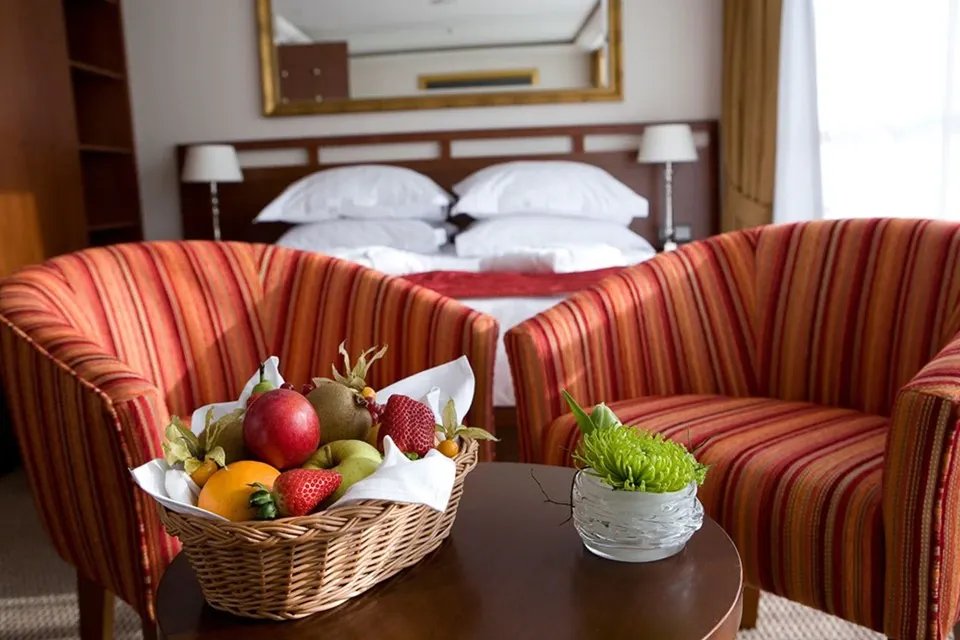
In-room temperature control
Deluxe hotel-style bedding with Egyptian linen, down pillows and duvet
Spacious bathrooms with multi-jet showerheads
Large wardrobe, full-length mirror, hair dryer, safe and direct-dial telephone
Flat-screen TV that also works as a computer
Entertainment on Demand system providing complimentary TV, movies and music library
Complimentary internet and Wi-Fi
Complimentary bottled water replenished daily
Desk and chair


In-room temperature control
Deluxe hotel-style bedding with Egyptian linen, down pillows and duvet
Spacious bathrooms with multi-jet showerheads
Large wardrobe, full-length mirror, hair dryer, safe and direct-dial telephone
Flat-screen TV that also works as a computer
Entertainment on Demand system providing complimentary TV, movies and music library
Complimentary internet and Wi-Fi
Complimentary bottled water replenished daily
Desk and chair


In-room temperature control
Deluxe hotel-style bedding with Egyptian linen, down pillows and duvet
Spacious bathrooms with multi-jet showerheads
Large wardrobe, full-length mirror, hair dryer, safe and direct-dial telephone
Flat-screen TV that also works as a computer
Entertainment on Demand system providing complimentary TV, movies and music library
Complimentary internet and Wi-Fi
Complimentary bottled water replenished daily
Desk and chair


In-room temperature control
Deluxe hotel-style bedding with Egyptian linen, down pillows and duvet
Spacious bathrooms with multi-jet showerheads
Large wardrobe, full-length mirror, hair dryer, safe and direct-dial telephone
Flat-screen TV that also works as a computer
Entertainment on Demand system providing complimentary TV, movies and music library
Complimentary internet and Wi-Fi
Complimentary bottled water replenished daily
Desk and chair
Our cruise specialists can help you find the perfect cabin and the best available pricing.
(+886) 02-2721-7300Contact Advisor