Date
2026-10-22
Duration
14 nights
Departure Port
Paris
France
Arrival Port
Bordeaux
France
Rating
—
Theme
—


AmaWaterways
Contemporary
2009
—
3,350 GT
144
73
45
360 m
12 m
—
No

Paris rewards every arrival as though it were the first — the sweep of the Seine, the Gothic tracery of Notre-Dame rising again from its 2019 ashes, the Eiffel Tower somehow managing to astonish at each encounter, the Louvre's glass pyramid reflecting clouds in the courtyard of a palace that served French kings for four centuries. Beyond the monuments, Paris is a city of neighbourhoods: the Belle Époque brasseries of Montparnasse, the covered passages of the 2nd arrondissement, the rooftop terraces of Le Marais. The Luxembourg Gardens in April, or a late-September evening on the Canal Saint-Martin, are among the most civilised experiences in the world.

Les Andelys occupies one of the Seine's most dramatic bends, dominated by the spectral ruins of Château Gaillard — Richard the Lionheart's 'Saucy Castle,' built with medieval speed in a single year and considered a masterpiece of twelfth-century military engineering. The view from the castle's white chalk promontory across the river's great loop is among the most beautiful in Normandy, a landscape that captivated Monet and Pissarro. Below, the twin villages of Grand and Petit Andely offer excellent Normandy cuisine, notably duck dishes prepared with local cider. Les Andelys is best visited April through October as part of a Seine river cruise; golden autumn light renders the chalk cliffs particularly luminous.

Founded in 1517 by Francis I and rebuilt after World War II devastation by Auguste Perret's visionary grid of reinforced concrete — now a UNESCO World Heritage Site — Le Havre is a city where urban architecture becomes a form of art. The monumental church of Saint-Joseph, lit from within by fifteen thousand pieces of coloured glass, is a masterpiece of post-war modernism. Day trips to Honfleur, the exquisite half-timbered port that launched Impressionism, and to the D-Day beaches of Normandy, make Le Havre one of the channel's most strategically placed cruise calls. The city is most agreeable May through September; the Honfleur excursion rewards in any season.

Rouen, the medieval capital of Normandy set in a wooded meander of the Seine, rewards slow exploration with one of France's richest concentrations of Gothic architecture. The vast cathedral — immortalised by Monet in his celebrated series of canvases — dominates a city where half-timbered lanes wind between Renaissance mansions and the square where Joan of Arc was burned in 1431. The covered market overflows with Normandy's great dairy bounty: camembert, livarot, and pont-l'évêque alongside cider and calvados. Paris lies just ninety minutes south by train. Spring and early autumn offer the most atmospheric conditions.

Vernon is a quietly beguiling Norman town on the Seine whose greatest treasure lies just four kilometers beyond its medieval bridge: the garden and water lily ponds at Giverny, where Claude Monet lived and painted for forty-three years, creating the luminous imagery that changed the course of modern art. The town itself retains considerable charm — a romanticly ruined twelfth-century bridge tower draped in ivy, half-timbered houses along the riverbank, and a fine museum housing several original Monet canvases. Monet's garden is open from April through October, reaching its peak splendor in May and June when his beloved water lilies are in full, painterly bloom.

Paris rewards every arrival as though it were the first — the sweep of the Seine, the Gothic tracery of Notre-Dame rising again from its 2019 ashes, the Eiffel Tower somehow managing to astonish at each encounter, the Louvre's glass pyramid reflecting clouds in the courtyard of a palace that served French kings for four centuries. Beyond the monuments, Paris is a city of neighbourhoods: the Belle Époque brasseries of Montparnasse, the covered passages of the 2nd arrondissement, the rooftop terraces of Le Marais. The Luxembourg Gardens in April, or a late-September evening on the Canal Saint-Martin, are among the most civilised experiences in the world.

Founded in 1270 by an English lieutenant of Edward I at the confluence of the Isle and Dordogne rivers, Libourne is the fortified bastide heart of Bordeaux wine country — and the historic trading capital of some of the world's most celebrated appellations: Pomerol and Saint-Émilion both lie within minutes. The medieval market square, ringed by arcaded stone buildings, still hosts produce markets and wine négociant houses that have traded here for centuries. A half-day excursion to the UNESCO-listed hilltop village of Saint-Émilion, with its monolithic church carved from a single limestone cliff, is unmissable. Libourne is most rewarding during harvest (September–October) and spring flowering (April–May).

Crowned by a Vauban citadel that UNESCO recognises as one of Europe's finest military fortifications, Blaye guards the Gironde estuary with a watchful grandeur unchanged since Louis XIV's engineers completed their work in 1689. Taste the local delicacy of poutargue de Blaye — cured mullet roe from the estuary — explore the merlot vineyards of the Blaye Côtes de Bordeaux appellation, and take an excursion south to Bordeaux's grand neoclassical boulevards. September and October bring the heady aromas of harvest season to the surrounding wine country.

The port of Bourg, with its Roman roots and charming medieval architecture, offers a unique glimpse into southern France's history and culture. Must-do experiences include savoring local delicacies like "Pâté en Croûte" and exploring nearby attractions such as the Lascaux caves and the ancient city of Arles. The best season to visit is spring, when the region blooms into life and the markets are brimming with fresh produce.

Where the Gironde estuary broadens toward the Atlantic, Cussac-Fort-Médoc occupies a quietly magnificent corner of Bordeaux wine country, its landscape shaped by Vauban's seventeenth-century star-shaped citadel — a UNESCO World Heritage fortification — and by centuries of châteaux producing some of the Left Bank's most distinguished Haut-Médoc cuvées. River cruisers dock here for château visits and private cellar tastings amid working vineyards, far from the tourist circuits of Saint-Émilion. September brings the harvest, filling the air with the intoxicating scent of fermenting Cabernet Sauvignon; the temperate maritime climate makes spring and autumn equally rewarding.

Cadillac, a picturesque commune in the Gironde department, is celebrated for its rich history, charming architecture, and exquisite culinary offerings. Must-do experiences include savoring local delicacies like foie gras and exploring the historical Château de Cadillac. The best season to visit is during the spring and early autumn, when the weather is delightful, and local markets are bustling with fresh produce.

Bordeaux, France's premier port city, is renowned for its historical significance, stunning architecture, and world-class wine. Must-do experiences include savoring local delicacies at Marché des Quais and exploring the breathtaking art installations at Place de la Bourse. The best season to visit is during the late spring and early autumn, when the weather is pleasant and the vineyards are in full bloom.
Day 1

Paris rewards every arrival as though it were the first — the sweep of the Seine, the Gothic tracery of Notre-Dame rising again from its 2019 ashes, the Eiffel Tower somehow managing to astonish at each encounter, the Louvre's glass pyramid reflecting clouds in the courtyard of a palace that served French kings for four centuries. Beyond the monuments, Paris is a city of neighbourhoods: the Belle Époque brasseries of Montparnasse, the covered passages of the 2nd arrondissement, the rooftop terraces of Le Marais. The Luxembourg Gardens in April, or a late-September evening on the Canal Saint-Martin, are among the most civilised experiences in the world.
Day 2

Les Andelys occupies one of the Seine's most dramatic bends, dominated by the spectral ruins of Château Gaillard — Richard the Lionheart's 'Saucy Castle,' built with medieval speed in a single year and considered a masterpiece of twelfth-century military engineering. The view from the castle's white chalk promontory across the river's great loop is among the most beautiful in Normandy, a landscape that captivated Monet and Pissarro. Below, the twin villages of Grand and Petit Andely offer excellent Normandy cuisine, notably duck dishes prepared with local cider. Les Andelys is best visited April through October as part of a Seine river cruise; golden autumn light renders the chalk cliffs particularly luminous.
Day 3

Founded in 1517 by Francis I and rebuilt after World War II devastation by Auguste Perret's visionary grid of reinforced concrete — now a UNESCO World Heritage Site — Le Havre is a city where urban architecture becomes a form of art. The monumental church of Saint-Joseph, lit from within by fifteen thousand pieces of coloured glass, is a masterpiece of post-war modernism. Day trips to Honfleur, the exquisite half-timbered port that launched Impressionism, and to the D-Day beaches of Normandy, make Le Havre one of the channel's most strategically placed cruise calls. The city is most agreeable May through September; the Honfleur excursion rewards in any season.
Day 5

Rouen, the medieval capital of Normandy set in a wooded meander of the Seine, rewards slow exploration with one of France's richest concentrations of Gothic architecture. The vast cathedral — immortalised by Monet in his celebrated series of canvases — dominates a city where half-timbered lanes wind between Renaissance mansions and the square where Joan of Arc was burned in 1431. The covered market overflows with Normandy's great dairy bounty: camembert, livarot, and pont-l'évêque alongside cider and calvados. Paris lies just ninety minutes south by train. Spring and early autumn offer the most atmospheric conditions.
Day 6

Vernon is a quietly beguiling Norman town on the Seine whose greatest treasure lies just four kilometers beyond its medieval bridge: the garden and water lily ponds at Giverny, where Claude Monet lived and painted for forty-three years, creating the luminous imagery that changed the course of modern art. The town itself retains considerable charm — a romanticly ruined twelfth-century bridge tower draped in ivy, half-timbered houses along the riverbank, and a fine museum housing several original Monet canvases. Monet's garden is open from April through October, reaching its peak splendor in May and June when his beloved water lilies are in full, painterly bloom.
Day 7

Paris rewards every arrival as though it were the first — the sweep of the Seine, the Gothic tracery of Notre-Dame rising again from its 2019 ashes, the Eiffel Tower somehow managing to astonish at each encounter, the Louvre's glass pyramid reflecting clouds in the courtyard of a palace that served French kings for four centuries. Beyond the monuments, Paris is a city of neighbourhoods: the Belle Époque brasseries of Montparnasse, the covered passages of the 2nd arrondissement, the rooftop terraces of Le Marais. The Luxembourg Gardens in April, or a late-September evening on the Canal Saint-Martin, are among the most civilised experiences in the world.
Day 9

Founded in 1270 by an English lieutenant of Edward I at the confluence of the Isle and Dordogne rivers, Libourne is the fortified bastide heart of Bordeaux wine country — and the historic trading capital of some of the world's most celebrated appellations: Pomerol and Saint-Émilion both lie within minutes. The medieval market square, ringed by arcaded stone buildings, still hosts produce markets and wine négociant houses that have traded here for centuries. A half-day excursion to the UNESCO-listed hilltop village of Saint-Émilion, with its monolithic church carved from a single limestone cliff, is unmissable. Libourne is most rewarding during harvest (September–October) and spring flowering (April–May).
Day 10

Crowned by a Vauban citadel that UNESCO recognises as one of Europe's finest military fortifications, Blaye guards the Gironde estuary with a watchful grandeur unchanged since Louis XIV's engineers completed their work in 1689. Taste the local delicacy of poutargue de Blaye — cured mullet roe from the estuary — explore the merlot vineyards of the Blaye Côtes de Bordeaux appellation, and take an excursion south to Bordeaux's grand neoclassical boulevards. September and October bring the heady aromas of harvest season to the surrounding wine country.
Day 11

The port of Bourg, with its Roman roots and charming medieval architecture, offers a unique glimpse into southern France's history and culture. Must-do experiences include savoring local delicacies like "Pâté en Croûte" and exploring nearby attractions such as the Lascaux caves and the ancient city of Arles. The best season to visit is spring, when the region blooms into life and the markets are brimming with fresh produce.
Day 12

Where the Gironde estuary broadens toward the Atlantic, Cussac-Fort-Médoc occupies a quietly magnificent corner of Bordeaux wine country, its landscape shaped by Vauban's seventeenth-century star-shaped citadel — a UNESCO World Heritage fortification — and by centuries of châteaux producing some of the Left Bank's most distinguished Haut-Médoc cuvées. River cruisers dock here for château visits and private cellar tastings amid working vineyards, far from the tourist circuits of Saint-Émilion. September brings the harvest, filling the air with the intoxicating scent of fermenting Cabernet Sauvignon; the temperate maritime climate makes spring and autumn equally rewarding.
Day 13

Cadillac, a picturesque commune in the Gironde department, is celebrated for its rich history, charming architecture, and exquisite culinary offerings. Must-do experiences include savoring local delicacies like foie gras and exploring the historical Château de Cadillac. The best season to visit is during the spring and early autumn, when the weather is delightful, and local markets are bustling with fresh produce.
Day 14

Bordeaux, France's premier port city, is renowned for its historical significance, stunning architecture, and world-class wine. Must-do experiences include savoring local delicacies at Marché des Quais and exploring the breathtaking art installations at Place de la Bourse. The best season to visit is during the late spring and early autumn, when the weather is pleasant and the vineyards are in full bloom.


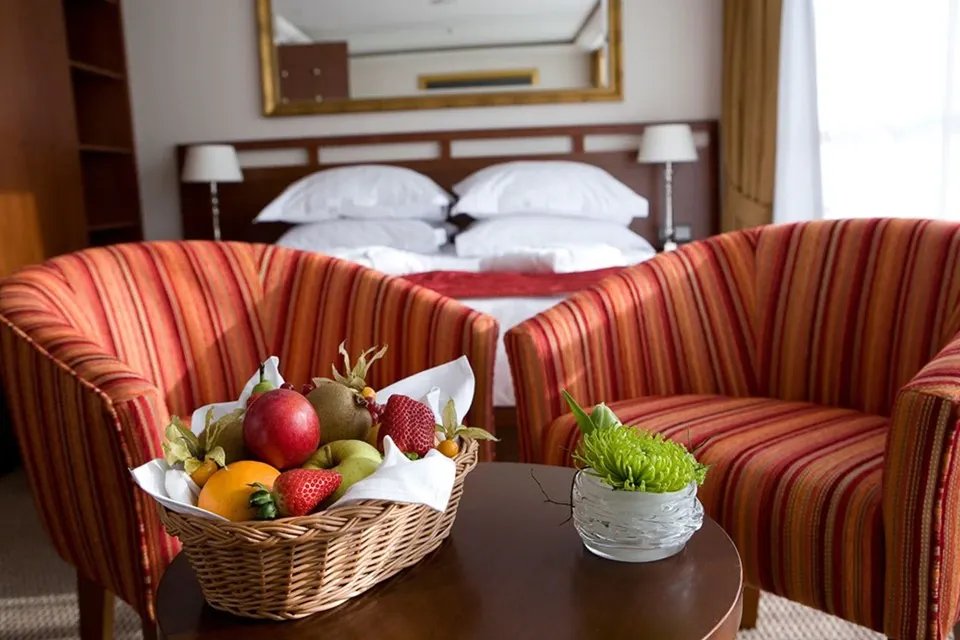
In-room temperature control
Deluxe hotel-style bedding with Egyptian linen, down pillows and duvet
Spacious bathrooms with multi-jet showerheads
Large wardrobe, full-length mirror, hair dryer, safe and direct-dial telephone
Flat-screen TV that also works as a computer
Entertainment on Demand system providing complimentary TV, movies and music library
Complimentary internet and Wi-Fi
Complimentary bottled water replenished daily
Desk and chair


In-room temperature control
Deluxe hotel-style bedding with Egyptian linen, down pillows and duvet
Spacious bathrooms with multi-jet showerheads
Large wardrobe, full-length mirror, hair dryer, safe and direct-dial telephone
Flat-screen TV that also works as a computer
Entertainment on Demand system providing complimentary TV, movies and music library
Complimentary internet and Wi-Fi
Complimentary bottled water replenished daily
Desk and chair


In-room temperature control
Deluxe hotel-style bedding with Egyptian linen, down pillows and duvet
Spacious bathrooms with multi-jet showerheads
Large wardrobe, full-length mirror, hair dryer, safe and direct-dial telephone
Flat-screen TV that also works as a computer
Entertainment on Demand system providing complimentary TV, movies and music library
Complimentary internet and Wi-Fi
Complimentary bottled water replenished daily
Desk and chair


In-room temperature control
Deluxe hotel-style bedding with Egyptian linen, down pillows and duvet
Spacious bathrooms with multi-jet showerheads
Large wardrobe, full-length mirror, hair dryer, safe and direct-dial telephone
Flat-screen TV that also works as a computer
Entertainment on Demand system providing complimentary TV, movies and music library
Complimentary internet and Wi-Fi
Complimentary bottled water replenished daily
Desk and chair
Our cruise specialists can help you find the perfect cabin and the best available pricing.
(+886) 02-2721-7300Contact Advisor