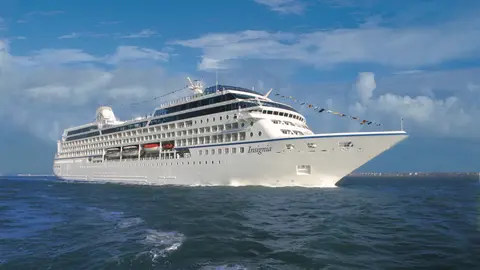
Oceania CruisesINS270913C
Paris to Athens
Date
2027-09-13
Duration
42 nights
Departure Port
Paris
France
Arrival Port
Athens (Piraeus)
Greece
Rating
Luxury
Theme
—
Date
2027-09-13
Duration
42 nights
Departure Port
Paris
France
Arrival Port
Athens (Piraeus)
Greece
Rating
Luxury
Theme
—
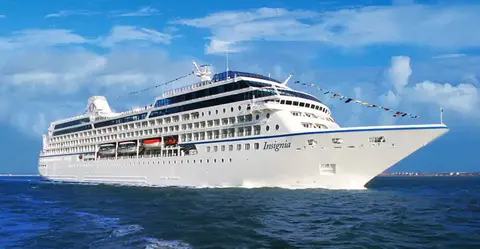

Oceania Cruises
1998
2018
30,277 GT
670
324
400
594 m
25.5 m
18 knots
Yes
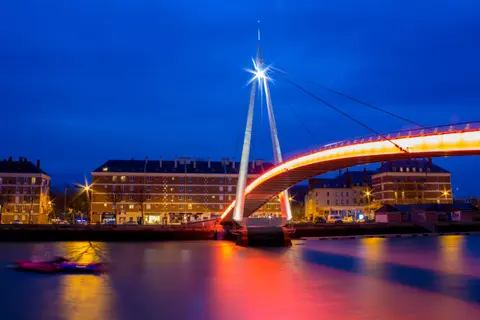
Founded in 1517 by Francis I and rebuilt after World War II devastation by Auguste Perret's visionary grid of reinforced concrete — now a UNESCO World Heritage Site — Le Havre is a city where urban architecture becomes a form of art. The monumental church of Saint-Joseph, lit from within by fifteen thousand pieces of coloured glass, is a masterpiece of post-war modernism. Day trips to Honfleur, the exquisite half-timbered port that launched Impressionism, and to the D-Day beaches of Normandy, make Le Havre one of the channel's most strategically placed cruise calls. The city is most agreeable May through September; the Honfleur excursion rewards in any season.

La Rochelle is a historic French Atlantic port city renowned for its medieval tower-flanked harbour, Renaissance arcaded streets, and proximity to the elegant Île de Ré. Visit from April through October to explore world-class museums, cycle the island's salt marshes and oyster villages, and dine on some of France's finest seafood.
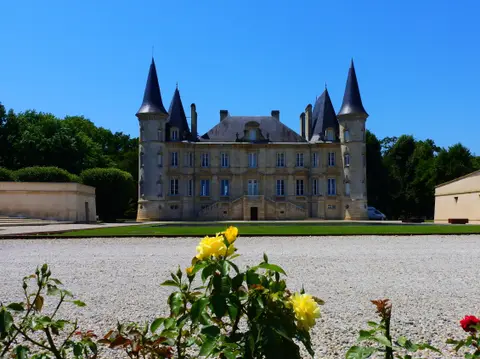
Pauillac is a historic port town in southwestern France, renowned for its exquisite wines and charming waterfront atmosphere. Must-do experiences include sampling local specialties like *canelé* and *entrecôte de boeuf*, as well as visiting the vibrant Sunday market. The best season to visit is during the spring and early autumn when the vineyards are in full bloom and the weather is delightful.

Saint Jean De Luz, France is a distinctive port city where deep cultural heritage meets authentic local atmosphere, featured on itineraries by Hapag-Lloyd Cruises. Must-do experiences include walking the historic center to experience the layered architectural heritage, and seeking out the regional culinary traditions at a locally favored establishment away from the port area. The optimal time to visit is May through September, when mild temperatures and long days favor unhurried exploration.
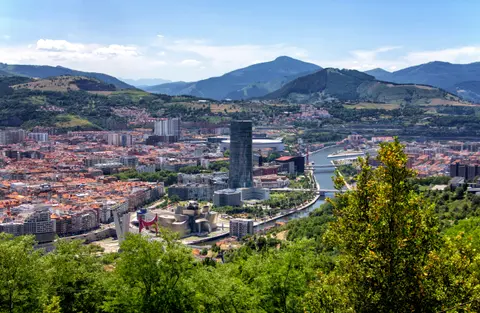
Bilbao is the Basque Country's cultural capital, where Frank Gehry's iconic Guggenheim Museum anchors a city transformed from industrial port to world-class destination. Visitors should not miss the pintxo bars of the Casco Viejo and the extraordinary Michelin-starred dining scene, alongside the museum's titanium splendor. The ideal months to visit are May through October, when mild Atlantic weather bathes the city in soft light perfect for exploring its riverside promenades and nearby Rioja wine country.
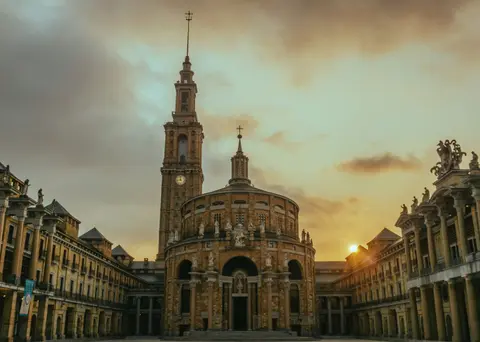
Gijón is a refined Atlantic port city on Spain's Asturian coast, where a three-thousand-year history, a celebrated cider and culinary culture, and the dramatic headland quarter of Cimadevilla converge to create one of Iberia's most compelling yet uncrowded cruise destinations. Visitors should not miss the traditional cider houses of Cimadevilla and a day trip to the Picos de Europa via Cangas de Onís. The finest months to visit are May through September, when long coastal evenings and mild Cantabrian weather reveal the city at its luminous best.
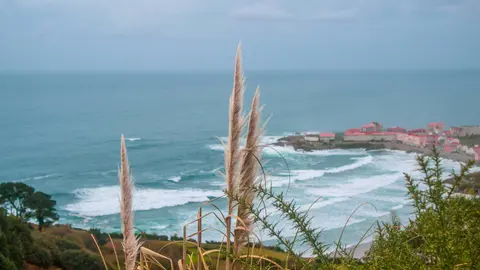
La Coruña, the Atlantic gateway to Spain's verdant Galicia region, is home to the Tower of Hercules — the world's oldest functioning Roman lighthouse and a UNESCO World Heritage Site — and a waterfront of luminous glass galleries unlike anything else in Europe. Visitors should not miss savouring pulpo á feira and wild percebes at the local markets, nor the short journey to Santiago de Compostela along the Camino. Late spring through early autumn offers the mildest weather, with September providing warm days, golden light, and fewer crowds along the granite streets of the Ciudad Vieja.

Porto, set dramatically on the granite bluffs above the Douro River, is among Europe's most romantically dishevelled cities — a place where baroque church towers rise above terracotta rooftops and century-old azulejo tilework lines every alley. Cross the iron Dom Luís I Bridge for sweeping views and descend into Vila Nova de Gaia's atmospheric wine lodges for a tasting of aged tawny port direct from the barrel. Seafood is magnificent: salt cod prepared a hundred ways, barnacles glistening with lemon, and custard tarts still warm from the oven. Spring and early autumn offer the finest conditions.
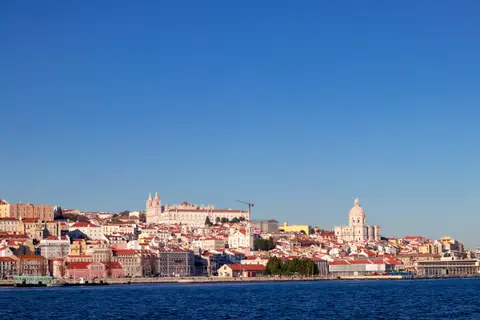
Lisbon, Portugal's enchanting capital, stands out for its rich history, stunning architecture, and vibrant culture. Must-try experiences include savoring local dishes like bacalhau à brás and pastéis de nata at Mercado da Ribeira. The best time to visit is during the spring or fall, when the weather is mild and the city is alive with festivals and events.
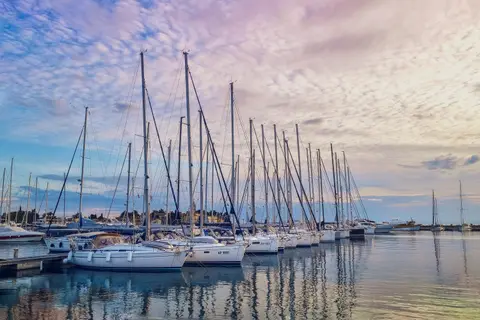
Motril, a captivating port on the Costa Tropical, shines with its rich history and unique blend of cultures, making it a perfect stop for travelers seeking both relaxation and local charm. Must-try experiences include savoring *tortilla del Sacromonte* and visiting the Mercado Municipal de Abastos. The best time to visit is in spring or fall, when the mild climate and local festivities create an enchanting atmosphere.
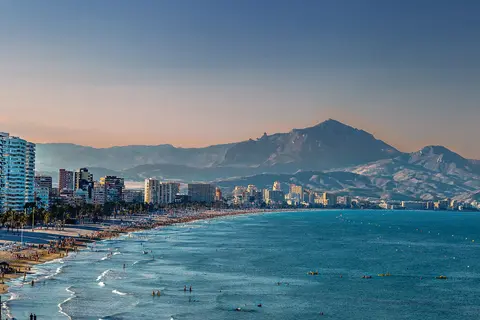
Alicante, a historic port city on Spain's Costa Blanca, captivates visitors with its rich history, stunning architecture, and vibrant culinary scene. Must-do experiences include savoring traditional paella by the seaside and exploring the bustling Mercado Central. The best time to visit is during the spring or early fall when the weather is pleasantly warm and the city is alive with festivities.
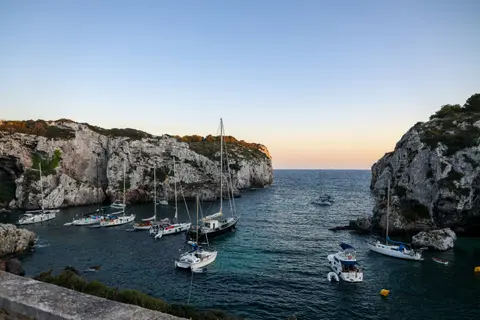
Mahón commands one of the Mediterranean's deepest natural harbours, a fjord-like inlet on Menorca that captivated British admirals, Phoenician traders, and Roman generals in turn — its Georgian townhouses and gin distilleries speaking eloquently to centuries of contested heritage. Explore the clifftop old town's baroque Santa María church with its 3,200-pipe organ, then cross the water to the imposing fortress of La Mola for sweeping harbour views. The island's prized caldereta de langosta, a slow-simmered lobster stew, is best savoured at the fishing village of Fornells. Visit between May and June or September and October for warmth without the summer crowds.
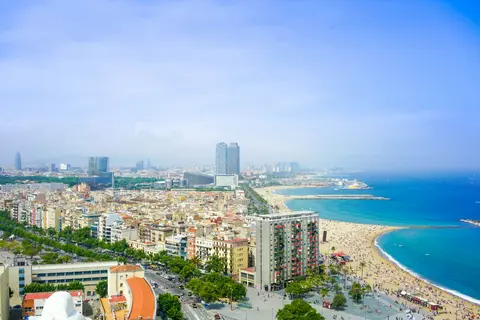
Barcelona is the city where Roman history, Gothic grandeur, and Gaudí's delirious Modernisme collide in a Mediterranean coastal capital of astonishing energy and beauty. The Sagrada Família — still under construction after 140 years — continues its audacious ascent toward completion, while the Gothic Quarter's Roman-era foundations and the Passeig de Gràcia's extraordinary concentration of Modernisme masterpieces reward days of exploration. For a complete sensory experience, lose an afternoon in the covered labyrinth of La Boqueria market before descending to the waterfront for Catalan seafood at its finest. May through June and September through October offer the most pleasant weather; the city connects directly to Paris by overnight train.
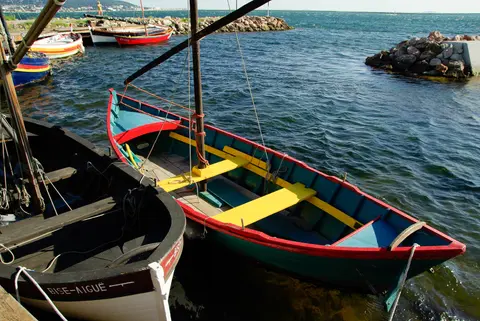
Sète is a canal-laced fishing port on France's Languedoc coast, built around the terminus of the Canal du Midi and crowned by the panoramic heights of Mont Saint-Clair. Visitors should not miss the iconic *tielle sétoise* pastry paired with Bouzigues oysters at the covered market, and the contemplative walk through the Cimetière Marin above the Mediterranean. Late spring through early autumn offers the finest conditions, with September bringing warm seas, golden light, and the spirited jousting tournaments on the canal that have defined Sète's character for over three hundred years.
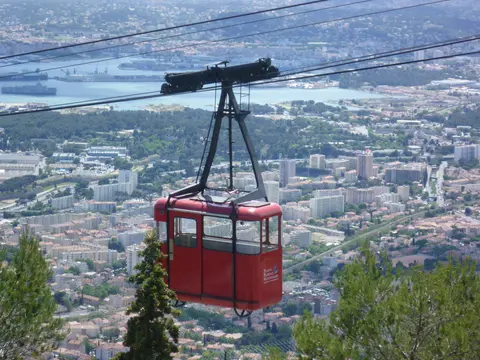
Toulon is the French Navy's Mediterranean home port, where the daily Cours Lafayette market, Mont Faron cable-car panoramas, and proximity to the Hyères Islands' pristine beaches deliver the French Riviera without the glamour-tax of Cannes or Saint-Tropez. Visit April through October via Cunard or Oceania for authentic Provençal markets, the 'other D-Day' memorial, and the Riviera that the French actually use.
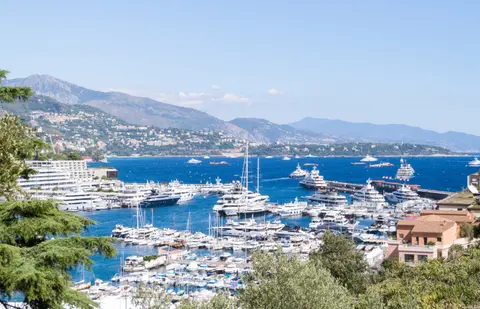
Monaco, Monaco is a distinctive port city where deep cultural heritage meets authentic local atmosphere, featured on itineraries by Regent Seven Seas Cruises. Must-do experiences include walking the historic center to experience the layered architectural heritage, and seeking out the regional culinary traditions at a locally favored establishment away from the port area. The optimal time to visit is May through September, when mild temperatures and long days favor unhurried exploration.
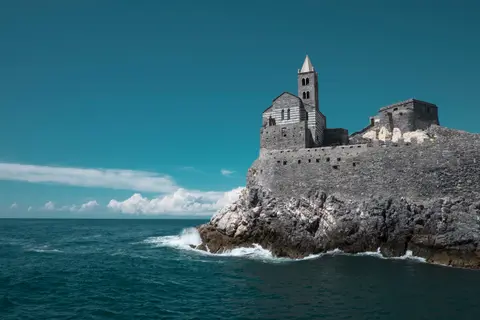
Tucked at the head of a deep Ligurian harbour that Byron and Shelley named the Gulf of Poets, La Spezia serves as the ideal base for exploring the Cinque Terre — five cliff-hanging fishing villages threaded by ancient paths above a turquoise sea. The town itself rewards exploration: the Museo Amedeo Lia houses one of Italy's finest private collections of medieval and Renaissance art, and the naval museum reflects La Spezia's long maritime history. A boat excursion to Portovenere and the island of Palmaria, or a trail walk between Vernazza and Corniglia, constitutes a perfect day from port. Best visited April through June and September through October, avoiding the summer heat and peak crowds.
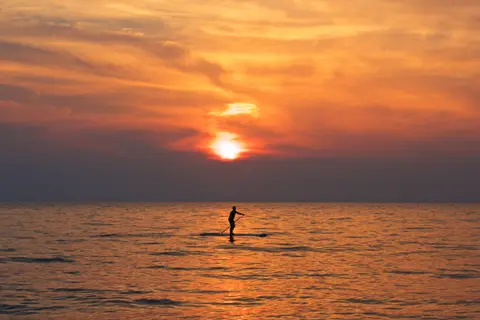
Purpose-built as a Medici utopia in the late sixteenth century, Livorno was conceived from the outset as a city without discrimination — its founding Leggi Livornine granted equal rights to Jews, Christians, Muslims, and merchants of every nation, making it one of the most cosmopolitan cities in Renaissance Europe. Today, the Venetian-style canals of the Venezia Nuova quarter reflect colourful palazzi with a distinctly faded glamour, while the Mercato Centrale's fish counters display the cacciucco ingredients — a robust Livornese brodetto of five sea creatures — that make this port city a pilgrimage for serious eaters. Day trips to Pisa and Lucca are effortless from here. The season runs April through October.
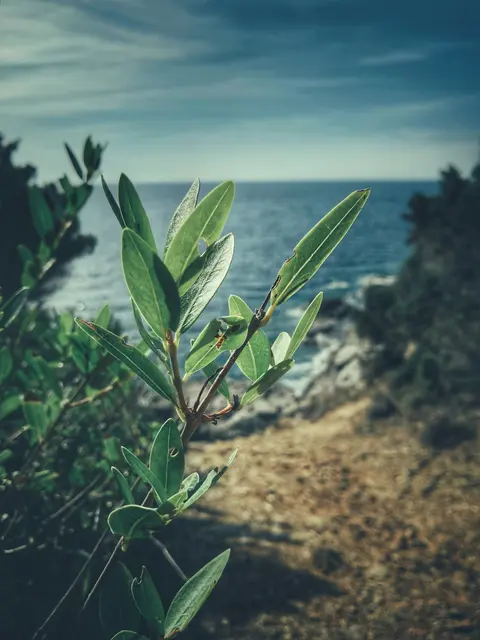
Piombino on Tuscany's coast is the gateway to Elba and the Tuscan Archipelago, perched on a promontory where Etruscan, Roman, and Renaissance history converge — from the Populonia necropolis to Leonardo da Vinci's fortifications. Must-dos include Baratti beach and archaeological park, cacciucco fish stew at the Porto Vecchio, and wine tasting in the rising Val di Cornia DOC vineyards. April through October delivers ideal Mediterranean weather for combining culture, cuisine, and coastline.
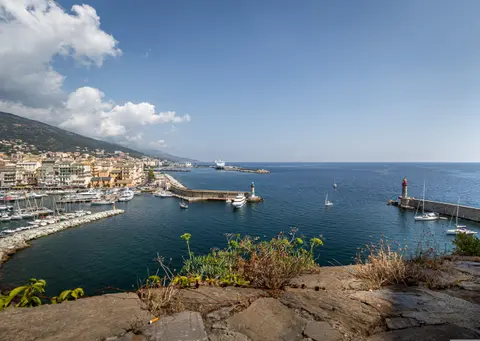
Bastia is Corsica's most authentically Genoese port city, where a crumbling Vieux Port, the island's largest Baroque church, and a citadel museum create the Mediterranean character that tourism brochures often overlook in favor of flashier resorts. Visit September via Seabourn or Silversea for Cap Corse's medieval watchtowers, Muscat grape harvest, and the genuine Corsican atmosphere that only centuries of Franco-Italian cultural layering can produce.
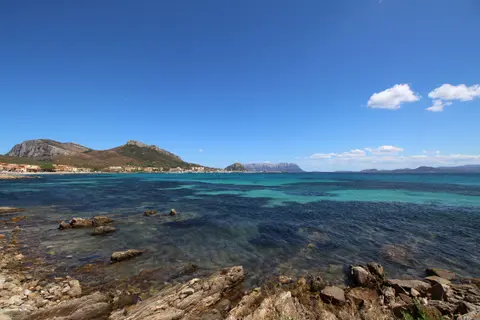
Olbia, Sardinia's northeastern gateway, offers three millennia of history from Carthaginian trading post to today's vibrant Italian city, too often bypassed in the rush to the Costa Smeralda. Sardinia's ceremonial suckling pig, DOCG Vermentino wines, and Bronze Age Nuragic ruins reward those who explore beyond the beach. AIDA, MSC Cruises, and Oceania Cruises dock at this convenient port where a walkable historic center and world-class coastline meet fiercely independent Sardinian culture.
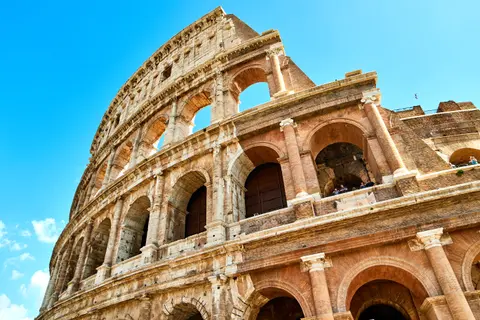
Rome's ancient maritime gateway since the Emperor Trajan commissioned its harbour in 106 AD, Civitavecchia is the natural prologue to the Eternal City — just seventy minutes southeast by express rail. The port's Renaissance fortress, designed in part by Michelangelo, anchors a working waterfront that has welcomed travellers for millennia. Beyond Rome's unmissable monuments, consider an afternoon in the Civitavecchia thermal baths, drawing on mineral waters prized since antiquity. Spring and autumn offer the ideal balance of mild weather and manageable crowds for exploring the capital's layered history.
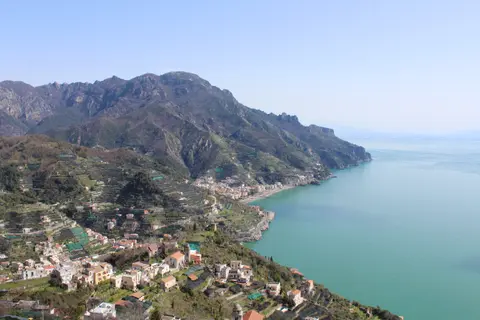
Salerno is a historic Campanian port city nestled between the Amalfi Coast and Cilento National Park, home to Europe's first medieval medical school and a magnificent Romanesque cathedral with Byzantine bronze doors. Visitors should not miss the Lungomare Trieste promenade at sunset and a plate of hand-rolled scialatielli ai frutti di mare in the atmospheric old town. The mild Mediterranean climate makes Salerno enchanting year-round, though late spring through early autumn offers the most luminous light and the fullest expression of its coastal character.
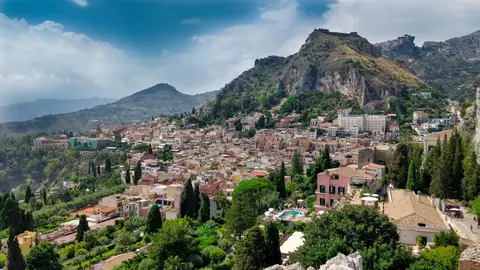
Messina guards the storied strait that separates Sicily from the Italian mainland — the passage Homer mythologised as Scylla and Charybdis — and its Norman cathedral's astronomical clock, one of the world's largest mechanical clocks, puts on a captivating automated display each noon as gilded figures enact scenes of the Resurrection. The city was catastrophically rebuilt after the 1908 earthquake, but its markets and waterfront convey the fierce energy of a Sicilian port that has witnessed two and a half millennia of Mediterranean history. Messina is the perfect gateway to Taormina, a 40-minute drive into the hills above the Ionian coast, with views of Etna at their most dramatic. Spring and autumn are ideal.
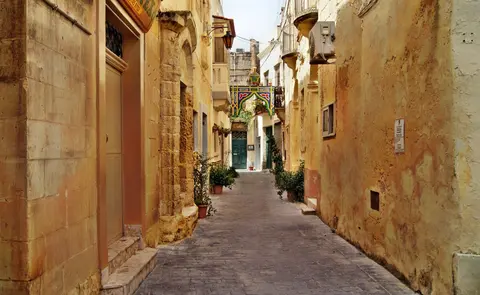
Valletta, Europe's smallest capital, is a fortress city of exceptional grandeur raised from bare limestone in just fifteen years after the Knights of St. John repelled the great Ottoman siege of 1565 — its rigid Renaissance grid of sun-drenched streets concealing a density of baroque palaces, gilded oratories, and subterranean World War II shelters unrivaled anywhere in the Mediterranean. The Grand Harbour, framed by golden bastions plunging into startlingly blue water, offers one of the most dramatically photogenic arrivals in the world for arriving vessels. Spring and autumn deliver the most comfortable temperatures for exploring this UNESCO-listed gem.
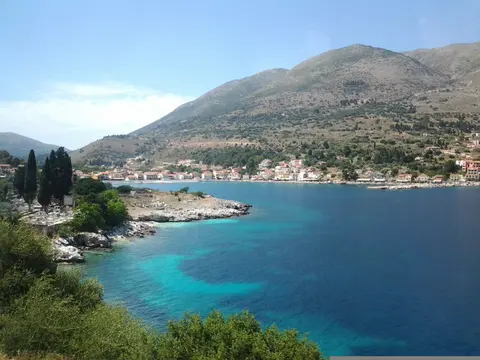
Argostoli is the capital of Kefalonia, the largest Ionian Island, renowned for dramatic geological wonders, pristine beaches, and the literary fame of Captain Corelli's Mandolin. Must-dos include visiting the subterranean Melissani Lake, admiring the cliffs of Myrtos Beach, and tasting Robola wine with fresh-grilled fish. May through October offers warm weather and calm seas, with June and September providing the best balance of conditions.
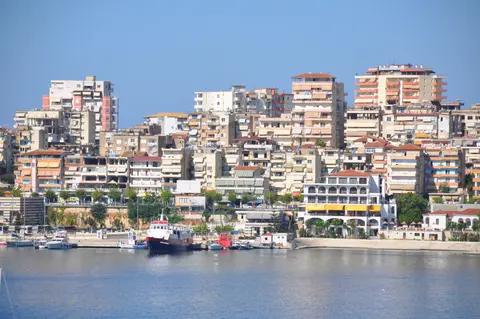
Sarandë is Albania's Ionian coast jewel, where the UNESCO-listed Butrint archaeological marvel and the impossibly turquoise Blue Eye spring create a Mediterranean experience rivaling Greece at a fraction of the cost. Visit June via Emerald Yacht Cruises or Virgin Voyages for six-civilization archaeological sites and Albania's exciting Mediterranean frontier.
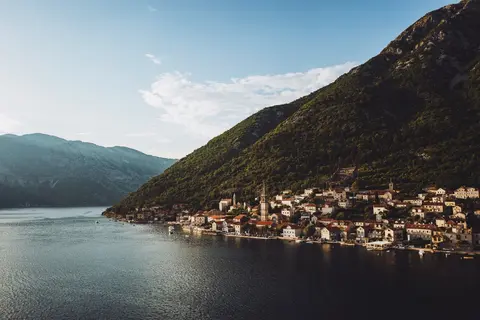
The port of Kotor, a UNESCO World Heritage site, is renowned for its stunning natural beauty and rich historical tapestry. A must-do experience includes wandering the cobblestone streets of the Old Town, where culinary delights like "kacamak" and fresh seafood await. The best time to visit is during the spring or early fall, when the weather is pleasant and the crowds are fewer.
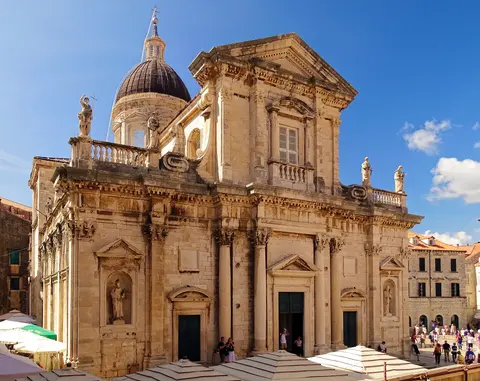
Dubrovnik, Croatia's stunning port city, is a blend of rich history, dramatic architecture, and vibrant culture, making it a must-visit destination. Don't miss a stroll along the city walls for breathtaking views and savor local dishes like "peka" and "black risotto." The best time to visit is in late spring or early fall when the weather is pleasant and the crowds are thinner.
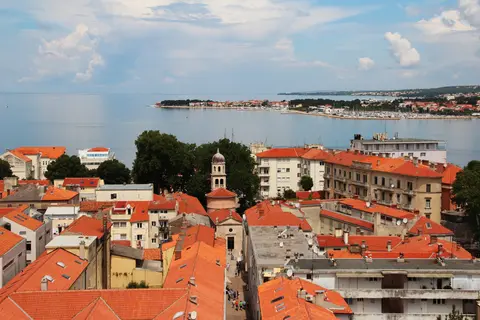
Zadar, a historic port city on Croatia's Dalmatian coast, is a captivating blend of ancient architecture and vibrant culture. Must-do experiences include visiting the Church of St. Donatus and enjoying the enchanting music of the Sea Organ. The best season to visit is during the warm summer months when the city comes alive with festivals and outdoor activities.
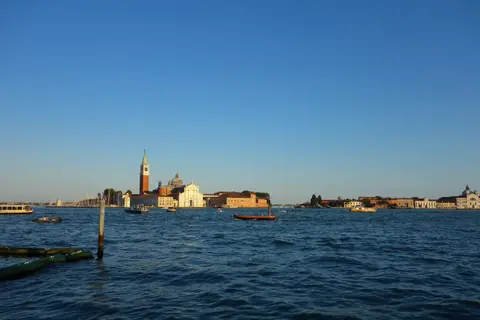
Venice, approached from the Fusina port across its luminous lagoon, remains one of the world's most extraordinary cities — a thousand-year-old republic built on 118 islands and laced with canals, palaces, and masterpieces. Must-dos include riding the Grand Canal by vaporetto, savouring cicchetti at a traditional bacaro, and visiting the colourful islands of Murano and Burano. April through June and September through November offer the finest light and the most manageable crowds.
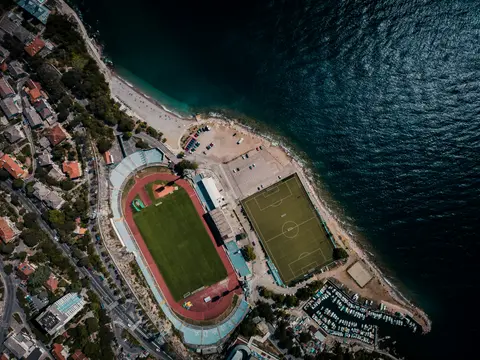
Rijeka is Croatia's vibrant third city and 2020 European Capital of Culture, where Habsburg waterfront architecture, a thriving arts scene, and one of Europe's most exuberant carnivals create an authentic alternative to the Dalmatian tourist trail. Visit from April through October for the magnificent Korzo promenade, Trsat Castle views, and gateway access to the Kvarner islands.
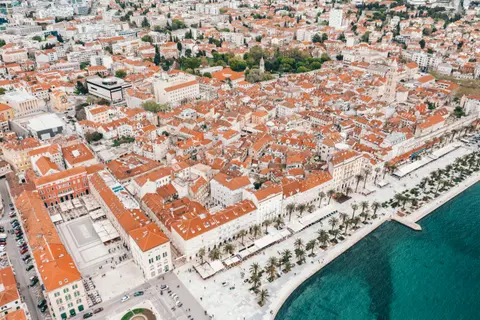
Split, Croatia's vibrant port city, is a unique blend of ancient history and modern life, centered around the remarkable Diocletian's Palace. Must-do experiences include savoring local dishes like pašticada and exploring the bustling markets. The best time to visit is during the spring and early fall, when the weather is pleasant and the tourist crowds are more manageable.
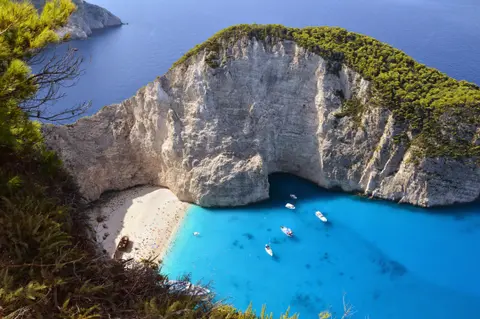
Zakynthos is a lush Ionian island famous for the spectacular Navagio (Shipwreck) Beach, endangered loggerhead turtle nesting sites, and a Venetian-influenced town rebuilt after the 1953 earthquake. Must-dos include a boat trip to Navagio Beach, watching turtle conservation efforts at Laganas Bay, and dining on grilled fish at a harbor taverna. Visit May to June or September to October for warm weather without peak crowds.
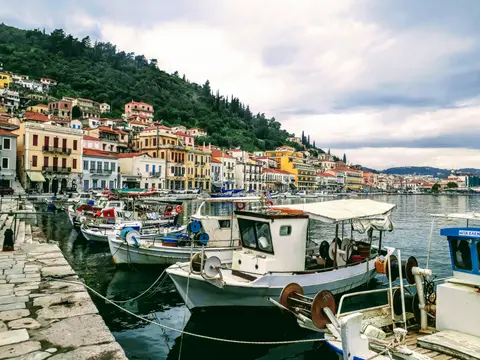
Gythio is ancient Sparta's port town on the Laconian Gulf, where Homeric mythology, neoclassical waterfront charm, and the wild Mani Peninsula's tower houses and underground caves converge. Visit from April through October for Diros Cave boat tours, Cape Tenaro's mythological Underworld entrance, and waterfront dining in one of the Peloponnese's most atmospheric harbor towns.
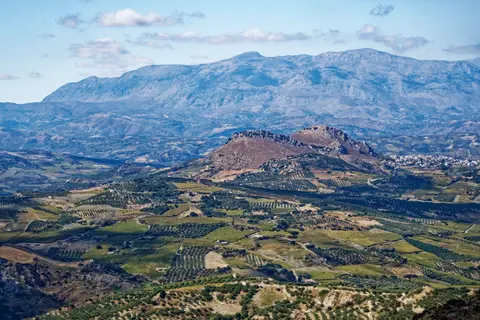
Heraklion, the capital of Crete, is a historic port city rich in Minoan heritage and Venetian architecture, making it an essential stop for cruise travelers. Must-do experiences include exploring the Palace of Knossos and indulging in local dishes like moussaka and dakos. The best season to visit is during the spring and early fall when the weather is mild and the local festivals are in full swing.
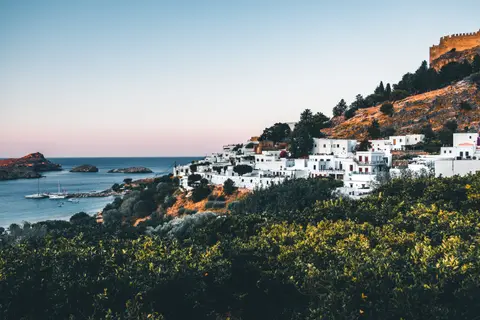
Rhodes, Greece's resplendent Dodecanese jewel, merges a UNESCO-listed Medieval Old Town built by the Knights of St. John with sun-soaked Aegean beauty just seven miles from the Turkish coast. Wander the Street of the Knights before tasting *pitaroudia* fritters and local Athiri wine at an Old Town taverna, then take a catamaran to the neoclassical harbor of Symi. The island basks in over 300 days of sunshine annually, with April through June and September through October offering ideal temperatures for exploration without the peak-summer crowds.
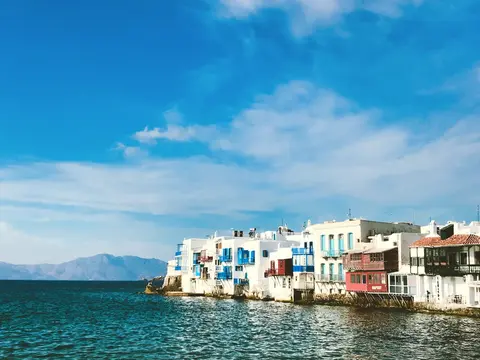
Mykonos is the Aegean at its most seductive — a labyrinth of bougainvillea-draped whitewashed alleys designed to disorient pirates (and occasionally visitors) leading to Kástro, the medieval hilltop quarter overlooking Little Venice, where balconied houses hang directly above the sea. The island's famous windmills, perched on a ridge above the old harbour, are best photographed at golden hour as pelicans patrol the waterfront below. Visit the sacred archaeological island of Delos — a 30-minute boat crossing — for one of the most significant ancient sites in the Greek world. May, June, and September offer the perfect balance of warmth, light, and bearable crowds.
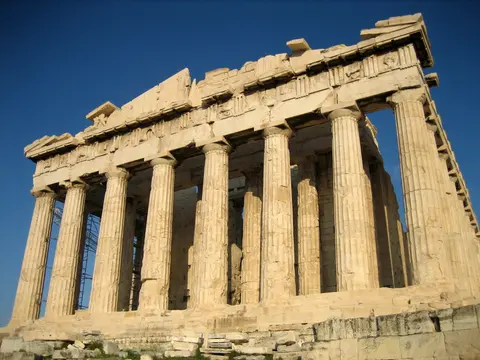
The port that launched Athenian democracy's naval supremacy at the Battle of Salamis, Piraeus remains Greece's maritime heartbeat — and the most convenient gateway to both the Acropolis and the Aegean island chains. Dine on grilled sea bream at a Mikrolimano harbourside taverna, visit the extraordinary bronze Piraeus Apollo, and set sail for Hydra or Santorini by afternoon. Late April through June and September offer the Aegean at its most golden and uncrowded.
Day 1
Founded in 1517 by Francis I and rebuilt after World War II devastation by Auguste Perret's visionary grid of reinforced concrete — now a UNESCO World Heritage Site — Le Havre is a city where urban architecture becomes a form of art. The monumental church of Saint-Joseph, lit from within by fifteen thousand pieces of coloured glass, is a masterpiece of post-war modernism. Day trips to Honfleur, the exquisite half-timbered port that launched Impressionism, and to the D-Day beaches of Normandy, make Le Havre one of the channel's most strategically placed cruise calls. The city is most agreeable May through September; the Honfleur excursion rewards in any season.
Day 2
Day 3
La Rochelle is a historic French Atlantic port city renowned for its medieval tower-flanked harbour, Renaissance arcaded streets, and proximity to the elegant Île de Ré. Visit from April through October to explore world-class museums, cycle the island's salt marshes and oyster villages, and dine on some of France's finest seafood.
Day 4
Pauillac is a historic port town in southwestern France, renowned for its exquisite wines and charming waterfront atmosphere. Must-do experiences include sampling local specialties like *canelé* and *entrecôte de boeuf*, as well as visiting the vibrant Sunday market. The best season to visit is during the spring and early autumn when the vineyards are in full bloom and the weather is delightful.
Day 5
Saint Jean De Luz, France is a distinctive port city where deep cultural heritage meets authentic local atmosphere, featured on itineraries by Hapag-Lloyd Cruises. Must-do experiences include walking the historic center to experience the layered architectural heritage, and seeking out the regional culinary traditions at a locally favored establishment away from the port area. The optimal time to visit is May through September, when mild temperatures and long days favor unhurried exploration.
Day 6
Bilbao is the Basque Country's cultural capital, where Frank Gehry's iconic Guggenheim Museum anchors a city transformed from industrial port to world-class destination. Visitors should not miss the pintxo bars of the Casco Viejo and the extraordinary Michelin-starred dining scene, alongside the museum's titanium splendor. The ideal months to visit are May through October, when mild Atlantic weather bathes the city in soft light perfect for exploring its riverside promenades and nearby Rioja wine country.
Day 7
Gijón is a refined Atlantic port city on Spain's Asturian coast, where a three-thousand-year history, a celebrated cider and culinary culture, and the dramatic headland quarter of Cimadevilla converge to create one of Iberia's most compelling yet uncrowded cruise destinations. Visitors should not miss the traditional cider houses of Cimadevilla and a day trip to the Picos de Europa via Cangas de Onís. The finest months to visit are May through September, when long coastal evenings and mild Cantabrian weather reveal the city at its luminous best.
Day 8
La Coruña, the Atlantic gateway to Spain's verdant Galicia region, is home to the Tower of Hercules — the world's oldest functioning Roman lighthouse and a UNESCO World Heritage Site — and a waterfront of luminous glass galleries unlike anything else in Europe. Visitors should not miss savouring pulpo á feira and wild percebes at the local markets, nor the short journey to Santiago de Compostela along the Camino. Late spring through early autumn offers the mildest weather, with September providing warm days, golden light, and fewer crowds along the granite streets of the Ciudad Vieja.
Day 9
Porto, set dramatically on the granite bluffs above the Douro River, is among Europe's most romantically dishevelled cities — a place where baroque church towers rise above terracotta rooftops and century-old azulejo tilework lines every alley. Cross the iron Dom Luís I Bridge for sweeping views and descend into Vila Nova de Gaia's atmospheric wine lodges for a tasting of aged tawny port direct from the barrel. Seafood is magnificent: salt cod prepared a hundred ways, barnacles glistening with lemon, and custard tarts still warm from the oven. Spring and early autumn offer the finest conditions.
Day 10
Lisbon, Portugal's enchanting capital, stands out for its rich history, stunning architecture, and vibrant culture. Must-try experiences include savoring local dishes like bacalhau à brás and pastéis de nata at Mercado da Ribeira. The best time to visit is during the spring or fall, when the weather is mild and the city is alive with festivals and events.
Day 11
Day 12
Motril, a captivating port on the Costa Tropical, shines with its rich history and unique blend of cultures, making it a perfect stop for travelers seeking both relaxation and local charm. Must-try experiences include savoring *tortilla del Sacromonte* and visiting the Mercado Municipal de Abastos. The best time to visit is in spring or fall, when the mild climate and local festivities create an enchanting atmosphere.
Day 13
Alicante, a historic port city on Spain's Costa Blanca, captivates visitors with its rich history, stunning architecture, and vibrant culinary scene. Must-do experiences include savoring traditional paella by the seaside and exploring the bustling Mercado Central. The best time to visit is during the spring or early fall when the weather is pleasantly warm and the city is alive with festivities.
Day 14
Mahón commands one of the Mediterranean's deepest natural harbours, a fjord-like inlet on Menorca that captivated British admirals, Phoenician traders, and Roman generals in turn — its Georgian townhouses and gin distilleries speaking eloquently to centuries of contested heritage. Explore the clifftop old town's baroque Santa María church with its 3,200-pipe organ, then cross the water to the imposing fortress of La Mola for sweeping harbour views. The island's prized caldereta de langosta, a slow-simmered lobster stew, is best savoured at the fishing village of Fornells. Visit between May and June or September and October for warmth without the summer crowds.
Day 15
Barcelona is the city where Roman history, Gothic grandeur, and Gaudí's delirious Modernisme collide in a Mediterranean coastal capital of astonishing energy and beauty. The Sagrada Família — still under construction after 140 years — continues its audacious ascent toward completion, while the Gothic Quarter's Roman-era foundations and the Passeig de Gràcia's extraordinary concentration of Modernisme masterpieces reward days of exploration. For a complete sensory experience, lose an afternoon in the covered labyrinth of La Boqueria market before descending to the waterfront for Catalan seafood at its finest. May through June and September through October offer the most pleasant weather; the city connects directly to Paris by overnight train.
Day 16
Sète is a canal-laced fishing port on France's Languedoc coast, built around the terminus of the Canal du Midi and crowned by the panoramic heights of Mont Saint-Clair. Visitors should not miss the iconic *tielle sétoise* pastry paired with Bouzigues oysters at the covered market, and the contemplative walk through the Cimetière Marin above the Mediterranean. Late spring through early autumn offers the finest conditions, with September bringing warm seas, golden light, and the spirited jousting tournaments on the canal that have defined Sète's character for over three hundred years.
Day 17
Toulon is the French Navy's Mediterranean home port, where the daily Cours Lafayette market, Mont Faron cable-car panoramas, and proximity to the Hyères Islands' pristine beaches deliver the French Riviera without the glamour-tax of Cannes or Saint-Tropez. Visit April through October via Cunard or Oceania for authentic Provençal markets, the 'other D-Day' memorial, and the Riviera that the French actually use.
Day 18
Monaco, Monaco is a distinctive port city where deep cultural heritage meets authentic local atmosphere, featured on itineraries by Regent Seven Seas Cruises. Must-do experiences include walking the historic center to experience the layered architectural heritage, and seeking out the regional culinary traditions at a locally favored establishment away from the port area. The optimal time to visit is May through September, when mild temperatures and long days favor unhurried exploration.
Day 19
Tucked at the head of a deep Ligurian harbour that Byron and Shelley named the Gulf of Poets, La Spezia serves as the ideal base for exploring the Cinque Terre — five cliff-hanging fishing villages threaded by ancient paths above a turquoise sea. The town itself rewards exploration: the Museo Amedeo Lia houses one of Italy's finest private collections of medieval and Renaissance art, and the naval museum reflects La Spezia's long maritime history. A boat excursion to Portovenere and the island of Palmaria, or a trail walk between Vernazza and Corniglia, constitutes a perfect day from port. Best visited April through June and September through October, avoiding the summer heat and peak crowds.
Day 20
Purpose-built as a Medici utopia in the late sixteenth century, Livorno was conceived from the outset as a city without discrimination — its founding Leggi Livornine granted equal rights to Jews, Christians, Muslims, and merchants of every nation, making it one of the most cosmopolitan cities in Renaissance Europe. Today, the Venetian-style canals of the Venezia Nuova quarter reflect colourful palazzi with a distinctly faded glamour, while the Mercato Centrale's fish counters display the cacciucco ingredients — a robust Livornese brodetto of five sea creatures — that make this port city a pilgrimage for serious eaters. Day trips to Pisa and Lucca are effortless from here. The season runs April through October.
Day 21
Piombino on Tuscany's coast is the gateway to Elba and the Tuscan Archipelago, perched on a promontory where Etruscan, Roman, and Renaissance history converge — from the Populonia necropolis to Leonardo da Vinci's fortifications. Must-dos include Baratti beach and archaeological park, cacciucco fish stew at the Porto Vecchio, and wine tasting in the rising Val di Cornia DOC vineyards. April through October delivers ideal Mediterranean weather for combining culture, cuisine, and coastline.
Day 22
Bastia is Corsica's most authentically Genoese port city, where a crumbling Vieux Port, the island's largest Baroque church, and a citadel museum create the Mediterranean character that tourism brochures often overlook in favor of flashier resorts. Visit September via Seabourn or Silversea for Cap Corse's medieval watchtowers, Muscat grape harvest, and the genuine Corsican atmosphere that only centuries of Franco-Italian cultural layering can produce.
Day 23
Olbia, Sardinia's northeastern gateway, offers three millennia of history from Carthaginian trading post to today's vibrant Italian city, too often bypassed in the rush to the Costa Smeralda. Sardinia's ceremonial suckling pig, DOCG Vermentino wines, and Bronze Age Nuragic ruins reward those who explore beyond the beach. AIDA, MSC Cruises, and Oceania Cruises dock at this convenient port where a walkable historic center and world-class coastline meet fiercely independent Sardinian culture.
Day 24
Rome's ancient maritime gateway since the Emperor Trajan commissioned its harbour in 106 AD, Civitavecchia is the natural prologue to the Eternal City — just seventy minutes southeast by express rail. The port's Renaissance fortress, designed in part by Michelangelo, anchors a working waterfront that has welcomed travellers for millennia. Beyond Rome's unmissable monuments, consider an afternoon in the Civitavecchia thermal baths, drawing on mineral waters prized since antiquity. Spring and autumn offer the ideal balance of mild weather and manageable crowds for exploring the capital's layered history.
Day 25
Salerno is a historic Campanian port city nestled between the Amalfi Coast and Cilento National Park, home to Europe's first medieval medical school and a magnificent Romanesque cathedral with Byzantine bronze doors. Visitors should not miss the Lungomare Trieste promenade at sunset and a plate of hand-rolled scialatielli ai frutti di mare in the atmospheric old town. The mild Mediterranean climate makes Salerno enchanting year-round, though late spring through early autumn offers the most luminous light and the fullest expression of its coastal character.
Day 26
Messina guards the storied strait that separates Sicily from the Italian mainland — the passage Homer mythologised as Scylla and Charybdis — and its Norman cathedral's astronomical clock, one of the world's largest mechanical clocks, puts on a captivating automated display each noon as gilded figures enact scenes of the Resurrection. The city was catastrophically rebuilt after the 1908 earthquake, but its markets and waterfront convey the fierce energy of a Sicilian port that has witnessed two and a half millennia of Mediterranean history. Messina is the perfect gateway to Taormina, a 40-minute drive into the hills above the Ionian coast, with views of Etna at their most dramatic. Spring and autumn are ideal.
Day 27
Valletta, Europe's smallest capital, is a fortress city of exceptional grandeur raised from bare limestone in just fifteen years after the Knights of St. John repelled the great Ottoman siege of 1565 — its rigid Renaissance grid of sun-drenched streets concealing a density of baroque palaces, gilded oratories, and subterranean World War II shelters unrivaled anywhere in the Mediterranean. The Grand Harbour, framed by golden bastions plunging into startlingly blue water, offers one of the most dramatically photogenic arrivals in the world for arriving vessels. Spring and autumn deliver the most comfortable temperatures for exploring this UNESCO-listed gem.
Day 28
Argostoli is the capital of Kefalonia, the largest Ionian Island, renowned for dramatic geological wonders, pristine beaches, and the literary fame of Captain Corelli's Mandolin. Must-dos include visiting the subterranean Melissani Lake, admiring the cliffs of Myrtos Beach, and tasting Robola wine with fresh-grilled fish. May through October offers warm weather and calm seas, with June and September providing the best balance of conditions.
Day 29
Sarandë is Albania's Ionian coast jewel, where the UNESCO-listed Butrint archaeological marvel and the impossibly turquoise Blue Eye spring create a Mediterranean experience rivaling Greece at a fraction of the cost. Visit June via Emerald Yacht Cruises or Virgin Voyages for six-civilization archaeological sites and Albania's exciting Mediterranean frontier.
Day 30
The port of Kotor, a UNESCO World Heritage site, is renowned for its stunning natural beauty and rich historical tapestry. A must-do experience includes wandering the cobblestone streets of the Old Town, where culinary delights like "kacamak" and fresh seafood await. The best time to visit is during the spring or early fall, when the weather is pleasant and the crowds are fewer.
Day 31
Dubrovnik, Croatia's stunning port city, is a blend of rich history, dramatic architecture, and vibrant culture, making it a must-visit destination. Don't miss a stroll along the city walls for breathtaking views and savor local dishes like "peka" and "black risotto." The best time to visit is in late spring or early fall when the weather is pleasant and the crowds are thinner.
Day 32
Zadar, a historic port city on Croatia's Dalmatian coast, is a captivating blend of ancient architecture and vibrant culture. Must-do experiences include visiting the Church of St. Donatus and enjoying the enchanting music of the Sea Organ. The best season to visit is during the warm summer months when the city comes alive with festivals and outdoor activities.
Day 33
Venice, approached from the Fusina port across its luminous lagoon, remains one of the world's most extraordinary cities — a thousand-year-old republic built on 118 islands and laced with canals, palaces, and masterpieces. Must-dos include riding the Grand Canal by vaporetto, savouring cicchetti at a traditional bacaro, and visiting the colourful islands of Murano and Burano. April through June and September through November offer the finest light and the most manageable crowds.
Day 35
Rijeka is Croatia's vibrant third city and 2020 European Capital of Culture, where Habsburg waterfront architecture, a thriving arts scene, and one of Europe's most exuberant carnivals create an authentic alternative to the Dalmatian tourist trail. Visit from April through October for the magnificent Korzo promenade, Trsat Castle views, and gateway access to the Kvarner islands.
Day 36
Split, Croatia's vibrant port city, is a unique blend of ancient history and modern life, centered around the remarkable Diocletian's Palace. Must-do experiences include savoring local dishes like pašticada and exploring the bustling markets. The best time to visit is during the spring and early fall, when the weather is pleasant and the tourist crowds are more manageable.
Day 37
Day 38
Zakynthos is a lush Ionian island famous for the spectacular Navagio (Shipwreck) Beach, endangered loggerhead turtle nesting sites, and a Venetian-influenced town rebuilt after the 1953 earthquake. Must-dos include a boat trip to Navagio Beach, watching turtle conservation efforts at Laganas Bay, and dining on grilled fish at a harbor taverna. Visit May to June or September to October for warm weather without peak crowds.
Day 39
Gythio is ancient Sparta's port town on the Laconian Gulf, where Homeric mythology, neoclassical waterfront charm, and the wild Mani Peninsula's tower houses and underground caves converge. Visit from April through October for Diros Cave boat tours, Cape Tenaro's mythological Underworld entrance, and waterfront dining in one of the Peloponnese's most atmospheric harbor towns.
Day 40
Heraklion, the capital of Crete, is a historic port city rich in Minoan heritage and Venetian architecture, making it an essential stop for cruise travelers. Must-do experiences include exploring the Palace of Knossos and indulging in local dishes like moussaka and dakos. The best season to visit is during the spring and early fall when the weather is mild and the local festivals are in full swing.
Day 41
Rhodes, Greece's resplendent Dodecanese jewel, merges a UNESCO-listed Medieval Old Town built by the Knights of St. John with sun-soaked Aegean beauty just seven miles from the Turkish coast. Wander the Street of the Knights before tasting *pitaroudia* fritters and local Athiri wine at an Old Town taverna, then take a catamaran to the neoclassical harbor of Symi. The island basks in over 300 days of sunshine annually, with April through June and September through October offering ideal temperatures for exploration without the peak-summer crowds.
Day 42
Mykonos is the Aegean at its most seductive — a labyrinth of bougainvillea-draped whitewashed alleys designed to disorient pirates (and occasionally visitors) leading to Kástro, the medieval hilltop quarter overlooking Little Venice, where balconied houses hang directly above the sea. The island's famous windmills, perched on a ridge above the old harbour, are best photographed at golden hour as pelicans patrol the waterfront below. Visit the sacred archaeological island of Delos — a 30-minute boat crossing — for one of the most significant ancient sites in the Greek world. May, June, and September offer the perfect balance of warmth, light, and bearable crowds.
Day 43
The port that launched Athenian democracy's naval supremacy at the Battle of Salamis, Piraeus remains Greece's maritime heartbeat — and the most convenient gateway to both the Acropolis and the Aegean island chains. Dine on grilled sea bream at a Mikrolimano harbourside taverna, visit the extraordinary bronze Piraeus Apollo, and set sail for Hydra or Santorini by afternoon. Late April through June and September offer the Aegean at its most golden and uncrowded.
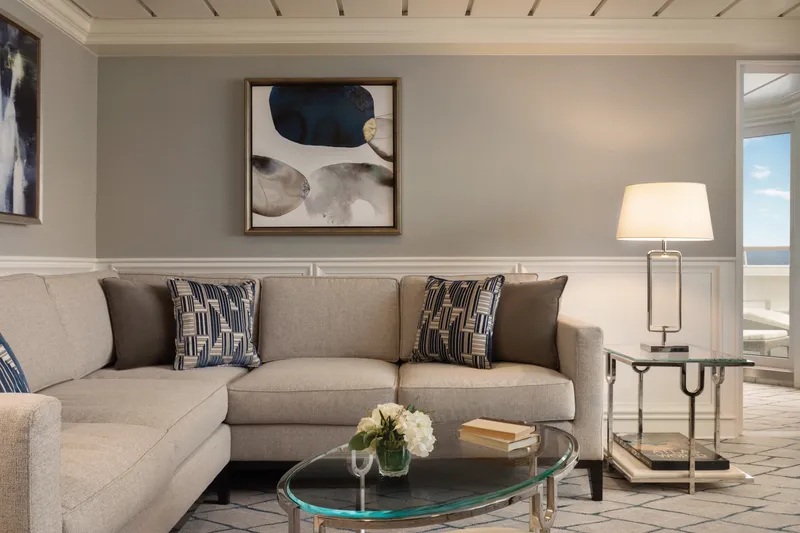
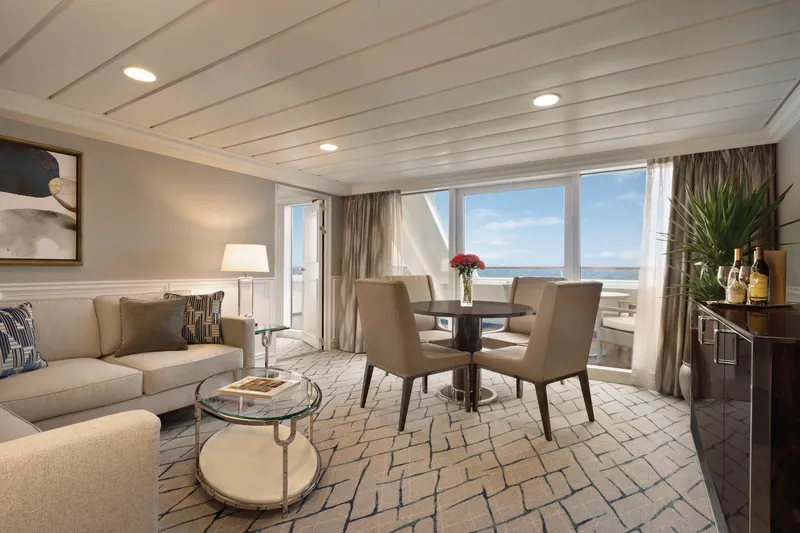

Lavish new fabrics and designer furnishings grace our six new Owner’s Suites – always among the first to be reserved. Immensely spacious and exceptionally luxurious, these suites span nearly 1,000 square feet and areas of quietude and relaxation. Every imaginable amenity is found here, further enhanced by a sumptuous re-designed bathroom with an oversized shower, a private teak veranda and two flat-screen televisions.
Owner's Suite Privileges
In addition to Stateroom Amenities
Free laundry service – up to 3 bags per stateroom+
Priority 11 am ship embarkation with priority luggage delivery++
24-hour Butler service
Complimentary in-suite bar setup with 6 full-size bottles of premium spirits and wines from our suite beverage menu
Complimentary welcome bottle of Champagne
Optional private in-suite lunch on embarkation day from noon to 2 pm
Fresh fruit basket replenished daily
Priority online specialty restaurant reservations each evening++
Unlimited access to the Aquamar Spa Terrace
iPad upon request for your enjoyment on board
Bulgari gift set and variety of amenities
Choice of daily printed newspaper
Complimentary Oceania Cruises logo tote bag and personalized stationery
Cashmere lap blankets, perfect for relaxing on your veranda
Complimentary shoe shine service
Complimentary pressing of garments upon embarkation++
Choice of pillow from a luxurious selection
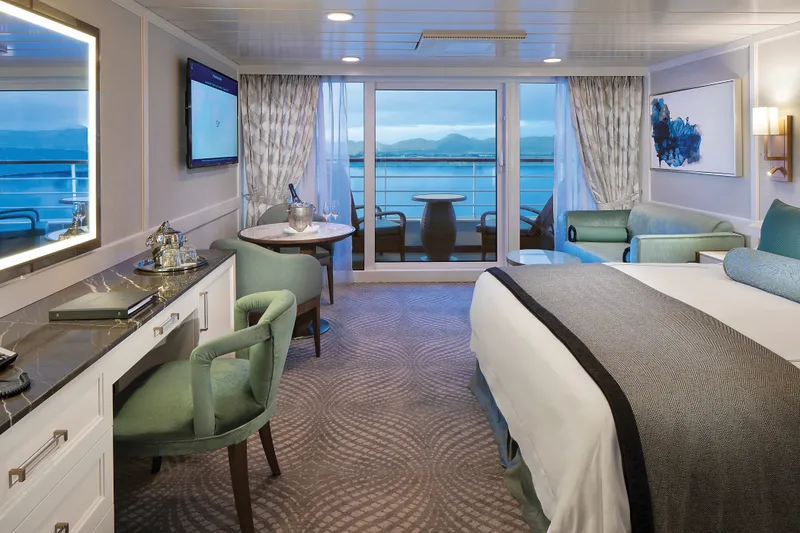
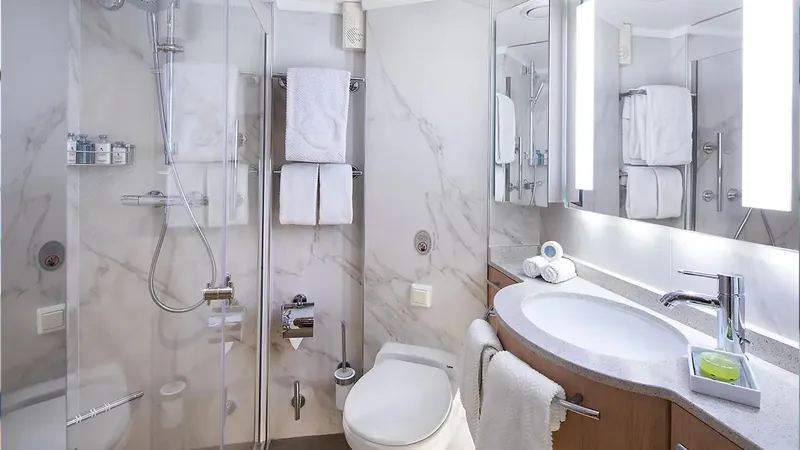

Our collection of 322-square-foot Penthouse Suites has been completely transformed with splendid new decor and exquisite furnishings in serene shades of the sea and sky. Spacious enough for private in-suite dining, the living area features a refrigerated mini-bar a vanity desk and the granite-clad bathroom is large enough for an indulgent walk-in shower. Relax on the beautifully furnished private teak veranda.
Penthouse Suite Privileges
In addition to Suite & Stateroom Amenities
Free laundry service – up to 3 bags per stateroom+
Priority 11 am ship embarkation with priority luggage delivery
24-hour Butler service
Priority online specialty restaurant reservations
Unlimited access to the Aquamar Spa Terrace
Complimentary iPad
Variety of Bulgari amenities
Complimentary Oceania Cruises logo tote bag
Cashmere lap blankets, perfect for relaxing on your veranda
Complimentary shoe shine service
Complimentary pressing of garments upon embarkation++
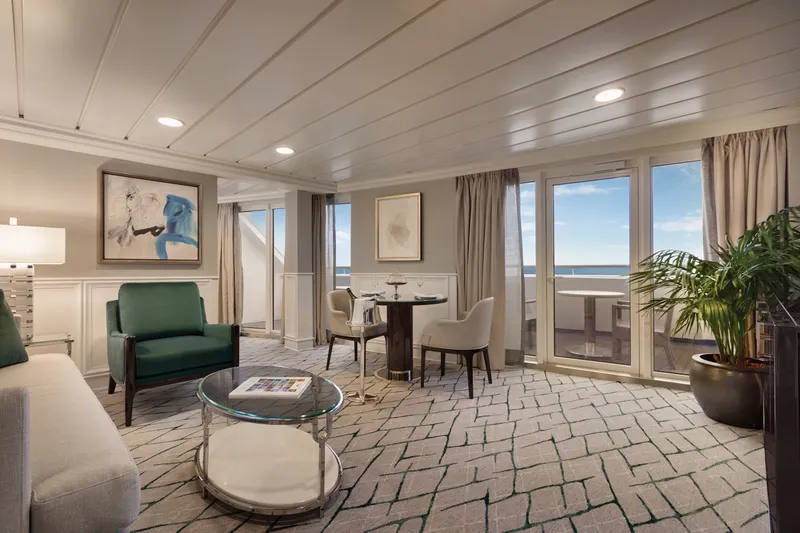
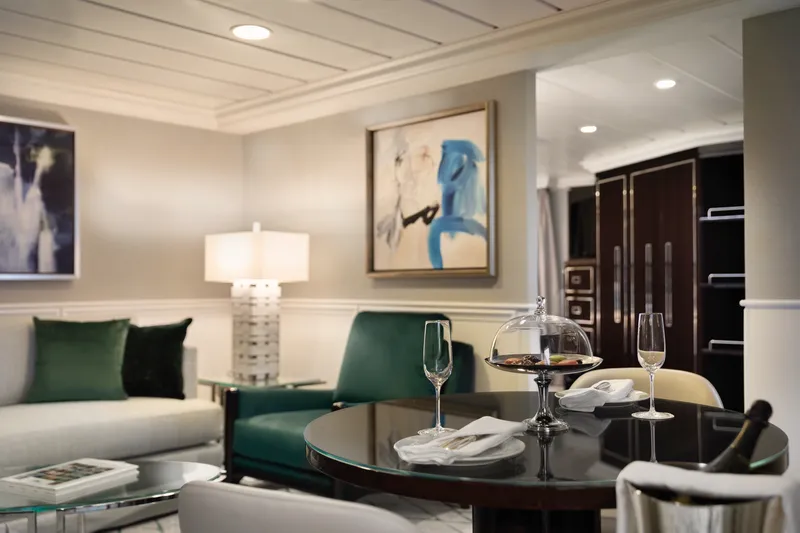
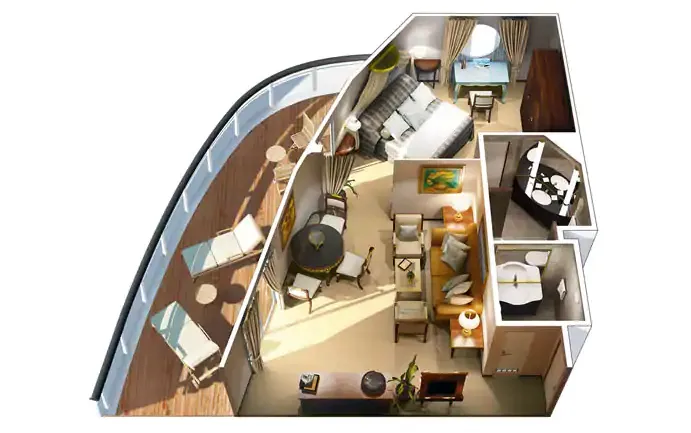
Named for their sweeping views over the ship's bow, the four Vista Suites each sprawl over 786 square feet. Every imaginable comfort is here, including a second bathroom for guests as well as a master bathroom newly redesigned in onyx and granite with a luxurious new shower. Relax on the private teak veranda, listen to music in enhanced surround sound or watch a movie on one of two flat-screen televisions. Access wireless Internet on a complimentary iPad.
Vista Suite Privileges
In addition to Suite & Stateroom Amenities
Free laundry service – up to 3 bags per stateroom+
Priority 11 am ship embarkation with priority luggage delivery
24-hour Butler service
Complimentary in-suite bar setup with 6 full-size bottles of premium spirits and wines from our suite beverage menu
Complimentary welcome bottle of Champagne
Fresh fruit basket replenished daily
Priority online specialty restaurant reservations
Unlimited access to the Aquamar Spa Terrace
Complimentary iPad
Bulgari gift set and variety of amenities
Choice of daily printed newspaper
Complimentary Oceania Cruises logo tote bag and personalized stationery
Cashmere lap blankets, perfect for relaxing on your veranda
Complimentary shoe shine service
Complimentary pressing of garments upon embarkation++
Choice of pillow from a luxurious selection

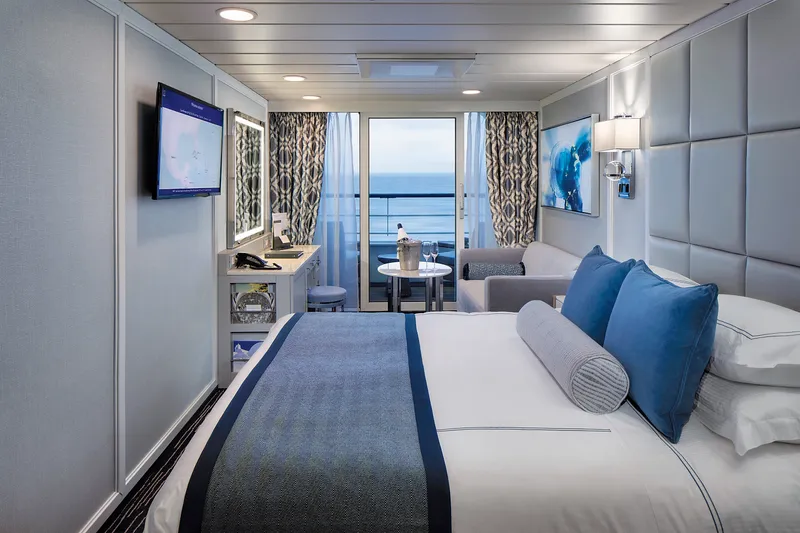

Located in the most desired of locations, Category A Concierge Level Veranda Staterooms offer an unrivaled combination of luxury and value. A wealth of amenities and a host of exclusive privileges (listed below) elevate the experience to the sublime.
These sleekly redefined 216-square-foot staterooms feature a wealth of amenities, including many of those found in our Penthouse Suites. The luxury is further enhanced by the fresh new decor, sumptuous Ultra Tranquility Beds, re-inspired verandas with stylish new furniture and the indulgence of exclusive Concierge Level amenities and privileges.
Concierge Level Exclusive Privileges
In addition to Stateroom Amenities
Room service from the Grand Dining Room menu during lunch and dinner
Free laundry service – up to 3 bags per stateroom+
Priority noon ship embarkation
Complimentary welcome bottle of Champagne
Priority online specialty restaurant reservations
Unlimited access to the Aquamar Spa Terrace
iPad upon request for your enjoyment onboard++
Complimentary Oceania Cruises logo tote bag
Cashmere lap blankets, perfect for relaxing on your veranda
Complimentary shoe shine service
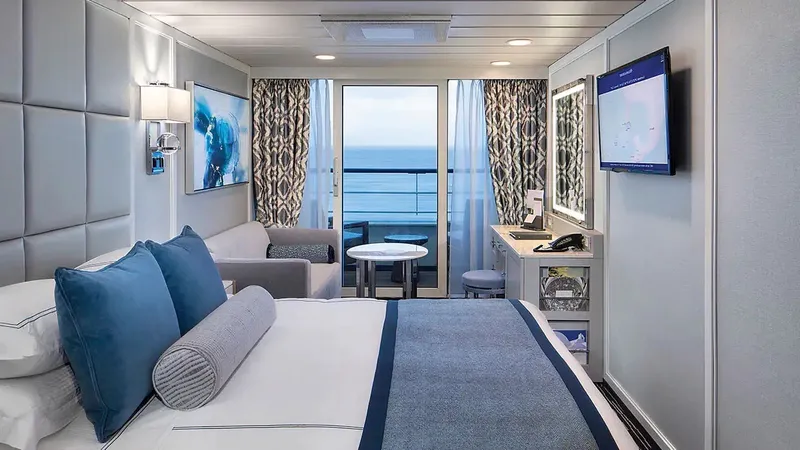


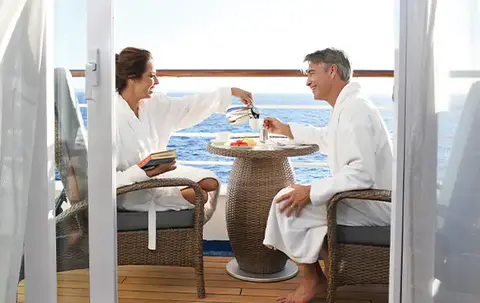
Custom-crafted furnishings, exotic stone finishes, supple upholstered headboards and chic lighting are just a few of the enhancements within these 216-square-foot staterooms that also boast our most popular luxury – a private teak veranda for watching the ever-changing panoramas. Conveniences within each stateroom include a vanity desk, refrigerated mini-bar, breakfast table and spacious seating area.
Veranda Stateroom Amenities
Ultra Tranquility Bed, an Oceania Cruises Exclusive
Private teak veranda
Twice daily maid service
Complimentary 24-hour room service
Signature Belgian chocolates with nightly turndown service
Plush cotton towels
Thick cotton robes and slippers
Bulgari amenities
Handheld hair dryer
Wireless Internet access and cellular service
Writing desk and stationary
Flat-screen television with live satellite news and programming
DVD player with extensive 24-hour room service menu
Security safe
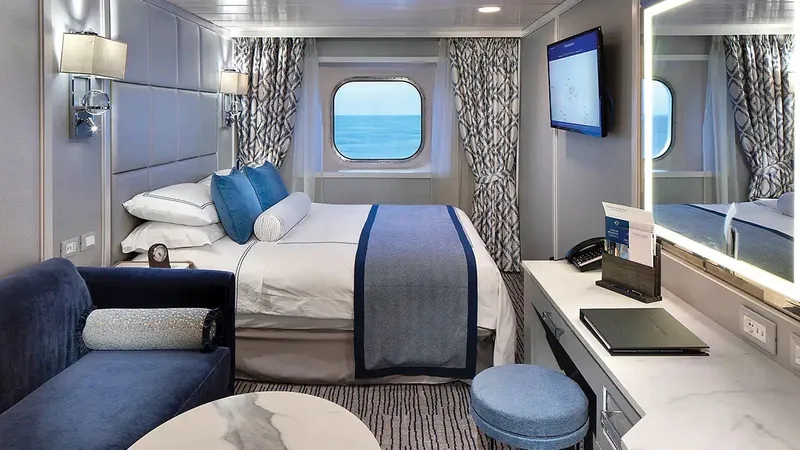


With entirely re-designed closets, dressers and vanities, these 165-squarefoot staterooms feel even more spacious. A generous seating area, vanity desk, refrigerated mini-bar and breakfast table are perfectly complemented by the soothing hues and stylish fabrics of the sleek new decor.
Deluxe Ocean View Stateroom Amenities
Ultra Tranquility Bed, an Oceania Cruises Exclusive
Complimentary 24-hour room service
Wireless Internet access and cellular service
Writing desk and stationary
Plush cotton towels
Thick cotton robes and slippers
Bulgari amenities
Handheld hair dryer
Flat-screen television with live satellite news and programming
DVD player with extensive 24-hour room service menu
Security safe
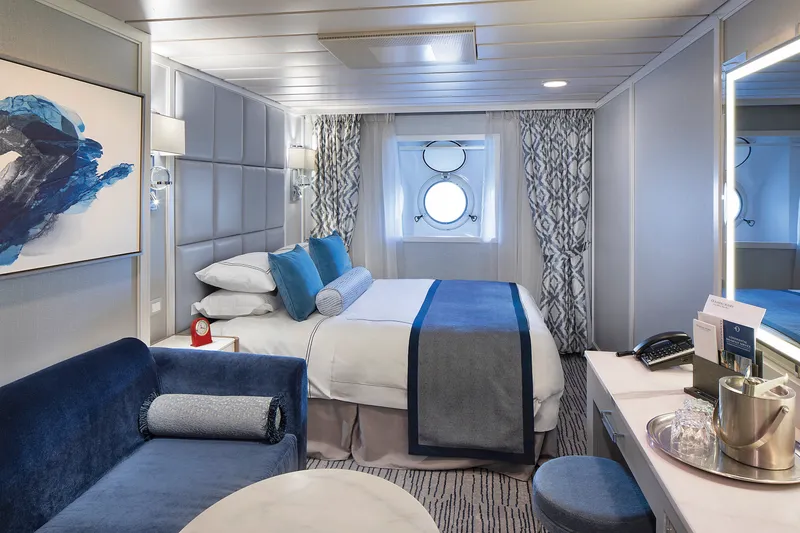


The light from a classic porthole illuminates the stunning decor in these 165-square-foot staterooms, tastefully designed to maximize space and convenience. Enjoy a comfortable seating area with a sofa on which to stretch out, as well as a vanity desk, breakfast table and refrigerated mini-bar.
Ocean View Stateroom Amenities
Ultra Tranquility Bed, an Oceania Cruises Exclusive
Complimentary 24-hour room service
Signature Belgian chocolates with nightly turndown service
Plush cotton towels
Thick cotton robes and slippers
Bulgari amenities
Handheld hair dryer
Wireless Internet access and cellular service
Writing desk and stationary
Flat-screen television with live satellite news and programming
DVD player with extensive 24-hour room service menu
Security safe


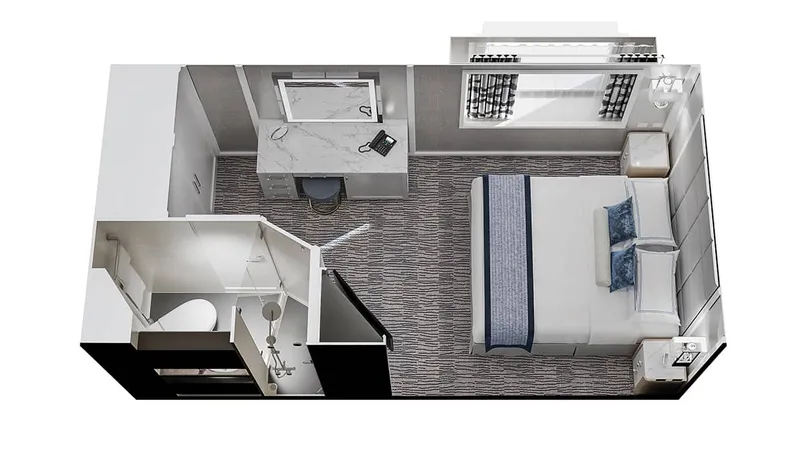
These charming staterooms are the perfect retreat for the solo traveler. Amply spacious and centrally located on Deck 6, each is equipped with a sublimely plush Tranquility Bed, refrigerated mini-bar, writing desk and abundant storage space.
Stateroom Amenities :
Tranquility Bed, an Oceania Cruises exclusive
FREE sodas replenished daily in your refrigerated mini-bar
FREE still and sparkling Vero Water
Private teak veranda
Luxury bath amenities
FREE room service menu 24 hours a day
Daily housekeeping service
Gourmet turndown chocolates upon request
Interactive television system with on-demand movies, weather and more
Starlink® WiFi service
Writing desk and stationery
Plush cotton towels, robes and slippers
Handheld hair dryer
Security safe
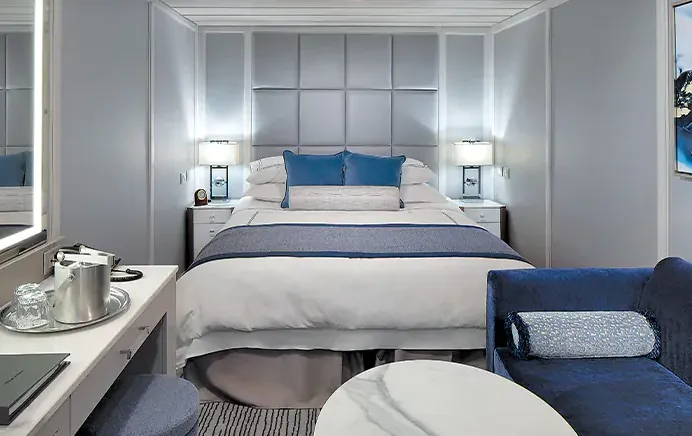


Beautifully re-designed with a modern flair, these private retreats boast 160 square feet of luxury. Highlights include a comfortable seating area, vanity desk, refrigerated minibar and plenty of storage. The ingenious use of space is complemented by the re-inspired decor.
Inside Stateroom Amenities
Ultra Tranquility Bed, an Oceania Cruises Exclusive
Complimentary and extensive 24-hour room service menu
Plush cotton towels
Thick cotton robes and slippers
Bulgari amenities
Handheld hair dryer
Flat-screen television with live satellite news and programming
DVD player with extensive media library
Wireless Internet access and cellular service
Writing desk and stationary
Security safe
Our cruise specialists can help you find the perfect cabin and the best available pricing.
(+886) 02-2721-7300Contact Advisor