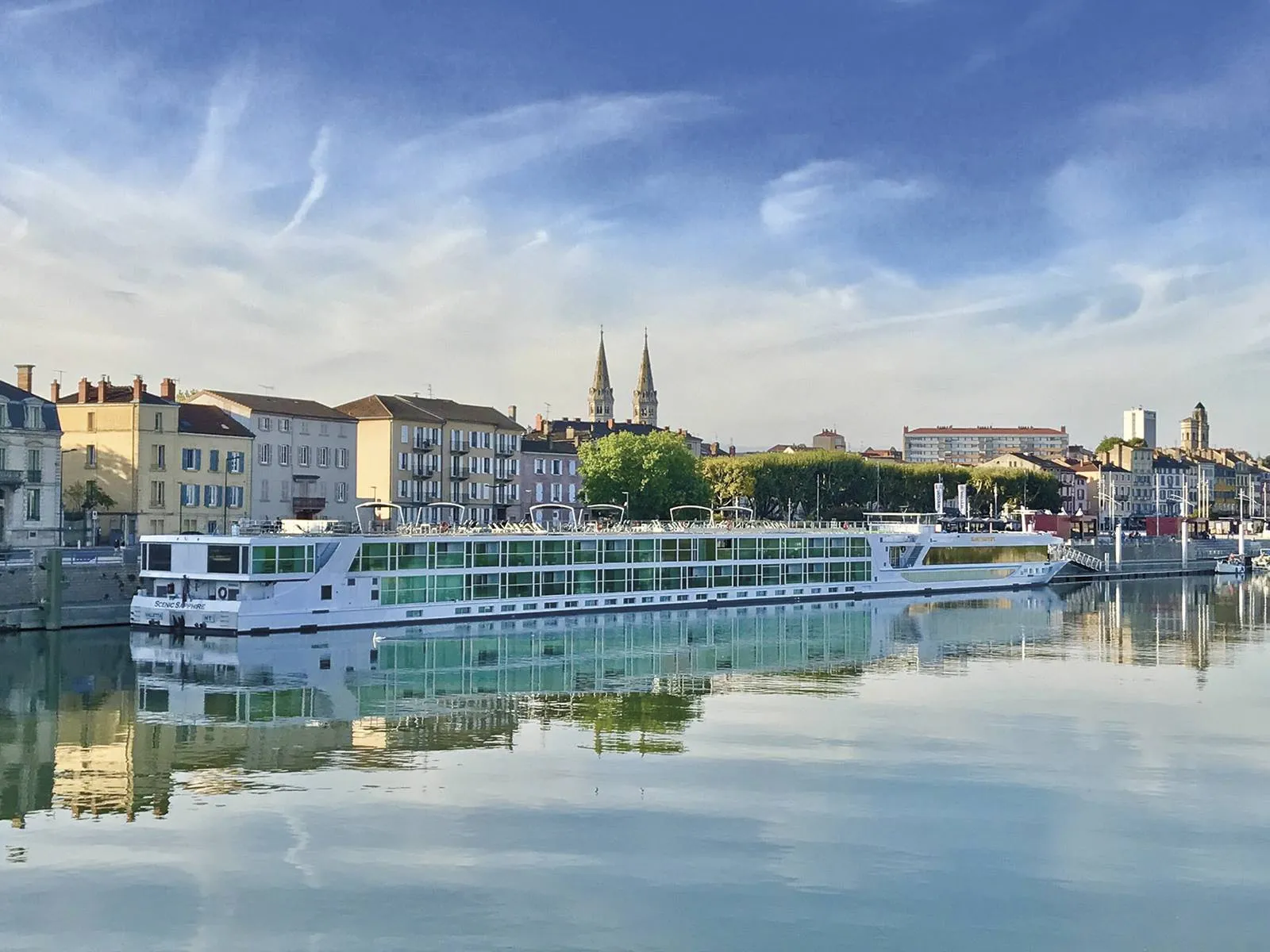
Date
2027-03-27
Duration
17 nights
Departure Port
Lyon
France
Arrival Port
Porto
Portugal
Rating
Luxury
Theme
—


Scenic River Cruises
Space-Ship
2008
2024
2,721 GT
151
—
53
—
—
—
No

Lyon sits at the confluence of the Rhône and the Saône — a geographic destiny that made it the capital of Roman Gaul, a Renaissance silk-trading powerhouse, and, by contemporary consensus, the undisputed gastronomic capital of France. The UNESCO-listed Vieux Lyon preserves Europe's finest concentration of Renaissance architecture, its labyrinthine traboules — secret passageways threading through courtyard after courtyard — offering endless discovery. Paul Bocuse's legacy lives on in the city's constellation of bouchons, where quenelles de brochet and tablier de sapeur are served with the straightforward confidence of a city that has never needed to prove its culinary supremacy. Lyon rewards a visit in any season, with the Festival of Lights in December being particularly magical.

Birthplace of photography and gateway to Burgundy's finest vineyards, Chalon-sur-Saône is a Saône River gem that rewards those who linger beyond its famous streets. The Musée Nicéphore Niépce, housed in a riverside mansion, chronicles the invention of the medium that changed human perception forever, while the surrounding Côte Chalonnaise wine villages — Mercurey, Givry, Rully — offer some of Burgundy's most approachable yet complex Pinot Noirs. Visit in late summer or early autumn for harvest season, when the vineyards blush gold and local restaurants celebrate the new vintage.

Tournus is a captivating commune in eastern France, renowned for its rich history, stunning architecture, and exceptional culinary experiences. Must-do activities include exploring the Abbey of Saint-Philibert and indulging in local dishes like coq au vin. The best season to visit is spring or early autumn when the weather is mild and the local markets are brimming with fresh produce.

Tournon-sur-Rhône is a captivating port town steeped in history, known for its medieval architecture and vibrant culinary scene. Must-do experiences include savoring local specialties such as caillettes and exploring the bustling Saturday market. The best time to visit is in the late spring or early fall when the weather is mild and the local festivities are in full swing.

Avignon's Palais des Papes — a fortress-palace of staggering medieval ambition where seven successive popes held court for seventy years — still dominates this Provençal city's skyline, its limestone bulk enclosing frescoed chapels and vast ceremonial halls that once shaped the destiny of Christendom. In July, the city transforms for the celebrated Festival d'Avignon, Europe's premier theatre gathering, turning every courtyard and cloister into a stage. Year-round, the beautifully preserved historic centre offers world-class Rhône Valley wines, refined Provençal cuisine, and the beguiling spectacle of the Pont Saint-Bénézet stretching halfway across the river. Lyon and Marseille are each accessible in under ninety minutes by TGV.

Arles, the most important city in Roman Gaul after Lyon, wears its history with casual magnificence: a first-century amphitheatre still hosts bullfights beneath open skies, and the haunting Alyscamps necropolis — once among the most prestigious burial grounds in the Western world — lines a poplar-shaded avenue with ancient sarcophagi. Yet Arles is equally celebrated as the city that intoxicated Vincent van Gogh, who produced over three hundred works here in fifteen fevered months; the Fondation Vincent van Gogh now honors his legacy in beautifully renovated rooms. Spring and autumn are ideal, with the Camargue's flamingo-filled wetlands just minutes south. Lyon is two hours north by TGV.

Viviers is one of France's most beautifully preserved medieval secrets — a cathedral town of barely four thousand souls perched on a limestone spur above the Rhône, serving as an episcopal seat since the fifth century when its bishops chose this formidable rock over the declining Roman city below. The Romanesque bell tower, vaulted passageways, and Renaissance townhouses of the haute ville form an ensemble of extraordinary architectural coherence, virtually unaltered since the seventeenth century. River cruise guests arriving from Lyon or Avignon typically spend languid afternoons exploring these narrow, time-suspended streets, best visited in spring or early autumn when Rhône Valley light is at its most golden.

Lyon sits at the confluence of the Rhône and the Saône — a geographic destiny that made it the capital of Roman Gaul, a Renaissance silk-trading powerhouse, and, by contemporary consensus, the undisputed gastronomic capital of France. The UNESCO-listed Vieux Lyon preserves Europe's finest concentration of Renaissance architecture, its labyrinthine traboules — secret passageways threading through courtyard after courtyard — offering endless discovery. Paul Bocuse's legacy lives on in the city's constellation of bouchons, where quenelles de brochet and tablier de sapeur are served with the straightforward confidence of a city that has never needed to prove its culinary supremacy. Lyon rewards a visit in any season, with the Festival of Lights in December being particularly magical.

Lyon sits at the confluence of the Rhône and the Saône — a geographic destiny that made it the capital of Roman Gaul, a Renaissance silk-trading powerhouse, and, by contemporary consensus, the undisputed gastronomic capital of France. The UNESCO-listed Vieux Lyon preserves Europe's finest concentration of Renaissance architecture, its labyrinthine traboules — secret passageways threading through courtyard after courtyard — offering endless discovery. Paul Bocuse's legacy lives on in the city's constellation of bouchons, where quenelles de brochet and tablier de sapeur are served with the straightforward confidence of a city that has never needed to prove its culinary supremacy. Lyon rewards a visit in any season, with the Festival of Lights in December being particularly magical.

Porto, set dramatically on the granite bluffs above the Douro River, is among Europe's most romantically dishevelled cities — a place where baroque church towers rise above terracotta rooftops and century-old azulejo tilework lines every alley. Cross the iron Dom Luís I Bridge for sweeping views and descend into Vila Nova de Gaia's atmospheric wine lodges for a tasting of aged tawny port direct from the barrel. Seafood is magnificent: salt cod prepared a hundred ways, barnacles glistening with lemon, and custard tarts still warm from the oven. Spring and early autumn offer the finest conditions.

Pinhão sits at the most photographed bend on the Douro River, where impossibly steep terraced vineyards — the schist-stone walls built by hand over centuries — have shaped a valley so beautiful it is protected as a UNESCO World Heritage Site and produced port wine for the world since the Marquis of Pombal established its boundaries in 1756. The village railway station, decorated with 24 azulejo tile panels depicting scenes of the grape harvest, is a minor masterpiece of Portuguese folk art that alone justifies a stop. The river cruise between Pinhão and Régua, passing through the heart of the Port wine country, is among the most beautiful journeys in Europe. Visit during the September harvest for an experience of extraordinary sensory richness.

Barca d'Alva, a remote frontier village at the uppermost navigable point of the Douro River, marks the eastern terminus of Portuguese river cruises where the landscape shifts from terraced port wine vineyards into the austere granite borderlands of Trás-os-Montes. The abandoned azulejo-tiled railway station, the almond orchards cascading to the river's edge, and the silence of the surrounding Côa Valley archaeological park — protecting the world's most important collection of open-air Palaeolithic rock art — make this an unexpectedly rich stopping point. Spring brings almond blossom along every hillside; autumn arrives golden with the vendange harvest. The Spanish city of Salamanca lies an hour's drive east.

Pocinho marks the easternmost navigable point of the Douro River — the terminus of the valley where port wine's history began and where the landscape reaches its most elemental and dramatic expression: near-vertical schist slopes terraced into vineyard stairways, the river running silver between them in the early morning light. The restored rabelo boats that once carried casks of wine downriver are now a romanticised memory, but the valley's working quintas welcome visitors for tastings of the upper Douro's increasingly celebrated unfortified wines. The Douro International Natural Park, bordering Spain, protects rare Egyptian vulture colonies on the surrounding plateau. September through October, during harvest, is the unmissable season.
Régua, gateway to Portugal's vertiginous Douro Valley wine country, sits at the point where the river enters its most dramatic gorge — terraced vineyards climbing impossible slopes on every side, their schist walls a testament to generations of viticultural determination. The Wine Museum in Pinhão's art nouveau azulejo station captures the region's soul, while the great quintas — Ramos Pinto, Croft, Niepoort — open their cellars for intimate tastings of vintage port and luminous dry whites. Harvest season in September and October transforms the valley into a festival of colour and ferment.

Porto, set dramatically on the granite bluffs above the Douro River, is among Europe's most romantically dishevelled cities — a place where baroque church towers rise above terracotta rooftops and century-old azulejo tilework lines every alley. Cross the iron Dom Luís I Bridge for sweeping views and descend into Vila Nova de Gaia's atmospheric wine lodges for a tasting of aged tawny port direct from the barrel. Seafood is magnificent: salt cod prepared a hundred ways, barnacles glistening with lemon, and custard tarts still warm from the oven. Spring and early autumn offer the finest conditions.

Porto, set dramatically on the granite bluffs above the Douro River, is among Europe's most romantically dishevelled cities — a place where baroque church towers rise above terracotta rooftops and century-old azulejo tilework lines every alley. Cross the iron Dom Luís I Bridge for sweeping views and descend into Vila Nova de Gaia's atmospheric wine lodges for a tasting of aged tawny port direct from the barrel. Seafood is magnificent: salt cod prepared a hundred ways, barnacles glistening with lemon, and custard tarts still warm from the oven. Spring and early autumn offer the finest conditions.
Day 1

Lyon sits at the confluence of the Rhône and the Saône — a geographic destiny that made it the capital of Roman Gaul, a Renaissance silk-trading powerhouse, and, by contemporary consensus, the undisputed gastronomic capital of France. The UNESCO-listed Vieux Lyon preserves Europe's finest concentration of Renaissance architecture, its labyrinthine traboules — secret passageways threading through courtyard after courtyard — offering endless discovery. Paul Bocuse's legacy lives on in the city's constellation of bouchons, where quenelles de brochet and tablier de sapeur are served with the straightforward confidence of a city that has never needed to prove its culinary supremacy. Lyon rewards a visit in any season, with the Festival of Lights in December being particularly magical.
Day 2

Birthplace of photography and gateway to Burgundy's finest vineyards, Chalon-sur-Saône is a Saône River gem that rewards those who linger beyond its famous streets. The Musée Nicéphore Niépce, housed in a riverside mansion, chronicles the invention of the medium that changed human perception forever, while the surrounding Côte Chalonnaise wine villages — Mercurey, Givry, Rully — offer some of Burgundy's most approachable yet complex Pinot Noirs. Visit in late summer or early autumn for harvest season, when the vineyards blush gold and local restaurants celebrate the new vintage.
Day 3

Tournus is a captivating commune in eastern France, renowned for its rich history, stunning architecture, and exceptional culinary experiences. Must-do activities include exploring the Abbey of Saint-Philibert and indulging in local dishes like coq au vin. The best season to visit is spring or early autumn when the weather is mild and the local markets are brimming with fresh produce.
Day 4

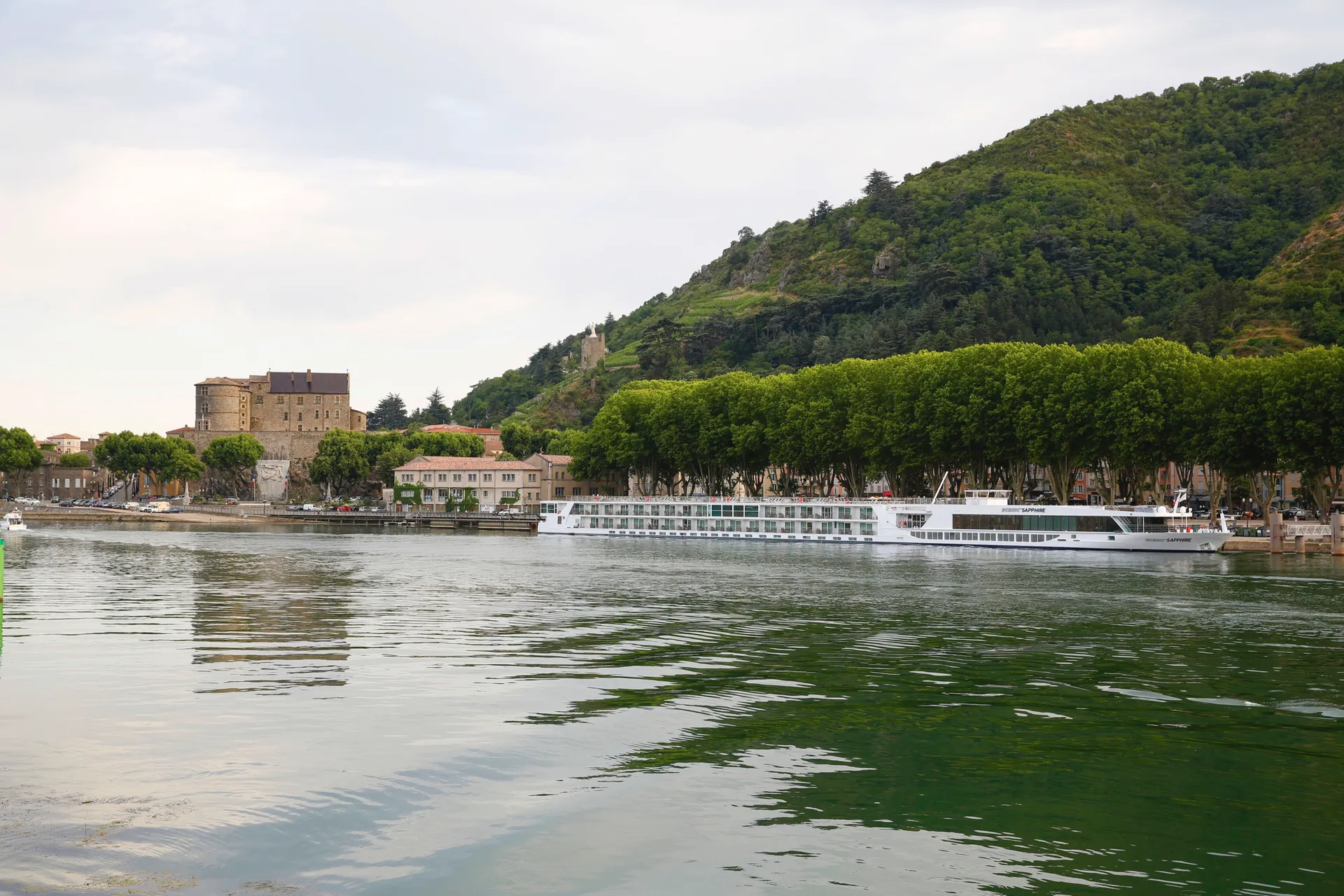
Tournon-sur-Rhône is a captivating port town steeped in history, known for its medieval architecture and vibrant culinary scene. Must-do experiences include savoring local specialties such as caillettes and exploring the bustling Saturday market. The best time to visit is in the late spring or early fall when the weather is mild and the local festivities are in full swing.
Day 5

Avignon's Palais des Papes — a fortress-palace of staggering medieval ambition where seven successive popes held court for seventy years — still dominates this Provençal city's skyline, its limestone bulk enclosing frescoed chapels and vast ceremonial halls that once shaped the destiny of Christendom. In July, the city transforms for the celebrated Festival d'Avignon, Europe's premier theatre gathering, turning every courtyard and cloister into a stage. Year-round, the beautifully preserved historic centre offers world-class Rhône Valley wines, refined Provençal cuisine, and the beguiling spectacle of the Pont Saint-Bénézet stretching halfway across the river. Lyon and Marseille are each accessible in under ninety minutes by TGV.
Day 7

Arles, the most important city in Roman Gaul after Lyon, wears its history with casual magnificence: a first-century amphitheatre still hosts bullfights beneath open skies, and the haunting Alyscamps necropolis — once among the most prestigious burial grounds in the Western world — lines a poplar-shaded avenue with ancient sarcophagi. Yet Arles is equally celebrated as the city that intoxicated Vincent van Gogh, who produced over three hundred works here in fifteen fevered months; the Fondation Vincent van Gogh now honors his legacy in beautifully renovated rooms. Spring and autumn are ideal, with the Camargue's flamingo-filled wetlands just minutes south. Lyon is two hours north by TGV.
Day 8

Viviers is one of France's most beautifully preserved medieval secrets — a cathedral town of barely four thousand souls perched on a limestone spur above the Rhône, serving as an episcopal seat since the fifth century when its bishops chose this formidable rock over the declining Roman city below. The Romanesque bell tower, vaulted passageways, and Renaissance townhouses of the haute ville form an ensemble of extraordinary architectural coherence, virtually unaltered since the seventeenth century. River cruise guests arriving from Lyon or Avignon typically spend languid afternoons exploring these narrow, time-suspended streets, best visited in spring or early autumn when Rhône Valley light is at its most golden.
Day 9

Lyon sits at the confluence of the Rhône and the Saône — a geographic destiny that made it the capital of Roman Gaul, a Renaissance silk-trading powerhouse, and, by contemporary consensus, the undisputed gastronomic capital of France. The UNESCO-listed Vieux Lyon preserves Europe's finest concentration of Renaissance architecture, its labyrinthine traboules — secret passageways threading through courtyard after courtyard — offering endless discovery. Paul Bocuse's legacy lives on in the city's constellation of bouchons, where quenelles de brochet and tablier de sapeur are served with the straightforward confidence of a city that has never needed to prove its culinary supremacy. Lyon rewards a visit in any season, with the Festival of Lights in December being particularly magical.
Day 11

Lyon sits at the confluence of the Rhône and the Saône — a geographic destiny that made it the capital of Roman Gaul, a Renaissance silk-trading powerhouse, and, by contemporary consensus, the undisputed gastronomic capital of France. The UNESCO-listed Vieux Lyon preserves Europe's finest concentration of Renaissance architecture, its labyrinthine traboules — secret passageways threading through courtyard after courtyard — offering endless discovery. Paul Bocuse's legacy lives on in the city's constellation of bouchons, where quenelles de brochet and tablier de sapeur are served with the straightforward confidence of a city that has never needed to prove its culinary supremacy. Lyon rewards a visit in any season, with the Festival of Lights in December being particularly magical.

Porto, set dramatically on the granite bluffs above the Douro River, is among Europe's most romantically dishevelled cities — a place where baroque church towers rise above terracotta rooftops and century-old azulejo tilework lines every alley. Cross the iron Dom Luís I Bridge for sweeping views and descend into Vila Nova de Gaia's atmospheric wine lodges for a tasting of aged tawny port direct from the barrel. Seafood is magnificent: salt cod prepared a hundred ways, barnacles glistening with lemon, and custard tarts still warm from the oven. Spring and early autumn offer the finest conditions.
Day 12

Pinhão sits at the most photographed bend on the Douro River, where impossibly steep terraced vineyards — the schist-stone walls built by hand over centuries — have shaped a valley so beautiful it is protected as a UNESCO World Heritage Site and produced port wine for the world since the Marquis of Pombal established its boundaries in 1756. The village railway station, decorated with 24 azulejo tile panels depicting scenes of the grape harvest, is a minor masterpiece of Portuguese folk art that alone justifies a stop. The river cruise between Pinhão and Régua, passing through the heart of the Port wine country, is among the most beautiful journeys in Europe. Visit during the September harvest for an experience of extraordinary sensory richness.
Day 13

Barca d'Alva, a remote frontier village at the uppermost navigable point of the Douro River, marks the eastern terminus of Portuguese river cruises where the landscape shifts from terraced port wine vineyards into the austere granite borderlands of Trás-os-Montes. The abandoned azulejo-tiled railway station, the almond orchards cascading to the river's edge, and the silence of the surrounding Côa Valley archaeological park — protecting the world's most important collection of open-air Palaeolithic rock art — make this an unexpectedly rich stopping point. Spring brings almond blossom along every hillside; autumn arrives golden with the vendange harvest. The Spanish city of Salamanca lies an hour's drive east.
Day 14

Pocinho marks the easternmost navigable point of the Douro River — the terminus of the valley where port wine's history began and where the landscape reaches its most elemental and dramatic expression: near-vertical schist slopes terraced into vineyard stairways, the river running silver between them in the early morning light. The restored rabelo boats that once carried casks of wine downriver are now a romanticised memory, but the valley's working quintas welcome visitors for tastings of the upper Douro's increasingly celebrated unfortified wines. The Douro International Natural Park, bordering Spain, protects rare Egyptian vulture colonies on the surrounding plateau. September through October, during harvest, is the unmissable season.
Day 15
Régua, gateway to Portugal's vertiginous Douro Valley wine country, sits at the point where the river enters its most dramatic gorge — terraced vineyards climbing impossible slopes on every side, their schist walls a testament to generations of viticultural determination. The Wine Museum in Pinhão's art nouveau azulejo station captures the region's soul, while the great quintas — Ramos Pinto, Croft, Niepoort — open their cellars for intimate tastings of vintage port and luminous dry whites. Harvest season in September and October transforms the valley into a festival of colour and ferment.
Day 16

Porto, set dramatically on the granite bluffs above the Douro River, is among Europe's most romantically dishevelled cities — a place where baroque church towers rise above terracotta rooftops and century-old azulejo tilework lines every alley. Cross the iron Dom Luís I Bridge for sweeping views and descend into Vila Nova de Gaia's atmospheric wine lodges for a tasting of aged tawny port direct from the barrel. Seafood is magnificent: salt cod prepared a hundred ways, barnacles glistening with lemon, and custard tarts still warm from the oven. Spring and early autumn offer the finest conditions.
Day 18

Porto, set dramatically on the granite bluffs above the Douro River, is among Europe's most romantically dishevelled cities — a place where baroque church towers rise above terracotta rooftops and century-old azulejo tilework lines every alley. Cross the iron Dom Luís I Bridge for sweeping views and descend into Vila Nova de Gaia's atmospheric wine lodges for a tasting of aged tawny port direct from the barrel. Seafood is magnificent: salt cod prepared a hundred ways, barnacles glistening with lemon, and custard tarts still warm from the oven. Spring and early autumn offer the finest conditions.


These spacious Suites (250ft²), located on the Sapphire and Diamond Decks, have a private full-length balcony and elegant en-suite bathrooms featuring a large vanity basin, bathtub with shower above.


These Suites on the Diamond Deck are the ultimate in luxury with more space (315ft²), impeccable service, thoughtful touches, an outdoor balcony, lounge area and an oversized bathroom.


These Suites on the Diamond Deck are the ultimate in luxury with more space (315ft²), impeccable service, thoughtful touches, an outdoor balcony, lounge area and an oversized bathroom.


At 325ft², and at the rear of the Diamond Deck, enjoy panoramic views of the breathtaking passing scenery through floor to ceiling windows across two walls of the cabin.


Located on the Sapphire and Diamond Decks they feature a full-length outdoor balcony with the exclusive Sun Lounge system and are larger than the standard river cruise cabins on Europe’s rivers.


Single Balcony Suites are located on the Jewel Deck with large picture windows to ensure a great view. They have a spacious design and clever layout alongside all the usual luxurious amenities and furnishings.


Standard Suites are located on the Jewel Deck with large picture windows to ensure a great view. They have a spacious design and clever layout alongside all the usual luxurious amenities and furnishings.
Our cruise specialists can help you find the perfect cabin and the best available pricing.
(+886) 02-2721-7300Contact Advisor