Date
October 18, 2026
Duration
14 nights
Departure Port
Paris · France
Arrival Port
Arles · United Kingdom
Rating
Luxury
Theme
History & Culture


Uniworld River Cruises
Super Ship
2017
—
1,500 GT
128
64
52
410 m
11.4 m
10 knots
No


Even if you’ve never been to Paris before, you’ll feel like you recognise every corner of the city. Countless films, books, paintings, poems and songs have been set in the city of love. Yet there’s always more to discover. The fashion capital of the world, a mecca of art and culture, an oasis for gourmets and a metropolis for media, education and political and economic power – Paris is all of this and more. Paris is a city whose beauty never fades. The Arc de Triomphe, Eiffel Tower, Notre Dame, Madeleine, Opéra, Louvre, Sacré-Coeur de Montmartre, Dôme des Invalides and Centre Pompidou are just some of the sights that exemplify this city’s fame and grandeur.


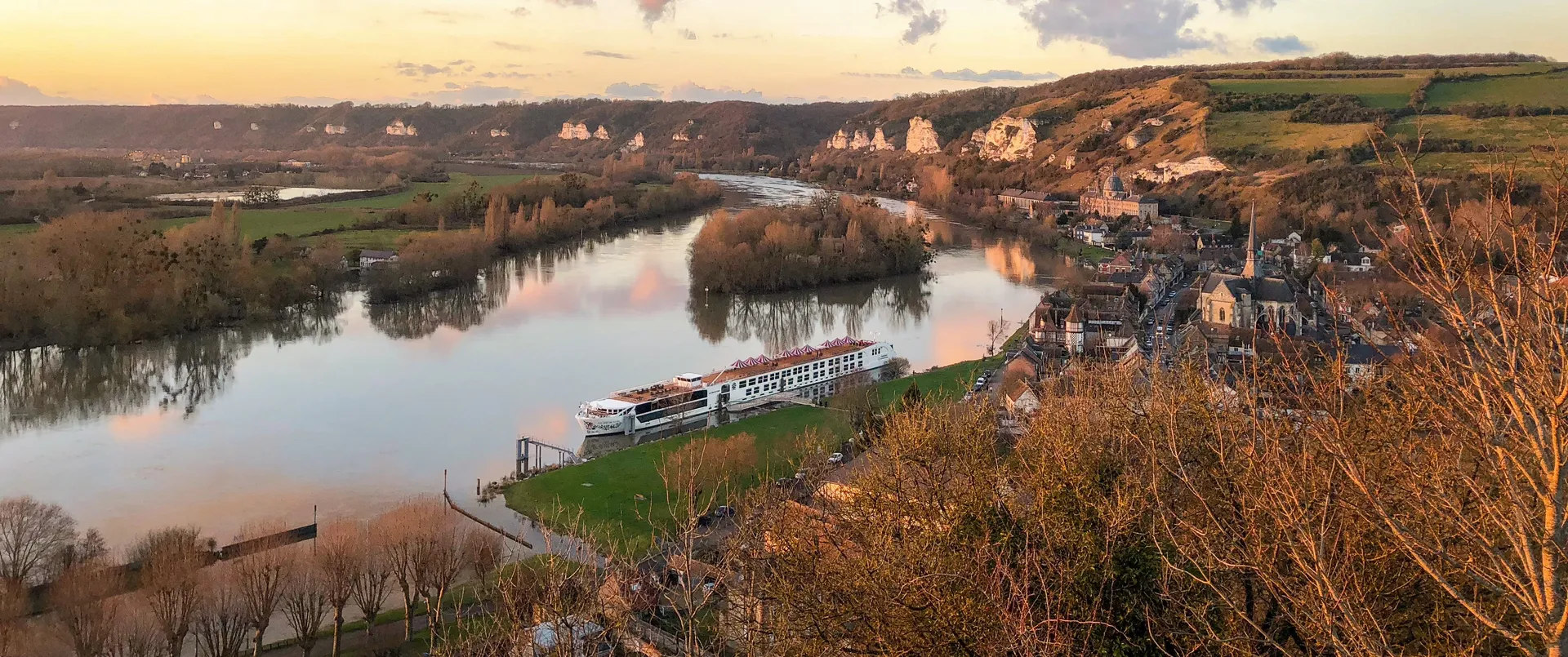
It’s said that you can hear the beams creaking like old bones when you see the Vieux Moulin de Vernon. The mill is perched on two pillars, seemingly suspended in mid-air over the Seine, while its roof sags like an old worn-out horse. Claude Monet painted the mill; reassuringly, the sag is visible in these paintings, which date back to 1883. Vernon has a few sights, such as a Gothic abbey church with stunningly colourful stained-glass windows. Nevertheless, it’s almost impossible to resist the lure of excursions to nearby destinations. In Château de Bizy (also known as ‘Little Versailles’), you can revel in luxurious Renaissance décor and go for a delightful stroll around the elegant park. Claude Monet’s house in Giverny is another magnet for culture enthusiasts and romantics – and rightly so. Unsurprisingly, the lush garden looks like a wild field of flowers from an impressionist painting. The crowning glory is the enchanting pond of water lilies – the subject of one of the most valuable paintings in the world.


It’s said that you can hear the beams creaking like old bones when you see the Vieux Moulin de Vernon. The mill is perched on two pillars, seemingly suspended in mid-air over the Seine, while its roof sags like an old worn-out horse. Claude Monet painted the mill; reassuringly, the sag is visible in these paintings, which date back to 1883. Vernon has a few sights, such as a Gothic abbey church with stunningly colourful stained-glass windows. Nevertheless, it’s almost impossible to resist the lure of excursions to nearby destinations. In Château de Bizy (also known as ‘Little Versailles’), you can revel in luxurious Renaissance décor and go for a delightful stroll around the elegant park. Claude Monet’s house in Giverny is another magnet for culture enthusiasts and romantics – and rightly so. Unsurprisingly, the lush garden looks like a wild field of flowers from an impressionist painting. The crowning glory is the enchanting pond of water lilies – the subject of one of the most valuable paintings in the world.


Giverny is a village in the region of Normandy in northern France. Impressionist painter Claude Monet lived and worked here from 1883 until his death in 1926. The artist’s former home and elaborate gardens, where he produced his famed water lily series, are now the Fondation Claude Monet museum. Nearby, the Musée des impressionnismes Giverny highlights the Impressionist art movement.


Situated in a natural amphitheater on the Seine River, Rouen's status as a commercial and cultural center reaches as far back as the Middle Ages. As a result of its importance, the city was the target of many sieges. During the English occupation in the Hundred Years' War, Rouen was the site where Joan of Arc was burned at the stake in 1431. Other tragedies include the destruction of a major part of the commercial and industrial center during bombing raids in World War II. Today the city presents an interesting mix of medieval and modern architecture. Rouen expanded outward during the 20th century with the development of industries; its increasingly busy port is now the fourth largest in France. The city's greatest attraction is its historic center. Known as the “City of a Hundred Spires,” many of its important edifices are churches. Dominating the large central square is the magnificent Notre-Dame Cathedral, a masterpiece of French Gothic architecture. You may recognize the west façade of the cathedral from a series of studies by Claude Monet, which are now displayed in the Musée d'Orsay in Paris. Surrounding the square are picturesque half-timbered houses with steeply pointed roofs. The wealth of architectural treasures and the ambiance of Rouen's historic center never fail to impress visitors. Rouen also serves as a gateway to Paris. Driving distance is 2 hours by car or 1.5 hours by train. (Trains arrive in Paris at St. Lazare Station.)


There was once a time when the Seine’s tidal bore, or mascaret, could get up to seven metres high. However, when the river was dredged and made navigable for ships, this natural spectacle ceased. Today, visitors to this small town are enchanted by the restaurants and cafes on the river’s promenade, from where you can watch the comings and goings on the Seine. There are plenty of interesting excursion options here. Honfleur, an idyllic fishing town, has gorgeous little lanes and a picturesque old port quarter that has hardly changed since the 17th century. Another tour option takes you to the region’s venerable monasteries. Some of these are still inhabited, while others – such as Jumièges Abbey – survive as spectacular ruins.


Situated in a natural amphitheater on the Seine River, Rouen's status as a commercial and cultural center reaches as far back as the Middle Ages. As a result of its importance, the city was the target of many sieges. During the English occupation in the Hundred Years' War, Rouen was the site where Joan of Arc was burned at the stake in 1431. Other tragedies include the destruction of a major part of the commercial and industrial center during bombing raids in World War II. Today the city presents an interesting mix of medieval and modern architecture. Rouen expanded outward during the 20th century with the development of industries; its increasingly busy port is now the fourth largest in France. The city's greatest attraction is its historic center. Known as the “City of a Hundred Spires,” many of its important edifices are churches. Dominating the large central square is the magnificent Notre-Dame Cathedral, a masterpiece of French Gothic architecture. You may recognize the west façade of the cathedral from a series of studies by Claude Monet, which are now displayed in the Musée d'Orsay in Paris. Surrounding the square are picturesque half-timbered houses with steeply pointed roofs. The wealth of architectural treasures and the ambiance of Rouen's historic center never fail to impress visitors. Rouen also serves as a gateway to Paris. Driving distance is 2 hours by car or 1.5 hours by train. (Trains arrive in Paris at St. Lazare Station.)


Mantes-la-Jolie is a commune in the Yvelines department in the Île-de-France region of north-central France. It is located to the west of Paris, 48.4 km from the centre of the capital.


Even if you’ve never been to Paris before, you’ll feel like you recognise every corner of the city. Countless films, books, paintings, poems and songs have been set in the city of love. Yet there’s always more to discover. The fashion capital of the world, a mecca of art and culture, an oasis for gourmets and a metropolis for media, education and political and economic power – Paris is all of this and more. Paris is a city whose beauty never fades. The Arc de Triomphe, Eiffel Tower, Notre Dame, Madeleine, Opéra, Louvre, Sacré-Coeur de Montmartre, Dôme des Invalides and Centre Pompidou are just some of the sights that exemplify this city’s fame and grandeur.


Even if you’ve never been to Paris before, you’ll feel like you recognise every corner of the city. Countless films, books, paintings, poems and songs have been set in the city of love. Yet there’s always more to discover. The fashion capital of the world, a mecca of art and culture, an oasis for gourmets and a metropolis for media, education and political and economic power – Paris is all of this and more. Paris is a city whose beauty never fades. The Arc de Triomphe, Eiffel Tower, Notre Dame, Madeleine, Opéra, Louvre, Sacré-Coeur de Montmartre, Dôme des Invalides and Centre Pompidou are just some of the sights that exemplify this city’s fame and grandeur.


Sitting in the Auvergne-Rhône-Alpes region of France, where the Rhône and Saône rivers converge, Lyon boasts a proud 2,000 year history. From its magnificent Roman Amphitheatre of Fourvière, to Renaissance architecture in Lyon’s old town, to the Presqu’ile peninsula, where impressive 19th century buildings house banks, cultural centres, and government buildings, alongside designer stores, independent retailers, restaurants, bars, cafes, and nightclubs. Check out the Vieux area of the city, and its grand houses of the 15th, 16th, and 17th centuries, built by the city’s wealthy silk merchants. Walk the Traboules, underground passageways that linked the weaving houses to the river. Visit the impressive Fourvière Basilica, and Lyon’s gothic cathedral. Seek out the Musée des Beaux-Arts, the largest fine-arts museum outside of Paris. Or choose to relax, stroll the Parc de la Tête d’Or, one of France’s largest botanical gardens, and stop off at a Bouchon, to enjoy some local Lyon cuisine.


Macon is a city in central Georgia. Ocmulgee National Monument has large Native American earthen mounds from around 1000 A.D., and its museum displays artifacts spanning thousands of years. The Tubman Museum’s exhibits on African-American art, history and culture include a huge mural and the Inventors Gallery. The Allman Brothers Band Museum at the Big House shows memorabilia in the rock band’s former home.


Tain-l'Hermitage is a commune in the Drôme department in southeastern France.


Viviers is a small and sleepy town in south-central France, in the province of Ardeche. This medieval town has retained a lot of its original appeal. A cruise through the city will be significantly different compared to a walk. The cruise trip on the Rhine river will typically run through the evening and will wind through the cobblestone streets of the city. The city has Medieval stone houses which will quickly give you an idea of how life was back in the 15th and 16th centuries. You will also notice that the place is very quiet, having about 3,000 inhabitants at the time. A key attraction you will see in the city is the famous Renaissance Maison des Chevaliers or House of Knights. This Renaissance-style house has a long and interesting history, having originally been the house of a rich merchant known as Noel Alberta. You will also see the famous Cathedral of St. Vincent which is even much older than the House of Knights. The cathedral was constructed in the 12th century and is currently protected as a historical monument.


As you stroll the squares and cobbled streets of Avignon, in south-eastern France, you can’t help but be impressed by the architectural influence of 400 years of papal rule. From its 800 year old ramparts that tower majestically over the Rhône River, to the UNESCO listed Pope’s Palace and city centre, the area is steeped in cultural history. However, to contrast the spectacular ancient architecture, the city has a young energetic population. With many attending the University of Avignon, they add a dynamic energy to the many cafes and bistros dotted around the town squares and alleyways. Visit the three magnificent Gothic churches, the old papal mint, Collection Lambert, and the Renaissance artwork in the Musee du Petit. Wander through the Rochers des Doms gardens. Take in the spectacular view across the city skyline, and relax with a liqueur coffee and pastries, in one of the many pavement cafes.

Tarascon, sometimes referred to as Tarascon-sur-Rhône, is a commune situated at the extreme west of the Bouches-du-Rhône department of France in the Provence-Alpes-Côte d'Azur region. Inhabitants are referred to as Tarasconnais or Tarasconnaises.


If you have a love of Roman history, then Arles should be on the visiting itinerary. Situated on the Rhône River, in Southern France, the city was at one time a provincial capital of ancient Rome. The Roman influence can still be seen to this day in its historical sites. Its semi-circular Roman theatre still stands on a hilltop. Its Amphitheatre, built between the 1st and 2nd century, and capable of accommodating over 20,000 spectators, is used today for plays, festivals and bullfights. While the Alyscamps, or Roman Necropolis, built by the Romans and Greeks, is the most famous burial site in the western world. Another site worthy of mention is the Constantine Thermes, built between the 3rd and 4th centuries during the reign of the Emperor Constantine. Arles is also said to have influenced Van Gough’s paintings, and the contemporary art on show at the Vincent Van Gough Foundation.


Lavishly appointed riverview stateroom (410 sq ft - 38 sq m) with a French balcony
Handcrafted Savoir Beds of England, built-in closet, hair dryer, safe, individual thermostat, flat-screen TV with infotainment centre and satellite, and bottled water
The Grand Suite offers extra benefits, including a separate spacious living room, bathroom with a separate rain shower and tub, and secluded toilet and bidet area


Lavishly appointed riverview stateroom (260 sq ft - 24 sq m) with a French balcony
Handcrafted Savoir Beds of England, built-in closet, hair dryer, safe, individual thermostat, bottled water and flat-screen TV with infotainment center and satellite
Marble bathroom with Asprey bath and body products, plush towels, towel warmer, cozy bathrobes and slippers


Lavishly appointed riverview staterooms (194 sq ft - 18 sq m) with a French balcony
Handcrafted Savoir Beds of England, built-in closet, hair dryer, safe, individual thermostat, flat-screen TV with infotainment centre and satellite, and bottled water
Marble bathroom with Asprey bath and body products, plush towels, towel warmer, cosy bathrobes and slippers


Lavishly appointed riverview staterooms (194 sq ft - 18 sq m) with a French balcony
Handcrafted Savoir Beds of England, built-in closet, hair dryer, safe, individual thermostat, flat-screen TV with infotainment centre and satellite, and bottled water
Marble bathroom with Asprey bath and body products, plush towels, towel warmer, cosy bathrobes and slippers


Lavishly appointed riverview stateroom (162-180 sq ft - 15-17 sq m)
Handcrafted Savoir Beds of England, built-in closet, hair dryer, safe, individual thermostat, flat-screen TV with infotainment centre and satellite, and bottled water
Marble bathroom with Asprey bath and body products, plush towels, towel warmer, cosy bathrobes and slippers
Our cruise specialists can help you find the perfect cabin and the best available pricing.
(+886) 02-2721-7300Contact Advisor