Date
2026-07-17
Duration
14 nights
Departure Port
Lake Como
Italy
Arrival Port
Paris
France
Rating
Luxury
Theme
History & Culture


Avalon Waterways
2019
—
2,775 GT
166
83
47
443 m
12 m
12 knots
No

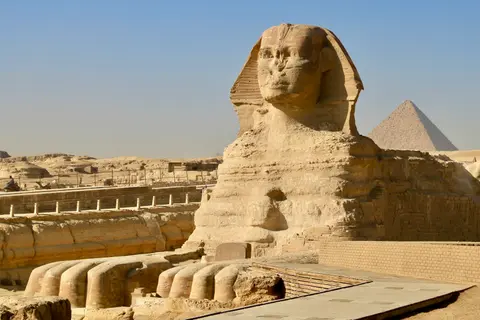
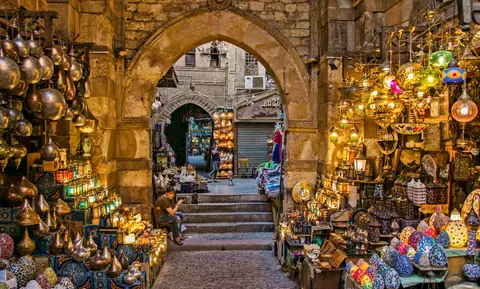
Cairo, where five thousand years of civilization press upon the present with relentless intensity, is anchored by the Great Pyramid of Giza — the sole survivor of the Seven Wonders of the Ancient World, already ancient when Cleopatra walked in its shadow. The Egyptian Museum's overwhelming treasure trove of pharaonic antiquities, including the golden mask of Tutankhamun, and the medieval labyrinth of Islamic Cairo, a UNESCO-listed district of a thousand mosques and medieval caravanserais, offer a lifetime of discovery in a city of twenty million souls. October through April brings the most tolerable temperatures. Luxor, with its Valley of the Kings, is a short domestic flight or overnight train journey south.

Cairo, where five thousand years of civilization press upon the present with relentless intensity, is anchored by the Great Pyramid of Giza — the sole survivor of the Seven Wonders of the Ancient World, already ancient when Cleopatra walked in its shadow. The Egyptian Museum's overwhelming treasure trove of pharaonic antiquities, including the golden mask of Tutankhamun, and the medieval labyrinth of Islamic Cairo, a UNESCO-listed district of a thousand mosques and medieval caravanserais, offer a lifetime of discovery in a city of twenty million souls. October through April brings the most tolerable temperatures. Luxor, with its Valley of the Kings, is a short domestic flight or overnight train journey south.

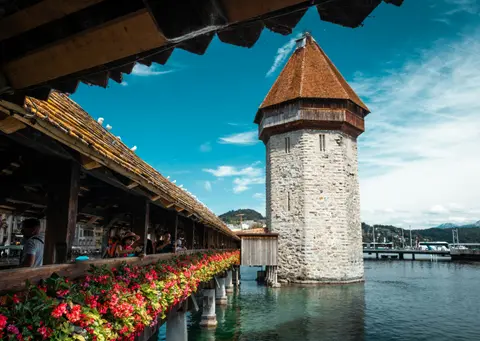
Framed by snowcapped Alps and the mirror-bright waters of Lake Lucerne, this medieval Swiss gem centres on the 14th-century Kapellbrücke — one of Europe's oldest covered bridges — and a colourful Altstadt that has changed little in five centuries. Ride the cog railway to cloud-wreathed Mount Pilatus, savour Älplermagronen in a timber-beamed tavern, and explore the nearby wonders of Interlaken and Grindelwald. Late spring through early autumn offers the most spectacular lake reflections and settled mountain weather.

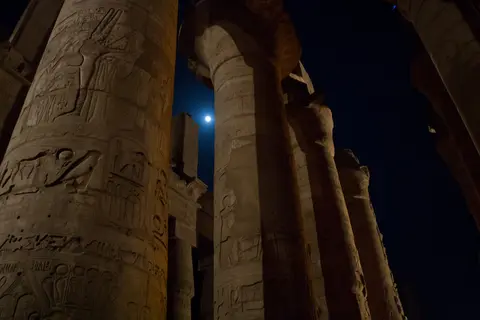
Luxor is the greatest open-air museum on earth — the modern city occupying the site of ancient Thebes, capital of Egypt during the New Kingdom's golden age when pharaohs such as Hatshepsut, Tutankhamun, and Ramesses II built temples of a scale and beauty that still stagger the imagination. The East Bank holds the incomparable complexes of Karnak and Luxor Temple; across the Nile, the West Bank conceals the Valley of the Kings, where sixty-three royal tombs were cut into the limestone beneath the pyramid-shaped peak of Al-Qurn. A felucca sunset sail on the Nile, with the cliffs of Thebes glowing amber, is among travel's most transcendent moments. October through April offers the ideal climate.

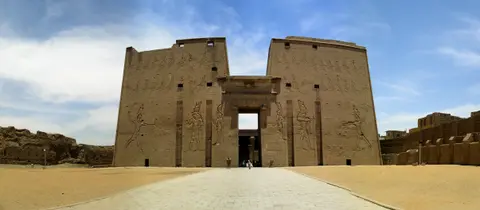
The Temple of Horus at Edfu is the most completely preserved pharaonic temple in Egypt — a colossus of golden sandstone rising above the Nile's western bank, its towering pylons, hypostyle halls, and sacred inner sanctum surviving almost intact after two millennia beneath the desert. Built between 237 and 57 BC under Ptolemaic rulers, it offers the clearest window into ancient Egyptian temple ritual that archaeology has preserved. The colossal granite statues of Horus at the entrance remain among the most striking sculptures of the ancient world. October through April brings ideal conditions: warm days, cool evenings, and the gentle rhythms of a Nile cruise.

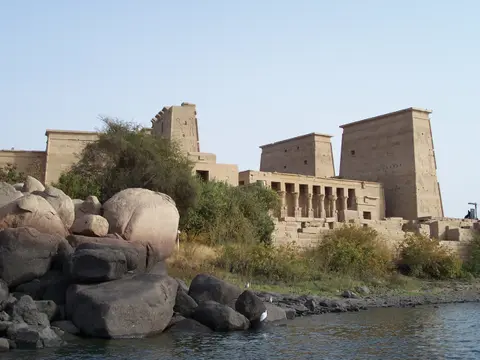
Aswan, Egypt's sunniest city and its ancient southern frontier, offers the Nile at its most scenic — wide, blue, and studded with felucca-dotted islands where temples emerge from the water's edge like visions from another age. The Temple of Philae, rescued from the rising waters of Lake Nasser and reassembled on a new island, is a jewel of Egyptian antiquity; Elephantine Island harbors ruins spanning predynastic times to the Roman era. For the full pharaonic experience, a sunset felucca ride to the Aga Khan Mausoleum rivals any luxury on the Nile. October through April offers the most comfortable temperatures; Abu Simbel is a short flight south.

Cairo, where five thousand years of civilization press upon the present with relentless intensity, is anchored by the Great Pyramid of Giza — the sole survivor of the Seven Wonders of the Ancient World, already ancient when Cleopatra walked in its shadow. The Egyptian Museum's overwhelming treasure trove of pharaonic antiquities, including the golden mask of Tutankhamun, and the medieval labyrinth of Islamic Cairo, a UNESCO-listed district of a thousand mosques and medieval caravanserais, offer a lifetime of discovery in a city of twenty million souls. October through April brings the most tolerable temperatures. Luxor, with its Valley of the Kings, is a short domestic flight or overnight train journey south.

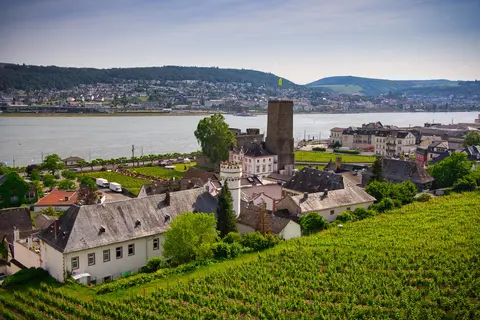
Rüdesheim am Rhein, a jewel of the UNESCO-listed Upper Middle Rhine Valley, is where Germany's most storied wine river cuts through vine-terraced slopes and medieval castle ruins. The pedestrianised Drosselgasse laneway — beloved since the Romantic era — hums with wine taverns pouring the region's celebrated Rieslings, crisp and mineral from the slate soils. The Niederwald Monument surveys the river from the heights, reached by cable car above the vineyards. Day trips by boat unlock Bacharach, Boppard, and the legendary Lorelei rock. September's harvest festivals transform the entire valley into a convivial celebration of the vintage.

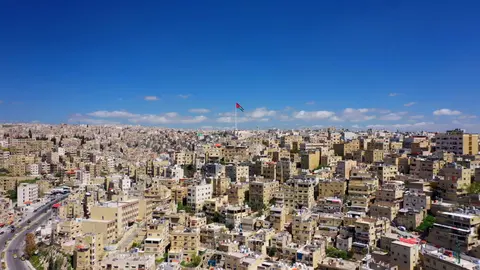
Amman is Jordan's ancient-modern capital, where a ten-thousand-year history unfolds across hilltop citadels, Roman theatres, and Umayyad palaces, all fuelled by one of the Middle East's finest street food cultures. Must-do experiences include exploring the Citadel, eating mansaf communally, and using the city as a base for Petra and the Dead Sea. Spring and autumn offer the most comfortable temperatures for exploring.

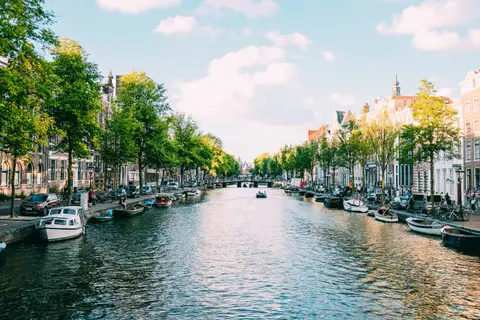
Amsterdam's UNESCO-listed canal ring — a concentric web of seventeenth-century merchant houses and arching stone bridges — remains one of the Western world's most perfectly preserved Golden Age cityscapes, best explored by bicycle or canal boat at a pace that lets the city's genius reveal itself slowly. The Rijksmuseum's collection of Rembrandt and Vermeer masterpieces is essential, while the Anne Frank House offers one of Europe's most profoundly moving historical encounters. Spring brings the iconic tulip season; summer fills the terraces of the Jordaan district. Schiphol Airport makes Amsterdam a seamless gateway to the entire European continent.

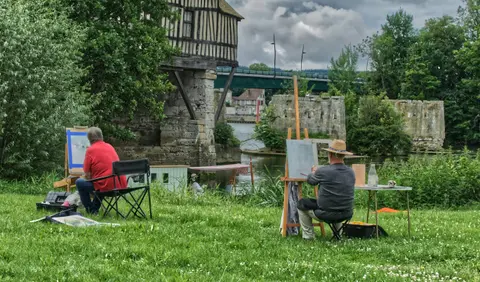
Vernon is a quietly beguiling Norman town on the Seine whose greatest treasure lies just four kilometers beyond its medieval bridge: the garden and water lily ponds at Giverny, where Claude Monet lived and painted for forty-three years, creating the luminous imagery that changed the course of modern art. The town itself retains considerable charm — a romanticly ruined twelfth-century bridge tower draped in ivy, half-timbered houses along the riverbank, and a fine museum housing several original Monet canvases. Monet's garden is open from April through October, reaching its peak splendor in May and June when his beloved water lilies are in full, painterly bloom.

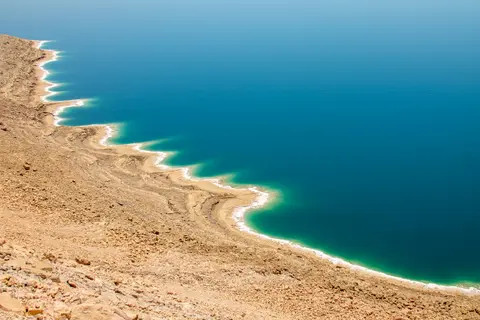
The Dead Sea is the lowest point on Earth, a mineral-rich body of water on the Jordan Rift Valley floor where the extreme salinity makes floating effortless and the therapeutic muds have been prized since antiquity. Must-dos include floating in the buoyant waters, bathing in the Ma'in hot springs' thermal waterfalls, and visiting the UNESCO-listed Baptism Site. October through April offers comfortable temperatures, with spring and autumn ideal for combining the Dead Sea with Petra and Amman.

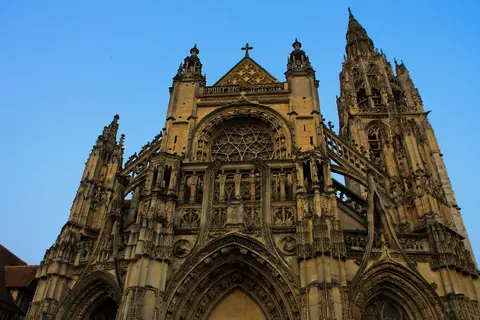
Caudebec-en-Caux nestles in a Seine meander between Rouen and the sea, famous for its Flamboyant Gothic Eglise Notre-Dame — a masterwork of late medieval stone lacework so exquisite that Henri IV called it 'the most beautiful chapel in my kingdom.' The town serves as an ideal quiet base for exploring the Seine Valley's quieter pleasures: the remarkable Abbaye de Jumiéges, its roofless nave open to the Norman sky, and the Manoir d'Ango, a Renaissance manor of extraordinary ambition, are both within easy reach. The tidal atmosphere of the Seine at this point rewards early morning walks along the embankment. Rouen, with its Gothic cathedral and Impressionist legacy, lies forty minutes east.
Day 1

Cairo, where five thousand years of civilization press upon the present with relentless intensity, is anchored by the Great Pyramid of Giza — the sole survivor of the Seven Wonders of the Ancient World, already ancient when Cleopatra walked in its shadow. The Egyptian Museum's overwhelming treasure trove of pharaonic antiquities, including the golden mask of Tutankhamun, and the medieval labyrinth of Islamic Cairo, a UNESCO-listed district of a thousand mosques and medieval caravanserais, offer a lifetime of discovery in a city of twenty million souls. October through April brings the most tolerable temperatures. Luxor, with its Valley of the Kings, is a short domestic flight or overnight train journey south.
Day 3

Cairo, where five thousand years of civilization press upon the present with relentless intensity, is anchored by the Great Pyramid of Giza — the sole survivor of the Seven Wonders of the Ancient World, already ancient when Cleopatra walked in its shadow. The Egyptian Museum's overwhelming treasure trove of pharaonic antiquities, including the golden mask of Tutankhamun, and the medieval labyrinth of Islamic Cairo, a UNESCO-listed district of a thousand mosques and medieval caravanserais, offer a lifetime of discovery in a city of twenty million souls. October through April brings the most tolerable temperatures. Luxor, with its Valley of the Kings, is a short domestic flight or overnight train journey south.
Day 4

Framed by snowcapped Alps and the mirror-bright waters of Lake Lucerne, this medieval Swiss gem centres on the 14th-century Kapellbrücke — one of Europe's oldest covered bridges — and a colourful Altstadt that has changed little in five centuries. Ride the cog railway to cloud-wreathed Mount Pilatus, savour Älplermagronen in a timber-beamed tavern, and explore the nearby wonders of Interlaken and Grindelwald. Late spring through early autumn offers the most spectacular lake reflections and settled mountain weather.
Day 5

Luxor is the greatest open-air museum on earth — the modern city occupying the site of ancient Thebes, capital of Egypt during the New Kingdom's golden age when pharaohs such as Hatshepsut, Tutankhamun, and Ramesses II built temples of a scale and beauty that still stagger the imagination. The East Bank holds the incomparable complexes of Karnak and Luxor Temple; across the Nile, the West Bank conceals the Valley of the Kings, where sixty-three royal tombs were cut into the limestone beneath the pyramid-shaped peak of Al-Qurn. A felucca sunset sail on the Nile, with the cliffs of Thebes glowing amber, is among travel's most transcendent moments. October through April offers the ideal climate.
Day 6

The Temple of Horus at Edfu is the most completely preserved pharaonic temple in Egypt — a colossus of golden sandstone rising above the Nile's western bank, its towering pylons, hypostyle halls, and sacred inner sanctum surviving almost intact after two millennia beneath the desert. Built between 237 and 57 BC under Ptolemaic rulers, it offers the clearest window into ancient Egyptian temple ritual that archaeology has preserved. The colossal granite statues of Horus at the entrance remain among the most striking sculptures of the ancient world. October through April brings ideal conditions: warm days, cool evenings, and the gentle rhythms of a Nile cruise.
Day 7

Aswan, Egypt's sunniest city and its ancient southern frontier, offers the Nile at its most scenic — wide, blue, and studded with felucca-dotted islands where temples emerge from the water's edge like visions from another age. The Temple of Philae, rescued from the rising waters of Lake Nasser and reassembled on a new island, is a jewel of Egyptian antiquity; Elephantine Island harbors ruins spanning predynastic times to the Roman era. For the full pharaonic experience, a sunset felucca ride to the Aga Khan Mausoleum rivals any luxury on the Nile. October through April offers the most comfortable temperatures; Abu Simbel is a short flight south.
Day 9

Cairo, where five thousand years of civilization press upon the present with relentless intensity, is anchored by the Great Pyramid of Giza — the sole survivor of the Seven Wonders of the Ancient World, already ancient when Cleopatra walked in its shadow. The Egyptian Museum's overwhelming treasure trove of pharaonic antiquities, including the golden mask of Tutankhamun, and the medieval labyrinth of Islamic Cairo, a UNESCO-listed district of a thousand mosques and medieval caravanserais, offer a lifetime of discovery in a city of twenty million souls. October through April brings the most tolerable temperatures. Luxor, with its Valley of the Kings, is a short domestic flight or overnight train journey south.

Rüdesheim am Rhein, a jewel of the UNESCO-listed Upper Middle Rhine Valley, is where Germany's most storied wine river cuts through vine-terraced slopes and medieval castle ruins. The pedestrianised Drosselgasse laneway — beloved since the Romantic era — hums with wine taverns pouring the region's celebrated Rieslings, crisp and mineral from the slate soils. The Niederwald Monument surveys the river from the heights, reached by cable car above the vineyards. Day trips by boat unlock Bacharach, Boppard, and the legendary Lorelei rock. September's harvest festivals transform the entire valley into a convivial celebration of the vintage.
Day 11

Amman is Jordan's ancient-modern capital, where a ten-thousand-year history unfolds across hilltop citadels, Roman theatres, and Umayyad palaces, all fuelled by one of the Middle East's finest street food cultures. Must-do experiences include exploring the Citadel, eating mansaf communally, and using the city as a base for Petra and the Dead Sea. Spring and autumn offer the most comfortable temperatures for exploring.
Day 12

Amsterdam's UNESCO-listed canal ring — a concentric web of seventeenth-century merchant houses and arching stone bridges — remains one of the Western world's most perfectly preserved Golden Age cityscapes, best explored by bicycle or canal boat at a pace that lets the city's genius reveal itself slowly. The Rijksmuseum's collection of Rembrandt and Vermeer masterpieces is essential, while the Anne Frank House offers one of Europe's most profoundly moving historical encounters. Spring brings the iconic tulip season; summer fills the terraces of the Jordaan district. Schiphol Airport makes Amsterdam a seamless gateway to the entire European continent.
Day 13

Vernon is a quietly beguiling Norman town on the Seine whose greatest treasure lies just four kilometers beyond its medieval bridge: the garden and water lily ponds at Giverny, where Claude Monet lived and painted for forty-three years, creating the luminous imagery that changed the course of modern art. The town itself retains considerable charm — a romanticly ruined twelfth-century bridge tower draped in ivy, half-timbered houses along the riverbank, and a fine museum housing several original Monet canvases. Monet's garden is open from April through October, reaching its peak splendor in May and June when his beloved water lilies are in full, painterly bloom.

The Dead Sea is the lowest point on Earth, a mineral-rich body of water on the Jordan Rift Valley floor where the extreme salinity makes floating effortless and the therapeutic muds have been prized since antiquity. Must-dos include floating in the buoyant waters, bathing in the Ma'in hot springs' thermal waterfalls, and visiting the UNESCO-listed Baptism Site. October through April offers comfortable temperatures, with spring and autumn ideal for combining the Dead Sea with Petra and Amman.
Day 15

Caudebec-en-Caux nestles in a Seine meander between Rouen and the sea, famous for its Flamboyant Gothic Eglise Notre-Dame — a masterwork of late medieval stone lacework so exquisite that Henri IV called it 'the most beautiful chapel in my kingdom.' The town serves as an ideal quiet base for exploring the Seine Valley's quieter pleasures: the remarkable Abbaye de Jumiéges, its roofless nave open to the Norman sky, and the Manoir d'Ango, a Renaissance manor of extraordinary ambition, are both within easy reach. The tidal atmosphere of the Seine at this point rewards early morning walks along the embankment. Rouen, with its Gothic cathedral and Impressionist legacy, lies forty minutes east.


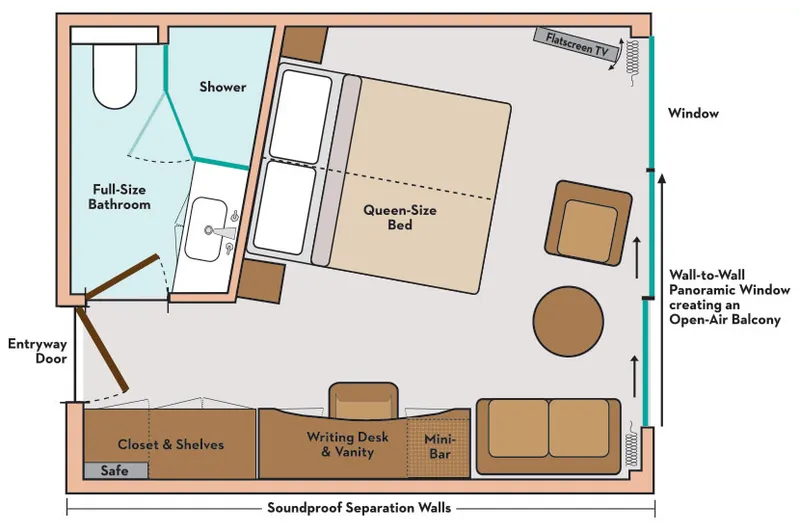
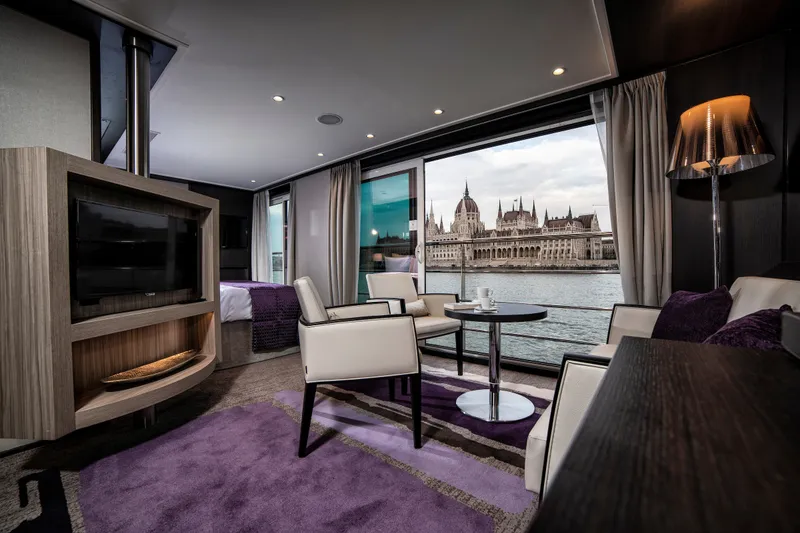
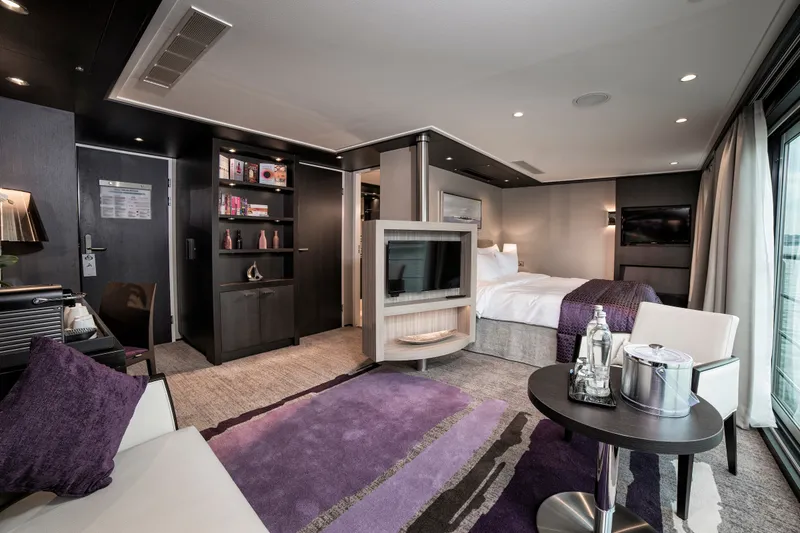
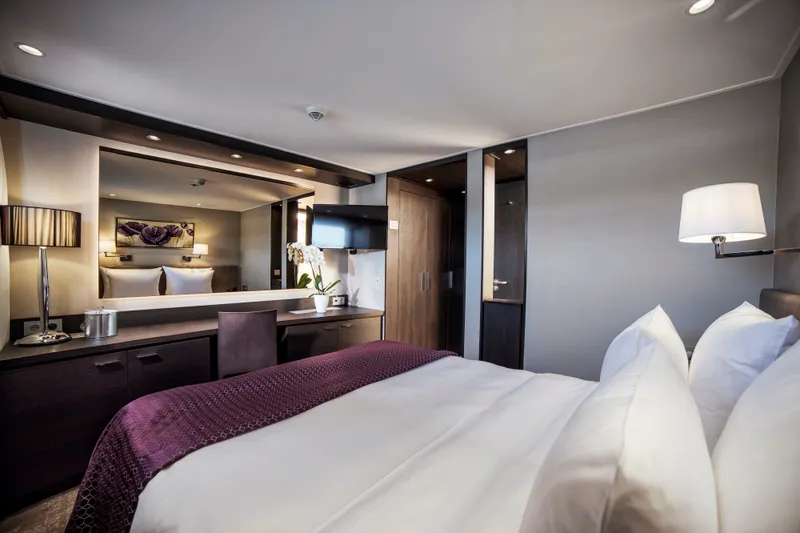
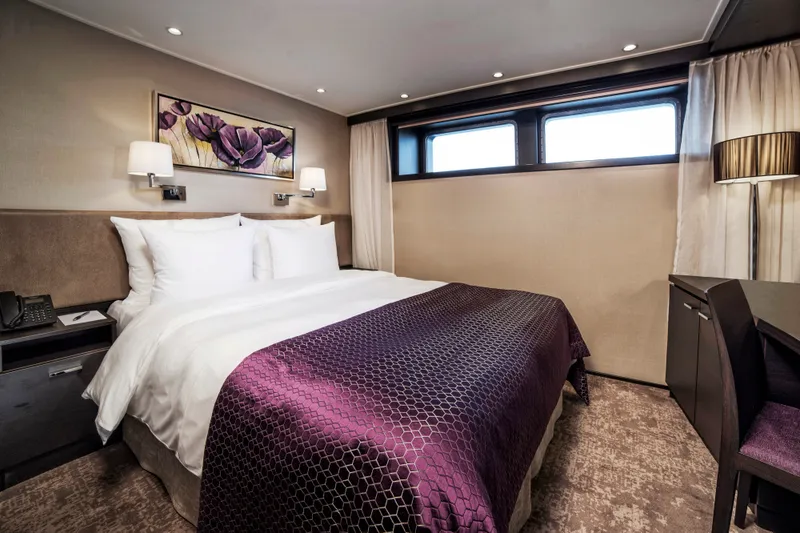
Stateroom Features:
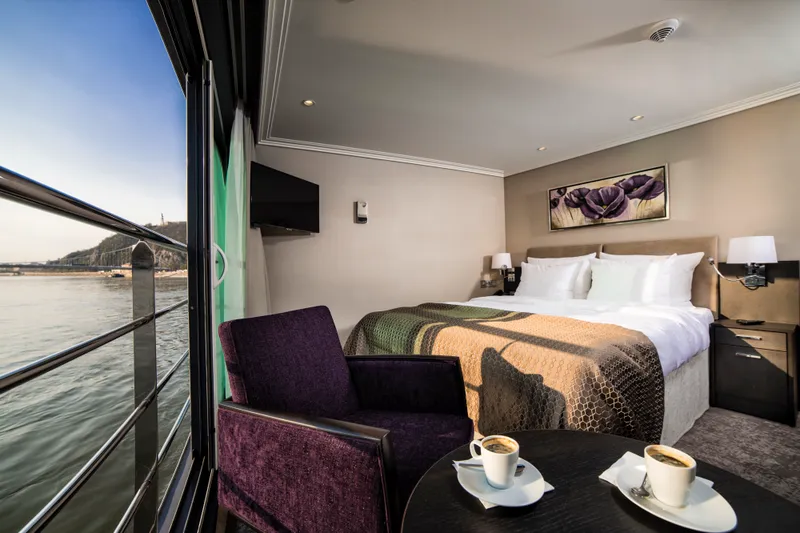
Comfort Collection Beds
Luxurious mattress toppers
Egyptian super-combed cotton linens
European-style duvets
Soft & firm pillows
Extra blankets
Choice of bed configuration
Nightly turn-down service
Bedside tables with reading lamps
Premium Hairdryer
L'Occitane bath products
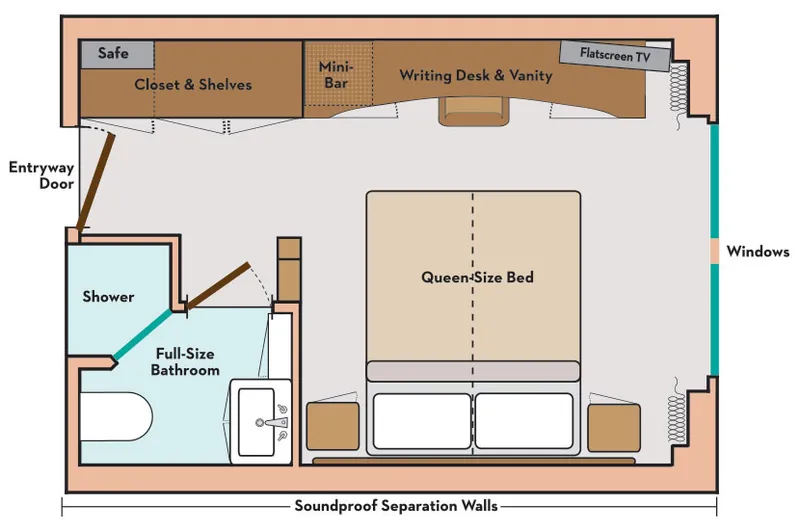
Spacious 3-door closets with shelves for ample storage
Easy under-bed luggage storage
Flatscreen satellite TV with English-speaking channels & over 100 free movie options
Alarm clock
Direct-dial telephone
Bathrobes & slippers
Well-stocked minibar
Complimentary filtered water
In-room safe
Individual climate control
Elegant, contemporary design
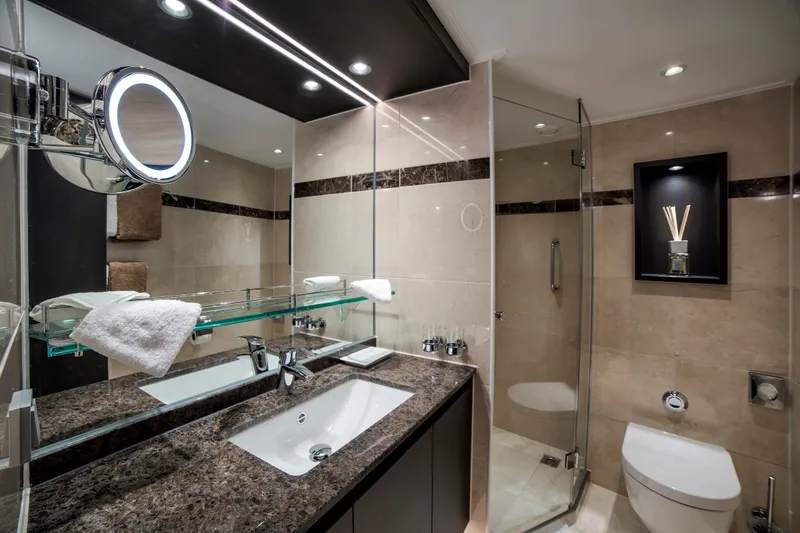
Large mirror in bathroom
Two windows
Full shower with glass door
Writing desk and chair
Lighted makeup mirror
Complimentary Wi-Fi
One Queen-Sized Bed or Two Twins
USB Ports
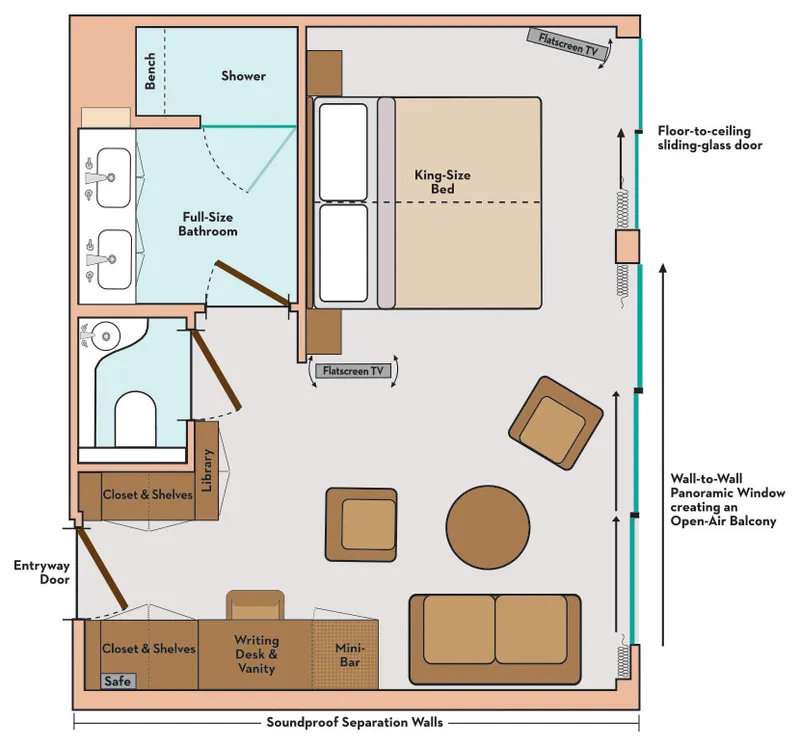
Stateroom Features:
Comfort Collection Beds
Luxurious mattress toppers
Egyptian super-combed cotton linens
European-style duvets
Soft & firm pillows
Extra blankets
Choice of bed configuration
Nightly turn-down service
Bedside tables with reading lamps
Premium Hairdryer
L'Occitane bath products
Spacious 3-door closets with shelves for ample storage
Easy under-bed luggage storage
Flatscreen satellite TV with English-speaking channels & over 100 free movie options
Alarm clock
Direct-dial telephone
Bathrobes & slippers
Well-stocked minibar
Complimentary filtered water
In-room safe
Individual climate control
Elegant, contemporary design
Large mirror in bathroom
Two windows
Full shower with glass door
Writing desk and chair
Lighted makeup mirror
Complimentary Wi-Fi
One Queen-Sized Bed or Two Twins
USB Ports


Stateroom Features:
Comfort Collection Beds
Luxurious mattress toppers
Egyptian super-combed cotton linens
European-style duvets
Soft & firm pillows
Extra blankets
Choice of bed configuration
Nightly turn-down service
Bedside tables with reading lamps
Premium Hairdryer
L'Occitane bath products
Spacious 3-door closets with shelves for ample storage
Easy under-bed luggage storage
Flatscreen satellite TV with English-speaking channels & over 100 free movie options
Alarm clock
Direct-dial telephone
Bathrobes & slippers
Well-stocked minibar
Complimentary filtered water
In-room safe
Individual climate control
Elegant, contemporary design
Large mirror in bathroom
Two windows
Full shower with glass door
Writing desk and chair
Lighted makeup mirror
Complimentary Wi-Fi
One Queen-Sized Bed or Two Twins
USB Ports

Our cruise specialists can help you find the perfect cabin and the best available pricing.
(+886) 02-2721-7300Contact Advisor