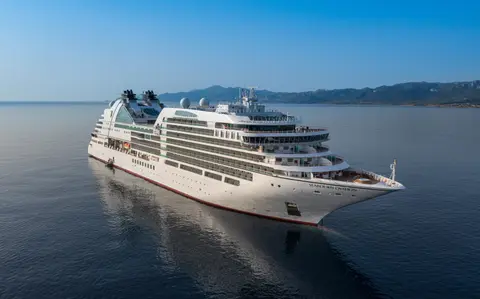
Seabourn8448B
Iberian Tyrehhnean and Meditarranean Treasures
Date
2024-06-22
Duration
30 nights
Departure Port
Lisbon
Portugal
Arrival Port
Civitavecchia
Italy
Rating
—
Theme
—
Date
2024-06-22
Duration
30 nights
Departure Port
Lisbon
Portugal
Arrival Port
Civitavecchia
Italy
Rating
—
Theme
—
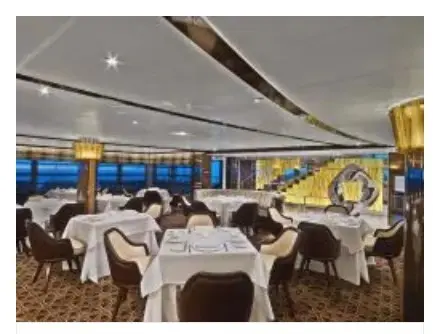
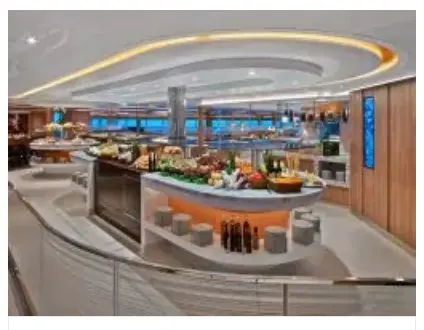




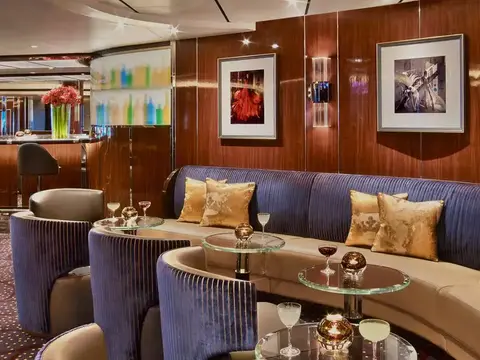
Seabourn
2017
—
40,350 GT
600
266
330
690 m
28 m
19 knots
No
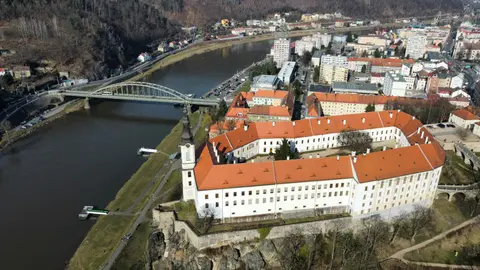
Děčín is a Czech border town where a magnificent Baroque castle overlooks the Elbe's crossing point and the gateway to Bohemian Switzerland's sandstone wonderland, including Europe's largest natural arch at Pravčická Gate. Visit May through October via Viking's Elbe river cruises for castle rose gardens, rock labyrinth hiking, and the atmospheric convergence of German and Bohemian landscapes.
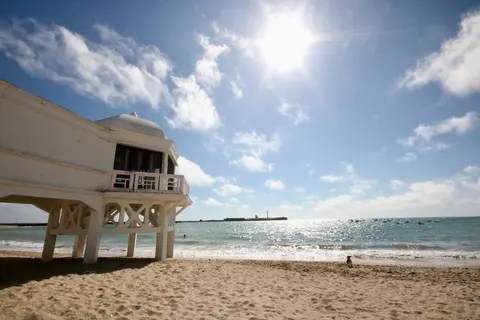
Cádiz, founded by Phoenician traders around 1100 BC and a strong contender for the oldest continuously inhabited city in Western Europe, juts into the Atlantic on a narrow peninsula where honey-colored ramparts frame improbable views of open ocean and the sun sets directly into the sea. The old quarter is an intoxicating labyrinth of baroque churches, hidden plazas, and carnival spirit — Cádiz's annual February carnival is the wildest and most satirically sharp in Spain — while the tapas culture here, centered on fresh Atlantic seafood cooked with Andalusian simplicity, represents Spanish cuisine at its most elemental and joyful. Visit February for carnival or spring for gentle Atlantic breezes. Seville is ninety minutes inland by bus or rail.
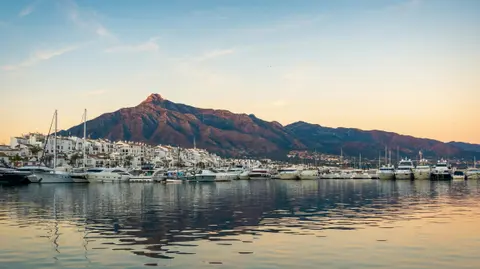
Marbella is an elegant Costa del Sol destination where Moorish heritage, fishing-village charm, and Mediterranean glamour converge around the legendary Puerto Banús marina. Visitors should not miss savouring espetos de sardinas on the beach and wandering the orange-tree-lined plazas of the whitewashed Old Quarter. The best months to visit are May through June and September through October, when golden light bathes the coastline, temperatures hover in the mid-twenties, and the crowds of high summer have yet to arrive or have gracefully departed.
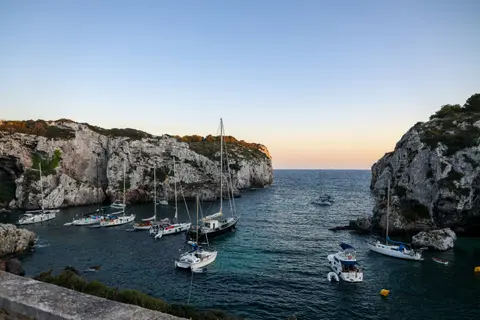
Mahón commands one of the Mediterranean's deepest natural harbours, a fjord-like inlet on Menorca that captivated British admirals, Phoenician traders, and Roman generals in turn — its Georgian townhouses and gin distilleries speaking eloquently to centuries of contested heritage. Explore the clifftop old town's baroque Santa María church with its 3,200-pipe organ, then cross the water to the imposing fortress of La Mola for sweeping harbour views. The island's prized caldereta de langosta, a slow-simmered lobster stew, is best savoured at the fishing village of Fornells. Visit between May and June or September and October for warmth without the summer crowds.
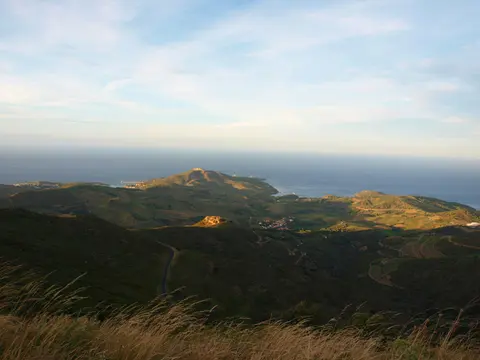
Port Vendres is a compelling Mediterranean port in France where centuries of history, vibrant local cuisine, and luminous coastal scenery converge. Visitors should explore the historic quarters on foot and surrender to the local dining culture, where fresh seafood and regional wines provide a masterclass in Mediterranean living. Best visited May through October, when the climate is at its most welcoming for outdoor exploration. Cruise lines including Azamara feature this port on their most compelling itineraries. Whether you have a few hours or a full day, the port rewards exploration at every pace and in every direction.
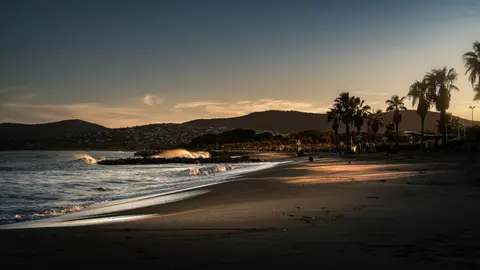
Saint-Raphaël is a refined French Riviera resort set between the dramatic red cliffs of the Estérel Massif and the Mediterranean, offering Côte d'Azur beauty without the crowds of Cannes or Nice. Must-dos include boat excursions along the Estérel's volcanic coastline, dining on bouillabaisse at the old port, and visiting the Roman ruins of neighboring Fréjus. May-June and September-October provide the finest weather with quieter beaches.
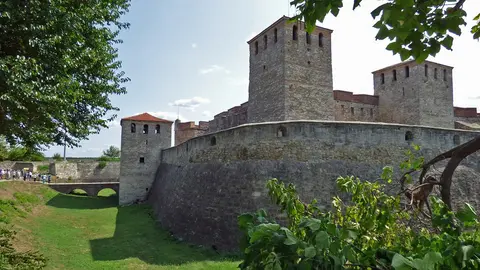
Vidin is a captivating port town on the Danube River known for its rich history, eclectic architecture, and vibrant local culture. Must-do experiences include exploring the Baba Vida Fortress and savoring local dishes like **kavarma** and **lutenitsa**. The best time to visit is during the spring and autumn months when the weather is pleasant and the local markets are bustling with activity.
Sciacca is Sicily's overlooked southwestern gem, where two-thousand-year-old thermal springs, hand-painted majolica ceramics, and a fishing harbor selling the morning catch directly from boats create the authentic Sicily that Italian travelers keep to themselves. Visit September via Azamara or Emerald Yacht Cruises for Arab-influenced seafood couscous and artisan ceramic workshops.
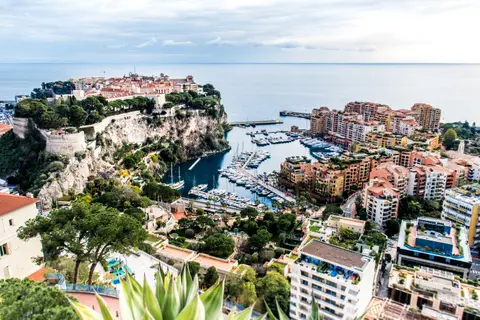
Monte Carlo, Monaco is a sovereign principality on the French Riviera where centuries of Grimaldi rule have forged an extraordinary concentration of elegance — from the legendary Casino de Monte-Carlo to the cliff-top Oceanographic Museum founded by Prince Albert I. No visit is complete without savouring *barbagiuan* at the Condamine market and exploring the old town of Monaco-Ville, where the cathedral and prince's palace command sweeping Mediterranean views. The most luminous months are May through September, with late spring offering the electric atmosphere of the Grand Prix season alongside gentler crowds and pristine coastal light.
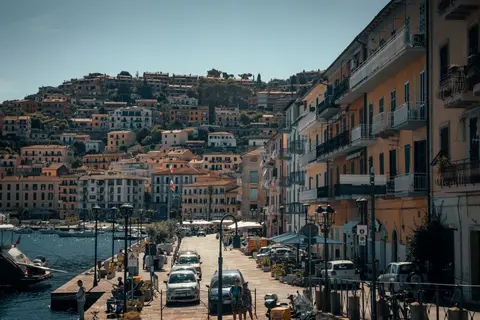
Porto Santo Stefano is a picturesque Tuscan port town on the Monte Argentario peninsula, combining working-harbor authenticity with some of the Tyrrhenian coast's finest seafood and hidden swimming coves. Must-dos include dining on caldaro fish stew at a waterfront trattoria, taking a ferry to the island of Giglio, and driving the panoramic road around the promontory. Visit May to October for swimming weather, with shoulder months offering the best balance of warmth and tranquility.
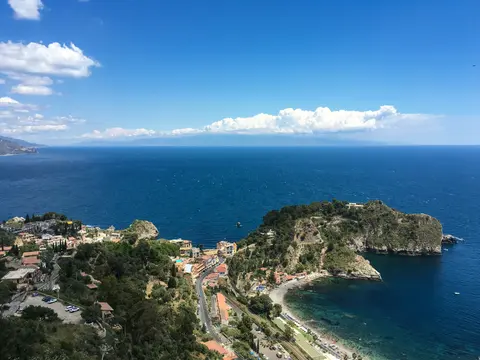
Taormina is a cliffside Sicilian jewel 200 meters above the Ionian Sea, featuring an ancient Greek theater with Mount Etna as its backdrop, the exquisite Isola Bella bay, and some of Sicily's finest cuisine. Must-dos include a performance at the Teatro Antico, the cable car to Isola Bella, and tasting Etna volcanic wines. April through June and September through October offer ideal temperatures.
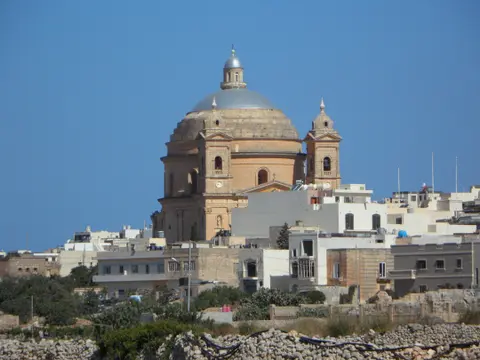
Mġarr is the harbor gateway to Gozo, Malta's greener sister island, home to the Ġgantija Temples—among the oldest free-standing structures on Earth, predating the pyramids—and the medieval Citadella fortress. Must-dos include visiting the 5,600-year-old temples, diving at Dwejra's dramatic coastline, and tasting fresh ġbejna cheese and rabbit stew. April through June and September through November offer ideal mild temperatures.
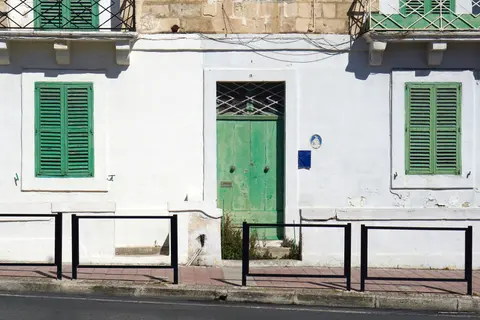
Valletta, the golden fortress capital of Malta, was hewn from a limestone peninsula in defiant haste after the Knights of Saint John — warrior monks of extraordinary valor — repulsed an overwhelming Ottoman assault in 1565. Its grid of steep baroque streets is dense with Caravaggio masterworks in the Co-Cathedral of St. John, shaded piazzas alive with café society, and bastions commanding breathtaking views over the Grand Harbour's legendary twin forts. The mild Mediterranean climate welcomes visitors year-round, though spring and autumn offer the most pleasurable temperatures for unhurried exploration of this compact UNESCO World Heritage capital.
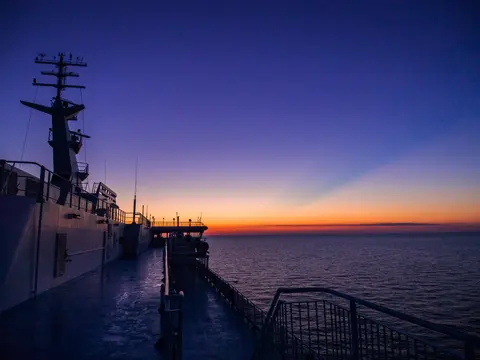
Ajaccio, the vibrant capital of Corsica, enchants visitors with its rich history as Napoleon's birthplace and its stunning coastal views. Don't miss trying local delicacies like figatellu and brocciu, and explore the nearby picturesque villages. The best season to visit is during the mild spring or fall months, when the weather is pleasant and the crowds are fewer.
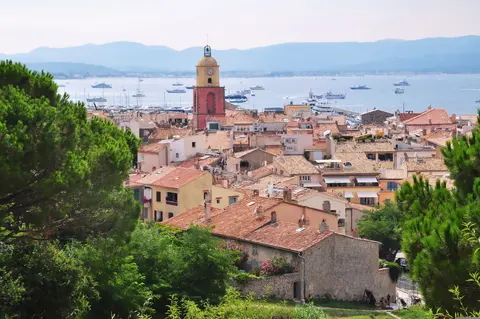
Saint-Tropez is the legendary Côte d'Azur fishing port turned global glamour destination, where Provençal authenticity endures beneath the mythology of yachts and celebrities. Must-dos include browsing the Musée de l'Annonciade's Fauvist masterpieces, tasting tarte tropézienne and fresh-caught rouget, and strolling the Sentier du Littoral coastal path to hidden coves. May through June and September through October offer the best weather with fewer crowds.
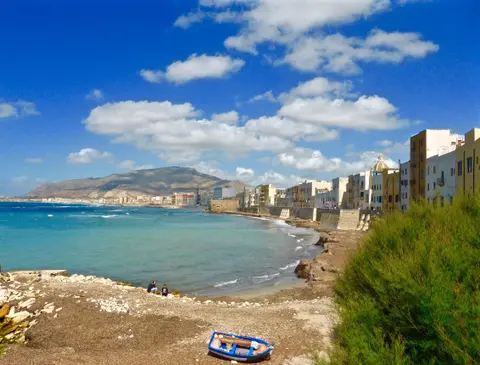
Trapani is western Sicily's sickle-shaped port city where ancient salt flats, cloud-wrapped medieval Erice, and the crystal-clear Egadi Islands converge at the Mediterranean's cultural crossroads. Visit April through October via Seabourn or Windstar for cable-car ascents to Norman-era pastry shops, sunset salt-flat reflections, and the Arab-influenced seafood couscous that distinguishes this coast from anywhere else in Italy.
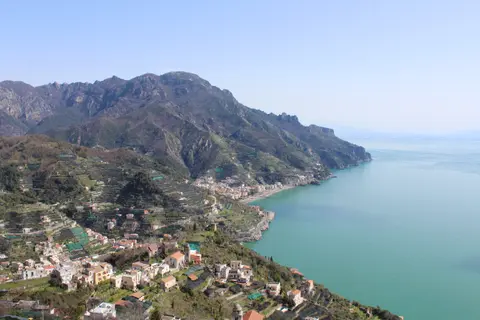
Salerno is a historic Campanian port city nestled between the Amalfi Coast and Cilento National Park, home to Europe's first medieval medical school and a magnificent Romanesque cathedral with Byzantine bronze doors. Visitors should not miss the Lungomare Trieste promenade at sunset and a plate of hand-rolled scialatielli ai frutti di mare in the atmospheric old town. The mild Mediterranean climate makes Salerno enchanting year-round, though late spring through early autumn offers the most luminous light and the fullest expression of its coastal character.
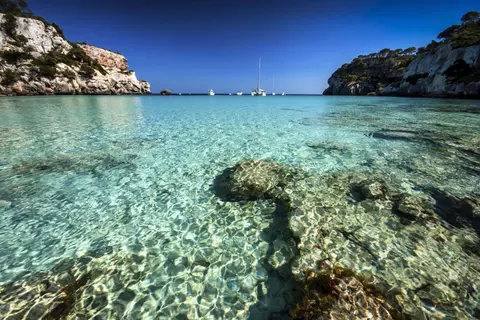
Mahón commands one of the Mediterranean's deepest natural harbours, a fjord-like inlet on Menorca that captivated British admirals, Phoenician traders, and Roman generals in turn — its Georgian townhouses and gin distilleries speaking eloquently to centuries of contested heritage. Explore the clifftop old town's baroque Santa María church with its 3,200-pipe organ, then cross the water to the imposing fortress of La Mola for sweeping harbour views. The island's prized caldereta de langosta, a slow-simmered lobster stew, is best savoured at the fishing village of Fornells. Visit between May and June or September and October for warmth without the summer crowds.
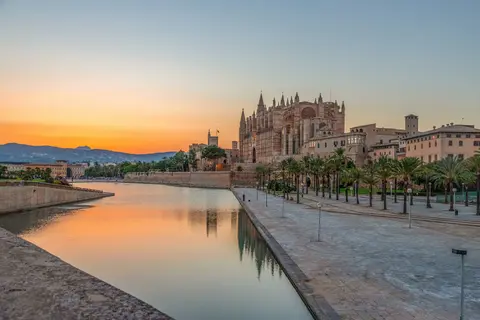
Palma de Mallorca announces itself with one of the most spectacular Gothic cathedrals in the world — La Seu, its honey-coloured sandstone buttresses rising directly from the bay, its interior modified by Antoni Gaudí and illuminated by the world's largest Gothic rose window. The old town behind it is a quarter of Arab baths, Renaissance palaces converted into boutique hotels, and the Passeig del Born — a plane-tree-shaded promenade where Balearic life conducts itself with unhurried grace. The local ensaïmada pastry and fresh sobrasada sausage from the island's black pigs are essential breakfast rituals. Visit May, June, or September: warm, brilliant, and measurably calmer than the July–August peak.
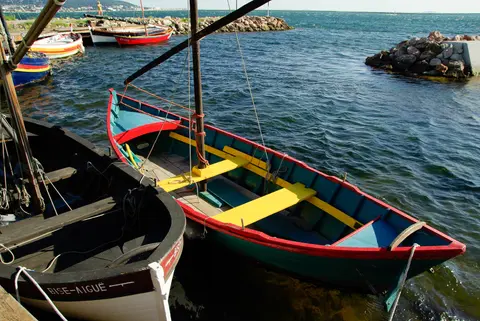
Sète is a canal-laced fishing port on France's Languedoc coast, built around the terminus of the Canal du Midi and crowned by the panoramic heights of Mont Saint-Clair. Visitors should not miss the iconic *tielle sétoise* pastry paired with Bouzigues oysters at the covered market, and the contemplative walk through the Cimetière Marin above the Mediterranean. Late spring through early autumn offers the finest conditions, with September bringing warm seas, golden light, and the spirited jousting tournaments on the canal that have defined Sète's character for over three hundred years.
Cavalaire is the southernmost beach resort along the Cote d’Azur, and takes pride in its distinction from nearby St. Tropez. Where the latter is all about glamour and glitz, and notably expensive in season, Cavalaire has a family-friendly atmosphere that mainly exploits its three-mile sandy beach and a wide variety of watersports to be enjoyed in the clear, clean waters. The beach was used by the Allies during the invasion of the Provence coast in 1944, but today it hosts a battalion of tots with sand pails and couples with coolers. Along the coast in both directions are a scattering of the hidden coves with creeks and small sandy beaches that give privacy to those with skills to handle the descents. Others, such as Bonporteau and Le Dattier are more easily accessed. Offshore, the playgrounds of the Iles d’Or beckon, and Porquerolles is a short ferry ride away. In the Massif des Maures behind the town, villages like Collobrieres and La Mole invite a pleasant stroll. The 17-acre Domaine de Rayol contains a variety of the sorts of scenic seaside gardens that are the pride of the Cote d’Azur.
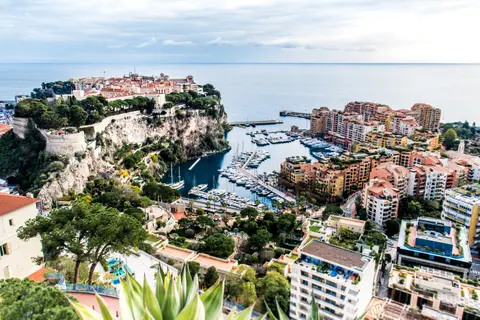
Monte Carlo, Monaco is a sovereign principality on the French Riviera where centuries of Grimaldi rule have forged an extraordinary concentration of elegance — from the legendary Casino de Monte-Carlo to the cliff-top Oceanographic Museum founded by Prince Albert I. No visit is complete without savouring *barbagiuan* at the Condamine market and exploring the old town of Monaco-Ville, where the cathedral and prince's palace command sweeping Mediterranean views. The most luminous months are May through September, with late spring offering the electric atmosphere of the Grand Prix season alongside gentler crowds and pristine coastal light.
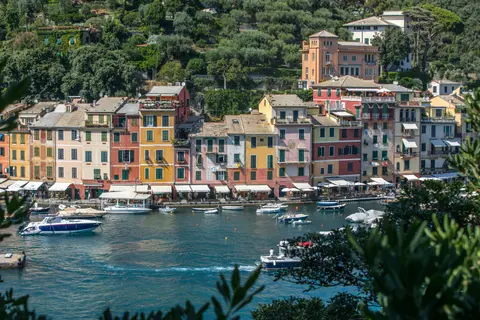
Portofino is a jewel-box fishing village on Italy's Ligurian coast, renowned for its pastel harbour, Castello Brown fortress views, and exquisite pesto-dressed trofie pasta at waterside trattorias. Visitors should walk the coastal trail to the Cristo degli Abissi underwater statue at San Fruttuoso and savour focaccia di Recco with a glass of local Vermentino. The ideal season stretches from late April through October, with September offering the perfect balance of warm Mediterranean light and the intimate calm that returns after summer's peak.
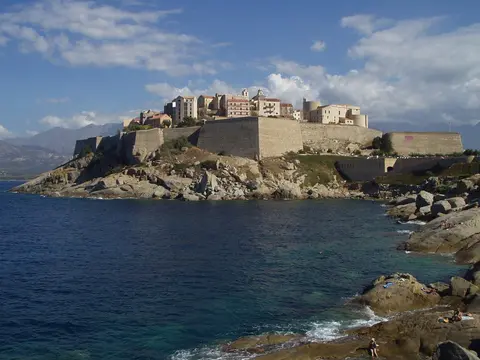
Calvi is Corsica's jewel-box port town where a commanding Genoese citadel overlooks the Mediterranean's finest urban beach — four miles of white sand lapped by Caribbean-clear water beneath snow-capped mountains. Visit June or September via Ponant or Explora Journeys for citadel walks, Corsican wild boar and brocciu cheese, and the essential paradox of an island that is French by law but entirely its own in character.
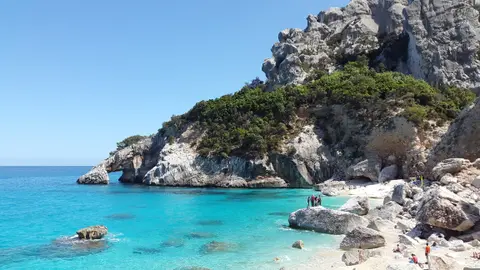
Golfo Aranci is a charming Sardinian fishing town at the gateway to the Costa Smeralda, blessed with crystalline waters, dolphin-frequented bays, and authentic Mediterranean character. Must-dos include tasting fregola with clams and Vermentino di Gallura wine at waterfront restaurants, boat trips to the Maddalena Archipelago, and swimming in the protected coves of Capo Figari. June through September offers the warmest seas, with May and September providing quieter conditions.
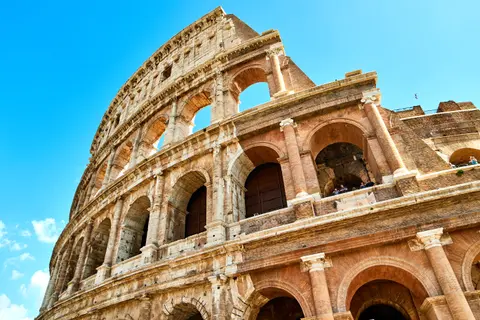
Rome's ancient maritime gateway since the Emperor Trajan commissioned its harbour in 106 AD, Civitavecchia is the natural prologue to the Eternal City — just seventy minutes southeast by express rail. The port's Renaissance fortress, designed in part by Michelangelo, anchors a working waterfront that has welcomed travellers for millennia. Beyond Rome's unmissable monuments, consider an afternoon in the Civitavecchia thermal baths, drawing on mineral waters prized since antiquity. Spring and autumn offer the ideal balance of mild weather and manageable crowds for exploring the capital's layered history.
Day 1
Děčín is a Czech border town where a magnificent Baroque castle overlooks the Elbe's crossing point and the gateway to Bohemian Switzerland's sandstone wonderland, including Europe's largest natural arch at Pravčická Gate. Visit May through October via Viking's Elbe river cruises for castle rose gardens, rock labyrinth hiking, and the atmospheric convergence of German and Bohemian landscapes.
Day 2
Day 3
Cádiz, founded by Phoenician traders around 1100 BC and a strong contender for the oldest continuously inhabited city in Western Europe, juts into the Atlantic on a narrow peninsula where honey-colored ramparts frame improbable views of open ocean and the sun sets directly into the sea. The old quarter is an intoxicating labyrinth of baroque churches, hidden plazas, and carnival spirit — Cádiz's annual February carnival is the wildest and most satirically sharp in Spain — while the tapas culture here, centered on fresh Atlantic seafood cooked with Andalusian simplicity, represents Spanish cuisine at its most elemental and joyful. Visit February for carnival or spring for gentle Atlantic breezes. Seville is ninety minutes inland by bus or rail.
Day 4
Marbella is an elegant Costa del Sol destination where Moorish heritage, fishing-village charm, and Mediterranean glamour converge around the legendary Puerto Banús marina. Visitors should not miss savouring espetos de sardinas on the beach and wandering the orange-tree-lined plazas of the whitewashed Old Quarter. The best months to visit are May through June and September through October, when golden light bathes the coastline, temperatures hover in the mid-twenties, and the crowds of high summer have yet to arrive or have gracefully departed.
Day 5
Day 6
Mahón commands one of the Mediterranean's deepest natural harbours, a fjord-like inlet on Menorca that captivated British admirals, Phoenician traders, and Roman generals in turn — its Georgian townhouses and gin distilleries speaking eloquently to centuries of contested heritage. Explore the clifftop old town's baroque Santa María church with its 3,200-pipe organ, then cross the water to the imposing fortress of La Mola for sweeping harbour views. The island's prized caldereta de langosta, a slow-simmered lobster stew, is best savoured at the fishing village of Fornells. Visit between May and June or September and October for warmth without the summer crowds.
Day 7
Port Vendres is a compelling Mediterranean port in France where centuries of history, vibrant local cuisine, and luminous coastal scenery converge. Visitors should explore the historic quarters on foot and surrender to the local dining culture, where fresh seafood and regional wines provide a masterclass in Mediterranean living. Best visited May through October, when the climate is at its most welcoming for outdoor exploration. Cruise lines including Azamara feature this port on their most compelling itineraries. Whether you have a few hours or a full day, the port rewards exploration at every pace and in every direction.
Day 8
Saint-Raphaël is a refined French Riviera resort set between the dramatic red cliffs of the Estérel Massif and the Mediterranean, offering Côte d'Azur beauty without the crowds of Cannes or Nice. Must-dos include boat excursions along the Estérel's volcanic coastline, dining on bouillabaisse at the old port, and visiting the Roman ruins of neighboring Fréjus. May-June and September-October provide the finest weather with quieter beaches.
Day 9
Vidin is a captivating port town on the Danube River known for its rich history, eclectic architecture, and vibrant local culture. Must-do experiences include exploring the Baba Vida Fortress and savoring local dishes like **kavarma** and **lutenitsa**. The best time to visit is during the spring and autumn months when the weather is pleasant and the local markets are bustling with activity.
Day 10
Sciacca is Sicily's overlooked southwestern gem, where two-thousand-year-old thermal springs, hand-painted majolica ceramics, and a fishing harbor selling the morning catch directly from boats create the authentic Sicily that Italian travelers keep to themselves. Visit September via Azamara or Emerald Yacht Cruises for Arab-influenced seafood couscous and artisan ceramic workshops.
Day 11
Monte Carlo, Monaco is a sovereign principality on the French Riviera where centuries of Grimaldi rule have forged an extraordinary concentration of elegance — from the legendary Casino de Monte-Carlo to the cliff-top Oceanographic Museum founded by Prince Albert I. No visit is complete without savouring *barbagiuan* at the Condamine market and exploring the old town of Monaco-Ville, where the cathedral and prince's palace command sweeping Mediterranean views. The most luminous months are May through September, with late spring offering the electric atmosphere of the Grand Prix season alongside gentler crowds and pristine coastal light.
Day 12
Porto Santo Stefano is a picturesque Tuscan port town on the Monte Argentario peninsula, combining working-harbor authenticity with some of the Tyrrhenian coast's finest seafood and hidden swimming coves. Must-dos include dining on caldaro fish stew at a waterfront trattoria, taking a ferry to the island of Giglio, and driving the panoramic road around the promontory. Visit May to October for swimming weather, with shoulder months offering the best balance of warmth and tranquility.
Day 13
Day 14
Taormina is a cliffside Sicilian jewel 200 meters above the Ionian Sea, featuring an ancient Greek theater with Mount Etna as its backdrop, the exquisite Isola Bella bay, and some of Sicily's finest cuisine. Must-dos include a performance at the Teatro Antico, the cable car to Isola Bella, and tasting Etna volcanic wines. April through June and September through October offer ideal temperatures.
Day 15
Mġarr is the harbor gateway to Gozo, Malta's greener sister island, home to the Ġgantija Temples—among the oldest free-standing structures on Earth, predating the pyramids—and the medieval Citadella fortress. Must-dos include visiting the 5,600-year-old temples, diving at Dwejra's dramatic coastline, and tasting fresh ġbejna cheese and rabbit stew. April through June and September through November offer ideal mild temperatures.
Valletta, the golden fortress capital of Malta, was hewn from a limestone peninsula in defiant haste after the Knights of Saint John — warrior monks of extraordinary valor — repulsed an overwhelming Ottoman assault in 1565. Its grid of steep baroque streets is dense with Caravaggio masterworks in the Co-Cathedral of St. John, shaded piazzas alive with café society, and bastions commanding breathtaking views over the Grand Harbour's legendary twin forts. The mild Mediterranean climate welcomes visitors year-round, though spring and autumn offer the most pleasurable temperatures for unhurried exploration of this compact UNESCO World Heritage capital.
Day 17
Day 18
Ajaccio, the vibrant capital of Corsica, enchants visitors with its rich history as Napoleon's birthplace and its stunning coastal views. Don't miss trying local delicacies like figatellu and brocciu, and explore the nearby picturesque villages. The best season to visit is during the mild spring or fall months, when the weather is pleasant and the crowds are fewer.
Day 19
Saint-Tropez is the legendary Côte d'Azur fishing port turned global glamour destination, where Provençal authenticity endures beneath the mythology of yachts and celebrities. Must-dos include browsing the Musée de l'Annonciade's Fauvist masterpieces, tasting tarte tropézienne and fresh-caught rouget, and strolling the Sentier du Littoral coastal path to hidden coves. May through June and September through October offer the best weather with fewer crowds.
Day 20
Trapani is western Sicily's sickle-shaped port city where ancient salt flats, cloud-wrapped medieval Erice, and the crystal-clear Egadi Islands converge at the Mediterranean's cultural crossroads. Visit April through October via Seabourn or Windstar for cable-car ascents to Norman-era pastry shops, sunset salt-flat reflections, and the Arab-influenced seafood couscous that distinguishes this coast from anywhere else in Italy.
Day 21
Salerno is a historic Campanian port city nestled between the Amalfi Coast and Cilento National Park, home to Europe's first medieval medical school and a magnificent Romanesque cathedral with Byzantine bronze doors. Visitors should not miss the Lungomare Trieste promenade at sunset and a plate of hand-rolled scialatielli ai frutti di mare in the atmospheric old town. The mild Mediterranean climate makes Salerno enchanting year-round, though late spring through early autumn offers the most luminous light and the fullest expression of its coastal character.
Day 22
Mahón commands one of the Mediterranean's deepest natural harbours, a fjord-like inlet on Menorca that captivated British admirals, Phoenician traders, and Roman generals in turn — its Georgian townhouses and gin distilleries speaking eloquently to centuries of contested heritage. Explore the clifftop old town's baroque Santa María church with its 3,200-pipe organ, then cross the water to the imposing fortress of La Mola for sweeping harbour views. The island's prized caldereta de langosta, a slow-simmered lobster stew, is best savoured at the fishing village of Fornells. Visit between May and June or September and October for warmth without the summer crowds.
Day 23
Palma de Mallorca announces itself with one of the most spectacular Gothic cathedrals in the world — La Seu, its honey-coloured sandstone buttresses rising directly from the bay, its interior modified by Antoni Gaudí and illuminated by the world's largest Gothic rose window. The old town behind it is a quarter of Arab baths, Renaissance palaces converted into boutique hotels, and the Passeig del Born — a plane-tree-shaded promenade where Balearic life conducts itself with unhurried grace. The local ensaïmada pastry and fresh sobrasada sausage from the island's black pigs are essential breakfast rituals. Visit May, June, or September: warm, brilliant, and measurably calmer than the July–August peak.
Day 24
Day 25
Sète is a canal-laced fishing port on France's Languedoc coast, built around the terminus of the Canal du Midi and crowned by the panoramic heights of Mont Saint-Clair. Visitors should not miss the iconic *tielle sétoise* pastry paired with Bouzigues oysters at the covered market, and the contemplative walk through the Cimetière Marin above the Mediterranean. Late spring through early autumn offers the finest conditions, with September bringing warm seas, golden light, and the spirited jousting tournaments on the canal that have defined Sète's character for over three hundred years.
Day 26
Cavalaire is the southernmost beach resort along the Cote d’Azur, and takes pride in its distinction from nearby St. Tropez. Where the latter is all about glamour and glitz, and notably expensive in season, Cavalaire has a family-friendly atmosphere that mainly exploits its three-mile sandy beach and a wide variety of watersports to be enjoyed in the clear, clean waters. The beach was used by the Allies during the invasion of the Provence coast in 1944, but today it hosts a battalion of tots with sand pails and couples with coolers. Along the coast in both directions are a scattering of the hidden coves with creeks and small sandy beaches that give privacy to those with skills to handle the descents. Others, such as Bonporteau and Le Dattier are more easily accessed. Offshore, the playgrounds of the Iles d’Or beckon, and Porquerolles is a short ferry ride away. In the Massif des Maures behind the town, villages like Collobrieres and La Mole invite a pleasant stroll. The 17-acre Domaine de Rayol contains a variety of the sorts of scenic seaside gardens that are the pride of the Cote d’Azur.
Day 27
Monte Carlo, Monaco is a sovereign principality on the French Riviera where centuries of Grimaldi rule have forged an extraordinary concentration of elegance — from the legendary Casino de Monte-Carlo to the cliff-top Oceanographic Museum founded by Prince Albert I. No visit is complete without savouring *barbagiuan* at the Condamine market and exploring the old town of Monaco-Ville, where the cathedral and prince's palace command sweeping Mediterranean views. The most luminous months are May through September, with late spring offering the electric atmosphere of the Grand Prix season alongside gentler crowds and pristine coastal light.
Day 28
Portofino is a jewel-box fishing village on Italy's Ligurian coast, renowned for its pastel harbour, Castello Brown fortress views, and exquisite pesto-dressed trofie pasta at waterside trattorias. Visitors should walk the coastal trail to the Cristo degli Abissi underwater statue at San Fruttuoso and savour focaccia di Recco with a glass of local Vermentino. The ideal season stretches from late April through October, with September offering the perfect balance of warm Mediterranean light and the intimate calm that returns after summer's peak.
Day 29
Calvi is Corsica's jewel-box port town where a commanding Genoese citadel overlooks the Mediterranean's finest urban beach — four miles of white sand lapped by Caribbean-clear water beneath snow-capped mountains. Visit June or September via Ponant or Explora Journeys for citadel walks, Corsican wild boar and brocciu cheese, and the essential paradox of an island that is French by law but entirely its own in character.
Day 30
Golfo Aranci is a charming Sardinian fishing town at the gateway to the Costa Smeralda, blessed with crystalline waters, dolphin-frequented bays, and authentic Mediterranean character. Must-dos include tasting fregola with clams and Vermentino di Gallura wine at waterfront restaurants, boat trips to the Maddalena Archipelago, and swimming in the protected coves of Capo Figari. June through September offers the warmest seas, with May and September providing quieter conditions.
Day 31
Rome's ancient maritime gateway since the Emperor Trajan commissioned its harbour in 106 AD, Civitavecchia is the natural prologue to the Eternal City — just seventy minutes southeast by express rail. The port's Renaissance fortress, designed in part by Michelangelo, anchors a working waterfront that has welcomed travellers for millennia. Beyond Rome's unmissable monuments, consider an afternoon in the Civitavecchia thermal baths, drawing on mineral waters prized since antiquity. Spring and autumn offer the ideal balance of mild weather and manageable crowds for exploring the capital's layered history.
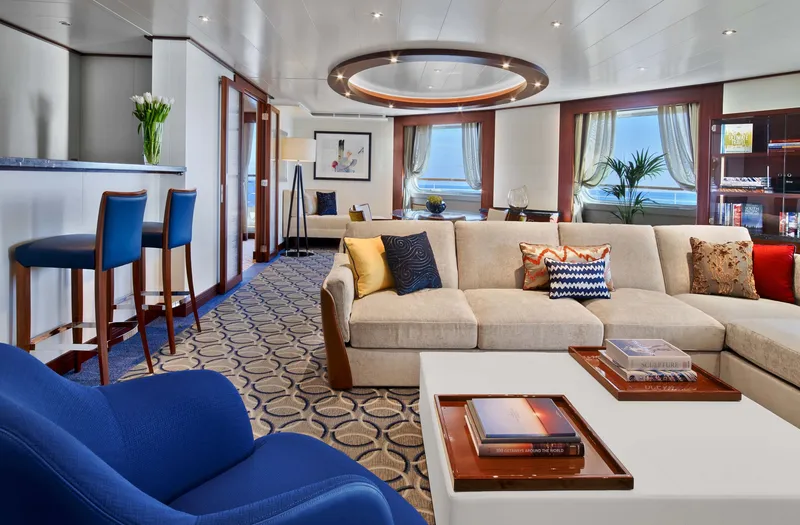
Located on Deck 8; Combine mid-ship suites 800 and 804 for suite 8004 or suites 801 and 805 for suite 8015 for a total inside space of 1,292 square feet (120 square meters) plus two verandas totaling 244 square feet (23 square meters)
Signature Suites feature
Expansive ocean views
Forward-facing windows
Dining for four to six
Bathroom with whirlpool bathtub
Guest bath
Pantry with wet bar
Two flat-screen TVs
Complimentary Internet/Wi-Fi service
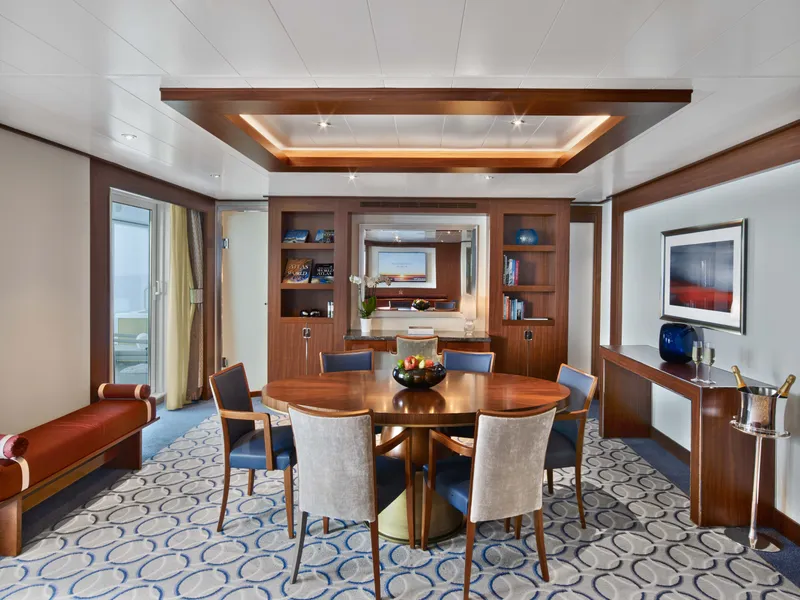
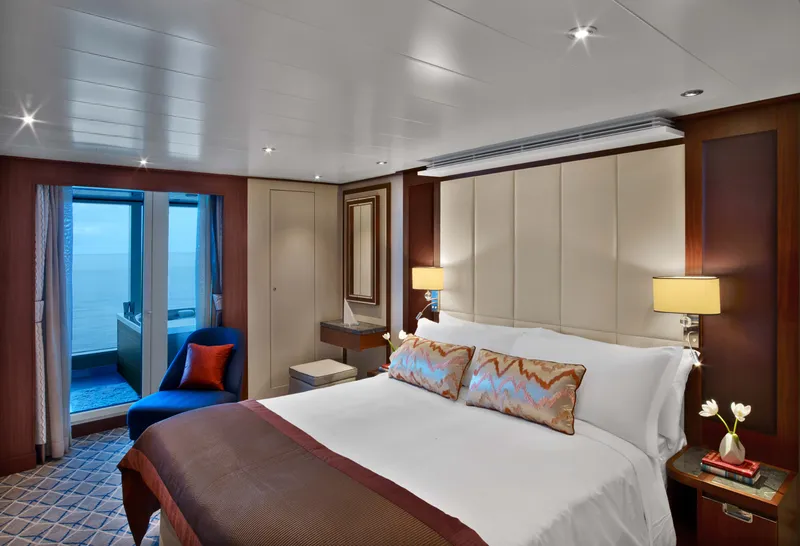
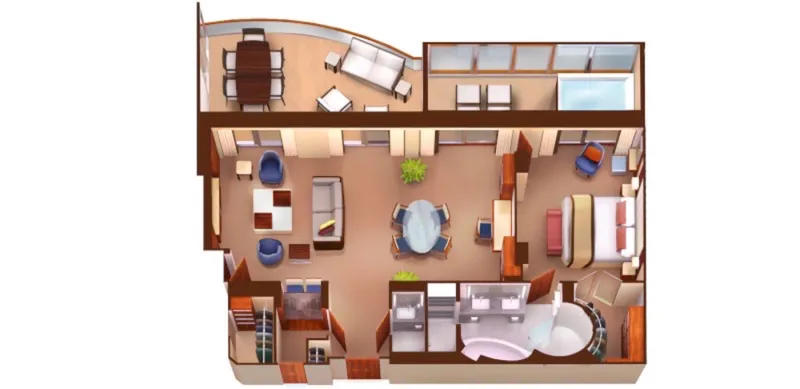
Located on Deck 8; Combine mid-ship suites 849 and 851 for suite 8491 or suites 846 and 848 for suite 8468 for a total inside space of 1,292 square feet (120 square meters) plus two verandas totaling 244 square feet (23 square meters)
Grand Wintergarden Suites feature:
Large windows
Dining for six
Glass-enclosed solarium with tub and day bed
Bathroom with whirlpool bathtub
Two bedrooms
Two bathrooms (one whirlpool)
Convertible sofa bed for one
Pantry with wet bar
Two flat-screen TVs
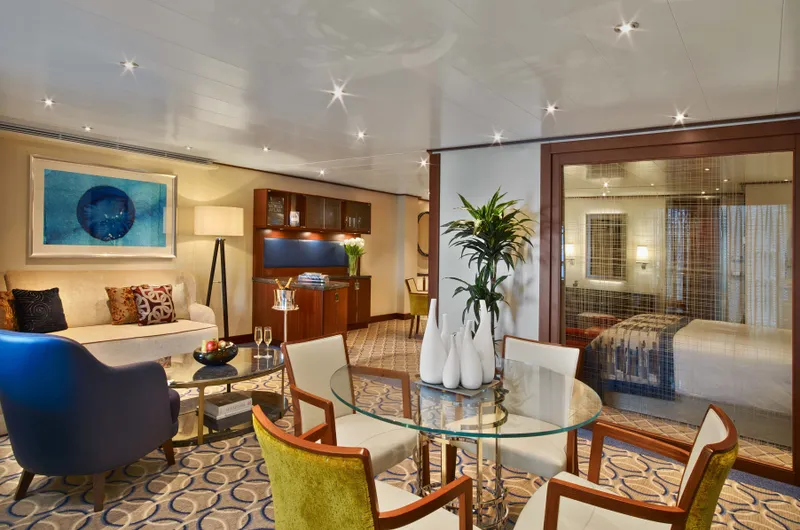

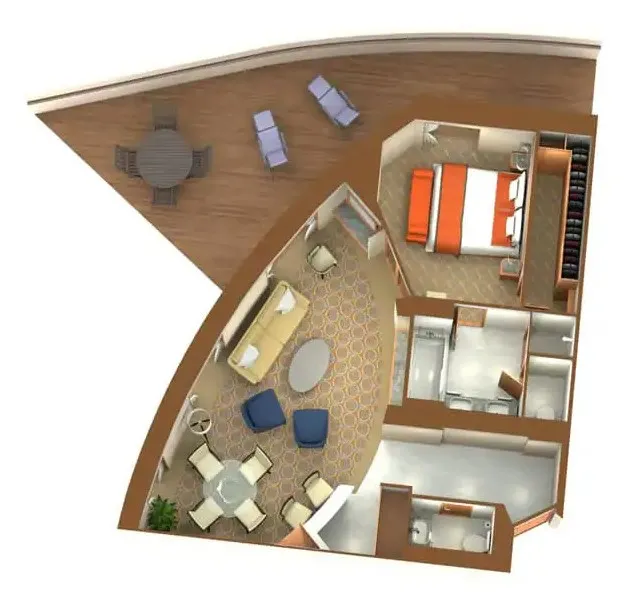
Located on Deck 7, 8, 9 and 10; total inside space of between 576 and 597 square feet (54 and 55 square meters) plus veranda of between 142 and 778 square feet (13 to 72 square meters)
Owner's Suites feature:
Expansive ocean views
Forward-facing windows
Dining for four to six
Bathroom with whirlpool bathtub
Guest bath
Pantry with wet bar
Two flat-screen TV
Complimentary Internet/Wi-Fi service
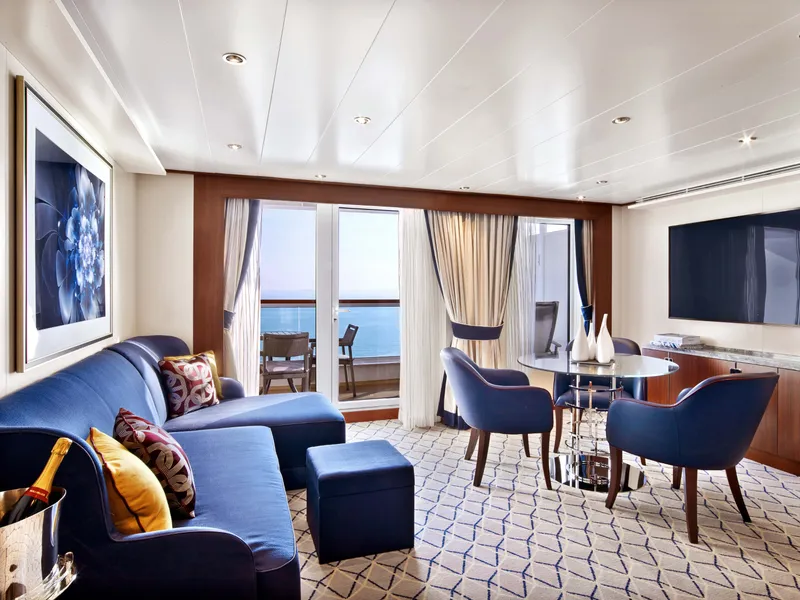
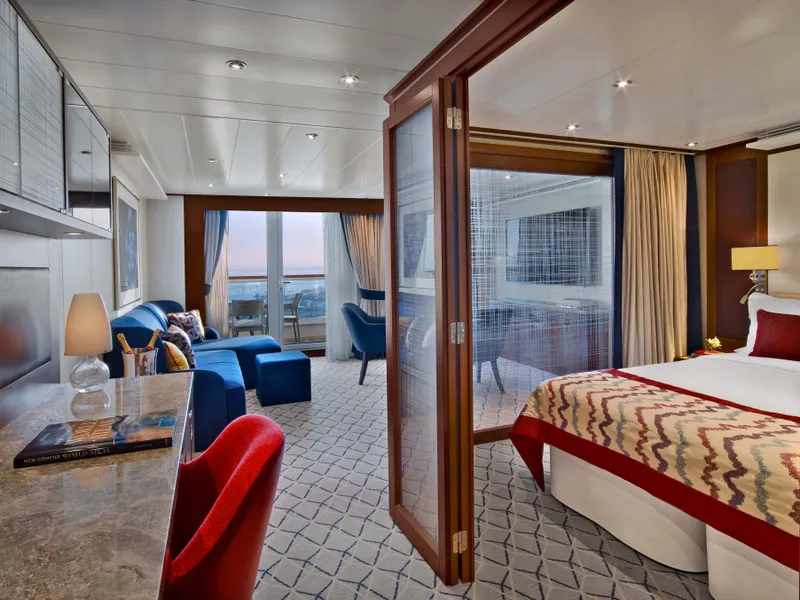

Located on Deck 10 and 11; total inside space of between 449 and 450 square feet (42 square meters) plus one veranda of between 93 and 103 square feet (9 and 10 square meters)
All Penthouse Suites feature:
Dining table for two to four
Separate bedroom
Glass door to veranda
Two flat-screen TVs
Fully stocked bar
Spacious bathroom with tub
Shower and large vanity
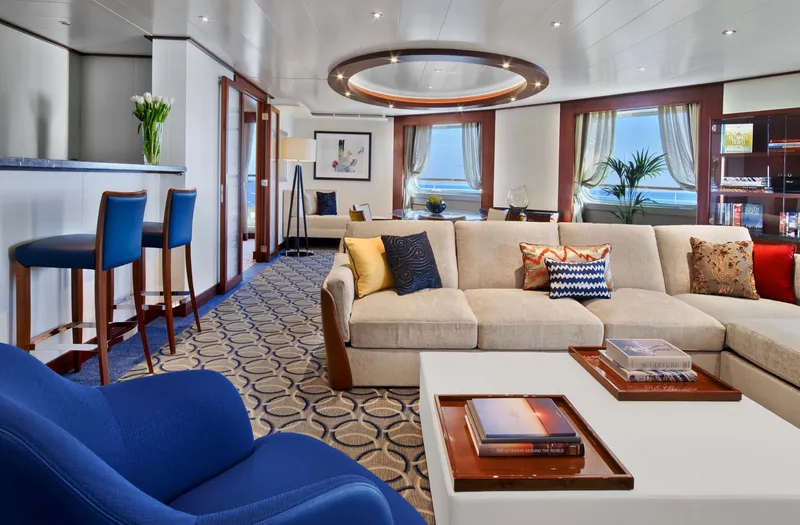
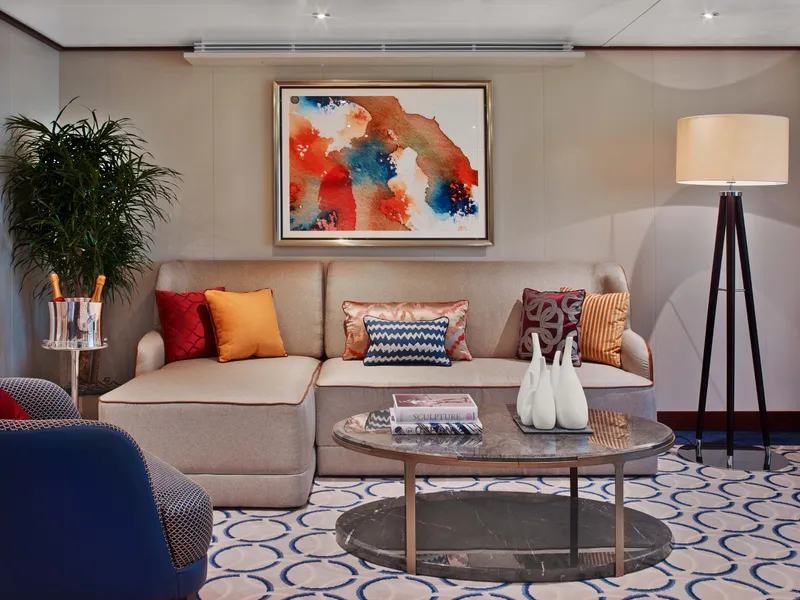
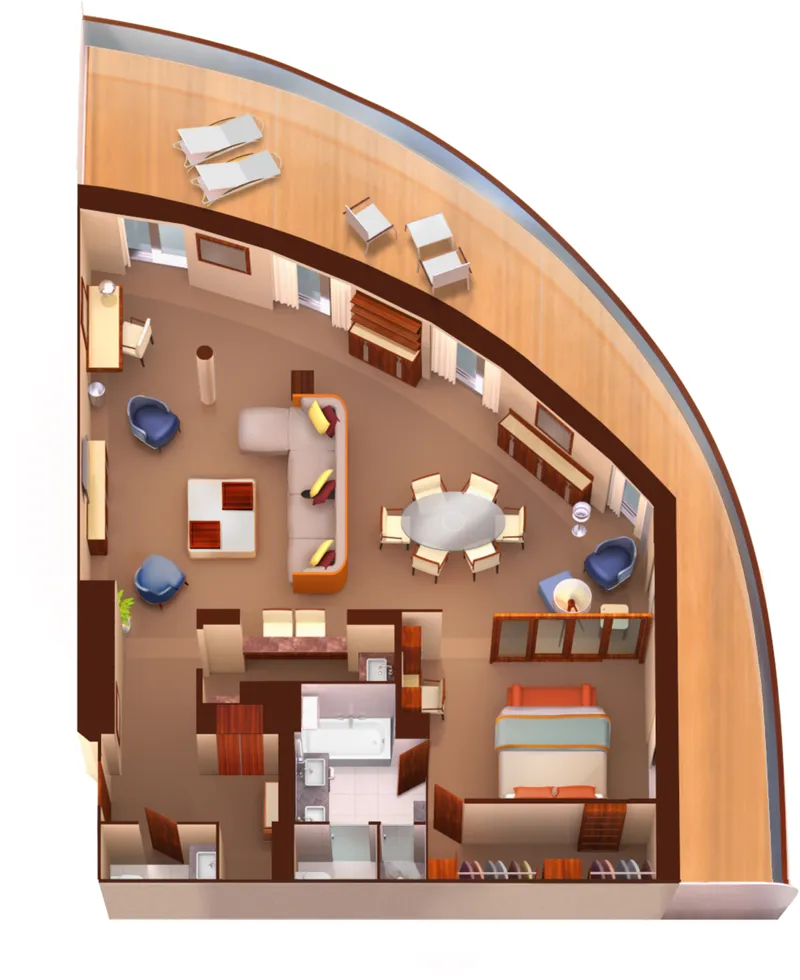
Located on Deck 8; forward suites 800 and 801 inside space of approximately 977 square feet of inside space, plus one veranda of 960 square feet (89 square meters).
Signature Suites feature:
Expansive ocean views
Forward-facing windows
Dining for four to six
Bathroom with whirlpool bathtub
Guest bath
Pantry with wet bar
Two flat-screen TVs
Complimentary Internet/Wi-Fi service
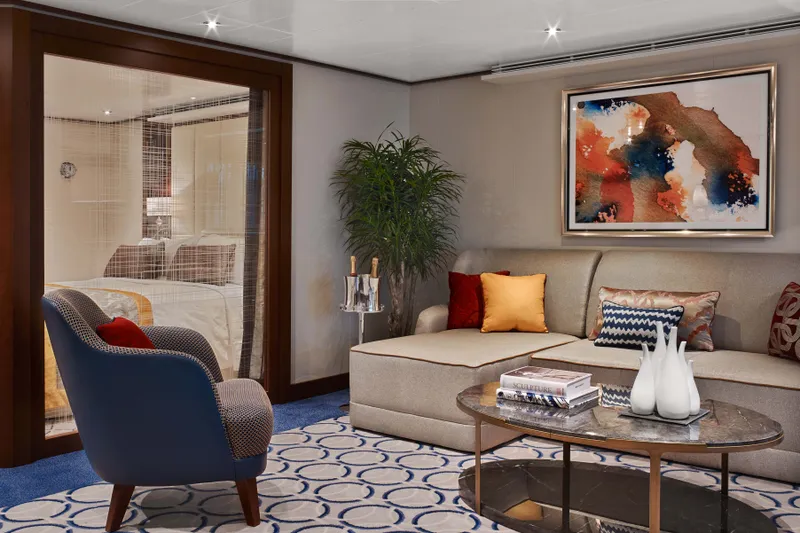
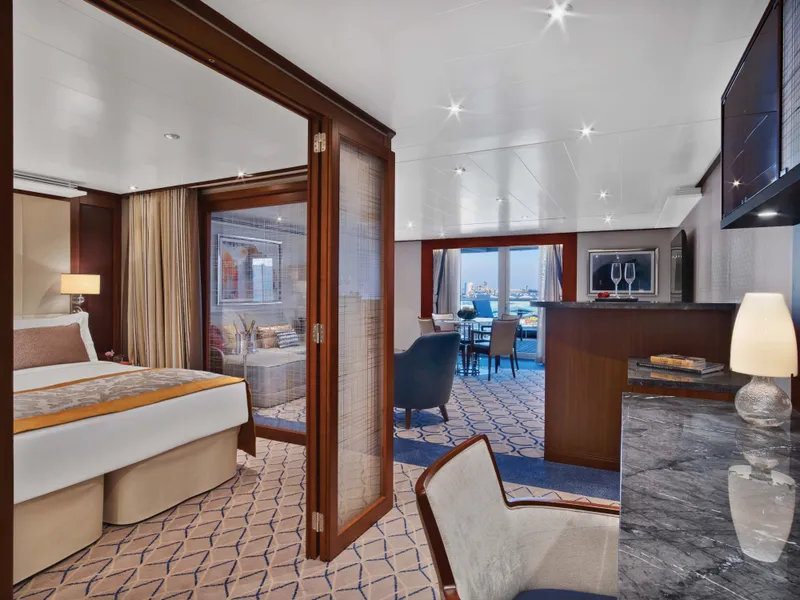
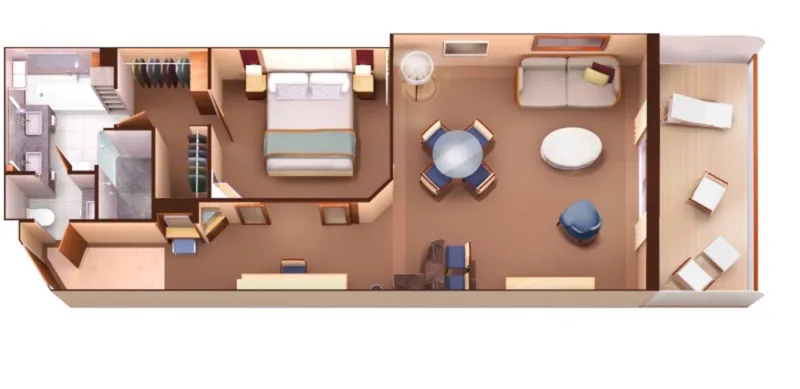
Located on Deck 11; total inside space of between 639 and 677 square feet (59 and 63 square meters) plus one veranda of 254 and 288 square feet. (24 and 27 square meters).
All Penthouse Spa Suites feature:
Dining table for two to four
Separate bedroom
Glass door to veranda
Two flat-screen TVs
Fully stocked bar
Spacious bathroom with tub
Shower and large vanity
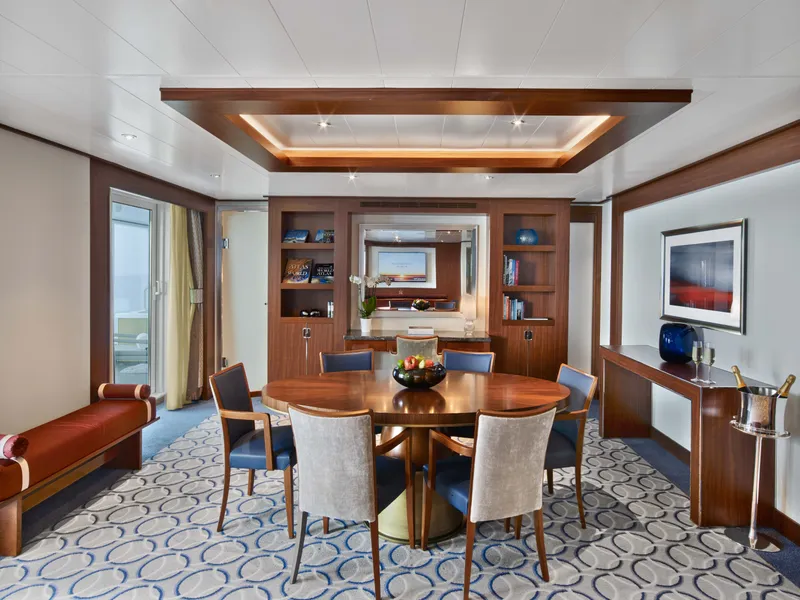
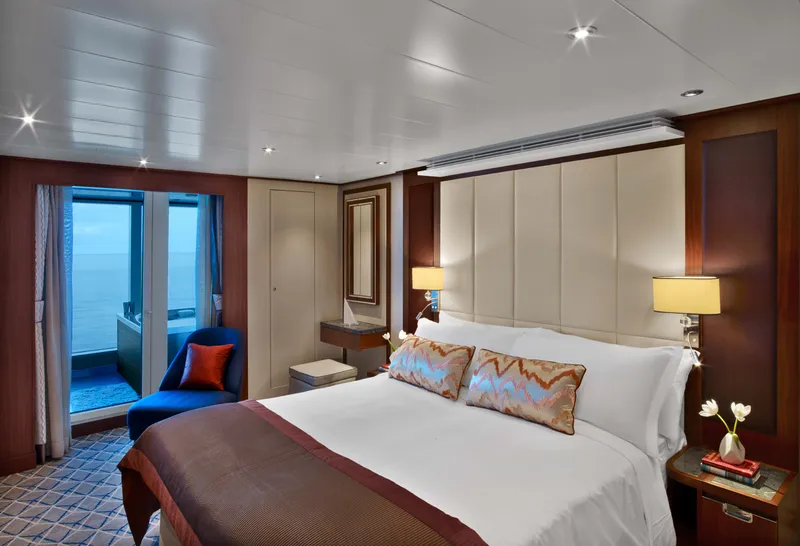
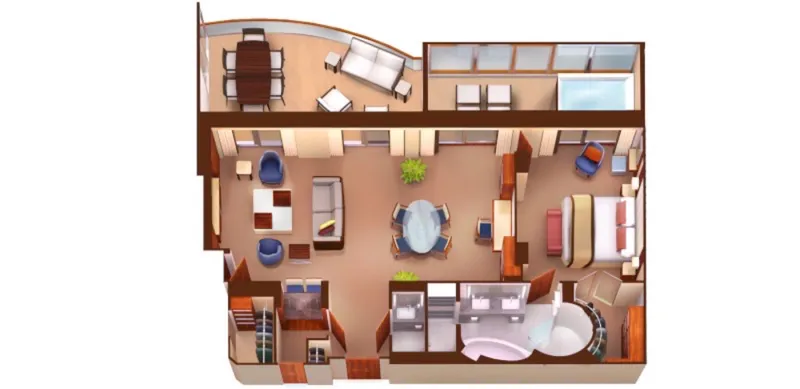
Located on Deck 8; mid-ship suites 846 and 849 inside space of 989 square feet (92 square meters) plus one veranda of 197 square feet (18 square meters)
Wintergarden Suites feature:
Large windows
Dining for six
Whirlpool bathtub
Guest bath
Convertible sofa bed for one
Pantry with wet bar
Glass-enclosed solarium with tub and day bed
Two closets
Two flat-screen TVs
Complimentary Internet/Wi-Fi service
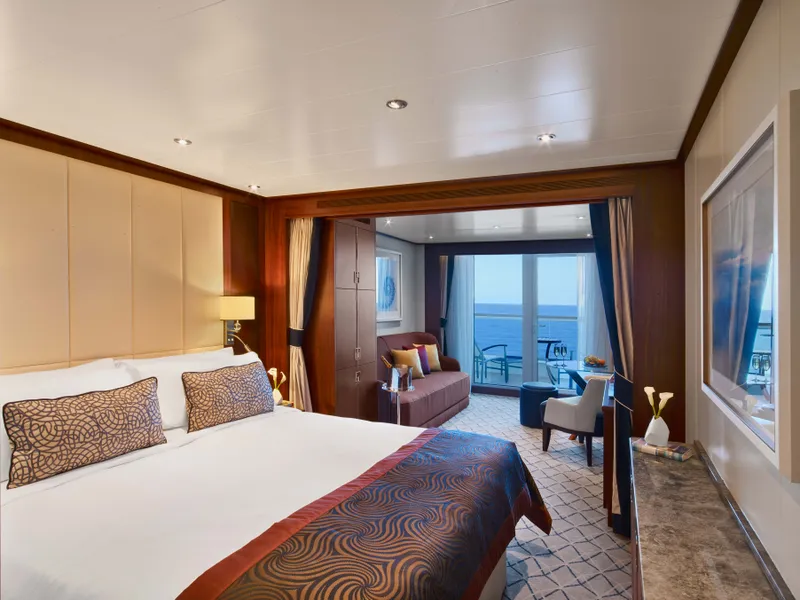

Located on Deck 5; total inside space of between 246 and 302 square feet (23 and 28 square meters) plus one veranda of between 68 and 83 square feet (6 and 7 square meters)
All Veranda Suites feature:
A full-length window
Glass door to private veranda
Comfortable living area
Queen-size bed or two twin beds
Dining table for two
Walk-in closet
Interactive flat-screen television with music and movies
Fully stocked bar and refrigerator
Makeup vanity
Spacious bathroom with shower.
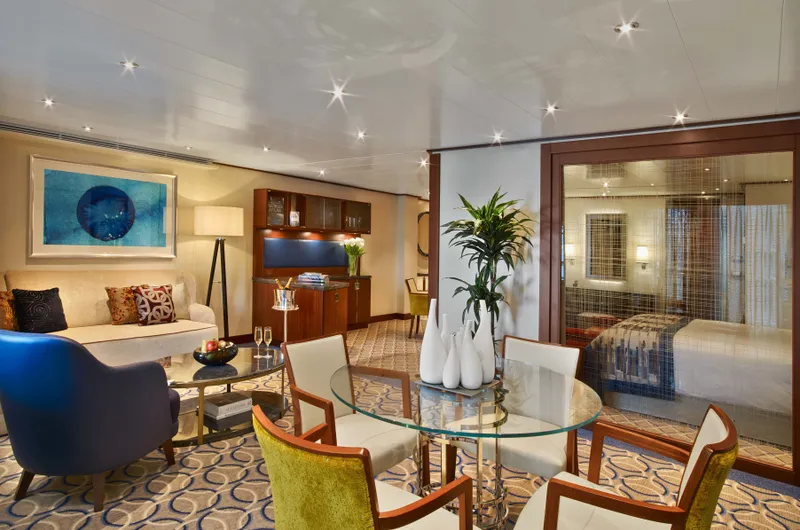
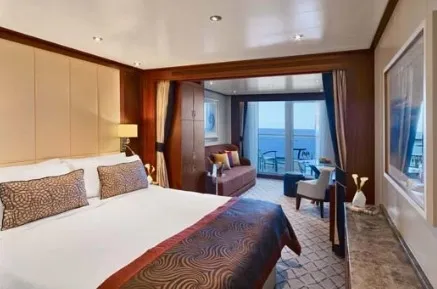
Veranda Suite Guarantee
Our cruise specialists can help you find the perfect cabin and the best available pricing.
(+886) 02-2721-7300Contact Advisor